
BAR-208 · Lesson 7 of 12 · 18 min
Delaware courts and civil procedure
▶ Video coming soon A video version of this lesson is on the way.
Tamsin's firm has a client who wants to sue a contractor over a botched renovation and, in the same case, stop the contractor from removing equipment from the property. Her supervising partner asked her which court to file in. 'I said Superior Court,' Tamsin tells Marchetti, 'and he asked why not Chancery. I didn't have a good answer.' Delaware's split between a court of law and a court of equity is one of the oldest features of its legal system, and it shapes both practice and the essays.
The Delaware court system
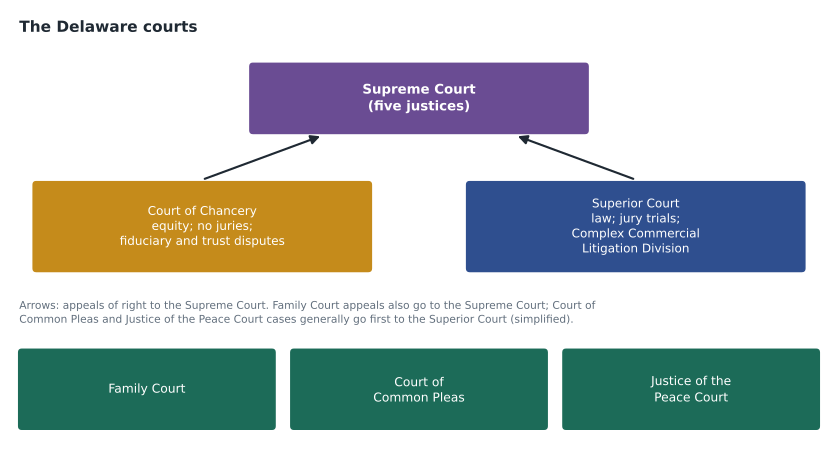
Delaware has a compact, centralized court system. Its main courts are:
The Supreme Court. Five justices, including the Chief Justice. It is the state's only appellate court, so appeals from the Court of Chancery and the Superior Court go directly to it. It also answers certified questions of Delaware law from other courts and agencies, and it regulates the practice of law, including bar admission.
The Court of Chancery. A court of equity, with a Chancellor, Vice Chancellors and magistrates in chancery. It has no juries. It hears claims for equitable relief, such as injunctions and specific performance, fiduciary duty and trust disputes, guardianships, and the corporate and alternative entity cases for which it is famous. Lesson 9 covers its doctrines.
The Superior Court. Delaware's court of general jurisdiction for claims at law, civil and criminal, with jury trials. Its Complex Commercial Litigation Division, created in 2010, hears high-value commercial disputes before judges who specialize in them.
The Family Court, the Court of Common Pleas and the Justice of the Peace Court. Family Court hears divorce, custody, support, protection from abuse and juvenile matters. The Court of Common Pleas hears civil cases up to a monetary limit, misdemeanors and some appeals. Justice of the Peace Courts handle small claims, landlord-tenant cases and minor offenses.
Judicial selection. Delaware judges are nominated by the Governor and confirmed by the Senate, typically for twelve-year terms. The Delaware Constitution includes political balance provisions for the major courts. A challenge to those provisions reached the US Supreme Court in Carney v. Adams (2020), which held that the challenger lacked standing and did not reach the merits.
Choosing between law and equity
The answer to Tamsin's partner turns on the remedy. The Court of Chancery has jurisdiction when the plaintiff seeks equitable relief or the claim is equitable in nature, such as breach of fiduciary duty. The Superior Court has jurisdiction over claims at law, especially claims for money damages, where the parties have a right to a jury.
The renovation client wants damages for breach of contract, a legal claim, and an order stopping the contractor from removing equipment, an equitable remedy. Two Chancery doctrines matter. First, the clean-up doctrine: once Chancery has jurisdiction over an equitable claim, it may decide related legal claims in the same case to avoid piecemeal litigation. Second, a plaintiff cannot manufacture equity jurisdiction by tacking on a request for an injunction that is not genuinely needed; Chancery looks at whether an adequate remedy at law exists.
If a case is filed in the wrong court, Delaware does not simply dismiss it. Under 10 Del. C. section 1902, a case brought in a court that lacks subject matter jurisdiction may be transferred to the proper Delaware court rather than lost, if the plaintiff elects transfer within the time allowed. Marchetti calls this one of the most useful sections in Title 10 for a new lawyer who picks the wrong door.
| Question | Court of Chancery | Superior Court |
|---|---|---|
| Typical claims | Equitable relief, fiduciary duty, trusts, entity disputes | Contract and tort damages, commercial claims, criminal cases |
| Jury | No | Yes, for legal claims |
| Remedies | Injunctions, specific performance, rescission, accounting, damages incident to equity | Money damages |
| Time bars | Laches, guided by analogous statutes of limitation | Statutes of limitation |
| Pleading rules | Court of Chancery Rules | Superior Court Civil Rules |
| Wrong court | Transfer available under 10 Del. C. section 1902 | Transfer available under 10 Del. C. section 1902 |
Civil procedure in the trial courts
Both trial courts have rules modeled closely on the Federal Rules of Civil Procedure, so a candidate who knows the federal rules starts with an advantage. The Superior Court Civil Rules and the Court of Chancery Rules use the same numbering for most core rules: Rule 12 motions, Rule 23 class actions, Rule 26 discovery, Rule 56 summary judgment.
The pleading standard. Delaware has not adopted the federal plausibility standard from Bell Atlantic v. Twombly and Ashcroft v. Iqbal. In Central Mortgage Co. v. Morgan Stanley Mortgage Capital Holdings (Del. 2011), the Delaware Supreme Court held that Delaware's standard for a motion to dismiss for failure to state a claim remains reasonable conceivability: the court accepts well-pleaded facts as true, draws reasonable inferences for the plaintiff and denies the motion unless the plaintiff could not recover under any reasonably conceivable set of circumstances. That standard is more forgiving to plaintiffs than federal practice, and it is a classic Delaware essay point.
Derivative suits. Stockholder derivative suits in Chancery must satisfy Court of Chancery Rule 23.1, which requires the plaintiff to plead demand on the board or explain with particularity why demand would be futile. Lesson 9 explains the Delaware test for demand futility.
Personal jurisdiction and forum statutes
Delaware's personal jurisdiction rules include several statutes that make Delaware the natural forum for disputes about Delaware entities.
The long-arm statute, 10 Del. C. section 3104, reaches nonresidents who transact business in Delaware, cause tortious injury in Delaware and engage in similar conduct, subject to the limits of due process.
The director and officer consent statute, 10 Del. C. section 3114, provides that a nonresident who accepts a position as a director of a Delaware corporation, and certain officers, consents to service of process and jurisdiction in Delaware for claims about their conduct in that role. It is why directors of Delaware companies who have never visited the state can be sued in Chancery.
Forum selection. Section 115 of the DGCL allows a Delaware corporation's charter or bylaws to require that internal corporate claims be brought in Delaware courts, but not to prohibit bringing them in Delaware. Many companies have adopted such provisions, which channel fiduciary duty litigation to the Court of Chancery.
Appeals and certified questions
Appeals from final judgments of the Court of Chancery and the Superior Court go directly to the Supreme Court. The notice of appeal is generally due within 30 days of the judgment. Interlocutory appeals are possible only in limited circumstances, with the trial court's certification and the Supreme Court's acceptance under the Supreme Court's rules.
The Supreme Court also accepts certified questions of law from other Delaware courts, from federal courts and from certain federal agencies. That procedure was used in 2025 and 2026 for a major corporate law question: the Court of Chancery certified questions about the constitutionality of the 2025 DGCL amendments, and the Supreme Court answered them in February 2026, as Lesson 9 explains.
Worked problem
Choosing a court for the renovation case
Tamsin's client paid a contractor 60,000 dollars for a renovation that was never finished. The contractor has announced it will remove equipment and materials paid for by the client. The client wants damages and an order preventing removal. Where should the firm file, and why?
Show solution
- Identify the claims: breach of contract (legal, damages) and a request to stop removal of property the client paid for (equitable, injunctive).
- Ask whether the equitable claim is genuine: an order preventing removal of specific property before judgment is real equitable relief, not a pretext.
- If so, Chancery has jurisdiction over the equitable claim and may decide the damages claim under the clean-up doctrine.
- If the firm prefers a jury for the damages claim, it could file in Superior Court and seek other provisional remedies there, accepting that Chancery-style injunctive relief may not be available.
- If either court lacks jurisdiction, 10 Del. C. section 1902 allows transfer rather than dismissal.
Answer: There is no single right answer; the analysis is what the Board rewards: identify the remedy, apply the jurisdictional rule, and note the clean-up doctrine and section 1902.
Common mistakes
MistakeApplying Twombly and Iqbal to a Delaware motion to dismiss.
InsteadDelaware uses the reasonable conceivability standard from Central Mortgage (Del. 2011).
MistakeFiling a pure damages claim in Chancery by adding a token injunction request.
InsteadChancery looks for genuine equitable relief and an inadequate remedy at law.
MistakeAssuming a case filed in the wrong Delaware court is lost.
InsteadUnder 10 Del. C. section 1902 it can be transferred to the proper court.
MistakeThinking there is an intermediate court of appeals.
InsteadAppeals from Chancery and Superior Court go directly to the Supreme Court.
The Court of Chancery in practice
Tamsin has filed papers in Chancery for her firm's estate matters but has never seen a corporate case. Marchetti describes what makes the court distinctive. Chancery handles a large volume of expedited litigation, particularly in mergers and acquisitions, where a party may need a ruling within weeks before a deal closes. Its judges write detailed opinions, often quickly, and those opinions form the body of Delaware corporate law that other states and federal courts follow. Magistrates in chancery handle many guardianship, trust and estate matters, with review by a Vice Chancellor or the Chancellor.
Because Chancery sits without a jury, trials are bench trials, and the court's findings of fact receive deference on appeal. Lawyers new to Chancery practice should read the court's rules and its guidelines on matters such as confidential filings and expedited proceedings, and should expect a court that knows corporate law extremely well and has little patience for weak arguments.
The Superior Court and the CCLD
The Superior Court is a court of general jurisdiction for claims at law, and it is where most personal injury, contract and criminal cases are tried. Its Complex Commercial Litigation Division assigns high-value commercial disputes to a small group of judges who manage them actively, often with early scheduling orders and close attention to discovery. Parties who want a jury and a specialized commercial judge often choose the CCLD over Chancery for damages claims.
Limitations periods and laches
Statutes of limitation apply in the Superior Court by their terms. Common Delaware periods include two years for personal injury and three years for most contract claims and many property claims, with special rules for instruments under seal and for some statutory claims. In Chancery, laches applies, guided by the analogous statute. Candidates should be ready to say which period applies and whether any tolling doctrine, such as inquiry notice or fraudulent concealment, might extend it.
Discovery and summary judgment
Because the trial courts' rules follow the federal rules, discovery and summary judgment work much as candidates learned them in law school. Parties may obtain discovery of nonprivileged matter relevant to a claim or defense, subject to the court's limits, and summary judgment is granted when there is no genuine issue of material fact and the moving party is entitled to judgment as a matter of law. Delaware courts expect parties to cooperate on electronic discovery and to raise disputes promptly.
Reading a civil procedure essay
A civil procedure essay on the Delaware exam may combine several of these topics: choosing a court, serving a nonresident defendant, responding to a motion to dismiss and preserving an issue for appeal. Marchetti teaches Tamsin to work through such a question in the order a lawyer would: jurisdiction over the subject and the parties first, then the pleadings, then motions, then trial and appeal. Following the life of the case keeps the answer organized and prevents the common mistake of discussing an appeal before establishing that the court could hear the case.
Service and personal jurisdiction in a short answer
When an essay asks whether a Delaware court can hear a claim against a nonresident, answer in two steps. First, is there a statutory basis, such as the long-arm statute in 10 Del. C. section 3104, the director and officer consent statute in section 3114, or a forum selection clause? Second, does exercising jurisdiction satisfy due process, with minimum contacts and fair play? A director of a Delaware corporation sued over board conduct will usually be reachable under section 3114; an out-of-state contractor who never did business in Delaware may not be.
Summary and key terms
- Delaware's Supreme Court is its only appellate court; the Court of Chancery (equity, no juries) and the Superior Court (law, juries) are the main trial courts.
- Chancery hears equitable claims and may decide related legal claims under the clean-up doctrine; Superior Court hears claims at law.
- 10 Del. C. section 1902 allows transfer instead of dismissal when a case is filed in the wrong court.
- Delaware's motion to dismiss standard is reasonable conceivability, not federal plausibility.
- Section 3104 (long-arm), section 3114 (director and officer consent) and DGCL section 115 (forum selection) make Delaware the forum for Delaware entity disputes.
- Court of Chancery
- Delaware's court of equity, without juries, known for corporate and fiduciary litigation.
- Clean-up doctrine
- The principle that Chancery, once it has equity jurisdiction, may resolve related legal claims in the same case.
- Reasonable conceivability
- Delaware's pleading standard on a motion to dismiss for failure to state a claim.
- Director consent statute
- 10 Del. C. section 3114, under which directors and certain officers of Delaware corporations consent to jurisdiction in Delaware.
- Certified question
- A question of Delaware law sent to the Delaware Supreme Court by another court or agency for an answer.
Practice problems
Work each problem on paper first, then reveal the answer to check.
Name the Delaware court that hears fiduciary duty claims without a jury.
Show answer
The Court of Chancery.
What statute lets a party transfer a case filed in the wrong Delaware court?
Show answer
10 Del. C. section 1902.
Why can a California director of a Delaware corporation be sued in the Court of Chancery?
Show answer
Under 10 Del. C. section 3114 a director consents to service and jurisdiction in Delaware for claims about conduct as a director.
Lesson quiz · 5 questions
Score 60% or more to complete this lesson.
Create a free account to save your progress, take quizzes and earn a certificate.