
BAR-121 · Lesson 9 of 12 · 22 min
Time management
▶ Video coming soon A video version of this lesson is on the way.
At noon on Friday, October 23, 2026, Marchetti runs a different kind of session. She asks everyone to turn on their cameras, sends a released performance test she has chosen, starts a 90-minute timer and says nothing more. At the end she asks each person to send a photo of their scratch paper and a note of what they were doing at each 15-minute mark. The notes tell the story. Dana finished reading the Library at minute 52. Ngozi started writing at minute 38 and finished with six minutes to spare, but her outline had missed an issue. Sofia wrote her last section in bullet points at minute 88. Marcus, who took the NextGen exam's 60-minute tasks in July, finished at 81 minutes and said it felt luxurious.
Almost every coach agrees that time is the hardest part of the MPT. The materials are long, the reading is dense, and 90 minutes passes quickly. This lesson gives you a time budget, shows how to read faster without reading carelessly, explains what to do when you fall behind, and covers how to handle two items in one session.
The basic split
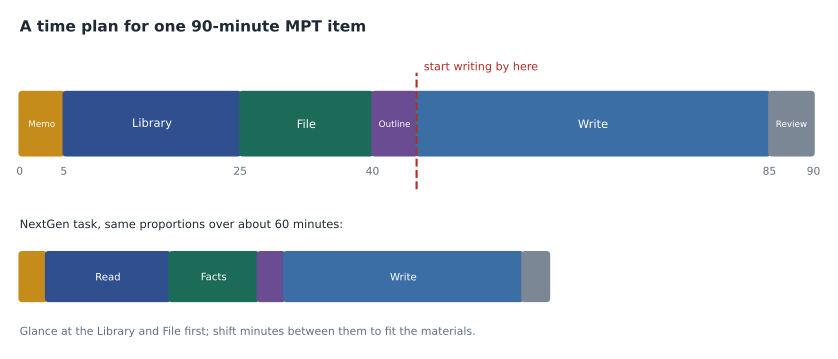
NCBE's instructions suggest spending about half your time reading, digesting and organizing before you write. That is the core of every time plan: about 45 minutes in, about 45 minutes out. Within the first half, Marchetti uses a more detailed budget, which she adjusts to the length of the materials:
| Minutes | Activity | Output on scratch paper |
|---|---|---|
| 0 to 5 | Read the task memo twice; read any format memo | One-sentence restatement and heading skeleton |
| 5 to 25 | Read the Library: statute first, then cases | A rule statement under each heading, with citations |
| 25 to 40 | Read the File | Facts sorted under each heading, good and bad marked; gaps noted |
| 40 to 45 | Finish the outline | Final headings, rules, key facts and conclusions in order |
| 45 to 85 | Write | The document, heading by heading |
| 85 to 90 | Review | Fix headings, add missed facts, check the task memo once more |
Some coaches suggest reading the File before the Library, on the theory that facts make the law easier to understand. Others prefer Library first, so that you read the File knowing which facts matter. Either can work. What matters is that you choose an order, practice it until it is automatic, and keep the total reading and outlining near 45 minutes. Marchetti prefers Library first for tasks heavy on statutes and File first for tasks where the facts are complex and the law is short. 'Glance at both before you decide,' she says. 'It takes ten seconds to see that the Library is one statute and two short cases.'
Reading faster without reading carelessly
Speed on a performance test comes from reading with a purpose, not from skimming. Because you read the task memo first and drew a skeleton, you know what you are looking for in each document. That alone makes reading faster: you can pass quickly over a paragraph that does not touch any heading and slow down when a sentence decides an element.
Other habits help. Read headnotes and the first and last paragraphs of each case first, to see what it decides, then read the reasoning that matters. Mark the Library and File as you go so you never have to reread to find something; Marchetti uses one symbol per heading in the margin. Write rules and facts on scratch paper as you find them, in your own short form, so that the outline builds itself. Skim distractors: a case or document that has nothing to do with the assignment deserves a minute, not ten.
Dana's 52-minute Library read came from briefing every case fully before deciding which mattered. 'Brief only what you will use,' Marchetti says. 'And you will not know what you will use until you know the task. That's why the memo comes first.'
Outlining is not optional
Five minutes of outlining saves fifteen minutes of writing. An outline on scratch paper, or in a separate window if your jurisdiction's software allows it, lists the headings in final order, the rule and citation for each, the two or three facts that decide it, and the conclusion. With an outline, writing is transcription and expansion. Without one, writing is thinking, and thinking under pressure produces disorganized answers that skip issues.
Ngozi's missed issue is the classic cost of a thin outline. She had written 'permit, visits, drop-off' and forgotten the sign, because the sign raised a second rule she had noted in the margin of the Library but never transferred to her outline. 'The outline is the checklist,' Marchetti says. 'If it is not on the outline, it is not in the answer.'
Writing at speed
Writing for 40 minutes is a long time if you know what you are writing. Use your outline headings as the document's headings, in the format the task memo requires. Write the rule, then the application, then the conclusion for each, and move on. Do not polish early sections at the expense of later ones. Do not write a statement of facts unless asked. Do not quote long passages; quote only the key words of a statute or holding and paraphrase the rest.
Track time at fixed points. Marchetti suggests checking the clock at the end of each major heading and comparing it to your plan. If the outline has three main sections and you have 40 minutes to write, each deserves roughly 13 minutes, adjusted for weight. If the first section took 20, you know immediately that the others must be shorter.
When you fall behind
Everyone falls behind sometimes. The worst response is to keep writing the current section in full and run out of time before reaching the rest. The point sheet rewards issues covered; an unfinished answer that never reaches the last two issues loses all the points for them. The best response is triage:
- Cut, do not skip. Shorten the remaining sections to rule, key facts and conclusion. A three-sentence analysis of an issue earns far more than no analysis.
- Use headings even for short sections. A grader scanning for an issue should still find it.
- Bullet points as a last resort. If you have two minutes left and an issue untouched, a heading and three bullet points (rule, facts, conclusion) are better than nothing. Graders generally give some credit for correct content even in outline form, though full sentences score better.
- Never leave the second item short to finish the first. The items are graded separately and equally.
Sofia's bullet-point ending is better than leaving the last section blank, Marchetti tells her, but she would have done better to see the problem at minute 70 and shorten the two sections before it. 'Check the clock at every heading,' she says. 'Then you see trouble while there's still time to fix it.'
Worked problem
Rescuing a running-late answer
At minute 74, Dana has finished parts I.A and I.B of the Ruiz memo in full and has parts I.C, I.D, I.E and II left, with 16 minutes remaining including review. Marchetti walks her through the triage.
Show solution
- Budget the remaining time: about 13 minutes of writing for four sections, roughly 3 minutes each, plus 3 minutes of review.
- Write I.C in three sentences: the visit limit is in the home occupation code; a qualifying home is a residential use; the limit does not apply.
- Write I.D in four sentences: wrong section cited; section 15.08.030 applies to all residences and is preserved by subsection (d); six square feet exceeds four; recommend a smaller sign.
- Write I.E in four sentences with Delaney, and II as a short list of the four conditions with the key fact for each.
- Use the last minutes to add a two-sentence conclusion flagging Leo, the most important point.
Answer: Every issue on the point sheet is covered, with rules, facts and conclusions, in the time available.
Two items in one session
UBE jurisdictions give the two MPT items together, usually in a single three-hour morning or afternoon session. Some let you work on them in any order and divide the time as you wish. The temptation is to spend extra time on whichever item you find easier, or to finish the first item no matter how long it takes. Resist it. Each item is worth the same, and the marginal point is almost always cheaper on the item you have spent less time on.
Marchetti's rule is a hard stop at 90 minutes. When the timer for the first item ends, finish the sentence you are writing and move on. If you finish an item early, use the remaining minutes on that item's review, not on the next item, unless you are confident the first is complete. Some examinees prefer to glance at both task memos in the first two minutes and start with the one that looks more manageable, to build confidence. That works if it does not cost more than a minute or two.
Laptop and logistics
Most jurisdictions administer the MPT on laptops with secure exam software. Practice typing your answers in a plain text editor without spell check or formatting, because many exam programs offer little of either. Learn to type headings that stand out without formatting, such as all capital letters or numbered lines. If your jurisdiction lets you use the printed booklet for notes, practice with printed materials, because marking paper is faster than taking notes on screen. If it does not, practice with materials on screen.
Marcus notes that the NextGen exam is entirely on laptops and that the performance task materials appear on screen. 'I practiced with a split screen: materials on the left, my answer on the right,' he says. 'It made the hour work.'
Practice under real conditions
Timing improves only with timed practice. Marchetti recommends that February examinees complete at least six full, timed performance tests before the exam, increasing to two items in a three-hour block for the last few. Released NCBE items and their point sheets are ideal for this, because the point sheets let you check coverage after each one. After each practice test, compare your time log to the plan and adjust one thing at a time.
Practice problems
Work each problem on paper first, then reveal the answer to check.
What does NCBE suggest about splitting MPT time?
Show answer
About half the time should go to reading, digesting and organizing before writing.
Why should you outline before writing?
Show answer
The outline is the checklist of issues and turns writing into transcription; it prevents missed issues.
What should you do if you fall behind?
Show answer
Shorten remaining sections to rule, key facts and conclusion, keep headings, and use bullet points only as a last resort.
Why should you not borrow time from the second item?
Show answer
The items are graded separately and equally; the marginal point is usually cheaper on the less-developed item.
How often should you check the clock while writing?
Show answer
At the end of each major heading, comparing progress to the plan.
How many timed practice tests does Marchetti recommend before the exam?
Show answer
At least six full timed tests, including some two-item three-hour blocks.
Common mistakes
MistakeI will read everything carefully and outline in my head.
InsteadWrite the outline; issues not on the outline tend to be missed.
MistakeIf I am behind, I should finish the current section properly.
InsteadTriage: cover every remaining issue briefly rather than one fully.
MistakeBriefing every case thoroughly saves time later.
InsteadBrief only what the task needs; skim distractors.
MistakeExtra time on the easier item maximizes my score.
InsteadEach item is worth the same; keep a hard 90-minute stop.
Adjusting the budget to the materials
Not every performance test has the same shape, so the budget flexes. A task with a long statute and two short cases needs more Library time and less File time. A task with a thin Library and a thick File of depositions and records needs the reverse. A drafting task needs less writing time for the document itself but some for the explanation. What stays constant is the principle: finish reading and outlining by about the halfway point, and protect at least 35 minutes for writing and 5 for review.
Marchetti suggests a two-minute survey at the start of every item, after the task memo, to set the budget. Flip through the Library and File, count the documents, note their length and look for obvious distractors. Then write your checkpoint times at the top of your scratch paper: Library done by minute 22, File done by 38, outline done by 45. Having the numbers in front of you makes it much harder to drift.
Ngozi, who finished the drill with time to spare but missed an issue, decides to spend some of her spare minutes on a slower Library read. Dana, who read too long, decides to set a hard checkpoint at minute 25 and move to the File even if she has not briefed every case. 'Both of you are right,' Marchetti says. 'A budget is a starting point. Your time log tells you which way to adjust it.'
Write your checkpoints the same way every time, in the same corner of your scratch paper, so that glancing at them becomes a reflex rather than a decision.
What not to do with your time
A few habits reliably waste minutes. Rewriting the task memo's facts into your answer when no statement of facts was requested. Quoting long passages from Library cases. Writing an introduction that restates the assignment in general terms. Analyzing an issue the task memo excluded. Polishing the first section while the last section waits. Each is a few minutes, and together they are often the difference between finishing and not finishing.
Summary and key terms
- Spend about 45 minutes reading and outlining and about 45 writing and reviewing.
- Read with the skeleton in hand, mark as you go and skim distractors.
- Outline every issue before writing; check the clock at each heading.
- When behind, shorten rather than skip; headings and brief analysis earn points.
- Give each item its full 90 minutes and practice under timed, realistic conditions.
- Time budget
- A planned allocation of minutes to each stage of an MPT item.
- Triage
- Shortening remaining sections so every issue is covered when time runs short.
- Hard stop
- Ending work on one item at its time limit and moving on regardless of completeness.
- Scratch paper outline
- Headings, rules, key facts and conclusions written down before drafting.
- Time log
- A record of what you were doing at fixed points in a practice test, used to adjust your plan.
Lesson quiz · 5 questions
Score 60% or more to complete this lesson.
Create a free account to save your progress, take quizzes and earn a certificate.