
BAR-121 · Lesson 7 of 12 · 22 min
Client and opposing-counsel letters
▶ Video coming soon A video version of this lesson is on the way.
On Friday, November 13, 2026, Marchetti sends two short task memos at once. 'Both are letters about Ruiz,' she says. 'One goes to Ms. Ruiz. One goes to the City Attorney. They contain some of the same facts and law, and if you swap a single paragraph between them you could hurt your client badly. Tell me which paragraph.' Dana answers before the others have finished reading. 'Leo. Ms. Ruiz needs to hear about it. The City Attorney does not.'
Letters appear regularly on the MPT. The most common are letters to clients explaining their legal position and recommending a course of action, and letters to opposing counsel or another party demanding, proposing or responding to something. Letters test communication more directly than any other task, because the writer must adjust content, tone and vocabulary to a reader who is not the supervising lawyer. This lesson covers both kinds, with model letters from the Ruiz matter.
The two task memos
Task one (excerpt). 'Please draft a letter for my signature to Ms. Ruiz explaining, in terms she will understand, whether state law protects her operation from the City's notice, what she should do now, and why. She is a careful reader but not a lawyer. Keep it to the point; she has eight children to watch.'
Task two (excerpt). 'Please draft a letter for my signature to Martin Greaves, Brookfield City Attorney, responding to the notice of violation. Ask the City to withdraw the permit, visit-limit and drop-off charges. Ms. Ruiz has authorized us to tell the City she will replace her sign with one that meets the general residential sign rule. The letter should persuade, not threaten. Remember that Mr. Greaves is a lawyer and will check every citation.'
Writing to a client
A client letter answers the client's question and tells the client what to do. The client is usually not a lawyer, so the letter explains legal concepts in plain language, avoids jargon and citations, and gets to the point quickly. It still needs to be accurate: simplification is fine, but a client letter that oversimplifies into error, or hides a real risk to sound reassuring, fails the client and the grader.
A good structure is simple. Open with the answer to the client's question in one or two sentences. Explain the law briefly, in terms of what it means for the client. Apply it to the client's facts, including the risks. Recommend specific steps. Close by inviting questions and, where appropriate, noting what you will do next. Use short paragraphs, and use headings if the letter covers several topics.
Plain language is a skill. 'Section 14-210(a) deems a licensed family child care home a residential use for purposes of all local zoning' becomes 'A state law says that, for zoning purposes, a licensed family child care home like yours counts as a home, not a business.' The second version loses no accuracy that matters to Ms. Ruiz.
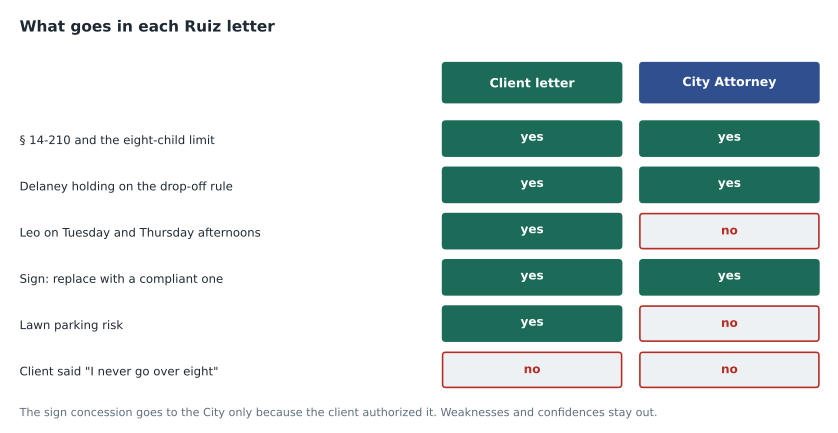
A client letter is confidential, so it can and should discuss weaknesses frankly. Ms. Ruiz needs to know that caring for Leo could cost her the protection of the statute, because she is the only person who can fix it.
A model client letter
Dear Ms. Ruiz:
You asked whether state law protects Little Sprouts from the City's notice of violation. The short answer is yes, as long as you never have more than eight children in your care at one time, counting Maya when she is home. There is one problem we need you to fix right away, which I explain below.
What the law says. A Marlow state law protects licensed family child care homes like yours. For zoning purposes, it treats your home as a home, not a business. Because of that, the City cannot require you to get a home occupation permit, and the City's rules for home businesses, including the limit on visits and the ban on business signs, do not apply to you. The law does let the City enforce certain rules that apply to every house in the neighborhood, such as general parking, noise, sign and fire safety rules.
The four charges. Based on what you have told us and the documents you gave us, three of the City's four charges should fail. You do not need a home occupation permit; the visit limit does not apply to you; and the new drop-off rule cannot be enforced against you, because it applies only to child care homes rather than to every house. The sign is different. The City cited the wrong rule, but the City has a separate rule, for every house, that allows one yard sign of up to four square feet. Your current sign is about six square feet. We recommend replacing it with a smaller one, two feet by two feet or less.
The problem we need you to fix. The state law protects only homes with no more than eight children in care at once. Your own children count only if they are under ten and at home, so Maya counts in the afternoons and Diego does not. On Tuesday and Thursday afternoons, when you watch your nephew Leo, our count is nine. The state's highest court has said that even one child over the limit, even briefly, means the law's protection does not apply. We understand that watching Leo is a family favor and not part of your business, but the law does not make that distinction. Please stop caring for Leo at your home during your child care hours, or make other arrangements so that you never have more than eight children in your care. This is the single most important thing you can do to protect Little Sprouts.
Two smaller points. Please ask parents not to pull onto your lawn when the driveway is full; the City may enforce a general rule against lawn parking. And please keep your child care license current; it expires March 31, 2027.
What happens next. Once you confirm that you have made these changes, we will write to the City Attorney asking the City to withdraw the charges. Please call me if you have any questions.
Sincerely, Priya Nandakumar
Writing to opposing counsel
A letter to opposing counsel is a persuasive document, but it is not a brief. It states your client's position, supports it with precise authority, asks for specific action, and leaves room for resolution. Opposing counsel is a lawyer, so citations are appropriate and must be accurate; the Ruiz task memo warns that Mr. Greaves will check them. Tone matters: firm and professional, never insulting or threatening. Many task memos say, as this one does, to persuade rather than threaten.
What you leave out matters as much as what you put in. Information relating to the representation is confidential under the rules of professional conduct, and a lawyer may not reveal it without the client's informed consent or another exception. The Leo facts, Ms. Ruiz's private statements and your own assessment of weaknesses do not belong in a letter to the other side. The sign concession does, because the task memo says Ms. Ruiz authorized it.
Ethics questions often hide in letter tasks. A letter to an unrepresented person must not imply that you are disinterested, and must not give that person legal advice other than to get a lawyer. A lawyer must not communicate about the matter with a person the lawyer knows is represented, except through that person's lawyer, so a letter to a represented opposing party goes to the party's lawyer. And statements of fact or law to others must be truthful. If a performance test raises any of these, the point sheet will credit handling it correctly.
A model letter to the City Attorney
Dear Mr. Greaves:
We represent Lena Ruiz, who operates Little Sprouts Family Child Care, a state-licensed family child care home at 418 Larch Street. We write in response to the City's notice of violation and ask that the City withdraw three of its four charges.
The home occupation permit and visit limit. Section 14-210 of the Family Child Care Act provides that a licensed family child care home 'is a residential use of property for purposes of all local zoning and land use regulation'. § 14-210(a). It expressly bars a city from requiring a 'home occupation permit' as a condition of operation. § 14-210(c). Little Sprouts is licensed by the Department of Children's Services for eight children, and it operates within that limit. Because it is a residential use, the City's home occupation provisions, including the permit requirement and the six-visit limit in section 17.40.050, do not apply to it.
The drop-off ordinance. Section 14-210(d) preserves local parking regulations only if they apply 'in the same way to all residences in the zone'. Section 10.12.020, adopted in June 2026, applies only to child care centers and family child care homes. The Court of Appeals has held that a parking requirement imposed only on family child care homes is not preserved by subsection (d), because it treats those homes as something other than residences. Delaney v. City of Port Ash (Marlow Ct. App. 2019). Section 10.12.020 cannot be enforced against Little Sprouts.
The sign. The home occupation sign ban in section 17.40.050(4) does not apply for the reasons above. Nonetheless, to resolve the matter, Ms. Ruiz will replace her current sign with one that complies with the general residential sign provision in section 15.08.030 within two weeks of the date of this letter.
We ask that the City confirm in writing, by December 4, that it withdraws the notice of violation. We would be glad to discuss the matter with you before then if that would be helpful.
Sincerely, Priya Nandakumar
Comparing the two letters
Put them side by side. The client letter has no citations, explains the law in a sentence or two, and devotes its longest paragraph to the Leo problem. The City letter cites every rule precisely, says the home 'operates within' its licensed limit, which is true now and which the firm will confirm before sending, and never mentions Leo. The client letter recommends steps; the City letter requests action by a date and offers a concession the client authorized.
Both are short. Neither restates every fact. Both follow their task memos: plain language and brevity for the client, persuasion without threats and precise citations for the City Attorney.
Worked problem
Turning a legal paragraph into plain language
Sofia drafts this for the client letter: "Pursuant to Harmon, the numerosity threshold in section 14-210(b) operates as a bright-line rule such that any excess, irrespective of magnitude or duration, vitiates the protections of subsection (a)." Marchetti asks for a version Ms. Ruiz would understand.
Show solution
- Identify the point: one child over eight, even briefly, means no protection.
- Replace citations with a description of the source: "the state's highest court has said".
- Replace jargon with ordinary words: "numerosity threshold" becomes "the limit of eight children".
- Tie it to the client's facts and the action she must take.
Answer: "The state's highest court has said that even one child over the limit of eight, even for a short time, means the law's protection does not apply. That is why you need to stop watching Leo during child care hours."
Other letters you may see
Task memos sometimes ask for letters to other audiences: a demand letter to a party who owes the client money, a letter to a government agency requesting action, a letter to a witness, or an opinion letter to a client on a transaction. The same principles apply. Identify the reader, decide what the reader needs and what the client wants, adjust vocabulary and citations to the reader, protect confidential information, and ask for a specific result.
Ngozi notes that in Nigeria, letters to the other side often open with a formal recital of the client's instructions. 'Keep the courtesy, drop the recital,' Marchetti says. 'Get to what you want in the first paragraph.'
Practice problems
Work each problem on paper first, then reveal the answer to check.
What should the first paragraph of a client letter do?
Show answer
Answer the client's question in one or two sentences.
Why does the Leo problem belong in the client letter but not the City letter?
Show answer
It is confidential information and a weakness; the client must fix it, and revealing it to the other side would harm her without consent.
How should citations differ between the two letters?
Show answer
The client letter generally omits them; the letter to a lawyer cites precisely and accurately.
What does "persuade, not threaten" mean for tone?
Show answer
Firm and professional, stating the position and requested action without insults or threats.
To whom should a letter go if the opposing party has a lawyer?
Show answer
To the party's lawyer, not to the party directly.
What should a letter to opposing counsel ask for?
Show answer
Specific action, ideally by a date, and it may offer authorized concessions.
Common mistakes
MistakeA client letter should reassure, so I should downplay risks.
InsteadClients need accurate risks and clear steps; reassurance comes from a plan.
MistakeLetters to opposing counsel should include every fact we know.
InsteadInclude only what persuades and what the client authorized; protect confidences.
MistakePlain language means leaving out the law.
InsteadExplain the law simply and accurately in terms of what it means for the reader.
MistakeA firm letter should warn of dire consequences.
InsteadFollow the task memo; persuasion without threats is usually required.
A quick check before you sign
Before finishing any letter, read it once as its recipient. For the client letter, ask whether Ms. Ruiz could act on it without calling you: does she know what to do, by when, and why? For the letter to the City Attorney, ask what Mr. Greaves would learn about your client that he did not know before, and whether your client authorized each piece of it. Then check the mechanics the task memo specified: whose signature block, whether to copy anyone, and any deadline you were told to set. Graders frequently find letters that are strong on substance but signed with the examinee's own name or missing the action the memo asked for. Both are easy points to keep.
Summary and key terms
- Identify the reader of every letter; adjust content, vocabulary and citations to that reader.
- Client letters answer the question first, explain the law plainly, disclose risks and recommend steps.
- Letters to opposing counsel cite precisely, request specific action and offer only authorized concessions.
- Keep confidential information and weaknesses out of letters to the other side.
- Watch for ethics issues: represented persons, unrepresented persons and truthfulness.
- Client letter
- A letter explaining a client's legal position in plain language and recommending action.
- Demand letter
- A letter asking another party to do something, such as pay money or stop conduct.
- Plain language
- Clear, ordinary wording that keeps legal accuracy without jargon.
- Confidential information
- Information relating to the representation that a lawyer may not reveal without consent or an exception.
- Represented person
- Someone with a lawyer in the matter, whom opposing counsel must contact through that lawyer.
Lesson quiz · 5 questions
Score 60% or more to complete this lesson.
Create a free account to save your progress, take quizzes and earn a certificate.