
BAR-121 · Lesson 8 of 12 · 22 min
Other tasks: plans, agreements and statements
▶ Video coming soon A video version of this lesson is on the way.
Marchetti adds lunchtime sessions on two Fridays when the evening slot is taken by torts drills. At noon on Friday, October 16, 2026, she opens with a list on her screen: will provisions, a settlement agreement clause, a discovery plan, a closing argument, jury instructions, a statement of facts, an investigation plan. 'Every one of these has appeared on a performance test in some form,' she says. 'You will not have practiced most of them. That's fine. The method is the same. What changes is the shape of the document.'
Memos, briefs and letters are the most common MPT tasks, but NCBE regularly asks for other documents. The July 2026 exam included a task asking examinees to analyze how assets should be distributed after a simultaneous death, which is neither a classic memo nor a brief. This lesson covers the other task types you are most likely to see, how to approach a document you have never drafted, and short original examples of each.
The general method for an unfamiliar task
When a task memo asks for something unfamiliar, three questions guide you. First, what is the document for? A will provision must transfer property as the client intends; a discovery plan must get the evidence needed to prove a claim; a closing argument must persuade a jury. Second, who will read or use it? A court, a jury, a client, the other side, a co-worker who will carry out the plan. Third, does the File include a model or format? Many unusual tasks come with a sample or instructions, and following them is most of the battle.
Then apply the same work as always: rules from the Library, facts from the File, organized to serve the document's purpose. Most unusual tasks also ask you to explain your choices, often in a short accompanying memo or in annotations. That explanation is where much of the legal analysis lives, so do not skip it.
Drafting agreement provisions
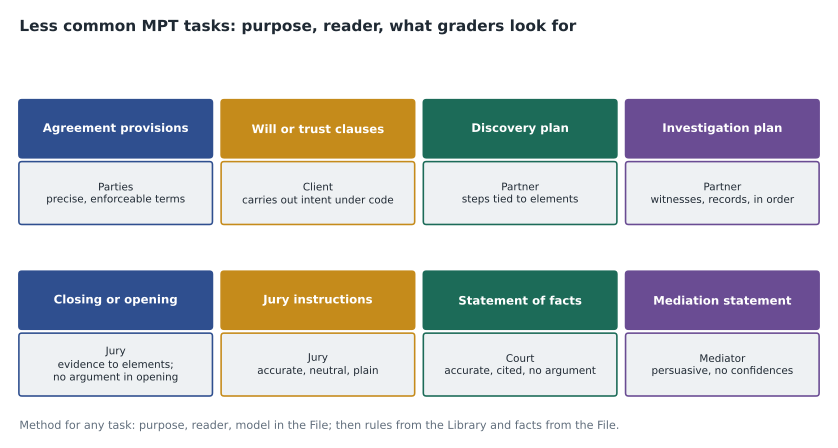
Drafting tasks ask you to write contract language: a clause in a settlement agreement, a lease provision, a non-competition covenant, a partnership agreement term. The Library supplies the law that limits what the clause can do, such as a statute making certain covenants unenforceable unless they meet requirements. The File supplies the client's goals and the deal's facts. Graders look for language that actually achieves the client's goal, complies with the law in the Library, is clear and unambiguous, and anticipates likely disputes.
Good drafting is precise and plain. Use defined terms consistently. Use 'shall' or 'must' for obligations, 'may' for permissions and 'may not' for prohibitions, and do not mix them for the same idea. Say who does what, by when, and what happens if they do not. Avoid words that invite argument, such as 'reasonable' or 'promptly', unless the law requires them or you define them.
Here is a short original example. A fictional Marlow statute provides that a settlement agreement resolving a zoning dispute with a city is enforceable only if it states the specific conduct each party will take and the date by which it will be completed. Ms. Ruiz and the City agree that she will replace her sign and the City will withdraw the notice. A weak provision says: 'Ruiz will fix the sign promptly and the City will drop the charges.' A strong one says: 'Ruiz shall, no later than December 15, 2026, remove the existing yard sign at 418 Larch Street and may replace it with a single sign not exceeding four square feet, set back at least five feet from the sidewalk. Within ten days after Ruiz notifies the City in writing that she has done so, the City shall withdraw the notice of violation dated September 28 in its entirety.' The strong version names the conduct, the date and the trigger, as the statute requires.
Will and trust provisions
Since July 2026, NCBE has said trusts and estates may appear on the MPT with the law supplied. A will or trust drafting task usually gives you the client's wishes in an interview transcript, the family facts, and a Library with the relevant probate code provisions and cases. Common traps include lapse and anti-lapse rules (what happens if a beneficiary dies before the testator), class gifts, ademption (a specific gift of property the testator no longer owns), abatement and the formalities of execution.
A short original example: a fictional Marlow anti-lapse statute provides that if a beneficiary who is the testator's descendant dies before the testator, the gift passes to the beneficiary's descendants unless the will expresses a contrary intent, and that words of survivorship alone, such as 'if he survives me', express a contrary intent. The client wants her house to go to her son, but if he dies first, to the son's children. Because the statute treats survivorship words as a contrary intent, a provision saying 'to my son Felix, if he survives me' would defeat the anti-lapse statute and send the house to the residuary beneficiaries if Felix died first. The better provision states the alternative expressly: 'I give my house at 12 Willow Court to my son Felix if he survives me by 30 days. If he does not, I give it to those of his children who survive me by 30 days, in equal shares.' An accompanying note explains why the provision does not rely on the statute.
Discovery and investigation plans
A discovery plan asks what evidence you need to prove or defend a claim, from whom, and by which device: interrogatories, requests for production, requests for admission, depositions or subpoenas to non-parties. The Library usually supplies the elements of the claim and the procedural rules on scope and limits. The File shows what you already know and what is missing. The best answers are organized by element: for each element, what you must prove, what evidence you have, what you still need, and how you will get it.
An investigation plan is similar but earlier and more informal: which witnesses to interview, which records to request, which public sources to check, in what order and why. Both kinds of plan reward linking every proposed step to an element or issue. A list of every possible deposition without explaining why each matters scores poorly.
For Ruiz, a short plan to prove the drop-off ordinance targets child care homes might include requesting the City Council's minutes and staff reports for the June 2026 adoption, a request for admission that section 10.12.020 applies to no other residential use, and an interrogatory asking which other residential uses must provide off-street drop-off areas. Each step ties to the subsection (d) element: whether the rule applies the same way to all residences.
Closing arguments, opening statements and jury instructions
Trial tasks ask you to persuade or instruct a jury. A closing argument tells the story of the case through the evidence admitted at trial, ties that evidence to each element the jury must find, addresses the other side's best points and asks for a specific verdict. It speaks to lay jurors, so it avoids citations and explains the law through the jury instructions the court will give. An opening statement previews the evidence and must not argue; the line between the two is itself a common point on the grading sheet.
Jury instruction tasks ask you to draft instructions that state the law accurately, neutrally and in language jurors understand, often with a short explanation of why each instruction is a correct statement of the Library law. Pattern instructions in the Library are a strong guide. A slanted instruction, such as one that tells the jury which facts to find, will be marked down even if you represent the party it favors.
Statements of facts and proposed findings
Some tasks ask only for a statement of facts, for a brief or for a court. A persuasive statement of facts tells the client's story accurately, organized and emphasized to support the argument, with citations to the record, and without argument or characterization a court would strike. An objective statement for an internal memo includes the bad facts in neutral terms. Proposed findings of fact and conclusions of law, submitted to a judge after a bench trial or hearing, state each finding in a numbered paragraph with record support and each conclusion with legal authority.
Mediation and settlement statements
A mediation statement is a persuasive document addressed to a neutral. It summarizes the dispute, explains the client's position and the strengths of the client's case, identifies the risks for the other side, and proposes or frames a resolution. Because it may be shared with the other side, it should not disclose confidential weaknesses or bottom lines unless the task memo says it will be kept confidential by the mediator.
Worked problem
Explaining drafting choices
Ngozi drafts the Ruiz settlement clause correctly but submits it without explanation. The task memo asked for "the provision and a brief explanation of how it satisfies the statute and protects Ms. Ruiz." Marchetti asks what is missing.
Show solution
- Identify each statutory requirement: specific conduct by each party and a completion date.
- Point to the words that satisfy each: "remove the existing yard sign ... may replace it with a single sign not exceeding four square feet"; "no later than December 15, 2026"; "the City shall withdraw ... within ten days after Ruiz notifies the City in writing".
- Explain how the clause protects the client: the City's obligation is triggered by her notice, not by its own inspection, and withdrawal is "in its entirety", covering all four charges.
- Note any remaining risk: the clause does not stop the City from issuing a new notice later, which the partner may want to address.
Answer: The explanation shows the grader the legal analysis behind the drafting, which is where most of the points are.
Recognizing the task type early
Marchetti's last point is about speed. 'Do not let an unusual task freeze you,' she says. 'Read the memo. Ask what the document is for and who reads it. Look for a model. Then do exactly what you would do for a memo: rules from the Library, facts from the File, organized for the reader.' She gives an example from her grading years: an investigation plan task where many examinees wrote a memo analyzing liability instead. 'They knew the law. They did not do the job. The examinees who wrote a numbered list of steps, each tied to an element, got the high scores.'
Dana raises the July 2026 trusts and estates item. 'If I see a simultaneous death statute I've never studied, I just read it like any other statute?' 'Exactly like any other statute,' Marchetti says. 'Elements, definitions, exceptions. Then the facts. The Library will have everything you need. That's the promise of the test.'
Practice problems
Work each problem on paper first, then reveal the answer to check.
What three questions should guide you on an unfamiliar task type?
Show answer
What the document is for, who will read or use it, and whether the File includes a model or format.
What makes a drafted provision strong?
Show answer
It achieves the client's goal, complies with the Library law, is clear and unambiguous, and anticipates disputes.
Why might "if he survives me" be a bad choice under the fictional anti-lapse statute?
Show answer
Because the statute treats survivorship words as a contrary intent, defeating the anti-lapse substitute gift.
How should a discovery plan be organized?
Show answer
By element: what must be proved, evidence in hand, evidence needed, and the device to obtain it.
What is the difference between an opening statement and a closing argument?
Show answer
An opening previews the evidence without arguing; a closing argues from the admitted evidence and asks for a verdict.
Why should a mediation statement avoid confidential weaknesses?
Show answer
It may be shared with the other side unless the task memo says the mediator will keep it confidential.
Common mistakes
MistakeIf I have never drafted a document type, I should write a memo instead.
InsteadWrite the document requested; responsiveness is the first grading criterion.
MistakeDrafting tasks do not need legal analysis.
InsteadThe explanation of drafting choices is where most of the legal analysis and points are.
MistakeJury instructions should favor my client.
InsteadInstructions must be accurate and neutral; slanted instructions are marked down.
MistakeA plan is just a list of every possible step.
InsteadTie each step to an element or issue and explain why it matters.
Annotations and cover memos
Many unusual tasks ask for the document plus an explanation, sometimes as a cover memo to the supervising attorney and sometimes as annotations after each provision or step. Treat the explanation as an objective memo in miniature: for each choice, state the rule from the Library that drove it, the facts that made it necessary, and any risk that remains. Keep it brief and organized to match the document, so the grader can read provision one and its explanation together.
Suppose the Ruiz settlement task had asked for both the clause and a cover memo. A good cover memo would explain, in a few short paragraphs, that the fictional statute requires specific conduct and a completion date, that the clause names both, that the City's withdrawal is triggered by Ms. Ruiz's written notice so the City cannot delay by failing to inspect, that 'in its entirety' covers all four charges, and that the clause does not prevent a new notice in the future, which the partner might address with a covenant not to re-cite the same conduct. Each paragraph ties a word in the clause to a rule or a client goal. That is the analysis graders are looking for in a drafting task, and it is often worth more points than the clause itself.
Summary and key terms
- Unusual tasks use the same method: purpose, reader, model, then rules and facts organized for the reader.
- Drafting tasks reward precise, plain language that meets the Library law and the client's goals, plus an explanation.
- Trusts and estates and family law may appear with the law supplied; read the statutes like any other.
- Plans should be organized by element; trial documents must respect the line between preview and argument.
- Persuasive documents shared with the other side should protect confidences.
- Drafting task
- An MPT assignment to write operative language, such as a contract clause or will provision.
- Anti-lapse statute
- A law substituting a predeceased beneficiary's descendants for the beneficiary, unless the will shows contrary intent.
- Discovery plan
- A plan identifying the evidence needed for each element and the discovery devices to obtain it.
- Jury instructions
- The court's neutral statements of law that the jury applies to the facts.
- Mediation statement
- A persuasive summary of a dispute addressed to a mediator.
- Proposed findings of fact
- Numbered factual findings, with record support, that a party asks a judge to adopt.
Lesson quiz · 5 questions
Score 60% or more to complete this lesson.
Create a free account to save your progress, take quizzes and earn a certificate.