
BAR-121 · Lesson 12 of 12 · 27 min
Capstone: two timed performance tests
▶ Video coming soon A video version of this lesson is on the way.
At 1:00 p.m. on Sunday, November 22, 2026, five cameras come on. Dana, Ngozi and Sofia are taking the capstone under exam conditions; Marcus is taking it cold for comparison; Eddie has joined to try the first item. Marchetti sends one file containing two complete performance tests, starts a three-hour timer and mutes herself. 'Ninety minutes each,' she says before she goes quiet. 'Hard stop at 2:30. I'll be here.'
This lesson contains both tests, followed by model answers, a self-grading guide and the group's results. Both are original and set in the fictional State of Marlow; every statute, case and person is invented. Each is shorter than a real MPT, so that both fit in one lesson, but each is complete: task memo, File and Library. The first is a trusts and estates task and the second a family law task, the two subjects NCBE says may appear on the MPT with the law supplied through February 2028. To get the most from them, set a timer for 90 minutes each and write your answers before reading the models.
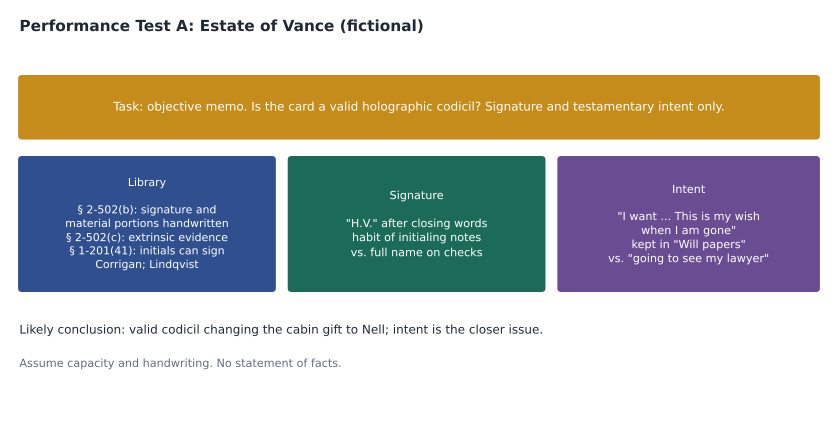
Performance Test A: In re Estate of Vance
Task memo. 'To: Applicant. From: Joan Feldt, Partner, Feldt and Marsh LLP. Re: Estate of Harriet Vance. Our client, Nell Vance, is the niece of Harriet Vance, who died on October 4, 2026. Harriet's 2019 will, properly signed and witnessed, leaves her lakeside cabin to her nephew Theo Vance and the rest of her estate to her sister. Nell found a handwritten card that may change the gift of the cabin. Before we decide whether to offer the card for probate as a codicil, I need an objective memorandum analyzing whether the card is a valid holographic codicil under the Marlow Probate Code. Address the signature requirement and testamentary intent. Assume Harriet had capacity and that the handwriting is hers; the expert report confirms it. Do not write a statement of facts.'
File: excerpt of 2019 will. 'Article Three. I give my cabin at 9 Heron Point Road to my nephew, Theodore Vance. Article Four. I give the rest of my estate to my sister, Marian Vance.' Signed by Harriet Vance and two witnesses, June 3, 2019.
File: the card. An index card, handwritten in blue ink on both sides. Front: 'Heron Point. I want the cabin to go to Nell, not Theo. She is the one who comes up every summer and fixes the dock. This is my wish when I am gone.' Back: 'H.V. 3/2/26.'
File: interview with Nell Vance (excerpt). Nell found the card on October 10, inside a sealed envelope labeled 'Will papers' in Harriet's desk, together with Harriet's copy of the 2019 will. Harriet always signed letters and checks 'Harriet Vance' but initialed household notes and recipe cards 'H.V.' Nell spent part of every summer at the cabin and repaired the dock in 2024 and 2025.
File: statement of Ruth Abbott, Harriet's friend. 'In early March, Harriet told me over lunch that she wanted Nell to have the cabin and that she was going to see her lawyer about changing her will. I don't think she ever did; she got sick in April.'
File: handwriting report. The front and back of the card are in Harriet Vance's handwriting, including the initials and date.
Library: Marlow Probate Code section 2-502 (fictional). (a) Except as provided in subsection (b), a will must be in writing, signed by the testator and signed by two witnesses. (b) A will that does not comply with subsection (a) is valid as a holographic will, whether or not witnessed, if the signature and the material portions of the document are in the testator's handwriting. (c) Intent that a document constitute the testator's will may be established by extrinsic evidence, including, for holographic wills, portions of the document that are not in the testator's handwriting. (d) In this section, 'will' includes a codicil.
Library: Marlow Probate Code section 1-201(41) (fictional). 'Sign' means to execute or adopt a tangible symbol, including a name, initials or other mark, with the present intent to authenticate a record.
Library: In re Estate of Corrigan (Marlow Supreme Court, 2018) (fictional). A handwritten document ending with the decedent's initials was offered as a holographic will. The court held that initials satisfy the signature requirement if the decedent intended them to authenticate the document, applying section 1-201(41). Relevant evidence includes where the mark appears (a mark at the end suggests completion and authentication), whether the decedent customarily used initials to sign documents of that kind, and whether the document appears complete. The court found intent where the decedent habitually initialed personal papers and the initials followed the last dispositive sentence.
Library: In re Estate of Lindqvist (Marlow Court of Appeals, 2022) (fictional). The decedent wrote a letter to her son saying, 'I am planning to change my will so that you get the farm.' The court held the letter lacked testamentary intent: a document expressing an intention to make a will in the future is not itself a will. The test is whether the decedent intended the document itself to dispose of property at death. Words such as 'I want' or 'my wish' may express testamentary intent when the document as a whole shows the decedent meant it to operate at death, and the court may consider extrinsic evidence such as where the document was kept and the decedent's statements. A decedent's statement that she planned to see a lawyer is relevant but not conclusive, because a testator may make an effective holographic will while also planning a formal one.
Performance Test B: Pereira v. Pereira
Task memo. 'To: Applicant. From: Luis Ostrow, Partner, Ostrow Family Law. Re: Pereira v. Pereira, Alder County District Court. We represent Daniel Pereira. His former wife, Clara Pereira, has moved to relocate their ten-year-old daughter, Sophie, from Brookfield to Granite Falls, about 280 miles away. Please draft the argument section of our brief opposing the motion. Make two arguments: first, that the motion should be denied because Clara did not give the notice the statute requires; second, that relocation is not in Sophie's best interests under the statutory factors. Use persuasive point headings. I will write the rest of the brief.'
File: parenting plan (2023). Clara has primary residence. Daniel has Sophie every other weekend from Friday to Sunday, every Wednesday evening for dinner, and two weeks each summer.
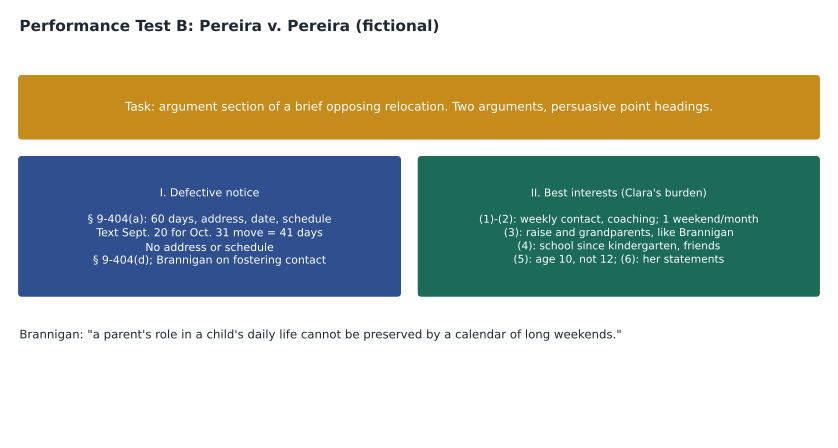
File: Daniel's declaration (excerpt). Daniel has exercised every scheduled visit since 2023. He coaches Sophie's soccer team on Tuesday and Thursday evenings and attends her Saturday games when it is Clara's weekend. Granite Falls is a five-hour drive. He works shifts at a Brookfield hospital and cannot move. Clara told him about the move by text on September 20, 2026, saying she planned to move on October 31; her motion was filed October 1.
File: Clara's declaration (excerpt). Clara has been offered a job in Granite Falls with about 15 percent higher pay and lower housing costs. Her parents live there and could help with child care. She proposes that Daniel have Sophie one weekend a month, half of each summer and alternating holidays, with Clara paying half the travel costs. Sophie's grades are good; she has close friends in Brookfield and has attended the same school since kindergarten.
File: guardian ad litem report (excerpt). Sophie, who is ten, told the guardian ad litem she 'would miss Dad and soccer a lot' and does not want to move, but would 'be okay' with her grandparents. The guardian found both parents loving and capable and noted that Sophie's relationship with her father is close and built on frequent contact.
Library: Marlow Family Code section 9-404 (fictional). (a) A parent with primary residence who intends to change the child's residence to a place more than 100 miles away must give the other parent written notice at least 60 days before the intended move, stating the new address, the date of the move and a proposed revised parenting schedule. (b) If the other parent objects, the court shall decide whether to permit the relocation. The relocating parent has the burden of proving by a preponderance of the evidence that the relocation is in the child's best interests. (c) The court shall consider: (1) the nature and quality of the child's relationship with each parent; (2) the likely effect of the move on the child's relationship with the non-relocating parent, and whether a revised schedule can preserve it; (3) the reasons for the move and for the objection; (4) the likely effect on the child's education, community ties and stability; (5) the preference of a child twelve years of age or older; and (6) any other factor bearing on the child's best interests. (d) A parent's failure to give notice under subsection (a) may be considered by the court in deciding whether to permit the relocation and in awarding attorney's fees.
Library: Brannigan v. Brannigan (Marlow Court of Appeals, 2020) (fictional). The court affirmed denial of a relocation 300 miles away. The mother's reasons, a modest raise and family support, were legitimate, but the father had weekly contact and was deeply involved in the children's activities, and the proposed monthly schedule would reduce his time by more than half. The court held that factor (2) weighs heavily when the move would replace frequent, routine contact with occasional long visits, because 'a parent's role in a child's daily life cannot be preserved by a calendar of long weekends'. It noted that a relocating parent's late or defective notice, while not automatically fatal, may reflect on the parent's willingness to foster the child's relationship with the other parent.
Model answer A: the Vance memo
Short answer. The card is probably a valid holographic codicil changing the gift of the cabin to Nell. The initials likely satisfy the signature requirement under Corrigan, and the card's language and its placement with the will likely show testamentary intent under Lindqvist. The friend's statement that Harriet planned to see her lawyer is the strongest evidence against intent, but Lindqvist says it is not conclusive.
I. The signature requirement. A holographic will or codicil is valid if the signature and the material portions are in the testator's handwriting. § 2-502(b), (d). To sign includes adopting initials with the present intent to authenticate a record. § 1-201(41). Under Corrigan, initials suffice when the decedent intended them to authenticate, considering their placement, the decedent's custom and whether the document appears complete. Here, the entire card, including the initials, is in Harriet's handwriting, which we are told to assume. The initials 'H.V.' appear on the back with the date, after the final dispositive sentence on the front ends with 'This is my wish when I am gone', which reads as a closing. Harriet customarily initialed household notes and recipe cards 'H.V.', as the Corrigan decedent initialed personal papers. Theo may argue that Harriet signed formal documents, such as letters and checks, with her full name, so initials show she did not regard the card as formal. That is a real argument, but Corrigan asks about her custom for documents of the kind at issue, and a handwritten index card is closer to the notes she initialed than to checks. A court would likely find the initials are a signature.
II. Testamentary intent. A document is a will only if the decedent intended the document itself to dispose of property at death, not merely to express a plan to make a will later. Lindqvist. 'I want' or 'my wish' can express that intent when the document as a whole shows it was meant to operate at death, and extrinsic evidence, such as where the document was kept and the decedent's statements, is admissible. Id.; § 2-502(c). The card names the property ('the cabin'), the beneficiary ('Nell'), the change ('not Theo'), and its timing ('This is my wish when I am gone'). Unlike the Lindqvist letter, which spoke of changing a will in the future, the card speaks of the disposition itself. Harriet kept it sealed in an envelope labeled 'Will papers' with her copy of the will, which suggests she regarded it as part of her testamentary plan. Theo's best evidence is Ruth Abbott's statement that in early March Harriet said she was going to see her lawyer about changing her will. That suggests Harriet may have viewed the card as a note toward a future formal change. But Lindqvist holds that such a statement is not conclusive, because a testator may make an effective holographic will while also planning a formal one, and Harriet fell ill in April before she could see a lawyer. On balance, a court would likely find testamentary intent, though this is the closer issue.
III. Effect. If valid, the card is a codicil that changes Article Three so the cabin passes to Nell; the rest of the will is unaffected. We should be prepared for Theo to contest, relying chiefly on the lawyer statement.
Model answer B: the Pereira argument
I. The court should deny the motion because Clara failed to give the written notice section 9-404(a) requires.
A parent who intends to move a child more than 100 miles must give written notice at least 60 days before the move, stating the new address, the date and a proposed revised schedule. § 9-404(a). Granite Falls is about 280 miles from Brookfield, so the requirement applies. Clara told Daniel of the move by text on September 20, only 41 days before her intended October 31 move date, and the File shows no new address or proposed schedule in that message; her schedule first appeared in her declaration. The statute allows the court to consider the failure in deciding whether to permit relocation, § 9-404(d), and the Court of Appeals has explained that late or defective notice may reflect on a parent's willingness to foster the child's relationship with the other parent. Brannigan. Clara's notice deprived Daniel of nearly three of the eight weeks the legislature guaranteed him to respond and plan. The court should weigh that failure heavily against relocation.
**II. Clara cannot carry her burden of proving relocation is in Sophie's best interests, because the move would replace Daniel's weekly role in Sophie's life with occasional visits.**
Clara bears the burden of proving by a preponderance of the evidence that relocation serves Sophie's best interests. § 9-404(b). The statutory factors weigh against her.
A. Sophie's close relationship with her father depends on frequent contact that the move would end. Under factors (1) and (2), the court considers the quality of each relationship and whether a revised schedule can preserve the non-relocating parent's relationship. Daniel has exercised every scheduled visit since 2023, sees Sophie every Wednesday and every other weekend, coaches her soccer team twice a week and attends her games even on Clara's weekends. The guardian ad litem found the relationship close and 'built on frequent contact'. Clara's proposed schedule, one weekend a month plus half the summer and alternating holidays, would cut his routine contact from roughly eight or more occasions a month to one, five hours away, and end his coaching. That is the situation Brannigan addressed: when a move replaces frequent, routine contact with occasional long visits, factor (2) weighs heavily, because 'a parent's role in a child's daily life cannot be preserved by a calendar of long weekends'.
B. Clara's reasons are legitimate but do not outweigh the harm to Sophie. Under factor (3), Clara's reasons, a raise of about 15 percent, lower housing costs and her parents' help, are legitimate. They are also nearly identical to the reasons the Brannigan court found insufficient: a modest raise and family support. Daniel's objection is grounded in preserving his daily role in Sophie's life, and his hospital shift work means he cannot follow her.
C. The move would disrupt Sophie's schooling, friendships and stability. Under factor (4), Sophie has attended the same school since kindergarten, has good grades and close friends in Brookfield, and plays on a team her father coaches. Relocation would remove her from every one of those ties at once.
D. Sophie's own statements support remaining in Brookfield. Factor (5) applies only to children twelve or older, and Sophie is ten, so the court does not weigh her preference under that factor. But under factor (6), any other factor bearing on her best interests, the court may consider what she told the guardian ad litem: that she would 'miss Dad and soccer a lot' and does not want to move. Her statement that she would 'be okay' with her grandparents shows resilience, not a wish to move.
Because the factors overwhelmingly favor preserving Sophie's relationship with her father and her community, Clara has not met her burden, and the motion should be denied.
Self-grading guide
Grade each answer against the points below before reading the group's results. A strong answer covers nearly all of them; a middle answer covers most of the major ones.
- Test A, responsiveness: objective memo, no statement of facts, signature and intent only, capacity and handwriting not argued.
- Test A, signature: section 2-502(b) and (d); section 1-201(41) definition; Corrigan factors; placement after the dispositive language; habit of initialing notes; Theo's full-name counterargument and response.
- Test A, intent: Lindqvist test; card's specific language versus the Lindqvist letter; 'Will papers' envelope; Abbott statement as the main counterargument; Lindqvist's not-conclusive holding; illness in April; candid rating of intent as the closer issue.
- Test B, responsiveness: argument section only; two arguments in order; persuasive point headings.
- Test B, notice: 100-mile threshold; 41 days instead of 60 (computed); missing address and schedule; section 9-404(d); Brannigan on notice and fostering the relationship.
- Test B, best interests: burden on Clara; factors (1) and (2) with weekly contact, coaching and every visit exercised; Brannigan's quotation; factor (3) acknowledged and distinguished; factor (4) school and friends; factor (5) inapplicable at age ten, but statements under factor (6).
The group's results
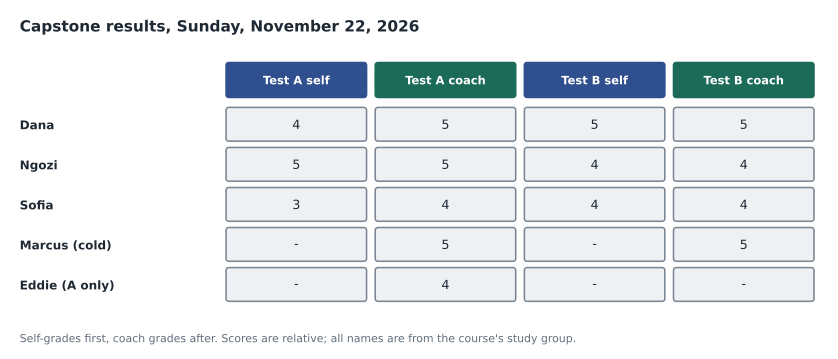
At 4:00 p.m. the timer ends. Everyone self-grades first, as Marchetti asked, and sends the scores before she sends hers that evening. Dana finished both tests for the first time with time to spare, crediting the hard stop at 90 minutes; she gave herself a 4 on Test A and Marchetti gave her a 5, because she found both counterarguments and computed the placement point carefully. Ngozi's Test A was a 5 and her Test B a 4: her brief covered every factor but used 'a court would likely find' twice, a habit from objective memos. Sofia read both task memos twice and wrote exactly what was asked, a first; she self-graded 3 and 4, and Marchetti gave her 4 and 4. 'You grade yourself a point low,' Marchetti tells her again. Marcus took both cold and earned two 5s. Eddie tried only Test A and earned a 4, noting that the Marlow holographic will rules felt familiar because Louisiana's olographic testament also requires the testament to be written, dated and signed in the testator's hand.
Marchetti's plan for the rest of the winter, all of it ahead of the group, is simple. Two released MPT items a week, timed and graded against their point sheets the next day. Two full three-hour, two-item blocks in January. Error logs updated after every test. And one rule she repeats until everyone can recite it: 'Read the memo twice. Write what it asks. Stop at ninety.'
Practice problems
Work each problem on paper first, then reveal the answer to check.
In Test A, why do the initials likely satisfy the signature requirement?
Show answer
Section 1-201(41) includes initials adopted to authenticate, and under Corrigan their placement after the dispositive language and Harriet's habit of initialing notes show that intent.
What distinguishes the Vance card from the Lindqvist letter?
Show answer
The card states the disposition itself and when it takes effect; the letter described a plan to change a will later.
What is the strongest evidence against testamentary intent in Test A, and why is it not conclusive?
Show answer
Harriet's statement that she would see her lawyer; Lindqvist says a testator may make an effective holographic will while planning a formal one.
How many days' notice did Clara give, and how many does the statute require?
Show answer
Forty-one days, from September 20 to October 31, instead of 60.
Why does factor (5) not apply to Sophie, and how can her statements still be used?
Show answer
She is ten, under the age of twelve in factor (5), but her statements may be considered under factor (6).
Which Brannigan principle is most useful for Daniel?
Show answer
That factor (2) weighs heavily when a move replaces frequent routine contact with occasional long visits.
Common mistakes
MistakeA capstone answer can skip counterarguments to save time.
InsteadCounterarguments are on the point sheet; address them briefly.
MistakeInitials can never be a signature.
InsteadUnder the fictional definition and Corrigan, initials suffice if adopted to authenticate.
MistakeA ten-year-old's wishes are irrelevant under section 9-404.
InsteadFactor (5) does not apply, but factor (6) allows the court to consider them.
MistakeLate notice automatically defeats a relocation motion.
InsteadSection 9-404(d) and Brannigan make it a factor the court may weigh, not automatically fatal.
Summary and key terms
- The capstone gives two complete original performance tests, one trusts and estates and one family law, to take timed.
- Test A turns on initials as a signature and on testamentary intent, with an honest treatment of the lawyer statement.
- Test B argues defective notice and the statutory factors, led by the effect on frequent father-daughter contact.
- Self-grade against the guide before reading the results, then log errors.
- The winter plan: timed released items, graded the next day, with a hard 90-minute stop.
- Holographic will
- A will valid without witnesses because its signature and material portions are in the testator's handwriting.
- Codicil
- A testamentary document that amends an existing will.
- Testamentary intent
- The intent that a document itself dispose of property at death.
- Relocation statute
- A law governing when a parent may move a child's residence a significant distance.
- Guardian ad litem
- A person appointed by a court to investigate and represent a child's best interests.
- Olographic testament
- Louisiana's handwritten testament, written, dated and signed in the testator's hand.
Lesson quiz · 5 questions
Score 60% or more to complete this lesson.
Create a free account to save your progress, take quizzes and earn a certificate.