
BAR-121 · Lesson 10 of 12 · 22 min
Organizing and writing under pressure
▶ Video coming soon A video version of this lesson is on the way.
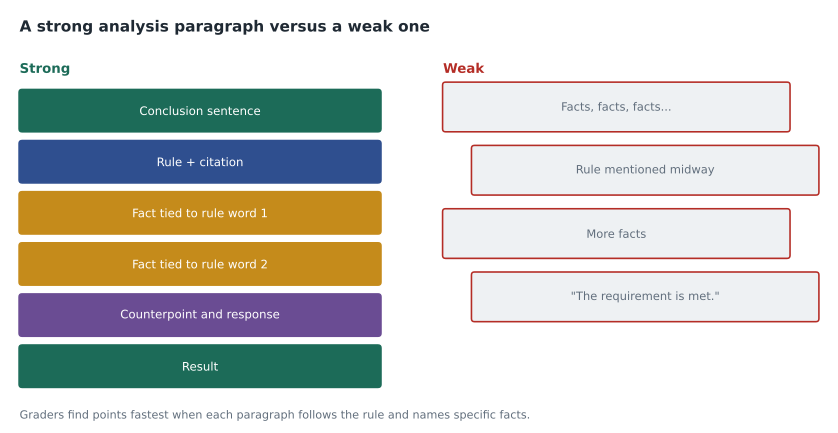
At noon on Friday, November 20, 2026, the last lunchtime session, Marchetti puts two paragraphs side by side on her screen. Both analyze the same issue from a released performance test. Both reach the same conclusion. Both cite the same case. One received a 5 from the grader who scored it; the other received a 3. 'Tell me why,' she says. It takes the group a few minutes. The weaker paragraph opens with two sentences of facts, mentions the case in the middle, and concludes without saying which fact decided it. The stronger one opens with its conclusion, states the rule in one sentence with the case name, uses three facts in three sentences, each tied to a word in the rule, and ends.
'Same knowledge, different writing,' Marchetti says. 'Under time pressure, structure is what you can control. That's today.' This lesson covers the habits that make answers easy to grade when you are writing fast: headings that carry the argument, paragraphs that follow the rule, sentences that use facts, and a short drill to practice them.
Write for a grader with a point sheet
The grader reading your answer has a point sheet listing the issues, the rules and the key facts, and a stack of answers to get through. Your job is to make each point easy to find and impossible to miss. That means three things. Headings that name the issues the point sheet lists, in the order a reader would expect. A rule stated clearly, with its source, near the start of each section. And facts from the File applied to that rule, in specific terms, so the grader can tick each one off.
None of this is about elegance. Bar graders read quickly and value clarity over style. A plain answer that hits every point will outscore a graceful one that buries them.
Headings that carry the argument
Use the headings from your outline, which came from the task memo. In an objective memo, headings can be short statements of the issue or the conclusion. In a brief, they should state the conclusion and reason, as Lesson 6 showed. Either way, a reader who reads only the headings should understand what the answer covers and, ideally, what it concludes.
Number headings consistently: I, II, III for main issues and A, B, C for sub-issues is enough. If your jurisdiction's software does not allow bold or underlining, set headings apart with capital letters or a blank line. A grader should be able to scan the answer and see its skeleton at a glance.
Paragraphs that follow the rule
Within a section, organize by the elements of the rule, in the order the rule states them. If the Ruiz definition has three elements, licensed, under 24 hours, and no more than eight children, write one short paragraph or sentence on each, in that order, spending the most time on the element that is actually in dispute. Graders expect this order because the point sheet follows it.
Each analysis paragraph has a predictable shape. Open with a sentence stating the point the paragraph makes. State or restate the governing rule if it has not been stated, with its source. Apply the rule using specific facts, each tied to a word or element of the rule. Address the counterargument if there is a real one. Close with a sentence that states the result. The shape is so predictable that, once practiced, it frees you to think about the content rather than the form.
Sentences that use facts
The single most common weakness in performance test answers is conclusory application: 'Ms. Ruiz meets the requirement.' The grader cannot give credit for factual analysis that is not on the page. Strong application names the fact, its source and why it matters under the rule: 'Ms. Ruiz holds a family child care license issued by the Department of Children's Services, valid through March 2027, so the home is licensed under section 14-210(b).'
Use numbers and specifics. 'Fourteen visits a day exceed the limit of six' is stronger than 'many visits exceed the limit'. 'The sign is about three feet by two feet, or six square feet, which exceeds the four-square-foot limit' is stronger than 'the sign is too large'. Specific facts show the grader you read the File closely, and arithmetic shown on the page earns credit even if a grader would quibble with the result.
Using the Library's words
Quote the key words of statutes and holdings, briefly. 'Applies in the same way to all residences' should appear in quotation marks somewhere in any good Ruiz answer, because those words decide two issues. Paraphrase the rest. Long block quotations waste time and suggest the writer is copying rather than analyzing.
Use the Library's terms consistently. If the statute says 'family child care home', do not switch to 'daycare', 'home daycare' and 'child care business' in different paragraphs. Consistent terms make the analysis easier to follow and avoid suggesting distinctions you do not intend.
A twenty-minute drill
Marchetti ends the session with a short drill: a miniature task with one statute, one case and a handful of facts, to be outlined and written in 20 minutes. It is far shorter than a real MPT, but it isolates the writing habits. All of it is fictional.
Task memo. 'Our client, tenant Rosa Albright, deducted the cost of a furnace repair from her December rent. Her landlord, Kestrel Property Group, has sued for the unpaid amount. Write a short objective analysis of whether Ms. Albright's deduction was lawful under Marlow Residential Tenancy Act section 33-118. Do not address any other defense.'
Library: Marlow Residential Tenancy Act, section 33-118 (fictional). (a) If a landlord fails to repair a condition that makes the dwelling unfit for habitation within ten days after receiving written notice from the tenant, the tenant may have the repair made and deduct its reasonable cost from the rent. (b) The deduction may not exceed one month's rent. (c) The tenant must give the landlord an itemized receipt for the repair with the reduced rent payment.
Library: Fenwick v. Arbor Lane Apartments (Marlow Court of Appeals, 2020) (fictional). The court held that the absence of heat in winter makes a dwelling unfit for habitation under section 33-118, and that a text message to the landlord's designated maintenance number is written notice if the landlord has told tenants to use it for repair requests. The court rejected the landlord's argument that notice must be on paper.
File (condensed). Ms. Albright's lease requires repair requests by text to Kestrel's maintenance line. Her furnace stopped working on December 2 during a cold snap; she texted the maintenance line that afternoon and received an automated reply. Nobody came. On December 14 she paid a licensed contractor 640 dollars to replace a failed igniter. Her monthly rent is 1,150 dollars. She paid 510 dollars on December 15 with a note saying 'furnace repair, see attached' and a copy of the contractor's itemized invoice.
Model answer.
Ms. Albright's deduction was likely lawful under section 33-118. The statute allows a tenant to repair a condition that makes the dwelling unfit for habitation and deduct the reasonable cost if the landlord fails to repair it within ten days after written notice, subject to a cap of one month's rent and an itemized receipt. § 33-118(a)-(c).
Unfit condition. The absence of heat in winter makes a dwelling unfit for habitation. Fenwick. Ms. Albright's furnace failed on December 2 during a cold snap, so the condition qualifies.
Written notice and ten days. A text to the landlord's designated maintenance number is written notice where the landlord directed tenants to use it. Fenwick. Kestrel's lease requires repair requests by text to its maintenance line, and Ms. Albright texted that line on December 2 and received an automated reply confirming receipt. Kestrel did not repair the furnace within ten days, by December 12. She arranged the repair on December 14, after the period ran. Kestrel may argue that an automated reply does not show that a person read the request, but Fenwick treats a text to the designated number as notice, and Kestrel chose that channel.
Reasonable cost and cap. She paid a licensed contractor 640 dollars to replace a failed igniter. Nothing in the File suggests the cost was unreasonable, though we should confirm typical prices. The deduction of 640 dollars is less than one month's rent of 1,150 dollars, so the cap is met. § 33-118(b).
Itemized receipt. She paid 510 dollars, which is 1,150 minus 640, with a note and a copy of the contractor's itemized invoice. § 33-118(c). The deduction appears to comply with every element.
What makes the model work
The answer opens with its conclusion and the rule. It follows the statute's order: condition, notice and timing, cost and cap, receipt. Each paragraph names facts with dates and dollar amounts and ties them to the rule's words. It shows the arithmetic: December 2 plus ten days, 1,150 minus 640. It addresses the landlord's best argument in one sentence. It flags one gap, the reasonableness of the price, without inventing an answer. And it is short enough to write in about twelve minutes after an eight-minute read and outline.
Ngozi finishes the drill in 19 minutes. Her answer covers every element, but the cost paragraph says only 'the cost was reasonable'. Marchetti asks how she knows. 'I don't,' Ngozi admits. 'Then say what you know and what you'd check,' Marchetti says. 'That's what a careful lawyer writes.'
Worked problem
Fixing a conclusory sentence
Sofia's drill answer says: "The notice was proper because she texted the landlord." Marchetti asks her to make it earn full credit.
Show solution
- State the rule element: written notice under section 33-118(a).
- Bring in the interpreting authority: Fenwick treats a text to a designated maintenance number as written notice when the landlord directed its use.
- Name the facts that satisfy each part: the lease designates the maintenance text line; she texted it on December 2; she received an automated reply.
- Address the counterpoint briefly: an automated reply may not show a person read it, but Fenwick looks to the channel the landlord chose.
Answer: "Ms. Albright gave written notice. Under Fenwick, a text to the landlord's designated maintenance number is written notice when the landlord has told tenants to use it. Kestrel's lease designates its maintenance text line, and she texted that line on December 2 and received an automated reply. Although Kestrel may argue that no person read the message, Fenwick looks to the channel the landlord chose."
Pressure habits
A few small habits help when the clock is running. Write the conclusion of each section first, then fill in the analysis; if time runs out mid-section, the grader still sees your answer. Leave a blank line between sections so you can insert a missed point later. Keep a running list in the margin of facts you meant to use and cross them off as you do. In the last five minutes, reread the task memo and check each instruction against your answer.
Marcus adds one from the NextGen exam. 'Short sentences,' he says. 'When I'm tired I write long sentences with five clauses. Graders hate them. Short sentences are faster to write and faster to read.'
Practice problems
Work each problem on paper first, then reveal the answer to check.
Why should headings track the task memo's issues?
Show answer
Because the point sheet follows the issues, and matching headings let the grader find each point quickly.
In what order should you analyze a rule's elements?
Show answer
In the order the rule states them, spending the most time on the disputed element.
What is conclusory application, and how do you fix it?
Show answer
Stating that a requirement is met without facts; fix it by naming specific facts, their source and why they satisfy the rule.
In the drill, when did the ten-day period end, and was the repair after it?
Show answer
It ended December 12; the repair on December 14 came after it.
Why does the model answer flag the reasonableness of the price?
Show answer
The File does not establish it; a careful answer states what is known and what to check rather than inventing a conclusion.
What should you do in the last five minutes?
Show answer
Reread the task memo and check each instruction, heading, rule, fact and conclusion against the answer.
Common mistakes
MistakeElegant prose earns higher scores.
InsteadClarity and coverage of the point sheet earn scores; plain writing is fine.
MistakeFacts can be summarized generally.
InsteadUse specific facts with numbers, dates and sources, tied to rule elements.
MistakeLong quotations show I used the Library.
InsteadQuote only key words; paraphrase the rest and analyze.
MistakeSwitching terms keeps the writing varied.
InsteadUse the Library's terms consistently to avoid confusion.
Using the counterargument without losing the thread
Counterarguments earn points, but they can also derail an answer if they sprawl. Keep each one to two or three sentences placed right after the application it challenges: state the other side's best point, explain why it is weaker or how a court is likely to treat it, and return to your conclusion. In the drill, the landlord's argument about the automated reply takes one sentence and its answer another. A paragraph that wanders through every conceivable objection buries the main analysis and costs time.
In an objective memo, a counterargument may change your conclusion or lower your confidence, and you should say so. In a brief, it is a point to rebut. Either way, place it where it belongs in the rule's structure rather than collecting all counterarguments at the end, where a grader may not connect them to the elements they concern.
Writing transitions that help a fast reader
Short signposts help a grader follow your structure without rereading. 'The first element is met because', 'The closer question is', 'Even if the court accepted that argument' and 'Accordingly' each tell the reader where they are in the analysis. They cost a few words and save the grader effort, which matters when an answer is one of a hundred. Avoid filler signposts that add nothing, such as 'It is important to note that' or 'In conclusion, it can be said that'.
Summary and key terms
- Write for a grader with a point sheet: clear headings, stated rules, specific facts.
- Organize each section by the rule's elements and each paragraph from conclusion through rule, facts and counterpoint.
- Avoid conclusory application; show facts, numbers and arithmetic on the page.
- Quote key Library words briefly and use terms consistently.
- Use pressure habits: conclusion first, margin fact lists, and a final check against the task memo.
- Conclusory application
- Asserting that a rule is satisfied without explaining which facts satisfy it.
- Topic sentence
- The opening sentence of a paragraph stating the point it makes.
- Repair and deduct
- A tenant remedy allowing the tenant to pay for a repair and subtract the cost from rent, under statutory conditions.
- Element-by-element analysis
- Applying each part of a rule to the facts in the order the rule states them.
- Final review
- The last minutes of an MPT item spent checking the answer against the task memo.
Lesson quiz · 5 questions
Score 60% or more to complete this lesson.
Create a free account to save your progress, take quizzes and earn a certificate.