
BAR-121 · Lesson 5 of 12 · 21 min
Objective memos
▶ Video coming soon A video version of this lesson is on the way.
Friday, October 30, 2026 is the first Friday session in three weeks; the two Fridays in between went to torts drills. Everyone has written the Ruiz memo. Marchetti has read all of them and starts with a compliment and a warning. 'Every one of you found the right rules. Two of you wrote briefs instead of memos. One of you never told the partner about Leo.' She does not say who. Ngozi looks at her screen and quietly types a note.
The objective memorandum is the most common MPT task. NCBE's summaries of recent items show objective memos year after year, on subjects from family law to legal ethics. It is also the task examinees think they know best and most often get subtly wrong. This lesson covers what makes a memo objective, how to structure one under time pressure, and how a model Ruiz memo looks.
What objective means
An objective memo predicts. It tells the supervising attorney how a court is likely to resolve each question, why, and how confident you are. It is written for an internal reader who will make decisions based on it, so it must include the weaknesses in the client's position and the strongest arguments the other side will make. It is not neutral in the sense of refusing to conclude; it reaches conclusions. It is neutral in the sense that the conclusions follow the law and facts wherever they lead.
Compare a brief. A brief argues; it presents the client's position as strongly as the law and facts allow, addresses the other side only to rebut it, and never volunteers a weakness it is not obliged to address. The same analysis can appear in both, but the framing differs. In a memo you write 'A court will likely find', 'The City's best argument is', 'This is our weakest point'. In a brief you write 'The court should hold', 'The City's argument fails because'.
Two Ruiz memos drifted into advocacy. One said, 'Ms. Ruiz is plainly entitled to the Act's protection and the City's notice is baseless.' The other treated Leo in one sentence: 'Any suggestion that occasional care for a family member affects the count is without merit.' Both are brief language. Neither tells the partner that the sign-in sheets give the City a strong argument.
The structure of a memo
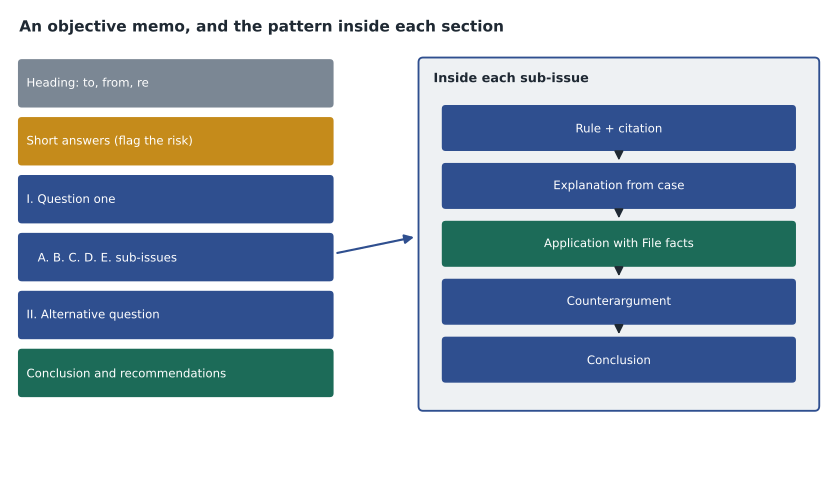
Task memos often specify a format, and the specified format always controls. When the memo says only 'write a memo', a standard structure works well and lets graders find points quickly:
- Heading. To, from, date, re. Use the names from the task memo; do not use your own name.
- Introduction or short answers. One short paragraph, or one sentence per question, giving your conclusions up front.
- Statement of facts, only if the task memo asks for one. The Ruiz memo said not to.
- Discussion, organized under headings that track the questions in the task memo, with subheadings for sub-issues.
- Conclusion, a few sentences summarizing the answers and any recommendations, such as steps to take or facts to gather.
Within each section of the discussion, use the familiar pattern: state the rule with its source, explain it with the relevant case where helpful, apply it to the facts in detail, address counterarguments, and conclude. Bar coaches give this pattern many names, such as IRAC or CREAC. The name does not matter. What matters is that every subsection contains a rule with a citation, specific facts from the File, reasoning that connects them, and a conclusion.
Citing the Library
Performance tests reward citing the Library. Each time you state a rule, cite the statute or case it comes from. You need not use full formal citations; NCBE's instructions say abbreviations and omitted page references are acceptable. 'Harmon' or '§ 14-210(b)' is enough. What graders look for is evidence that you used the authorities provided, attributed each rule correctly, and relied on binding authority over persuasive.
Cite facts too, at least informally. 'According to the sign-in sheets' or 'Ms. Ruiz told us' shows the grader where a fact comes from and makes inconsistencies visible, as when the interview and the sheets disagree.
Short answers that work
Start with the answers. A busy partner reading the first paragraph should know your conclusions; a grader reading it should see that you understood the assignment. Short answers should be specific and should flag uncertainty. 'Probably yes' is better than 'yes' when the analysis is close. 'Yes, unless Leo counts' is better than either for Ruiz.
A model Ruiz memo
Here is a model discussion for the Ruiz memo, written in about 50 minutes of writing time after 40 minutes of reading and outlining. It is not the only good answer. A grader would give a high score to any answer that reached reasonable conclusions with the same rules, facts and candor.
MEMORANDUM. To: Priya Nandakumar. From: Applicant. Re: Lena Ruiz, Little Sprouts Family Child Care; City of Brookfield notice of violation.
Short answers. (1) Probably yes, but with a serious risk. Ms. Ruiz's home qualifies as a family child care home under section 14-210 on Mondays, Wednesdays and Fridays, but on Tuesday and Thursday afternoons her care of her nephew likely brings the count to nine, and under Harmon a home over eight loses the section's protection entirely. If the home qualifies, the City cannot enforce the home occupation permit, visit limit or sign ban, or the child care drop-off ordinance, but it could enforce its general four-square-foot residential sign limit and its general lawn parking rule. (2) If the home does not qualify, Ms. Ruiz does not meet section 17.40.050: she lacks a permit, exceeds six client visits a day, likely exceeds the 25 percent floor-area limit, and displays an advertising sign.
I. Section 14-210 of the Family Child Care Act.
A. Whether the home is a family child care home. Section 14-210 protects only a licensed home in which the licensee provides care, for less than 24 hours a day, to no more than eight children, counting the licensee's own children under ten who are present. § 14-210(b). The Marlow Supreme Court treats the eight-child limit as a bright line: a home over the limit, even slightly or temporarily, is not a family child care home under the section and loses its protection entirely. Harmon. All children in care count; the licensee's own children count only if under ten and present; a child not in care, such as a visiting relative who is not being cared for, does not count. Id.
Ms. Ruiz holds a state family child care license with a capacity of eight, valid through March 2027, and provides care from 7:00 a.m. to 6:00 p.m. with no overnight care. The license and hours elements are met. On every weekday morning, seven enrolled children are present; her daughter Maya, six, is at school and does not count because she is not present. On Monday, Wednesday and Friday afternoons, Maya is home and counts as the licensee's own child under ten, bringing the total to eight. Her son Diego is eleven and does not count. On those days the home is within the limit.
Tuesday and Thursday afternoons are the problem. The sign-in sheets show Ms. Ruiz's eight-year-old nephew, Leo, present from 3:30 to 5:45, and Sam's email confirms she watches him while his mother works. Leo is not her own child, so the own-children rule does not exclude him, and Harmon's exclusion covers only relatives who are not being cared for. Watching a child while his parent works, and signing him in alongside the enrolled children, is care. A court would likely count Leo, making nine children on those afternoons.
Ms. Ruiz could argue that unpaid, occasional care of a family member is not what the statute regulates, and that Delaney recognized the legislature's purpose of keeping home child care in neighborhoods. Those arguments are weak. Section 14-210(b) does not distinguish paid from unpaid care, and Harmon rejected an argument that a small and temporary excess should be overlooked. Ms. Ruiz told us she 'never goes over eight', but the sheets contradict her, and the City may obtain them. I recommend that, before we respond to the City, Ms. Ruiz stop caring for Leo at the home during care hours or adjust her enrollment so that the count never exceeds eight. If she does, the home would clearly qualify going forward.
B. The home occupation permit requirement. A qualifying home is a residential use for all local zoning, § 14-210(a), and a city may not require a home occupation permit as a condition of operating. § 14-210(c). If the home qualifies, the permit charge fails.
C. The client visit limit. The six-visit limit appears only in the home occupation code, § 17.40.050(3), which governs home occupations. Because a qualifying home is a residential use, the home occupation code does not apply to it. Seven families arriving and leaving produce about fourteen visits a day, but that is legally irrelevant if the home qualifies.
D. The yard sign. The City cited the home occupation sign ban, § 17.40.050(4), which does not apply to a qualifying home. However, section 14-210(d) preserves sign regulations that apply in the same way to all residences in the zone, and section 15.08.030 limits every residential lot to one sign of no more than four square feet. Ms. Ruiz's sign is about three feet by two feet, or six square feet, and therefore exceeds that limit, although its eight-foot setback complies. The City cited the wrong section but could cite the right one. I recommend she replace the sign with one of four square feet or less.
E. The off-street drop-off requirement. Section 10.12.020 requires every child care center and family child care home to provide a two-vehicle drop-off area. Section 14-210(d) preserves parking regulations only if they apply in the same way to all residences, and Delaney held that a parking requirement aimed only at child care homes is not preserved because it treats them as something other than residences. Section 10.12.020 applies only to child care operations, and its June 2026 adoption underscores that it targets them. The charge should fail. Delaney also held that a city may enforce a general rule against parking on lawns. Ms. Ruiz said parents occasionally pull onto the grass; if Brookfield has a general lawn parking rule, the City could enforce it, and she should ask parents to use the street.
II. In the alternative: the home occupation requirements. If the home does not qualify, section 17.40.050 governs. It requires a permit and four conditions. Ms. Ruiz has no permit. Her one nonresident employee, Ms. Diaz, is allowed, and her husband is a resident, so condition (1) is likely met because care occurs inside the dwelling. Condition (2), 25 percent of floor area, is likely not met: the children use the living room, playroom and kitchen of an 1,800-square-foot house, but we lack room measurements and should obtain them. Condition (3) is not met; fourteen visits a day exceed six. Condition (4) is not met; the sign advertises the occupation. She could not operate as she does now under the home occupation code, which makes resolving the Leo issue under part I essential.
Conclusion. Ms. Ruiz's best path is section 14-210, which defeats three of the four charges outright and the fourth as cited. Its protection depends on keeping the count at eight or fewer at all times, so she should stop caring for Leo during care hours. She should also replace the sign with a compliant one and keep parents off the lawn. If the home does not qualify, she cannot meet the home occupation code as she currently operates.
What makes the model work
Marchetti points out five features. The short answers commit to conclusions and flag the risk. The headings mirror the task memo, including one subheading per charge. Each subsection states the rule with a citation before applying it. The weakness is analyzed in full, with the client's counterarguments and a candid rating. And the memo ends with concrete recommendations, which the partner will act on.
It also leaves things out. It does not restate the facts in a separate section. It does not discuss Pruitt or the Pell letter. It does not brief Harmon and Delaney in full; it uses only the parts that matter. 'Length is not the goal,' Marchetti says. 'Coverage of the point sheet is.'
Common objective memo mistakes
The most common mistakes are advocacy language; burying conclusions at the end; organizing by case instead of by issue; stating rules without citations; reciting facts without tying them to elements; omitting counterarguments; skipping the alternative question; and failing to recommend next steps when the memo invites them. Each is easy to fix with a template you practice until it is automatic.
Dana's draft had all the right analysis but put the conclusion on Leo in the last sentence of the memo. 'The partner reads your short answers, decides what to do, and then reads the rest if she has time,' Marchetti says. 'If the most important risk is not in the first paragraph, it is not in the memo.'
Practice problems
Work each problem on paper first, then reveal the answer to check.
What is the difference in stance between an objective memo and a brief?
Show answer
A memo predicts and includes weaknesses; a brief argues for the client and addresses the other side only to rebut it.
Where should conclusions appear in an objective memo?
Show answer
Up front, in short answers or an introduction, and again in the conclusion.
What pattern should each discussion subsection follow?
Show answer
Rule with citation, explanation, application with File facts, counterargument and conclusion.
How formal must Library citations be?
Show answer
Not formal; abbreviations such as a case name or section number are enough.
Why does the model memo address the sign under section 15.08.030 when the City did not cite it?
Show answer
Because candor requires flagging a rule the City could still enforce under section 14-210(d).
What should the conclusion of a memo include when the task invites it?
Show answer
A summary of answers and concrete recommendations, such as steps to take or facts to gather.
Common mistakes
MistakeObjective means refusing to conclude.
InsteadAn objective memo reaches conclusions, with honest confidence levels.
MistakeI should organize the discussion case by case.
InsteadOrganize by issue, using each authority where it applies.
MistakeCounterarguments weaken my memo.
InsteadThey are required in a memo and earn points.
MistakeA long memo scores better.
InsteadCoverage of the issues on the point sheet matters, not length.
Summary and key terms
- An objective memo predicts outcomes for an internal reader and includes weaknesses and counterarguments.
- Lead with specific short answers that flag uncertainty; organize the discussion by the task memo's questions.
- In each subsection, state and cite the rule, apply File facts, address counterarguments and conclude.
- Cite Library authorities informally and attribute facts to their sources.
- End with concrete recommendations when the task invites them.
- Short answer
- A one- or two-sentence conclusion to each question placed at the start of a memo.
- IRAC
- Issue, rule, application, conclusion: a common pattern for organizing legal analysis.
- CREAC
- Conclusion, rule, explanation, application, conclusion: a variant pattern emphasizing explanation of the rule.
- Counterargument
- The strongest argument against your conclusion, which an objective memo must address.
- Advocacy language
- Wording that argues rather than predicts, inappropriate in an objective memo.
Lesson quiz · 5 questions
Score 60% or more to complete this lesson.
Create a free account to save your progress, take quizzes and earn a certificate.