
BAR-121 · Lesson 3 of 12 · 23 min
Working the library
▶ Video coming soon A video version of this lesson is on the way.
On Friday, October 2, 2026, the group meets with the Ruiz Library open. Marchetti asks a simple question to start: 'How many of you read the cases first?' Most hands go up. 'And how many of you read the statute first?' Only Eddie's goes up. 'Louisiana habit,' he says. 'The code comes first, the cases explain it.' Marchetti smiles. 'On this one, Eddie wins. When the Library has a statute, the statute is the rule. The cases tell you what its words mean.'
This lesson is about reading the Library efficiently and turning it into rules you can apply. On a performance test you do not need to know the law in advance, but you do need to find it quickly in unfamiliar authority, understand how the pieces fit, and state each rule in a sentence you can build an analysis around.
What a Library contains
NCBE's instructions say the Library contains the cases, statutes, regulations or rules you need, and may contain some that are not relevant. The authorities are usually edited: opinions are shortened, footnotes removed and irrelevant parts cut. Statutes may be excerpted. Sometimes a Library includes secondary material, such as a comment to a uniform act or an excerpt from a treatise, which can help you interpret a provision but does not bind a court.
The authorities belong to a fictional jurisdiction and its court system, and may include authorities from other fictional jurisdictions or from federal courts. You must sort them by weight. A decision of the jurisdiction's highest court binds its lower courts. A decision of the intermediate appellate court binds trial courts but can be overruled or limited by the highest court. A decision from another state is persuasive at most. When two Library cases seem to conflict, check the courts and the dates before deciding which controls.
Read the statute first
When the Library contains a statute or code provision, read it first, slowly, and break it into elements. Statutes are drafted precisely, and performance tests often turn on a single word: 'and' versus 'or', 'shall' versus 'may', 'including' versus 'consisting of', a cross-reference to a definition, or an exception buried in the last subsection. Then read the cases with the elements in mind, asking which element each case interprets.
Here is the Ruiz Library's statute and code provisions, as the examinee would see them. Remember that all of this is fictional Marlow law written for this course.
Marlow Family Child Care Act, section 14-210. Family child care homes; local regulation. (a) A family child care home licensed under this chapter is a residential use of property for purposes of all local zoning and land use regulation. (b) In this section, a family child care home is a home in which the licensee provides care, for less than 24 hours a day, to no more than eight children, counting the licensee's own children under ten years of age who are present in the home. (c) A city or county may not require a family child care home to obtain a conditional use permit, variance, home occupation permit or business license as a condition of operating in a residential zone. (d) Nothing in this section prevents a city or county from enforcing a regulation on parking, noise, signs or fire safety that applies in the same way to all residences in the zone.
Brookfield City Code section 17.40.050. Home occupations. A home occupation is permitted in a residential zone only with a home occupation permit and only if: (1) the occupation is conducted entirely within the dwelling by persons who reside there, except that one nonresident employee may work on the premises; (2) the occupation uses no more than 25 percent of the floor area of the dwelling; (3) no more than six client or customer visits occur on the premises per day; and (4) no sign advertising the occupation is displayed on the exterior of the premises.
Brookfield City Code section 15.08.030. Residential signs. In a residential zone, each lot may display one sign not exceeding four square feet in area, set back at least five feet from the sidewalk.
Brookfield City Code section 10.12.020. Child care drop-off areas. Every child care center and family child care home in the City shall provide an off-street area for dropping off and picking up children, large enough for two vehicles. (Adopted June 2026.)
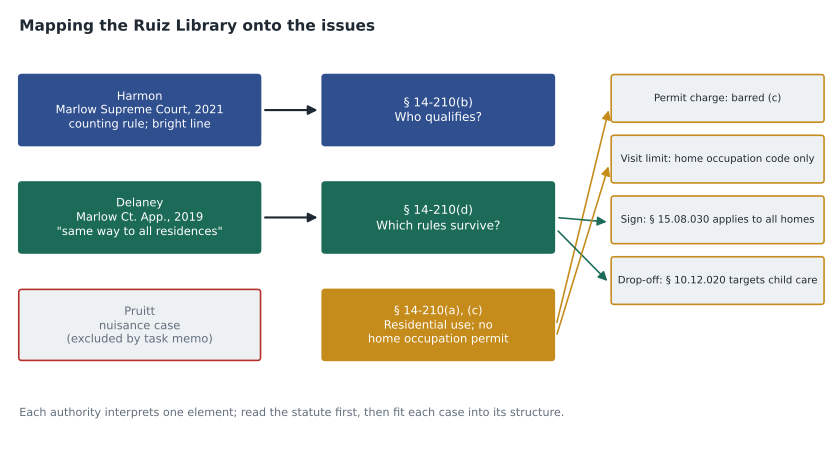
Read section 14-210 as Marchetti does. Subsection (b) is a definition with elements: the home is licensed; care is for less than 24 hours a day; and no more than eight children are in care, counting the licensee's own children under ten who are present. Subsection (a) gives the consequence: a qualifying home is a residential use for all local zoning. Subsection (c) bars four specific kinds of permission, and 'home occupation permit' is one of them. Subsection (d) is the exception: the city keeps four kinds of regulation, but only if the regulation 'applies in the same way to all residences in the zone'. That last phrase will decide the drop-off charge and may decide the sign charge.
Now look at what the code provisions add. Section 17.40.050 applies only to home occupations, so if section 14-210(a) makes a qualifying child care home a residential use, the home occupation rules do not apply to it at all. Section 15.08.030 is a sign rule for every residential lot, so it looks like the kind of regulation subsection (d) preserves. Section 10.12.020 applies only to child care centers and family child care homes, not to all residences.
Then read the cases
The Ruiz Library has three cases. Two matter and one does not. An examinee should be able to tell which is which within a minute or two of starting each one.
Delaney v. City of Port Ash (Marlow Court of Appeals, 2019). A licensed family child care home caring for eight children challenged a Port Ash ordinance requiring child care homes to provide two off-street parking spaces for parents. The city argued the ordinance was a parking regulation that section 14-210(d) preserved. The court disagreed. It held that subsection (d) preserves only regulations that 'apply in the same way to all residences', and that a parking rule aimed only at child care homes treats them as something other than residences, which is exactly what subsection (a) forbids. The court said the city could enforce its general rule against parking on lawns, which applied to every house, but not the special parking requirement. The court added that the legislature's purpose was to increase the supply of home-based child care by preventing local governments from 'regulating family child care homes out of residential neighborhoods'.
Harmon v. Town of Elkridge (Marlow Supreme Court, 2021). A licensee cared for nine unrelated children plus her own seven-year-old son, ten in all, and argued that section 14-210 still protected her because the excess was small and temporary. The Supreme Court held that the protection of subsection (a) applies only to a home that meets the definition in subsection (b), and that the eight-child limit is a bright line. A home over the limit is not a family child care home under the section, regardless of how slightly it exceeds the limit, and the town could enforce its ordinary zoning rules against it, including its home occupation ordinance. The court explained how to count: all children in care count, and the licensee's own children count only if they are under ten and present in the home. A licensee's own child of ten or older does not count, and neither does a child who is not in care, such as a visiting relative who is not being cared for.
Pruitt v. Gale (Marlow Court of Appeals, 2015). Neighbors sued a homeowner whose rooster crowed before dawn, alleging private nuisance. The court discussed the elements of private nuisance and affirmed an injunction limiting the hours the rooster could be outdoors.
Sorting relevant from irrelevant
Pruitt is a nuisance case. The task memo said Sam Okoye is handling the neighbors' nuisance threat. Pruitt is therefore irrelevant to the assignment, however interesting it is. Dana admits she spent four minutes reading it carefully. 'That's the trap,' Marchetti says. 'Some Library material is there to test whether you can tell what matters. Skim the first paragraph, see that it is nuisance, and move on.'
Harmon is from the Marlow Supreme Court, decided after Delaney, and it interprets subsection (b), the definition. Delaney is from the Court of Appeals and interprets subsection (d), the exception. They do not conflict: each addresses a different element. Together they give the analysis its structure. Harmon tells you whether Ms. Ruiz is inside the statute at all and how to count. Delaney tells you which regulations the city may still enforce if she is.
Turning authority into rules
The goal of the Library work is a list of rule statements, one or more per heading in your skeleton, that you will copy into your answer and apply. A good rule statement combines the statute's text with the court's interpretation and cites both. For Ruiz:
- Qualifying home. A licensed home providing less-than-24-hour care is a family child care home only if no more than eight children are in care, counting the licensee's own children under ten who are present (section 14-210(b)). The limit is a bright line; a home over it loses the section's protection entirely (Harmon).
- Effect of qualifying. A qualifying home is a residential use for all local zoning (section 14-210(a)), and the city may not require a home occupation permit as a condition of operating (section 14-210(c)).
- Preserved regulations. The city may enforce parking, noise, sign and fire safety regulations only if they apply in the same way to all residences in the zone (section 14-210(d)); a rule aimed only at child care homes is not preserved (Delaney).
- Home occupation fallback. A home occupation requires a permit and must meet four conditions, including no more than one nonresident employee, no more than six client visits per day, and no exterior sign (section 17.40.050).
Each rule statement uses the statute's own words where possible. On a performance test, quoting or closely paraphrasing the key language is valuable, because the point sheet is built around that language and the grader will be looking for it.
Reading a case quickly
Library cases are edited, but they still repay a disciplined approach. For each case, Marchetti suggests noting five things on scratch paper: the court and year; the facts in one line; the holding in one line; the reasoning, especially any test or factors; and anything the court says about policy or purpose. Purpose matters more on a performance test than on an essay, because close questions often turn on it. Delaney's statement that the legislature wanted to prevent cities from 'regulating family child care homes out of residential neighborhoods' will help you argue that the sign charge, brought under the home occupation code, should fail.
Watch for the court's own limits. Harmon says the eight-child line is bright and that small, temporary excesses do not matter. That is the bad fact waiting for Ms. Ruiz if her count is over eight. Delaney says the city may still enforce its general lawn parking rule. That tells you what the city can still do even if it loses the drop-off charge, which a candid memo should mention.
Worked problem
Synthesizing two cases into one rule
Ngozi asks how to combine Harmon and Delaney when they interpret different subsections. Marchetti walks through it.
Show solution
- Start with the statute's structure: definition in (b), consequence in (a) and (c), exception in (d).
- Assign each case to the element it interprets: Harmon to (b), Delaney to (d).
- Order the analysis the way a court would: first whether the home qualifies, then what follows, then the exception.
- Write a synthesized rule paragraph citing both: the home must qualify under (b) as Harmon applies it; if it does, (a) and (c) remove the permit requirement, and (d) preserves only regulations that apply equally to all residences, as Delaney held.
Answer: Synthesis does not require the cases to address the same question; it means fitting each into the statutory structure so the reader sees one coherent rule.
Common Library mistakes
The first common mistake is reading cases before the statute, which leaves you without a frame for what each case decides. The second is treating every case as equally important and briefing each one in the answer in turn, which produces a book report instead of an analysis. The third is ignoring court hierarchy and dates. The fourth is missing a definition or exception buried in a later subsection. The fifth is importing outside law: a Marlow statute that resembles a real state's statute is still a Marlow statute, and the Library version governs.
Sofia found the fourth mistake in her own July performance test. 'There was a definition section at the end that I skipped because I thought I knew what the word meant,' she says. 'It defined it differently.'
Marchetti closes with homework: read the rest of the Ruiz File, which she sends that night, and sort every fact into the skeleton, including the facts that hurt.
Practice problems
Work each problem on paper first, then reveal the answer to check.
Why should you read a Library statute before the cases?
Show answer
The statute is the rule; breaking it into elements gives you a frame for what each case interprets.
How should you treat a Library case that resembles a real case you know?
Show answer
Read it as written; it may be modified, and the Library version governs.
Which Ruiz case is irrelevant, and why?
Show answer
Pruitt, because it concerns private nuisance, which the task memo excluded.
What does Harmon hold about the eight-child limit?
Show answer
It is a bright line; a home over it loses the section's protection entirely, however slight the excess.
What does Delaney hold about subsection (d)?
Show answer
It preserves only regulations that apply in the same way to all residences; rules aimed at child care homes are not preserved.
What five things should you note about each case?
Show answer
Court and year, facts, holding, reasoning or test, and any statement of policy or purpose.
Common mistakes
MistakeI should brief every Library case in my answer in turn.
InsteadOrganize by issue and use each case where it applies; a case-by-case book report scores poorly.
MistakeIf two cases seem to conflict, the longer one controls.
InsteadCheck court level and date; the higher court and, at the same level, the later decision generally control.
MistakeI know what a defined term means, so I can skip the definition.
InsteadLibrary definitions often differ from ordinary or real-world meanings.
MistakeEvery case in the Library must be used.
InsteadSome authorities are distractors; using them wastes time and can mislead the analysis.
Summary and key terms
- Read the statute first and break it into elements; then read each case for the element it interprets.
- Sort authorities by court and date; higher courts bind lower ones.
- Identify and skim irrelevant authorities quickly, especially those excluded by the task memo.
- Write a rule statement for each heading, using the statute's words and citing the case that interprets it.
- Note each court's statements of purpose and its own limits; they decide close questions.
- Binding authority
- A decision that a court must follow, such as one from the same jurisdiction's highest court.
- Persuasive authority
- Authority a court may consider but need not follow, such as a decision from another state.
- Rule synthesis
- Combining a statute and the cases interpreting it into a single coherent rule statement.
- Distractor
- An authority or fact included in an MPT that is irrelevant to the assigned task.
- Bright-line rule
- A rule applied mechanically, without weighing how close a case comes to the line.
Lesson quiz · 5 questions
Score 60% or more to complete this lesson.
Create a free account to save your progress, take quizzes and earn a certificate.