
AWS-104 · Lesson 11 of 12 · 19 min
Partners, Marketplace and other resources
▶ Video coming soon A video version of this lesson is on the way.
Cascade Ridge is not going to do everything itself. The practice management system comes from a vendor. A consultant, Gwen, is guiding the move. At some point the group may want a managed backup service, a security product or extra hands for the cutover weekend. On November 12, after the Health session, Gwen gives Mateo a map of the people and places around AWS that can help: the AWS Partner Network, AWS Marketplace, AWS's own experts, and the large library of free technical resources. The exam guide's last task statement in the billing domain is about knowing these exist and when to use them.
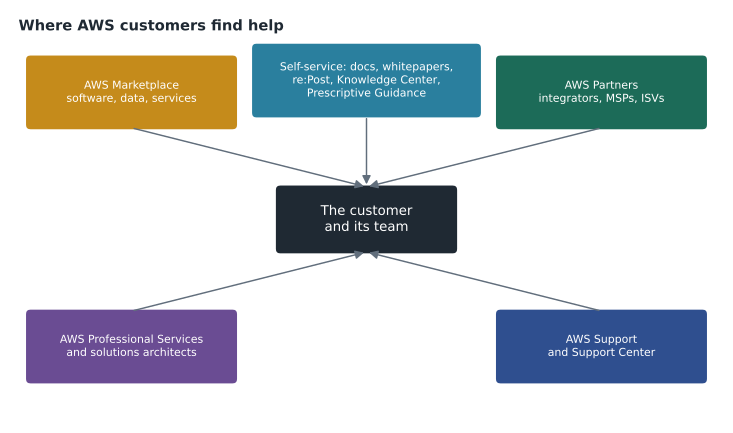
The AWS Partner Network
The AWS Partner Network (APN) is AWS's global program for companies that build on AWS or help customers use it. Partners fall broadly into two groups.
- Services partners, including system integrators and consulting firms, help customers plan, build, migrate and run workloads. Some are managed service providers (MSPs) that run parts of a customer's environment day to day.
- Software partners, often called independent software vendors (ISVs), build software products that run on AWS or integrate with it, and many sell them through AWS Marketplace.
AWS validates partner expertise with competencies and service designations, for example in migration, security or a specific service. A partner with a migration competency has shown AWS that it has done successful migrations with certified staff. For Cascade Ridge, Gwen suggests looking for a partner with healthcare or migration experience for the cutover weekend, to add people at the moment they are most needed.
What partners get
The exam guide asks you to identify the benefits of being an AWS Partner. Joining the APN gives a company access to partner training and certification, including role-based learning paths, so its staff can become certified; partner events and marketing programs; technical support and tools for building solutions; funding programs for some projects; and volume-based pricing and discounts for partners that resell AWS. In return, AWS gains a large network of experts who bring customers to the cloud.
AWS Marketplace
AWS Marketplace is a curated digital catalog where customers find, buy, deploy and manage third-party software, data and services that run on AWS. Products come in many forms: software as a service (SaaS) subscriptions, Amazon Machine Images with software preinstalled, container images, machine learning models, data products and professional services.
For a finance team, three features of AWS Marketplace stand out, and the exam guide names them:
- Cost management. Marketplace charges appear on the AWS bill, so software purchases are consolidated with AWS usage. Many products are priced hourly, by usage or by subscription, and can be tracked in Cost Explorer like other charges.
- Governance. A Private Marketplace lets an organization limit which products its users may buy to an approved list.
- Entitlements. Licenses bought through Marketplace are tracked as entitlements, which can be managed and shared across accounts, for example with AWS License Manager.
Sellers can also make private offers: custom prices or terms for one customer, accepted through Marketplace. Hannah likes the governance angle: if a clinic manager wants a new piece of software, buying it through a Private Marketplace with approved vendors is safer than a credit card sign-up nobody reviews.
# Illustrative: hourly Marketplace software on top of the EC2 instance it runs on.
ec2_rate = 0.192            # USD per hour, instance (illustrative)
software_rate = 0.25        # USD per hour, vendor's product (illustrative)
hours = 730
print(f"EC2 instance : {ec2_rate * hours:7.2f} USD")
print(f"Software     : {software_rate * hours:7.2f} USD")
print(f"On the bill : {(ec2_rate + software_rate) * hours:7.2f} USD, as separate lines")EC2 instance : 140.16 USD Software : 182.50 USD On the bill : 322.66 USD, as separate lines
What this code does
It works out the monthly cost of running AWS Marketplace software, which bills an hourly software fee on top of the EC2 instance it runs on. It multiplies each illustrative hourly rate by 730 hours and prints both charges and their total. The two appear as separate lines on the bill, so the software can cost more than the server itself.
AWS's own experts
Not every kind of help comes from partners. AWS itself offers technical assistance.
| Who | What they do |
|---|---|
| AWS Professional Services | A global team of AWS consultants who work with customers, often alongside partners, on large projects such as migrations and transformations, under a paid engagement |
| AWS solutions architects | Technical experts who help customers design architectures; account teams for many customers include a solutions architect |
| Technical Account Managers | Named engineers for Enterprise Support and Unified Operations customers (lesson 9) |
| AWS Support engineers | The engineers who answer support cases, with response targets by plan |
| AWS Training and Certification | Courses, labs and certifications, including AWS Skill Builder |
Free technical resources
Most questions never need a person. AWS publishes a large library of free material, and the exam expects you to know where to look.
| Resource | What it is | When to use it |
|---|---|---|
| AWS documentation | User guides, API references and developer guides for every service | How a service works and how to configure it |
| AWS whitepapers and guides | In-depth papers on architecture, security, cost and industries, including the Well-Architected Framework | Design principles and best practices |
| AWS blogs | Announcements, deep dives and examples from AWS teams | What is new and how others use a service |
| AWS re:Post | A community question-and-answer site moderated by AWS, with answers from AWS staff and experts | A question others may have asked or can answer |
| AWS Knowledge Center | Articles answering the most common questions AWS Support receives | Common problems and their fixes |
| AWS Prescriptive Guidance | Strategies, guides and patterns from AWS and partners for migrations and modernization | Step-by-step help for a planned project |
| AWS Well-Architected Tool | A free console tool for reviewing a workload against the Well-Architected pillars | Checking a design before and after launch |
| AWS Skill Builder | AWS's online learning center, with free and paid courses and labs | Learning and exam preparation |
Mateo's study plan for the February exam now has concrete sources: the CLF-C02 exam guide and practice questions on Skill Builder, the Well-Architected Framework whitepaper, and the AWS Pricing and Support pages. Gwen adds a habit: when he hits an error, search the Knowledge Center and re:Post first, then open a case.
Which help, when
Gwen summarizes the choices for Lorraine, who wants to know what costs money.
- Free and self-service: documentation, whitepapers, blogs, re:Post, Knowledge Center, Prescriptive Guidance, the Well-Architected Tool and the free courses on Skill Builder.
- Included with a support plan: customer service and billing help (all plans), technical cases (paid plans), a TAM (Enterprise and above).
- Paid engagements: AWS Professional Services, partner consulting and managed services.
- Products: software and data bought through AWS Marketplace, billed through the AWS bill.
Choosing a partner
Gwen has hired partners for many clients, and she gives Mateo a short checklist for the cutover helper.
- Relevant validation: an AWS competency or designation for migration, or for Microsoft workloads on AWS, which covers SQL Server.
- Similar customers: references from organizations of similar size, ideally in health care, where privacy and uptime expectations are high.
- Certified people: the names and certifications of the engineers who will actually do the work, not only the firm's total.
- A clear scope and price: what the partner will and will not do, and how changes are priced.
- Exit and handover: documentation and knowledge transfer, so Cascade Ridge can run the result itself.
Partners can be found in the AWS Partner Solutions Finder, which can be searched by location, industry, service and validation.
How Marketplace products are priced
Marketplace products use several pricing models, and a finance team should recognize them.
| Model | How it is charged | Example use |
|---|---|---|
| Free trial | No software charge for a set period (infrastructure may still be charged) | Trying a monitoring tool for 30 days |
| Hourly or usage-based | Software charge per hour or per unit of use, on top of infrastructure | A firewall image billed by the hour it runs |
| Annual or multi-year contract | Up-front or scheduled payments for a set term, often at a discount | A security product licensed for the whole organization |
| SaaS subscription | Monthly or contract pricing for a service run by the seller | A practice analytics dashboard |
| Bring your own license | No software charge through Marketplace; you use a license bought elsewhere | Deploying an image for software already owned |
Training and certification
AWS Training and Certification is how individuals and partners build skills. AWS Skill Builder offers free digital courses, including Cloud Practitioner exam preparation, and paid subscriptions with labs and practice exams. Certifications run from the foundational Cloud Practitioner through associate, professional and specialty levels. For partners, certified staff count toward program tiers and validations; for customers, they reduce dependence on outside help. Mateo's February exam is one step in Cascade Ridge's plan to run its own cloud, not just to move into it.
The AWS Partner Network in practice
For a small organization, the most useful parts of the partner ecosystem are often the simplest. A managed service provider can watch systems at night and apply patches, which matters to a group that has one IT generalist. A reseller partner can provide consolidated invoicing in local currency and sometimes help with commitment planning. A software vendor's product in Marketplace can save months of building something that already exists. Each choice trades money for time and expertise, and each should be compared with what AWS-managed services already provide.
Lorraine asks whether using a partner changes the support plan. It does not, Gwen explains: Cascade Ridge's own support plan still covers its own accounts. Some partners resell AWS with their own support layered on top, in which case the partner's contract defines who to call first. For Cascade Ridge, which will hold its own accounts, AWS Support and any partner simply work side by side.
Professional Services and solutions architects
AWS Professional Services usually works on larger, longer engagements, often alongside a partner, and is paid for like any consulting work. AWS solutions architects are part of many customers' account teams and help with architecture guidance as part of the relationship. For a customer of Cascade Ridge's size, Gwen expects most help to come from partners, AWS documentation and Support, with solutions architects available for occasional design conversations.
Asking good questions in public
AWS re:Post is public, so Hannah sets one rule for the team: never post account IDs, IP addresses, resource names, client data or logs that contain them. A good re:Post question describes the service, what was expected, what happened and the error text with anything private removed. Questions that need private details belong in a support case, where AWS engineers can look at the account itself. Followed carefully, the public community and private support complement each other well.
Worked problem
Choosing the right help
Four needs come up during the migration plan: (1) a firewall product from a known security vendor, billed on the AWS invoice; (2) an extra team of experienced migration engineers for the cutover weekend; (3) a step-by-step pattern for moving a SQL Server database to Amazon RDS; (4) an answer to an unusual error message. Where should Cascade Ridge look for each?
Show solution
- Firewall product: AWS Marketplace, from an ISV.
- Extra migration engineers: an AWS Partner with migration expertise, or AWS Professional Services.
- Migration pattern: AWS Prescriptive Guidance.
- Error message: the AWS Knowledge Center and AWS re:Post, then a support case if needed.
Answer: Marketplace, a partner or Professional Services, Prescriptive Guidance, and Knowledge Center or re:Post.
Common mistakes
MistakeAWS Marketplace is only for AWS's own products.
InsteadMarketplace mainly sells third-party software, data and services from ISVs and other sellers.
MistakeMarketplace purchases are billed separately from AWS.
InsteadMarketplace charges appear on the AWS bill.
MistakeAWS re:Post is a paid support channel.
Insteadre:Post is a free community question-and-answer site moderated by AWS.
MistakeOnly partners can help with large projects.
InsteadAWS Professional Services also works with customers on large projects, often alongside partners.
Summary and key terms
- The AWS Partner Network includes services partners, such as system integrators, consulting firms and managed service providers, and software partners, known as independent software vendors.
- Partners gain training and certification, events, support and, for resellers, volume discounts, and AWS validates them with competencies.
- AWS Marketplace is a curated catalog of third-party software, data and services whose charges appear on the AWS bill, with governance through Private Marketplace, managed entitlements and private offers.
- AWS's own technical assistance includes Professional Services, solutions architects, Technical Account Managers and Support engineers.
- Free resources include documentation, whitepapers, blogs, re:Post, the Knowledge Center, Prescriptive Guidance, the Well-Architected Tool and Skill Builder.
- AWS Partner Network
- AWS's program for companies that build on AWS or help customers use it
- System integrator
- A services partner that designs, builds and integrates systems for customers
- Independent software vendor
- A company that builds and sells software, often through AWS Marketplace
- AWS Marketplace
- A curated catalog of third-party software, data and services billed through AWS
- Private Marketplace
- A Marketplace feature that limits purchases to approved products
- AWS Professional Services
- AWS's consulting team for large customer projects
- AWS re:Post
- A free community question-and-answer site moderated by AWS
- AWS Prescriptive Guidance
- Strategies, guides and patterns for migrations and modernization
Practice problems
Work each problem on paper first, then reveal the answer to check.
Where would you buy a third-party security product that is billed on your AWS invoice?
Show answer
AWS Marketplace.
Name two benefits of joining the AWS Partner Network.
Show answer
Training and certification, events, technical support, and volume discounts for resellers.
Which resource collects answers to the most common questions AWS Support receives?
Show answer
The AWS Knowledge Center.
What does a Private Marketplace let an organization do?
Show answer
Limit purchases to an approved list of products.
Lesson quiz · 5 questions
Score 60% or more to complete this lesson.
Create a free account to save your progress, take quizzes and earn a certificate.