
AUTO-430 · Lesson 9 of 12 · 25 min
Fuel, ignition, emissions and driveability review
Marty opened the driveability session by putting a scan tool screenshot on the lounge television: short-term fuel trim +3 percent, long-term +18 percent on bank 1, short-term +2 and long-term +4 on bank 2, at idle; at 2,500 rpm steady, bank 1 long-term fell to +7. "What is it?" Kiran answered before Theo had finished reading: a lean condition on one bank that gets better with airflow, so unmetered air on bank 1, probably an intake or exhaust manifold leak upstream of the sensor. It was, almost exactly, Gord's pickup from the AUTO-230 capstone. "Good," Marty said. "Now tell me three things that would look the same and how you'd rule each one out." That is a driveability question.
Engine Performance, A8, has 50 scored questions on general diagnosis, ignition systems, fuel, air induction and exhaust systems, emission control systems, and computerized engine controls. Its stems are often long, with scan data or a waveform, so pacing matters. The advanced L1 test goes further into the same material for experienced technicians.
The review follows AUTO-230 (Fuel, Ignition and Emission Systems) and AUTO-330 (Engine Performance and Diagnostics).
Combustion and air-fuel ratio
Gasoline burns completely at a stoichiometric air-fuel ratio of about 14.7:1 by mass, which is lambda 1.0. Richer than that, lambda below 1, raises carbon monoxide and hydrocarbons; leaner, lambda above 1, raises oxygen and, with high combustion temperatures, oxides of nitrogen. The three-way catalyst works best in a narrow window around lambda 1, so the engine control module constantly corrects the mixture using oxygen or air-fuel ratio sensors. Exam questions use gas readings: high hydrocarbons with normal carbon monoxide suggest a misfire; high carbon monoxide suggests a rich mixture; high oxygen suggests a lean mixture or an exhaust leak.
Fuel trims
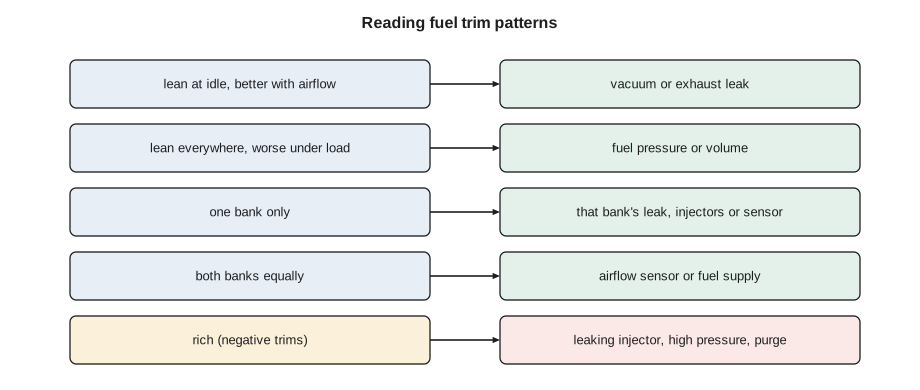
Fuel trims are the module's corrections. Short-term trim reacts quickly to the oxygen sensor; long-term trim learns the steady correction. Positive trims mean the module is adding fuel because it sees lean; negative trims mean it is removing fuel because it sees rich. Total trim, short-term plus long-term, beyond about plus or minus 10 percent deserves attention, and beyond about 20 to 25 percent usually sets a code. The pattern of trims tells you where to look: lean at idle that improves with airflow suggests a vacuum leak, because a fixed leak is a smaller share of a larger airflow; lean everywhere that gets worse under load suggests low fuel delivery; one bank lean points to that bank, such as a leak or a sensor on that side; both banks lean together point to something shared, like the fuel supply or the mass airflow sensor.
# Fuel trim totals and what the pattern suggests
cases = {"idle": ((3, 18), (2, 4)), "2,500 rpm steady": ((1, 7), (1, 3))}
for cond, (b1, b2) in cases.items():
    t1, t2 = sum(b1), sum(b2)
    print(f"{cond:<18} bank 1 total {t1:+3d}%   bank 2 total {t2:+3d}%")
idle1, cruise1 = sum(cases["idle"][0]), sum(cases["2,500 rpm steady"][0])
if idle1 > 10 and cruise1 < idle1 / 2:
    print("bank 1 lean at idle, better with airflow: suspect unmetered air on bank 1")
elif idle1 > 10:
print("lean at all loads: suspect fuel delivery or airflow measurement")idle bank 1 total +21% bank 2 total +6% 2,500 rpm steady bank 1 total +8% bank 2 total +4% bank 1 lean at idle, better with airflow: suspect unmetered air on bank 1
Sensors that set the mixture
The mass airflow sensor measures incoming air; a contaminated sensor reads low, so the engine runs lean and the module adds fuel, often with the trims climbing most at high airflow. Harold's over-oiled air filter coating his MAF in AUTO-230 was the example. A manifold absolute pressure sensor reads intake pressure; at idle on a healthy engine at sea level it reads low, about 9 inHg absolute, and with the key on and the engine off it reads barometric pressure, which at Ridgeline's altitude is noticeably below sea level. Upstream oxygen or air-fuel ratio sensors control fueling; the downstream sensor monitors the catalyst. A narrowband oxygen sensor switches between about 0.1 and 0.9 V; a wide-band sensor reports lambda or a current. Coolant and intake air temperature sensors, throttle position and the crank and cam sensors complete the picture.
Worked problem
Is the MAF reading plausible?
A 5.3 L V8 idles at 600 rpm. A rule of thumb gives airflow at idle of roughly 0.7 to 1.0 g/s per liter of displacement at sea level, less at altitude. The scan tool shows 2.1 g/s. Is that plausible?
Show solution
- Expected at sea level: 5.3 × 0.7 to 1.0 = about 3.7 to 5.3 g/s.
- At Ridgeline's altitude, air density is roughly 10 to 20 percent lower, so about 3.0 to 4.7 g/s.
- 2.1 g/s is well below that.
Answer: Not plausible. The sensor is reading low, likely contaminated, or there is unmetered air entering after it. Check for intake leaks after the sensor, then clean or test the sensor.
Ignition and misfires
Coil-on-plug ignition dominates current vehicles. A misfire is detected by the crankshaft speed dropping on that cylinder's power stroke. Diagnosis isolates the cause by moving parts: swap the coil to another cylinder and see if the misfire follows; if it follows the coil, the coil is at fault; if it stays, test the plug, the injector, and compression. An ignition scope shows the firing line, spark line and coil oscillations; a spark line that is short and high suggests high resistance in the secondary, such as a wide plug gap or a cracked boot; a long, low spark line suggests a fouled plug or low compression. Harold's coil with shorted turns in AUTO-330 showed as a weak spark and a short ringing pattern.
Spark plugs are inspected for gap, wear and deposits, and replaced at the maker's interval with the specified heat range and gap; a carbon-fouled plug points to a rich mixture or weak spark, an oil-fouled plug to oil entering the cylinder, and a blistered white insulator to overheating.
Emission controls and OBD
Exhaust gas recirculation lowers combustion temperature and oxides of nitrogen; a stuck-open valve causes rough idle and stalling, a stuck-closed one causes detonation and high oxides of nitrogen. The evaporative system stores fuel vapor in a charcoal canister and purges it into the engine; a stuck-open purge valve causes rich trims at idle and hard starting after refueling; leak tests find holes down to 0.020 in. Catalysts are monitored by comparing the upstream and downstream oxygen sensors: a good catalyst stores oxygen and smooths the downstream signal. Diesel and some gasoline vehicles add particulate filters and, on diesels, urea injection.
OBD-II monitors test each system and report readiness. A trouble code tells you which test failed, not which part is bad. Freeze frame records the conditions when the code set. Mode 06 shows the test results and limits, which can reveal a marginal component before a code sets, as on courier van 1's cylinder 5 in AUTO-330. Codes follow the SAE J2012 structure: a P for powertrain, a 0 for generic or 1 for maker-specific, then the system and the specific fault.
| Code range | System |
|---|---|
| P0100–P0199 | Fuel and air metering |
| P0200–P0299 | Fuel and air metering, injector circuits |
| P0300–P0399 | Ignition system and misfire |
| P0400–P0499 | Auxiliary emission controls: EGR, EVAP, catalyst monitor results |
| P0500–P0599 | Vehicle speed, idle control and auxiliary inputs |
| P0600–P0699 | Computer and output circuits |
| P0700–P0899 | Transmission |
In the United States, the Clean Air Act prohibits removing or disabling emission controls and selling defeat devices, and the EPA enforces it. Many areas, including Colorado's Front Range, require periodic emissions inspection, which for most newer vehicles means an OBD check of codes and readiness monitors. Removing or disabling emission equipment is never legitimate repair.
Driveability strategy
AUTO-330 lesson 1 set out the strategy the exam rewards: verify the complaint and the conditions, check bulletins and history, scan all modules, analyze data and freeze frame, form a theory, test the theory with the right tool, repair, and verify the repair under the conditions that caused the fault. No-code complaints, like the hesitation in AUTO-330's capstone, are found by recording data during the fault and looking for what changes first.
More practice in this area
Worked problem
An emissions gas question
A five-gas analyzer at idle shows high hydrocarbons, normal carbon monoxide, high oxygen and the engine idles roughly with a steady miss. What is most likely?
Show solution
- High hydrocarbons mean unburned fuel is leaving the cylinders.
- Normal carbon monoxide means the mixture is not rich.
- High oxygen means air that went into the cylinders was not used.
- A cylinder that does not fire passes its fuel and air straight through.
Answer: A misfire, most likely ignition or a mechanical fault on one cylinder. Check the misfire counters, then isolate the cylinder.
Worked problem
An oxygen sensor question
A narrowband upstream oxygen sensor reads a steady 0.1 V at warm idle, and long-term fuel trim is +22 percent. Technician A says the sensor has failed and should be replaced. Technician B says the engine is probably lean and the cause should be found. Who is right?
Show solution
- 0.1 V means the sensor sees oxygen, which means lean.
- Positive trims show the module agrees and is adding fuel.
- A sensor that has failed would not normally be matched by the trims, which are based on it but would drive the mixture rich if the sensor were falsely lean; confirm with a propane enrichment test: if the voltage rises, the sensor works.
Answer: Technician B only. A sensor reporting lean is usually telling the truth; find the leak, the low fuel pressure or the airflow error.
Worked problem
A readiness question
A vehicle failed an inspection because the evaporative and catalyst monitors are incomplete. The battery was replaced last week and there are no codes. What should be done?
Show solution
- A battery disconnect or a module reset clears the monitors.
- Each monitor runs only under its own conditions, such as a cold start for the evaporative monitor.
- The maker's drive cycle, or simply normal driving over several days, completes them.
Answer: Complete the drive cycle the maker specifies, confirm readiness with the scan tool, then retest. Clearing codes just before an inspection causes the same failure.
A8 and the engine block of the Red Seal exam both like questions about fuel delivery: a fuel pressure that is correct at idle but falls under load points to a weak pump, a restricted filter or a voltage drop to the pump; pressure that bleeds down quickly after shutdown points to a leaking injector, a check valve or a regulator, and causes hard starting after a hot soak. Direct injection adds a high-pressure pump driven by the camshaft, with its own pressure sensor and its own codes, and its rail pressure runs many times higher than port injection.
Kiran's driveability errors were almost all reasoning errors: she knew the facts but chose an unusual cause. Her habit for the last weeks was to ask, before choosing, what a working technician would see most often. The exam is written for the common case.
Questions on ignition also test timing on older systems and the crankshaft and camshaft sensors on current ones. A crank sensor fault that cuts the engine out when hot and lets it restart after cooling is a classic pattern, and a scope captures the signal dropping out at the moment it happens, as on Gord's hot stall in AUTO-330. A cam sensor fault usually lets the engine run but sets a correlation or circuit code and may lengthen cranking while the module works out the engine's position.
On the emissions side, catalyst questions ask what destroys a catalyst: misfires that send unburned fuel into it and melt the substrate, oil or coolant contamination, and rich running. Replacing a failed catalyst without fixing the cause sends the new one the same way. The exam's answer for a repeat catalyst failure is always to find the misfire, the oil consumption or the rich condition first.
Exhaust gas recirculation questions often hinge on when the symptom appears. EGR flow is not wanted at idle, so a valve stuck open shows as a rough idle or stalling that disappears when the valve is blocked off for a test; a valve stuck closed or passages blocked with carbon show as detonation under load and a flow code, with no idle symptom at all.
Common mistakes
MistakeTreating a code as a part to replace.
InsteadA code names a failed test; test the circuit and the component.
MistakeReading only long-term fuel trim.
InsteadAdd short-term and long-term trims and compare idle with higher airflow.
MistakeBlaming the oxygen sensor for a lean code.
InsteadThe sensor is usually reporting a real lean condition; find the leak or fuel problem.
MistakeIgnoring altitude in MAP and airflow readings.
InsteadBarometric pressure and air density are lower at altitude.
MistakeSwapping a coil without checking whether the misfire moved.
InsteadMove the coil and recheck; if the misfire stays, look elsewhere.
Summary and key terms
- Stoichiometric gasoline combustion is about 14.7:1, lambda 1; catalysts need the mixture near lambda 1.
- Positive trims mean the module is adding fuel; compare banks and idle against higher airflow.
- A contaminated MAF reads low and causes lean trims; MAP reads barometric pressure with the engine off.
- Isolate misfires by moving parts and testing spark, fuel and compression.
- Codes name failed tests; freeze frame, readiness and Mode 06 add the detail.
- Emission controls must never be removed or disabled.
- Stoichiometric ratio
- The air-fuel ratio for complete combustion, about 14.7:1 for gasoline.
- Lambda
- The actual air-fuel ratio divided by the stoichiometric ratio.
- Fuel trim
- The engine control module's correction to the base fuel quantity.
- Freeze frame
- Data recorded at the moment a trouble code set.
- Mode 06
- OBD test results with their limits for monitored systems.
Practice problems
Work each problem on paper first, then reveal the answer to check.
Bank 1 total trim is +21 percent at idle and +8 percent at 2,500 rpm; bank 2 is normal. What is likely?
Show answer
Unmetered air on bank 1, such as an intake or exhaust leak before the sensor.
Technician A says high hydrocarbons with normal carbon monoxide suggest a misfire. Technician B says high carbon monoxide suggests a lean mixture. Who is right?
Show answer
Technician A only; high carbon monoxide means rich.
A misfire stays on cylinder 3 after the coil is moved to cylinder 5. What next?
Show answer
Test the plug, the injector and compression on cylinder 3.
What does a stuck-open purge valve usually cause?
Show answer
Rich trims at idle and hard starting after refueling.
Lesson quiz · 5 questions
Score 60% or more to complete this lesson.
Create a free account to save your progress, take quizzes and earn a certificate.