
AUTO-430 · Lesson 5 of 12 · 26 min
Drivetrain review
Theo admitted at the start of the drivetrain session that planetary gears had always looked like magic to him. Marty took the lid off a coffee tin full of washers and showed him: one big ring, one small sun in the middle, three washers between them on a cardboard carrier. Hold one, drive one, take power from the third, and you get a reduction, an overdrive, a reverse or a straight-through lock. "That's all a planetary set ever does. Everything else in an automatic is deciding which one to hold." Kiran had used the same picture to explain Ines's power-split hybrid in her high-voltage term, and still found the questions on clutch packs and shift timing the hardest in her practice sets.
Drivetrains are split across two tests. A2, Automatic Transmission/Transaxle, has 50 scored questions on general diagnosis, in-vehicle service, and off-vehicle repair of the transmission and its electronic controls. A3, Manual Drive Train and Axles, has 40 scored questions on clutches, manual transmissions and transaxles, driveshafts and half shafts, differentials and axles, and four-wheel-drive and all-wheel-drive components.
The review follows AUTO-310 (Drivetrains and Transmissions).
Gears, ratios and torque
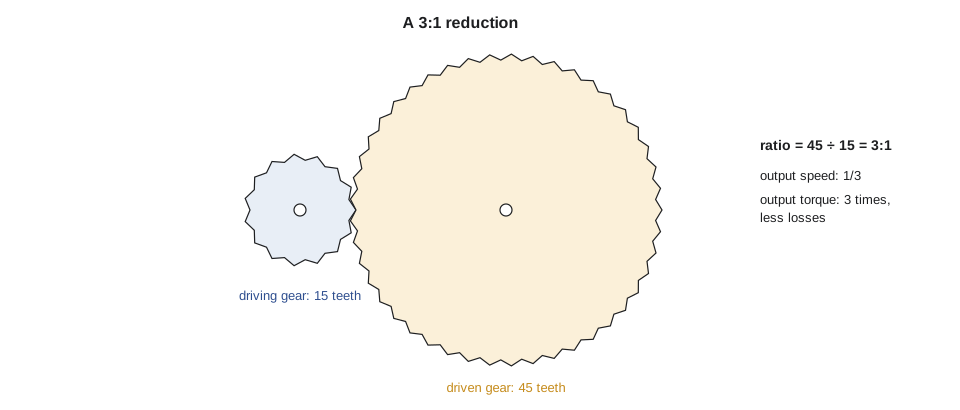
A gear ratio is the number of teeth on the driven gear divided by the number on the driving gear. A ratio greater than 1 is a reduction: the output turns slower than the input, with torque multiplied by the same ratio, less friction losses. A ratio less than 1 is an overdrive. The overall ratio in a gear is the transmission ratio times the final drive ratio. Vehicle speed follows from engine speed, the overall ratio and the tire's distance per revolution, and that relationship appears in exam questions about speedometer error after a tire size change, about engine speed at highway cruise, and about why a vehicle feels sluggish with taller tires.
# Overall ratio and road speed in each gear
import math
gears = {1: 4.696, 2: 2.985, 3: 2.146, 6: 1.000, 10: 0.636}
final = 3.42
tire_d = 31.5                 # tire diameter
rpm = 2500
for n, g in gears.items():
    overall = g * final
    wheel_rpm = rpm / overall
    speed = wheel_rpm * math.pi * tire_d * 60 / 63360
print(f"gear {n}: ratio {g:.3f}, overall {overall:5.2f}, at {rpm} rpm = {speed:5.1f} mph")gear 1: ratio 4.696, overall 16.06, at 2500 rpm = 14.6 mph gear 2: ratio 2.985, overall 10.21, at 2500 rpm = 22.9 mph gear 3: ratio 2.146, overall 7.34, at 2500 rpm = 31.9 mph gear 6: ratio 1.000, overall 3.42, at 2500 rpm = 68.5 mph gear 10: ratio 0.636, overall 2.18, at 2500 rpm = 107.7 mph
Clutches and manual transmissions
AUTO-310 lessons 3 and 4 covered these. A clutch that slips under load points to a worn disc, oil on the friction surface, a weak pressure plate or no free play in the release system holding it partly released. A clutch that drags, so gears grind and the vehicle creeps with the pedal down, points to too much free play, air in a hydraulic release system, a warped disc or a seized pilot bearing. Chatter on engagement often comes from oil or glazing on the disc or worn mounts. Dual-mass flywheels absorb engine pulses; excessive free rotation or rattle at idle shows wear.
In a manual transmission, synchronizers match the speed of the gear and the shaft before the collar engages. Grinding into one gear points to that gear's synchronizer or blocker ring; jumping out of gear points to worn engagement teeth, a weak detent or worn mounts letting the case move. Gear oil must be the specified type, because some synchronizers need a fluid that is not too slippery: GL-5 oils can harm some brass synchronizers that need GL-4.
Automatic transmissions
The torque converter couples the engine to the transmission through fluid. At stall, with the output held and the engine at full throttle, it multiplies torque, typically by about two; as speed rises it approaches a one-to-one coupling, and a converter clutch then locks it mechanically for efficiency. A stall test that reads above specification points to slipping clutches or bands; below specification, to an engine lacking power or a stator one-way clutch that freewheels. Converter clutch shudder, often at light throttle around 60 to 50 mph, is commonly a fluid problem first.
Planetary gearsets give the ratios, with clutches and bands holding or driving members. In a simple set, holding the sun and driving the ring gives a reduction out of the carrier; holding the ring and driving the sun gives a larger reduction; driving the carrier gives overdrive; holding the carrier gives reverse; locking any two members gives direct drive. The exam often gives a clutch application chart and asks which element is faulty when one gear is missing: the element used only in the missing gear is the most likely cause.
| Held | Driven | Output | Result |
|---|---|---|---|
| Sun | Ring | Carrier | Reduction |
| Ring | Sun | Carrier | Larger reduction |
| Sun | Carrier | Ring | Overdrive |
| Carrier | Sun | Ring | Reverse |
| Any two locked together | Input | Output | Direct drive, 1:1 |
Electronic control uses shift solenoids and pressure control solenoids commanded by the transmission control module, with inputs from turbine and output speed sensors, throttle position, fluid temperature and the range sensor. Modern units learn adaptive values for each shift, which is why AUTO-310 lesson 6 relearned a van after a battery disconnect. Diagnosis starts with the fluid: level checked by the maker's procedure, often at a specified temperature, and condition. Then codes, data, a road test with the scan tool, pressure tests and, last, removal.
CVTs and dual-clutch transmissions
A belt or chain CVT varies its ratio continuously by moving the halves of two variable pulleys. It needs its own fluid, with friction properties that let the belt grip; the wrong fluid causes slipping and judder. A dual-clutch transmission is two manual gearboxes in one case, each with its own clutch, one for odd gears and one for even; it preselects the next gear and shifts by swapping clutches. Dry-clutch versions can shudder when creeping in traffic, and both types need clutch adaptation relearns after repairs. A power-split hybrid's electronic CVT, reviewed in lesson 11, is a planetary set with motor-generators, not a belt.
Driveshafts, axles and differentials
Driveline vibration questions follow AUTO-310 lesson 9 and AUTO-210 lesson 9. A U-joint operating at an angle speeds up and slows down twice per revolution; a two-joint driveshaft cancels this when the working angles at the two ends are nearly equal and the yokes are in phase. Unequal angles, often from a pinion angle error after spring or axle work, give a vibration at twice driveshaft speed. That was the cause of the courier van's buzz in AUTO-310's capstone, traced back to shims left out during the suspension course work. Worn CV joints click on tight turns, outer joint, or clunk and vibrate under acceleration, inner joint; a torn boot is the usual start.
Differentials let the wheels on one axle turn at different speeds in turns. Ring and pinion noise that changes between drive and coast points to gear contact pattern or bearing preload; noise only in turns points to the differential's side or pinion gears. A limited-slip differential needs a friction modifier in its oil, or it chatters in tight turns. Setup questions ask about backlash, measured with a dial indicator on a ring gear tooth, and the gear contact pattern, read with marking compound.
Transfer cases and all-wheel drive
Part-time four-wheel drive locks the front and rear driveshafts together, so it must not be used on dry pavement, where the axles' different paths in turns cause wind-up, binding and tire scrub. Full-time and all-wheel-drive systems have a center differential or a coupling that allows speed differences. Electronically controlled couplings vary the torque sent to the secondary axle and depend on matched tires: a tire of different circumference makes the system see constant slip, which can overheat the coupling. That was Harold's all-wheel-drive case. Gord's transfer case would not engage because of a corroded shift motor connector, which is why the exam's first answer for an electronic shift fault is usually the electrical supply and connector, not the internal parts.
Worked problem
A tire mismatch on an AWD vehicle
One tire on an all-wheel-drive vehicle has been replaced with a new tire of 80.0 in circumference; the other three are worn to 78.8 in. What is the difference in percent, and is it a concern?
Show solution
- Difference: 80.0 − 78.8 = 1.2 in.
- Per cent: 1.2 ÷ 78.8 × 100 = about 1.5 percent.
- Many makers allow only about 0.5 percent, or a few millimeters of tread depth difference.
Answer: About 1.5 percent, well beyond typical limits. The coupling sees constant slip; the usual fixes are matching tires or shaving the new one.
Traps in this area
Drivetrain questions often give a symptom that two components could cause and a condition that separates them: in all gears or only one, on drive or on coast, straight or turning, hot or cold. The most common trap is skipping the fluid check on automatic transmissions; the exam's first step is almost always the fluid level and condition. The second is driveline vibration: decide its order, once or twice per revolution of what, before choosing a cause.
More practice in this area
Worked problem
A clutch question
A vehicle with a hydraulic clutch grinds when shifted into reverse and creeps forward at a stop in first gear with the pedal fully down. The fluid reservoir is full. What should be checked first?
Show solution
- Grinding into gear and creeping with the pedal down both mean the clutch is not fully releasing: drag.
- With the reservoir full, a leak is less likely, but air in the system or a worn master or slave cylinder can still shorten the release travel.
- Mechanical causes include a warped disc, a disc binding on its splines or a seized pilot bearing.
Answer: Check the release travel at the slave cylinder and bleed the system. If the travel is correct, the cause is inside the bell housing.
Worked problem
A shift complaint question
An electronically controlled automatic shifts late and harshly from first to second after the battery was disconnected for a repair. There are no codes and the fluid is correct. What is most likely?
Show solution
- The battery disconnect has erased the adaptive shift values on many transmissions.
- With no codes and good fluid, a mechanical or solenoid fault is less likely.
- Many makers specify a relearn, by scan tool or a defined drive cycle.
Answer: Lost adaptive values. Run the maker's relearn before diagnosing further. That was courier van 3 in AUTO-310.
Worked problem
A driveline vibration question
A rear-wheel-drive van has a vibration that starts at about 50 mph and grows with speed, felt in the floor, after its rear springs were replaced. Wheel balance is good. The driveshaft turns about 2,900 rpm at that speed. What frequency would a U-joint angle problem produce, and what should be checked?
Show solution
- Driveshaft speed: 2,900 rpm ÷ 60 = about 48 revolutions per second.
- A U-joint working-angle problem produces a vibration at twice driveshaft speed: about 97 Hz.
- Spring replacement can change the pinion angle if shims or the spring seats were changed.
Answer: About 97 Hz, a second-order driveshaft vibration. Measure the working angles at both ends of the driveshaft and correct the pinion angle.
Differential and transfer case questions often test fluids. A limited-slip axle needs its friction modifier; a transfer case may need automatic transmission fluid or a specific transfer case fluid, not gear oil; electronically controlled couplings use their own fluid, and the wrong one causes binding or noise. When the stem mentions recent service, the fluid used is often the clue.
Kiran's drivetrain errors were split between knowledge gaps on clutch pack and band application, which she fixed by drawing the application chart for a common six-speed from memory every Sunday until she could do it without looking, and reasoning errors on vibration, which she fixed by always working out the order of a vibration before choosing a cause. Marty's shortcut was to ask what turns at the speed of the vibration: the tires and wheels once per wheel revolution, the driveshaft once or twice per driveshaft revolution, and the engine with its firing pulses. Match the frequency to the part that turns at it, and most vibration questions answer themselves.
Manual transmission questions on both exams also ask about shift linkage and cables, which can cause hard shifting or a lever that will not reach a gear, and about the clutch interlock switch that stops the engine cranking unless the pedal is down. A no-crank complaint on a manual vehicle that is fixed by pressing the pedal harder points to that switch or its adjustment, not to the starter.
Common mistakes
MistakeCalling any automatic transmission complaint internal before checking the fluid.
InsteadCheck level by the maker's procedure and condition first.
MistakeUsing GL-5 gear oil where GL-4 is specified.
InsteadFollow the maker's specification; some synchronizers need GL-4.
MistakeRunning part-time 4WD on dry pavement.
InsteadIt causes wind-up and binding; use it only on loose or slippery surfaces.
MistakeIgnoring pinion angle after suspension work.
InsteadUnequal U-joint angles cause a vibration at twice driveshaft speed.
MistakeForgetting relearns after transmission or clutch work.
InsteadRun the adaptive or clutch relearn the maker specifies.
Summary and key terms
- Gear ratio is driven teeth over driving teeth; the overall ratio is the gear ratio times the final drive.
- Clutch slip, drag and chatter each have a short list of causes; synchronizers explain grinding into one gear.
- Torque converters multiply torque at stall and lock up for efficiency; shudder is often a fluid problem.
- Planetary sets give reduction, overdrive, reverse or direct drive depending on what is held and driven.
- CVTs and dual-clutch units need their own fluids and relearns.
- Driveline vibration depends on U-joint angles; AWD couplings need matched tires.
- Overall ratio
- The transmission gear ratio multiplied by the final drive ratio.
- Stall test
- A test of converter and transmission holding ability at full throttle with the output held.
- Synchronizer
- A device that matches the speeds of a gear and its shaft before engagement.
- Working angle
- The angle between the shafts at a U-joint.
- Wind-up
- Stress in a locked driveline when the axles must travel different distances.
Practice problems
Work each problem on paper first, then reveal the answer to check.
A transmission has a 2.15:1 third gear and a 3.42:1 final drive. What is the overall ratio?
Show answer
2.15 × 3.42 = about 7.35:1.
Technician A says a stall speed above specification points to slipping clutches. Technician B says it points to a weak engine. Who is right?
Show answer
Technician A only; a low stall speed suggests a weak engine or a stator fault.
A vehicle vibrates at twice driveshaft speed after rear spring replacement. What should be checked?
Show answer
The pinion and U-joint working angles.
Why must a limited-slip differential get the right oil?
Show answer
It needs a friction modifier; without it the clutches chatter in turns.
Lesson quiz · 5 questions
Score 60% or more to complete this lesson.
Create a free account to save your progress, take quizzes and earn a certificate.