
AUTO-430 · Lesson 11 of 12 · 25 min
Hybrid, EV and driver assistance review
The newest material in the program was also the area where the study group had the most hands-on experience, because Ridgeline had spent two years learning it with real customers: Ines's power-split hybrid, Dr. Singh's electric car, Hal's trial electric van and the calibration area beside the alignment rack. Even so, Kiran's practice set on high-voltage safety had one wrong answer that bothered her more than any other: she had chosen to remove the service disconnect before putting on her insulated gloves. "That one isn't about marks," Marty said. "That one is about going home."
Hybrid and electric vehicle and driver assistance topics are not separate tests in the A1 to A8 series, but they appear throughout A6, A5, A4 and A8, and ASE offers advanced specialist tests for them: L3, light duty hybrid and electric vehicle specialist, and L4, advanced driver assistance systems specialist, introduced in 2022 and since revised. ASE also offers xEV safety certifications at two levels. Kiran planned to take L3 the year after finishing A1 to A8.
The review follows AUTO-410 (Hybrid and Electric Vehicles) and AUTO-420 (Driver Assistance Systems).
High-voltage safety
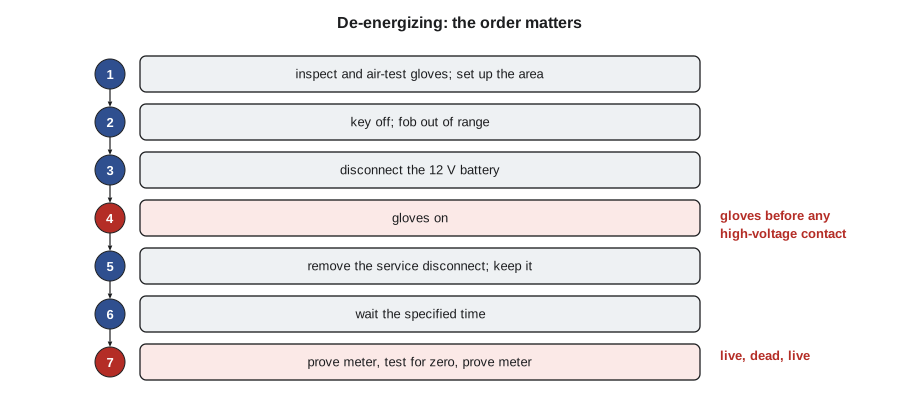
AUTO-410 lessons 2 and 3 set the rules, and the exam's correct answers follow them exactly. Only trained, qualified technicians work on high-voltage systems. Before work, inspect and air-test the class 0 rubber insulating gloves, which are rated for 1,000 V and worn with leather protectors; use insulated tools, a CAT III rated meter and a non-conductive rescue hook nearby; set up the work area with barriers and signs; and have a second trained person as an observer. Then follow the maker's de-energizing procedure: key off and the key fob out of range, 12 V battery disconnected, gloves on before touching any high-voltage component, service disconnect removed and kept in your pocket, wait the specified time for capacitors to discharge, then verify zero voltage at the specified points with the meter tested on a known source before and after: live, dead, live.
Orange cables carry high voltage on every maker's vehicles. Never cut, pierce or probe an orange cable or connector except at the maker's specified test points. Never bypass an interlock or open a battery pack outside the maker's procedure. A damaged battery that is hot, venting, swollen or smoking is a fire risk that may reignite hours later; it is isolated outdoors and handled by the maker's or the fire service's procedure.
# Insulation resistance check against a common ohms-per-volt limit
pack_v = 650
limit_ohm_per_v = 500           # a common AC-circuit limit; DC-only circuits often use 100
readings = {"pack to chassis": 2.40e6, "inverter cables": 1.10e6, "electric compressor": 0.21e6}
minimum = pack_v * limit_ohm_per_v
print(f"pack {pack_v} V x {limit_ohm_per_v} ohm/V = minimum {minimum / 1e6:.2f} megohms")
for part, r in readings.items():
print(f"{part:<20}{r / 1e6:5.2f} megohms {'pass' if r >= minimum else 'below limit: isolate and test further'}")pack 650 V x 500 ohm/V = minimum 0.33 megohms pack to chassis 2.40 megohms pass inverter cables 1.10 megohms pass electric compressor 0.21 megohms below limit: isolate and test further
Hybrid architectures and batteries
A series hybrid drives the wheels only with the electric motor, using the engine as a generator. A parallel hybrid can drive with the engine, the motor or both through a common transmission. A power-split hybrid, like Ines's, uses a planetary gearset to divide engine power between the wheels and a generator, so the engine speed can be set independently of road speed; it acts as an electronic CVT. Plug-in hybrids have larger batteries charged from the grid. A common exam reasoning point, from AUTO-410 lesson 4: a power-split hybrid's engine runs at a stop in cold weather to heat the cabin, the catalyst or the battery, and that is normal.
Battery packs are built of cells in series to raise voltage and in parallel to raise capacity. A pack described as 96s has 96 cells or cell groups in series; at a nominal 3.7 V each, it is about 355 V. Energy is voltage times capacity: a 355 V pack of 150 Ah stores about 53 kWh. Lithium iron phosphate cells, used in Hal's trial van, have a lower nominal voltage of about 3.2 V but long life. The battery management system monitors each cell's voltage and temperature, balances cells, limits charge and discharge power, and controls cooling and heating. Cold batteries accept less charge, which is why regeneration weakens and fast charging slows on cold mornings, and why Dr. Singh's car needed preconditioning before fast charging.
# Battery pack voltage, energy and fast-charge time (illustrative)
cells_series, cell_v, cell_ah = 96, 3.7, 150
pack_v = cells_series * cell_v
kwh = pack_v * cell_ah / 1000
print(f"{cells_series}s at {cell_v} V = {pack_v:.0f} V nominal; {cell_ah} Ah = {kwh:.1f} kWh")
usable = 0.92 * kwh
charger_kw, eff = 120, 0.92
print(f"10 to 80% of usable: {0.7 * usable:.1f} kWh at {charger_kw} kW peak")
print(f"about {0.7 * usable / (charger_kw * 0.75 * eff) * 60:.0f} min with taper (75% average of peak)")
print(f"at 29 kWh per 100 mi that is about {usable / 29 * 100:.0f} mi of range")96s at 3.7 V = 355 V nominal; 150 Ah = 53.3 kWh 10 to 80% of usable: 34.3 kWh at 120 kW peak about 25 min with taper (75% average of peak) at 29 kWh per 100 mi that is about 169 mi of range
Motors, inverters, regeneration and charging
Most electric drive motors are permanent-magnet synchronous motors, with some induction motors. The inverter converts the pack's DC to three-phase AC at the frequency that sets motor speed, and runs the conversion backwards during regeneration. A DC-DC converter replaces the alternator, charging the 12 V battery from the pack, and the 12 V battery still powers the modules and contactors, so a weak 12 V battery can stop an electric vehicle from becoming ready. That is the most common no-ready cause and a favorite exam answer.
Charging levels: Level 1 uses a standard household outlet and is slow; Level 2 uses a 208 to 240 V circuit and an onboard charger, typically 7 to 11 kW in North America; DC fast charging bypasses the onboard charger and feeds the pack directly. North American connectors are moving from CCS1 to the SAE J3400 connector, originally Tesla's. The charging station and vehicle communicate through the pilot signal before power flows; a station that will not start charging is often a pilot or proximity circuit problem, a damaged inlet or a temperature limit, not the battery.
Driver assistance systems
AUTO-420 covered cameras, radar, ultrasonic sensors and lidar, and the features they support: adaptive cruise, automatic emergency braking, lane keeping, blind spot and cross-traffic alert, parking assist and surround view. The exam questions here are mostly about when calibration is needed and in what order the work is done. Calibration is needed whenever a sensor's position or view relative to the vehicle's thrust line may have changed: windshield replacement for a forward camera, bumper or grille repairs and impacts for radars, alignment or ride height changes for both, suspension work and, on many vehicles, a steering angle sensor reset after any steering work.
The order is fixed: repair the mechanical faults, set ride height and tire pressures, perform the alignment, calibrate the steering angle sensor, then calibrate the driver assistance sensors, then road test and post-scan. Calibrating a camera before the alignment, or aligning to hide a bent part, gives a calibration that is wrong as soon as the geometry is corrected. AUTO-420's capstone, with its bent tie rod and its mispositioned glass bracket, was the example of both.
# How far a small aiming error moves a sensor's view at distance
import math
for dist in (165, 330, 490):
    for err in (0.5, 1.0, 2.0):
        off = dist * math.tan(math.radians(err))
print(f"at {dist:3} ft, a {err:.1f} degree error = {off:4.1f} ft to the side")at 165 ft, a 0.5 degree error = 1.4 ft to the side at 165 ft, a 1.0 degree error = 2.9 ft to the side at 165 ft, a 2.0 degree error = 5.8 ft to the side at 330 ft, a 0.5 degree error = 2.9 ft to the side at 330 ft, a 1.0 degree error = 5.8 ft to the side at 330 ft, a 2.0 degree error = 11.5 ft to the side at 490 ft, a 0.5 degree error = 4.3 ft to the side at 490 ft, a 1.0 degree error = 8.6 ft to the side at 490 ft, a 2.0 degree error = 17.1 ft to the side
Worked problem
A calibration order question
A vehicle with a forward camera and a forward radar comes in after a minor front collision: a new bumper cover, a replaced lower control arm, and a cracked windshield that will be replaced. In what order should the work be done?
Show solution
- Mechanical repairs first: control arm, bumper cover and radar bracket inspection.
- Windshield replacement, with glass meeting the maker's specification.
- Ride height and tire pressures, then a four-wheel alignment.
- Steering angle sensor calibration.
- Forward camera and radar calibrations by the maker's procedure.
- Post-scan and a road test to confirm the features work.
Answer: Repairs, glass, alignment, steering angle sensor, sensor calibrations, then verification. Any calibration done before the alignment would have to be repeated.
Traps in this area
Safety questions in this block give options that are almost right in the wrong order, and the order is the answer: gloves on before the service disconnect, verify the meter before and after the zero-voltage test. Calibration questions do the same with the repair order. And many electric vehicle faults that look high-voltage are 12 V faults: check the small battery first.
More practice in this area
Worked problem
A charging question
An electric vehicle's DC fast charging stops at about 40 kW on a cold morning even though the station is rated at 150 kW. The car was parked outside overnight and not preconditioned. What is most likely?
Show solution
- The battery management system limits charging power when the cells are cold, to protect them.
- Preconditioning warms the pack on the way to the charger.
- A station or connector fault usually stops charging or shows an error rather than holding a steady low power.
Answer: Normal cold limiting. Precondition before fast charging; diagnose only if the limit continues with a warm pack.
Worked problem
An isolation fault question
A hybrid sets an isolation fault after an outside shop recharged its A/C system. The insulation resistance of the electric compressor circuit reads low. What is the most likely cause?
Show solution
- The electric compressor's windings sit in the refrigerant and oil.
- Electric compressors need an oil with high electrical insulation.
- Adding the wrong oil lowers the insulation between the windings and the case.
Answer: The wrong oil added to the electric compressor, as in Ines's case in AUTO-410. The fix follows the maker's procedure, often flushing the oil or replacing the compressor.
Worked problem
A calibration question
Technician A says a forward radar should be calibrated after its bracket is replaced, even if no warning is shown. Technician B says a camera calibration is not needed after a windshield replacement if the camera has no codes. Who is right?
Show solution
- A new bracket can change the radar's aim slightly, and the system may not detect a small error: A is right.
- Many cameras do not set a code after glass replacement, yet the camera's view through the new glass and its mounting may have changed; makers require calibration after replacement: B is wrong.
Answer: Technician A only. Absence of a code is not proof of correct aim.
Hybrid questions often concern the engine's behavior. A power-split hybrid's engine starting and stopping on its own is normal, and the engine may run at a stop when the battery is low, the catalyst is cold or the cabin needs heat. Service needs a maintenance mode to keep the engine running for tests such as an exhaust gas check or an oil leak inspection, and the maker's procedure for entering it is part of what the exam expects you to look up.
Driver assistance questions also cover the shop environment for calibration: a level floor, the specified space in front of the vehicle, even lighting without reflections, the vehicle at its correct ride height with a full fuel tank or a specified load, and the battery supported by a maintainer during the procedure. A failed calibration is often a setup problem rather than a sensor problem, which is why AUTO-420 spent a whole lesson on the calibration area before the first calibration was attempted.
Common mistakes
MistakeRemoving the service disconnect before putting on insulated gloves.
InsteadGloves go on before any high-voltage component is touched.
MistakeTesting for zero voltage without proving the meter.
InsteadTest on a known source before and after: live, dead, live.
MistakeDiagnosing a no-ready EV starting at the pack.
InsteadCheck the 12 V battery and its connections first.
MistakeCalibrating the camera before the alignment.
InsteadAlign, calibrate the steering angle sensor, then calibrate the sensors.
MistakeProbing orange cables anywhere convenient.
InsteadUse only the maker's specified test points.
Summary and key terms
- High-voltage work needs training, class 0 gloves with protectors, insulated tools, a rated meter, an observer and the maker's procedure.
- De-energize in order and verify zero voltage live, dead, live.
- Series, parallel and power-split hybrids differ in how engine and motor share the work.
- Pack voltage comes from cells in series; energy is voltage times capacity; cold limits charge and regeneration.
- Inverters run the motor and regeneration; a DC-DC converter charges the 12 V battery, which still matters.
- Calibrate driver assistance sensors after repairs that can move them, in the right order.
- Service disconnect
- A removable plug that breaks the high-voltage battery circuit for service.
- Class 0 gloves
- Rubber insulating gloves rated for 1,000 V, used with leather protectors.
- Inverter
- The unit that converts DC to three-phase AC for the motor and back during regeneration.
- DC-DC converter
- The unit that charges the 12 V battery from the high-voltage pack.
- Thrust line
- The direction the rear axle points the vehicle, the reference for sensor calibration.
Practice problems
Work each problem on paper first, then reveal the answer to check.
A pack has 108 cells in series at 3.65 V. What is its nominal voltage?
Show answer
About 394 V.
Technician A says insulated gloves must be air-tested before use. Technician B says the service disconnect can be removed before the gloves are on if the key is off. Who is right?
Show answer
Technician A only.
An electric vehicle will not become ready, and the instrument cluster flickers. What is the first check?
Show answer
The 12 V battery and its connections.
Why is the forward camera calibrated after the alignment?
Show answer
The calibration references the thrust line, which the alignment can change.
Lesson quiz · 5 questions
Score 60% or more to complete this lesson.
Create a free account to save your progress, take quizzes and earn a certificate.