
AUTO-430 · Lesson 6 of 12 · 25 min
Brakes review
Brakes are the topic most technicians think they know best, which is why Marty started the session with a question nobody got right on the first try: a vehicle's pedal slowly sinks to the floor under steady pressure at a stop, but there is no external leak and the fluid level has not dropped. What is it? Theo said a caliper; Kiran said air. The answer, a master cylinder bypassing internally, past its primary cup, sent them both back to AUTO-130 lesson 3. Brakes are full of questions where the obvious answer is a part you can see and the right one is inside something.
Brakes, A5, has 45 scored questions on hydraulic systems, drum brakes, disc brakes, power assist, wheel bearings and parking brakes, and electronic brake control systems such as ABS, traction and stability control.
The review follows AUTO-130 (Brake Systems), with the regenerative braking material from AUTO-410.
Hydraulics and leverage
Brake questions begin with physics. The pedal is a lever: a pedal ratio of 4:1 turns 65 lb of driver force into 260 lb on the pushrod. The booster multiplies that further. In the master cylinder, the force divided by the piston's area gives the line pressure, and Pascal's law sends the same pressure to every caliper and wheel cylinder. Each caliper piston turns that pressure back into force, multiplied by its larger area. A smaller master cylinder bore gives more pressure for the same force, with a longer pedal stroke; a larger caliper piston gives more clamp force from the same pressure.
# From pedal to caliper: force, pressure and clamp force
import math
pedal_force = 65
pedal_ratio = 4.0
boost = 3.5
mc_bore = 1.0
cal_bore = 2.125
push = pedal_force * pedal_ratio * boost
pressure = push / (math.pi / 4 * mc_bore ** 2)
clamp = pressure * (math.pi / 4 * cal_bore ** 2)
print(f"pushrod force with booster: {push:,.0f} lb")
print(f"line pressure: {pressure:,.0f} psi")
print(f"clamp force from one 2.125 in caliper piston: {clamp:,.0f} lb")pushrod force with booster: 910 lb line pressure: 1,159 psi clamp force from one 2.125 in caliper piston: 4,109 lb
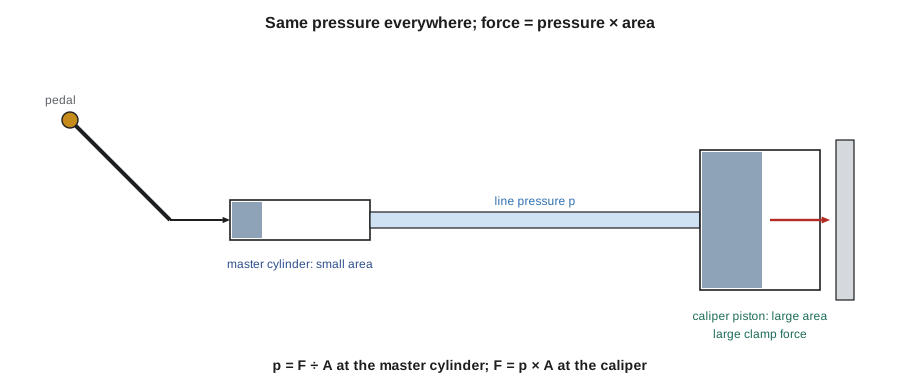
Dual-circuit systems split the hydraulics so that a leak in one circuit leaves the other working. Split systems are either front and rear or diagonal, each circuit serving one front and the opposite rear wheel. A pedal that goes lower than normal but still stops the car, with a warning light, means one circuit has failed. Proportioning, now usually done electronically by the ABS module as electronic brake force distribution, limits rear pressure so the rear wheels do not lock first.
Fluid, bleeding and pedal complaints
Brake fluid absorbs water from the air, which lowers its boiling point; boiled fluid makes vapor, which compresses, giving a soft pedal after hard use. DOT 3, DOT 4 and DOT 5.1 are glycol based and can be mixed in an emergency; DOT 5 is silicone based, does not absorb water and must not be mixed with the others. AUTO-130 lesson 4 covered testing fluid by boiling point or moisture content and flushing it on schedule. Bleeding usually starts at the wheel farthest from the master cylinder, unless the maker specifies otherwise, and ABS units often need a scan-tool-commanded bleed to clear air from the modulator.
| Pedal complaint | Most likely causes |
|---|---|
| Spongy pedal | Air in the fluid, boiled fluid, flexing hoses |
| Low pedal, firm | Rear drums out of adjustment, worn pads, one circuit failed |
| Pedal slowly sinks, no external leak | Master cylinder bypassing internally |
| Hard pedal, poor stopping | Booster failure: no vacuum, failed check valve or diaphragm, or electric booster fault |
| Pulsation | Rotor thickness variation from runout or deposits; on drums, out-of-round drums |
| Pull to one side when braking | Seized caliper or slide pins, contaminated pads, restricted hose, uneven friction |
Disc and drum brakes
Disc brake questions cover pads, calipers and rotors. Floating calipers slide on pins, and seized pins cause uneven pad wear, a pull and dragging. Pad wear indicators squeal at a set thickness. Rotors are measured for thickness, minimum thickness being stamped on the rotor, for thickness variation, or parallelism, and for lateral runout with a dial indicator. AUTO-130 lesson 7 showed that most pulsation comes from thickness variation that grows from runout, often caused by wheel nuts tightened unevenly or the hub face not cleaned. Ines's runout after an outside shop over-tightened her wheel nuts was the example.
Drum brakes use shoes pushed out by a wheel cylinder. A self-energizing design wraps the leading shoe into the drum for more force; self-adjusters keep clearance correct, usually working in reverse or with parking brake application. A drum is measured for its maximum diameter, stamped on the drum, and for out-of-round. Rear drums that are out of adjustment give a low pedal and a parking brake that pulls up too far. Electronic parking brakes on disc systems, reviewed in AUTO-130 lesson 9, have motors on the calipers and need the scan tool to retract the pistons for pad service.
Worked problem
A rotor measurement question
A front rotor's minimum thickness is 1.024 in. Measurements around it read 1.040, 1.039, 1.039, 1.040, 1.038 and 1.039 in. Lateral runout on the vehicle is 0.001 in. Can it be reused, and what is its thickness variation?
Show solution
- Thinnest reading: 1.038 in, above the minimum.
- Thickness variation: 1.040 − 1.038 = 0.002 in.
- A typical maker limit for thickness variation is around 0.0005 to 0.001 in.
- Runout is within typical limits.
Answer: It is above minimum thickness but its thickness variation is over a typical limit, so it should be machined if the result stays above the discard specification, or replaced, and the cause of the variation found.
ABS, traction and stability control
ABS uses wheel speed sensors to detect a wheel slowing faster than the vehicle, then the hydraulic modulator holds, releases and reapplies pressure to that wheel several times a second. The driver feels pulsation in the pedal; that is normal. Traction control uses the same modulator to brake a spinning drive wheel and asks the engine to reduce power. Stability control adds a steering angle sensor, a yaw rate sensor and lateral acceleration sensing, and brakes individual wheels to keep the vehicle going where the driver steers. Faults usually begin at the wheel speed sensors: a damaged tone ring, a rusted sensor out of position, which was courier van 3's case in AUTO-130, or a broken wire. The exam's first step for an ABS light is to retrieve the codes and look at wheel speed data, not to replace the modulator.
Wheel slip is the difference between vehicle speed and wheel speed, divided by vehicle speed. ABS aims to keep slip in the range where the tire grips best, around 10 to 20 percent; a locked wheel has 100 percent slip and no steering control.
Regenerative braking and brake-by-wire
Hybrids and electric vehicles slow the car first with the motor acting as a generator, which charges the battery, and blend in the friction brakes as needed. Many have brake-by-wire systems in which the pedal moves a simulator and the module decides how much regenerative and friction braking to use. Two exam points follow from AUTO-130 lesson 11 and AUTO-410 lesson 9. First, because the friction brakes do less work, rotors on these vehicles often corrode and pads seize from lack of use, as on Dr. Singh's EV; cleaning and servicing slides and using the brakes firmly when testing are part of the fix. Second, many brake-by-wire systems can apply the brakes on their own, when a door opens or the system wakes, so the maker's service mode must be set before working on the hydraulics, or the system can push a piston out with a technician's hand in the way.
Traps in this area
Brake questions reward knowing what is normal: ABS pedal pulsation during a stop on ice is normal, a pedal that drops slightly after starting the engine is normal power assist, regeneration that weakens on a cold morning is normal battery limiting. They also reward thinking about what is shared: two front brakes pulling equally do not cause a pull, and a fault in the circuit both share does not cause a side-to-side difference.
More practice in this area
Worked problem
A booster question
A vehicle with a vacuum booster has a hard pedal and long stopping distances. With the engine off, the technician pumps the pedal to remove the reserve, holds light pressure on the pedal and starts the engine. The pedal does not drop. What does this mean, and what is checked next?
Show solution
- With a working booster, the pedal drops slightly when the engine starts, because vacuum begins to assist.
- No drop means the booster is getting no vacuum or is not working.
- Check the vacuum supply at the booster first: the hose, the check valve and engine vacuum. If vacuum is good, the booster's diaphragm or valve has failed.
Answer: The booster is not assisting. Test the vacuum supply and check valve before condemning the booster.
Worked problem
A drum brake question
Technician A says a parking brake lever that pulls up too far on a vehicle with rear drums usually means the shoes are out of adjustment. Technician B says the parking brake cable should be tightened first to correct it. Who is right?
Show solution
- Rear shoes that have not self-adjusted leave extra clearance, so the parking brake must move further: A is right.
- Tightening the cable first hides the real problem and can leave the shoes dragging after they are adjusted; the shoes are adjusted first, then the cable if needed: B is wrong.
Answer: Technician A only. The order of adjustments is a common test point.
Worked problem
A hydraulics calculation
A master cylinder piston has an area of 0.78 sq in. The pushrod force is 560 lb. Each front caliper has one piston of 3.4 sq in. What is the line pressure and the clamp force at one front caliper?
Show solution
- Line pressure: 560 ÷ 0.78 = about 718 psi.
- Clamp force: 718 × 3.4 = about 2,440 lb.
- The same pressure acts everywhere in the circuit; only the area changes the force.
Answer: About 718 psi and 2,440 lb.
Stability control questions often describe a warning that comes on only during turns or on rough roads. Those conditions point to the sensors the system compares: a steering angle sensor that needs calibration after an alignment, a yaw rate sensor whose mounting has loosened, or a wheel speed signal that drops out over bumps because of a damaged sensor or wiring. The scan tool's data for each sensor during a road test, compared with what the vehicle is actually doing, finds it.
Kiran's error log in brakes had one recurring entry: questions where she picked the part she could see. The cure was the same question each time: which component could cause this without anything visible?
Electronic parking brakes add their own questions. A rear caliper with a motor-driven parking mechanism must be put in service mode with the scan tool before the pads are changed, so the motor retracts the piston; forcing the piston back with a tool damages the mechanism. After the work, the system is cycled and often calibrated. A parking brake warning after a battery replacement may mean the system needs its initialization routine, which the service information describes.
Wheel bearings and hubs are part of the brake test on the ASE side and of block F on the Red Seal side. Questions ask how to check end play with a dial indicator, why a hub bearing's mounting surface must be clean before the rotor goes on, and why wheel nuts are tightened in a star pattern to the specified torque with a torque wrench, not an impact wrench. Uneven wheel nut torque distorts the rotor hat, which leads to runout, thickness variation and eventually pulsation, the chain of cause and effect that Ines's car showed in AUTO-130.
Common mistakes
MistakeReplacing a caliper for a slowly sinking pedal with no leak.
InsteadA master cylinder bypassing internally is the usual cause.
MistakeMixing DOT 5 silicone fluid with glycol fluids.
InsteadNever mix them; DOT 3, 4 and 5.1 are compatible with each other.
MistakeMachining a rotor without finding the runout cause.
InsteadClean the hub face and torque the wheel nuts evenly, or the variation returns.
MistakeCondemning the ABS modulator first for an ABS light.
InsteadRead codes and wheel speed data; sensors and tone rings fail far more often.
MistakeWorking on a brake-by-wire hydraulic system without service mode.
InsteadSet the maker's service mode so the system cannot self-apply.
Summary and key terms
- Pedal ratio, booster and master cylinder area set line pressure; caliper area turns pressure into clamp force.
- Dual circuits keep half the brakes working after a leak; electronic distribution manages rear pressure.
- Brake fluid absorbs water and loses boiling point; DOT 5 silicone does not mix with the others.
- Rotor thickness variation causes pulsation; runout causes the variation; minimum thickness is stamped on the part.
- ABS, traction and stability control use wheel speed, steering angle and yaw data; sensors fail most often.
- Hybrids and EVs blend regenerative and friction braking; their friction parts corrode from underuse; brake-by-wire needs service mode.
- Pascal's law
- Pressure applied to a confined fluid is transmitted equally in all directions.
- Pedal ratio
- The lever ratio of the brake pedal from pad to pushrod.
- Thickness variation
- The difference between the thickest and thinnest points of a rotor.
- Wheel slip
- The difference between vehicle speed and wheel speed as a percentage of vehicle speed.
- Brake-by-wire
- A system in which the pedal sends a command and the module decides how to apply the brakes.
Practice problems
Work each problem on paper first, then reveal the answer to check.
A master cylinder piston has 1 sq in area and a 200 lb pushrod force. What is the line pressure?
Show answer
In inch units: a 200 lb pushrod force on a 1 sq in piston gives 200 psi.
Technician A says DOT 4 fluid can be mixed with DOT 5.1. Technician B says DOT 5 can be added to a DOT 3 system. Who is right?
Show answer
Technician A only.
A vehicle pulls left only when braking. Name two likely causes.
Show answer
A seized right caliper or slide pins, or contaminated pads, or a restricted right hose; the left brake doing more than the right.
Why do rotors corrode faster on electric vehicles?
Show answer
Regenerative braking does most of the stopping, so the friction brakes are rarely used firmly.
Lesson quiz · 5 questions
Score 60% or more to complete this lesson.
Create a free account to save your progress, take quizzes and earn a certificate.