
AUTO-430 · Lesson 7 of 12 · 25 min
Suspension, steering and alignment review
For the suspension session, Marty wrote three numbers on the whiteboard: camber, caster, toe. "If you can tell me what each one does to tire wear, to pull and to steering feel, you have half the alignment questions. The other half are about which parts you check before you touch an adjustment." Kiran's practice sets on this block were her best, because the year of potholes in AUTO-210 had put most of the shop's regular customers on the alignment rack. Theo's were his worst, because he knew tires inside out but had never run the rack himself.
Suspension and Steering, A4, has 40 scored questions on steering systems, suspension systems, wheel alignment diagnosis, adjustment and repair, and wheels and tires.
The review follows AUTO-210 (Suspension, Steering and Alignment), with tire basics from AUTO-110 lesson 9.
Springs, dampers and suspension designs
Springs carry the vehicle's weight and set its ride height; dampers, commonly called shocks and struts, control how fast the springs move. A sagging spring lowers ride height, changes alignment angles and can make the vehicle bottom out; it is diagnosed by measuring ride height at the maker's points, not by eye. Worn dampers let the body bounce more than once after a push, let the tires lose contact on rough roads and cause cupped tire wear. A MacPherson strut combines the damper with the steering pivot and carries the spring; short-and-long-arm designs use two control arms of unequal length to control camber as the wheel moves. Multi-link rear suspensions use several links to control toe and camber separately.
Electronic and air suspension systems, from AUTO-210 lesson 5, add height sensors, a compressor and air springs or adjustable dampers. A vehicle that sinks overnight points to an air spring or line leak; a compressor that runs constantly and then shuts down on a timer points to a leak or a worn compressor, which was Harold's case. Air suspension must be put in service or jack mode before lifting, or the module tries to level the vehicle while it is on the lift.
Steering systems
Rack-and-pinion steering turns the steering wheel's rotation into side-to-side movement of tie rods. The steering ratio, the steering wheel degrees per road wheel degree, is typically between about 12:1 and 20:1. Hydraulic power steering uses a pump, a rotary valve and a piston in the rack; a whine that rises with steering effort points to low or aerated fluid or a worn pump, which was Gord's case. Electric power steering uses a motor on the column or the rack, controlled by a module using a torque sensor; it depends on the 12 V supply, so a weak battery can reduce assist and set codes, as on Dr. Singh's EV. Steering angle sensors must often be calibrated after an alignment or steering work.
Worn inner tie rods, outer tie rod ends, ball joints and control arm bushings show up as looseness during a dry park test or a pry-bar check, and as wander, clunks and uneven tire wear. A ball joint is checked with the load taken off it as the service information specifies, which depends on whether the spring sits on the lower or upper arm.
Tires, wheels and bearings
The tire size code gives the section width in millimeters, the aspect ratio as a percentage of the width, the construction, the rim diameter in inches, and the load index and speed rating. The overall diameter is the rim diameter plus twice the sidewall height, and it sets how far the vehicle travels per revolution, which affects speedometer reading, gearing and all-wheel-drive couplings. Tire wear patterns are among the most tested topics: both edges worn means underinflation, the center worn means overinflation, one edge worn means camber or toe, feathering across the tread means toe, and cupping means worn dampers or an imbalance.
# Tire size: overall diameter and revolutions per distance
import math
def tire(width, aspect, rim):
    side = width * aspect / 100            # mm
    dia = rim * 25.4 + 2 * side            # mm
    return dia
for size in [(265, 70, 17), (285, 70, 17), (215, 55, 17)]:
    w, a, r = size
    d = tire(w, a, r)
    revs = 1_609_344 / (math.pi * d)
    print(f"{w}/{a}R{r}: diameter {d / 25.4:.1f} in, {revs:.0f} revolutions per mile")
d1, d2 = tire(265, 70, 17), tire(285, 70, 17)
print(f"speedometer reads {(d2 - d1) / d1 * 100:.1f}% low after fitting 285/70R17 in place of 265/70R17")265/70R17: diameter 31.6 in, 638 revolutions per mile 285/70R17: diameter 32.7 in, 617 revolutions per mile 215/55R17: diameter 26.3 in, 767 revolutions per mile speedometer reads 3.5% low after fitting 285/70R17 in place of 265/70R17
Vibration questions sort by speed and order. A vibration that rises with road speed and is felt in the steering wheel usually comes from a front tire or wheel: imbalance, radial or lateral runout, a bent wheel, or a tire with a shifted belt. One felt in the seat usually comes from the rear. A road force balancer finds tire uniformity problems that a static balance cannot. Wheel bearings make a growl or hum that changes with speed and often changes with turning, louder when load shifts onto the bad bearing. Hub bearings with integrated wheel speed sensor rings can also set ABS codes.
Alignment angles
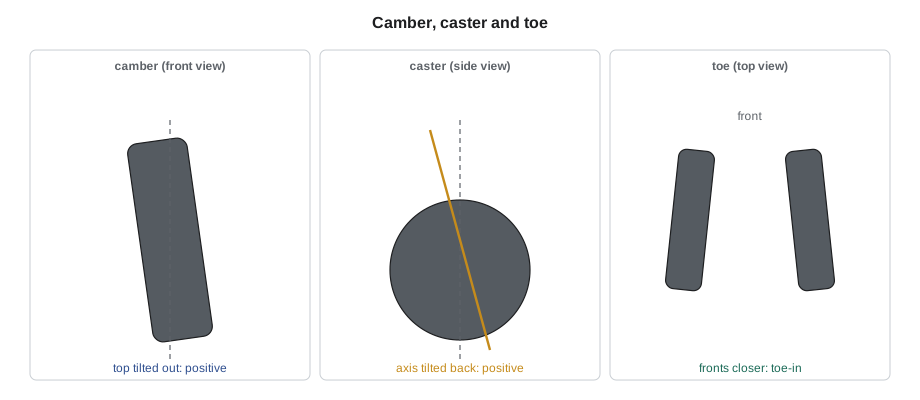
Camber is the tilt of the wheel from vertical when viewed from the front; negative camber tilts the top inward. Too much camber wears one edge of the tire, and unequal camber side to side causes a pull toward the side with more positive camber. Caster is the tilt of the steering axis viewed from the side; positive caster gives straight-line stability and steering return, and unequal caster causes a pull toward the side with less positive caster. Toe is the difference in distance between the front and the rear of the tires on an axle; toe-in points them inward. Incorrect toe is the biggest cause of tire wear, by feathering, and rear toe sets the thrust line, the direction the rear axle points the vehicle.
| Angle | Main effect when wrong | Pull? |
|---|---|---|
| Camber | Wear on one edge | Toward the more positive side |
| Caster | Stability and return; little wear | Toward the less positive side |
| Toe | Feathered wear on both tires; steering wheel off center if split | Rarely, unless the thrust angle is off |
| Thrust angle | Vehicle tracks at an angle; steering wheel off center | Vehicle dog-tracks |
| Steering axis inclination and included angle | Diagnostic: show bent parts | Not adjustable |
Steering axis inclination and the included angle are not adjustable, but they are diagnostic. AUTO-210's capstone used them: when camber is wrong and the included angle is correct, the steering knuckle is fine and something else, such as a bent control arm, has moved; when the included angle is wrong, the knuckle or strut is bent. Before any alignment, check ride height, tire pressures and sizes, and look for worn or bent parts. Adjusting toe to hide a bent tie rod, as the AUTO-420 capstone showed, leaves the steering wheel off center and the geometry wrong.
# Toe conversion between degrees and a distance across the rim
import math
rim = 27.5       # tire diameter used by the aligner for the conversion
for deg in (0.05, 0.10, 0.25, 0.42):
    dist = rim * math.tan(math.radians(deg))
print(f"toe {deg:.2f} degrees per wheel = {dist:.3f} in")toe 0.05 degrees per wheel = 0.024 in toe 0.10 degrees per wheel = 0.048 in toe 0.25 degrees per wheel = 0.120 in toe 0.42 degrees per wheel = 0.202 in
Worked problem
Which way will it pull?
A vehicle's front alignment reads camber left −0.2°, right −0.9°; caster left 4.0°, right 4.1°; total toe within specification. Which way will it pull, and why?
Show solution
- Caster is nearly equal, so it contributes little.
- Camber: the left is more positive (−0.2° compared with −0.9°), a difference of 0.7°.
- A vehicle pulls toward the side with more positive camber.
Answer: It pulls left. Before adjusting, measure the right side's included angle and inspect for a bent part, because a 0.7° difference after a pothole often means damage, not just adjustment.
Traps in this area
The commonest trap is adjusting an angle without checking what moved it. The second is mixing up the direction of a pull: camber pulls toward the more positive side, caster toward the less positive side. The third is forgetting the steps after the alignment: steering angle sensor calibration and, on vehicles with driver assistance cameras, the calibrations lesson 11 reviews.
More practice in this area
Worked problem
A steering question
A vehicle with hydraulic power steering has a whine when the steering is turned at a stop, and the fluid looks foamy. What is most likely?
Show solution
- Foam means air in the fluid.
- Air enters through a low fluid level, a loose suction hose or clamp, or a leaking pump shaft seal.
- Aerated fluid makes the pump whine and the assist uneven.
Answer: Aerated fluid from a low level or an air leak on the suction side. Find the leak, correct the level and bleed the system as the maker specifies. Gord's pickup in AUTO-210 had this pattern.
Worked problem
A vibration question
A customer reports a vibration in the steering wheel that starts at about 55 mph and fades above 70 mph. The front tires were balanced last month. What should be checked next?
Show solution
- A vibration in the steering wheel at highway speed points to the front tires and wheels.
- Balance alone does not find radial runout or a tire whose uniformity is poor.
- A road force measurement and a runout check find tire and wheel faults that a static or dynamic balance misses.
Answer: Check radial and lateral runout and road force. A shifted belt or a bent wheel is likely; matching or replacement fixes it.
Worked problem
A wheel bearing question
A hum that grows with road speed gets louder when the vehicle turns right and quieter when it turns left. Which bearing is most likely worn?
Show solution
- Turning right shifts the vehicle's weight onto the left wheels.
- A bearing that gets louder under load is the one carrying more load.
- So the noise louder in a right turn points to a left-side bearing.
Answer: A left-side wheel bearing, usually the front. Confirm on the lift by feel and with a chassis ear before replacing.
Electric power steering questions combine steering and electrical knowledge. The assist motor draws high current, so a weak battery, a poor ground or a voltage drop in the feed can reduce assist and set codes, especially at parking speeds where the demand is highest. A steering wheel that pulls to one side only with the engine running, on an electric system, can point to a torque sensor that needs calibration or has drifted.
Alignment questions also cover the equipment: compensating the sensors or targets for wheel runout, setting the vehicle at its specified ride height with the specified load, and centering and locking the steering wheel before setting toe. A careless setup gives readings that look precise and are wrong.
Ride height questions catch many candidates because they seem too simple. A vehicle that sits low at one corner after a heavy load, a towing hitch or a broken spring changes every alignment angle on that side, and the steering axis inclination and camber readings change with it. Before blaming a control arm for a camber error, the exam expects you to measure the ride height at the points the maker specifies and correct it. A vehicle with self-leveling air suspension must also be at its normal height with the engine running or the system in its alignment mode before readings are taken.
Tire questions also cover pressure monitoring. Direct systems use a sensor in each wheel, which may need relearning after a tire rotation or a sensor replacement; indirect systems compare wheel speeds through the ABS and need a reset after inflation. A pressure warning that comes on every cold morning and goes out after driving is usually a tire set close to its minimum pressure, because pressure drops with temperature by roughly 1 psi for every 10 °F.
Common mistakes
MistakeAdjusting camber without checking for bent parts.
InsteadMeasure steering axis inclination and the included angle; replace bent parts.
MistakeSaying caster pulls toward the more positive side.
InsteadCaster pulls toward the less positive side; camber toward the more positive side.
MistakeLifting an air suspension vehicle without service mode.
InsteadSet jack or service mode so the system does not try to level.
MistakeIgnoring rear toe when the steering wheel is off center.
InsteadCheck the thrust angle; set the front toe to the thrust line.
MistakeSkipping the steering angle sensor calibration.
InsteadCalibrate after alignment or steering work when the maker specifies.
Summary and key terms
- Springs set ride height; dampers control spring movement; measure ride height at the maker's points.
- Rack-and-pinion steering may be hydraulic or electric; electric assist depends on the 12 V supply.
- Tire codes give width, aspect ratio, rim size, load index and speed rating; overall diameter sets distance per revolution.
- Wear patterns diagnose inflation, camber, toe and damper problems.
- Camber pulls toward the more positive side, caster toward the less positive side; toe causes most wear.
- Check ride height, tires and parts before aligning; calibrate the steering angle sensor after.
- Camber
- The wheel's tilt from vertical seen from the front.
- Caster
- The steering axis tilt seen from the side.
- Toe
- The difference in distance between the fronts and rears of the tires on an axle.
- Thrust line
- The direction in which the rear axle points the vehicle.
- Included angle
- Steering axis inclination plus camber, used to identify bent parts.
Practice problems
Work each problem on paper first, then reveal the answer to check.
What is the overall diameter of a 265/70R17 tire?
Show answer
Sidewall 265 × 0.70 = 185.5 mm, or 7.3 in; 17 + 2 × 7.3 = about 31.6 in.
Technician A says feathered wear across the tread means incorrect toe. Technician B says wear on both edges means overinflation. Who is right?
Show answer
Technician A only; both edges worn means underinflation.
A vehicle's steering wheel is off center but it drives straight. What is likely?
Show answer
Toe set without centering the wheel, or a thrust angle the front toe was not set to.
Why must camber and included angle be read together?
Show answer
If camber is wrong and the included angle is right, a control arm or mounting has moved; if the included angle is wrong, the knuckle or strut is bent.
Lesson quiz · 5 questions
Score 60% or more to complete this lesson.
Create a free account to save your progress, take quizzes and earn a certificate.