
AUTO-430 · Lesson 8 of 12 · 25 min
Electrical and electronics review
Electrical was the block the study group feared most and needed most. On the first practice exam, the three of them together got fewer than half the network questions right. Marty did not start with networks. He drew a battery, a fuse, a switch, a bulb and a ground on the whiteboard and asked where a voltmeter would read 12 volts, where it would read zero, and where it would read something in between, with the switch closed and a corroded ground. "Every electrical question on the exam, including the network ones, is this drawing with more boxes in it."
Electrical/Electronic Systems, A6, has 50 scored questions on general electrical diagnosis, batteries, starting and charging, lighting, instruments and driver information, body electrical systems including power accessories and supplemental restraints, and networks. A6 is widely considered the hardest A-series test, and it is the one candidates most often need to retake.
The review follows AUTO-220 (Electrical and Electronic Systems), with module programming from AUTO-330 lesson 11.
Ohm's law and circuit faults
Ohm's law, voltage equals current times resistance, and the power equation, power equals voltage times current, are in every electrical question, sometimes as arithmetic and more often as reasoning. In a series circuit, the current is the same everywhere and the voltages across the loads add up to the source voltage; in a parallel circuit, each branch has the source voltage and the currents add. An open circuit stops current; a short to ground bypasses the load and usually blows the fuse; a short to power keeps a load on when it should be off; high resistance, from corrosion or a loose terminal, reduces current and makes a load dim or slow.
A voltage drop test, from AUTO-220 lesson 3, measures the voltage across part of a circuit while current flows. It is the single most useful electrical test, and the exam returns to it constantly. A good connection or a short length of wire drops very little, typically under 0.1 V per connection and under about 0.5 V across a whole side of a circuit under load; a starter cable circuit may be allowed slightly more by the maker. A reading near source voltage across a closed switch means the switch is open inside; a reading of near zero across a load that does not work means no current is flowing, so the open is elsewhere.
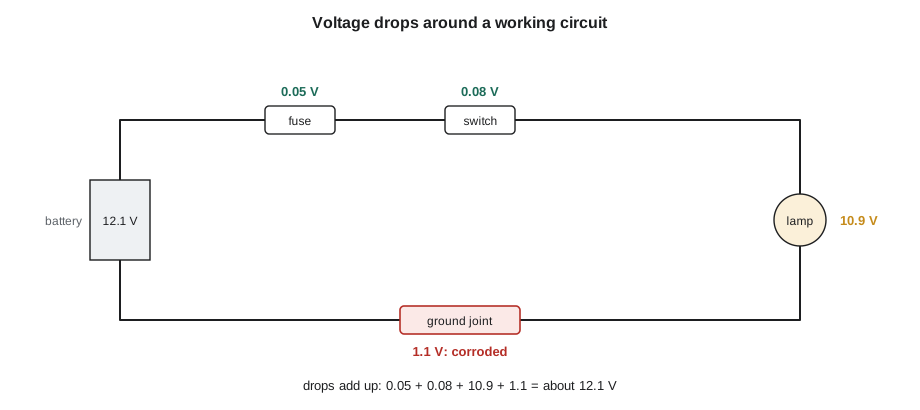
# Voltage drop survey around a lamp circuit (readings with the circuit on)
source = 12.1
drops = {"fuse": 0.05, "switch": 0.08, "power wire": 0.06, "lamp": 10.81, "ground wire and connection": 1.10}
print(f"sum of drops: {sum(drops.values()):.2f} V against source {source:.2f} V")
for part, v in drops.items():
    if part == "lamp":
        print(f"{part:<28}{v:6.2f} V  the load")
    else:
        print(f"{part:<28}{v:6.2f} V  {'too high' if v > 0.2 else 'ok'}")
lamp_r = 2.2
print(f"lamp power now about {10.81 ** 2 / lamp_r:.0f} W, against {11.9 ** 2 / lamp_r:.0f} W with a good ground")sum of drops: 12.10 V against source 12.10 V fuse 0.05 V ok switch 0.08 V ok power wire 0.06 V ok lamp 10.81 V the load ground wire and connection 1.10 V too high lamp power now about 53 W, against 64 W with a good ground
Meters and testing
A digital multimeter set to volts is connected in parallel across what is being measured; set to amps it is connected in series, in the circuit; set to ohms it must be connected to a circuit with no power. Measuring resistance through a powered circuit gives false readings and can damage the meter. A test light shows voltage but not how much; a powered test light can damage electronic circuits and must never be used on airbag or module circuits. Fused jumper leads bypass a suspect switch or wire safely. Parasitic draw, the current the vehicle uses with everything off, is measured with an ammeter or a clamp-on probe after the modules have gone to sleep; AUTO-220's capstone found a telematics box keeping the network awake. Many makers allow around 20 to 50 milliamps after the sleep time, which can be 45 minutes or more.
Batteries, starting and charging
A battery's state of charge is read from its open-circuit voltage after the surface charge is removed: about 12.6 V is fully charged and about 12.2 V is half charged for a flooded battery, slightly higher for AGM. Capacity is tested with a load test or a conductance tester. Cold cranking amps is the current a battery can deliver at 0 °F for 30 seconds while staying above 7.2 V. A replaced battery on many vehicles must be registered with the battery management system so the charging strategy matches it.
Starting system questions combine Ohm's law with voltage drop: a slow crank with a good battery points to high resistance in the cables, connections or the starter itself, found by voltage drop on the positive and ground sides while cranking, or to an engine that is hard to turn. A click with no crank points to the solenoid, its feed, or a large voltage drop. Charging system questions cover alternator output, measured under load against the rating; ripple from a failed diode, measured on AC volts or with a scope, as on courier van 1 in AUTO-220; and smart charging, where the module varies the alternator's target voltage, so a reading of 12.8 V at idle may be normal.
Worked problem
A slow-crank question
A pickup cranks slowly. The battery tests good at 12.6 V and passes a load test. While cranking, battery voltage is 10.4 V, the drop on the positive cable from the battery post to the starter terminal is 0.9 V, and the ground side from the starter case to the battery negative post is 0.15 V. What is the fault?
Show solution
- The battery is good and holds above 9.6 V while cranking.
- The ground side drop of 0.15 V is acceptable for a high-current circuit.
- The positive side drop of 0.9 V is far above a typical limit of about 0.5 V.
Answer: High resistance on the positive side: a corroded cable end, a loose terminal or a damaged cable. Gord's pickup had the same pattern in AUTO-220.
Wiring diagrams and body electrical
Exam questions often include a wiring diagram and ask where to test next or what fault matches the symptoms. Read the diagram the way AUTO-220 lesson 5 taught: find the power source and fuse, follow the path through switches and connectors to the load, then to ground, and note what else shares each fuse, connector and ground. A fault that affects several circuits at once points to what they share, usually a fuse, a ground or a module. Lighting and body questions cover headlamps and their switching, often through a body module, turn signals that flash fast when a bulb is out or when LEDs replace bulbs, power windows and locks, and instrument cluster faults that come from the network rather than the gauge.
Modules and networks
Modules communicate on networks. The controller area network, CAN, uses two twisted wires, CAN high and CAN low. A high-speed CAN bus at rest sits at about 2.5 V on both wires; when active, CAN high rises to about 3.5 V and CAN low falls to about 1.5 V. Each end of the bus has a 120 ohm terminating resistor, so with the battery disconnected, the resistance between CAN high and CAN low at the diagnostic connector should read about 60 ohms. A reading of about 120 ohms means one terminator is missing or the bus is open on one side; near zero means the wires are shorted together. LIN buses are single-wire, slower subnetworks for things like mirrors and switches, run by a master module. A gateway module routes messages between networks and, on many newer vehicles, controls scan tool access, which is why secure gateways require an authorized login.
| Reading between CAN high and CAN low, battery off | Meaning |
|---|---|
| About 60 ohms | Both terminating resistors present, bus intact |
| About 120 ohms | One terminator missing or the bus open on one side |
| Near 0 ohms | CAN high and CAN low shorted together |
| Very high or open | Both terminators missing or measured at the wrong pins |
Network diagnosis starts with a full scan to see which modules respond and which have lost communication codes. A module that does not respond while the others do points to that module's power, ground or network connection. Several modules losing communication with one point to a shared fault or a module dragging the bus down; disconnecting modules one at a time while watching the bus finds it. The minivan's damaged connector terminal after a bumper repair, and courier van 3's chafed CAN low wire in AUTO-220's capstone, were the examples.
Module programming, from AUTO-330 lesson 11, follows the maker's procedure through J2534 or the maker's tool, with a battery maintainer holding a stable voltage, a stable internet connection and the correct calibration file. Security-related functions need the technician's registered access. Programming is legitimate repair only within what the maker releases: no changes to emissions, odometer or immobilizer functions.
Traps in this area
Electrical questions love two traps. The first is static readings: a voltage reading taken with no current flowing looks perfect even with a badly corroded connection, because the corrosion only drops voltage when current flows. The second is the shared component: when several things fail together, the answer is what they share. And remember A6's reputation: read every electrical stem twice.
More practice in this area
Worked problem
A wiring diagram question
The left low beam and the left front parking lamp are both out. The right side works. Both left lamps share a ground point behind the left headlamp. What is the most likely cause, and how is it confirmed?
Show solution
- Two different circuits on the same side have failed together.
- What they share is the ground point.
- A voltage drop test across the ground with the lamps switched on would read close to source voltage if the ground is open, or a significant drop if it is high resistance.
Answer: A faulty shared ground. Confirm with a voltage drop test from the lamp ground terminal to the battery negative with the lamps on.
Worked problem
A charging question
With the engine at 2,000 rpm and all loads on, an alternator rated at 150 A produces 95 A. An AC voltage reading at the output terminal is 1.1 V. What is likely?
Show solution
- Output well below rating with all loads on suggests a fault.
- A good alternator's AC ripple is usually well under 0.5 V.
- High ripple with low output points to a failed diode or stator winding.
Answer: A failed diode or stator winding in the alternator. Confirm with a scope; replace or rebuild the alternator.
Worked problem
A parasitic draw calculation
A vehicle's battery has 70 Ah of capacity and is fully charged. Its parasitic draw after the modules sleep is 410 mA, against a limit of 50 mA. If the vehicle will no longer start at half charge, about how long can it sit?
Show solution
- Usable before a no-start: 70 × 0.5 = 35 Ah.
- At 0.41 A: 35 ÷ 0.41 = about 85 hours.
- At the 50 mA limit: 35 ÷ 0.05 = 700 hours, about a month.
Answer: About three and a half days, against about a month for a vehicle within the limit. That was courier van 3's telematics box in AUTO-220.
Network questions on the exam rarely ask you to decode a message. They ask what to measure and what the measurement means: the bus resistance with the battery off, the bus voltages with the key on, which modules respond to a scan, and what a lost communication code in one module says about another. They also test module replacement: a new module usually needs programming or configuration, and some need a security procedure to be paired with the vehicle.
Kiran's network gap closed on the training board. After two evenings measuring terminating resistance, opening and shorting the bus wires on purpose and watching which modules dropped off, the questions that had looked impossible turned into the same circuit questions as everything else: a pair of wires, two resistors and some modules that need power and ground.
Common mistakes
MistakeChecking a circuit with static voltage only.
InsteadLoad the circuit and measure voltage drops with current flowing.
MistakeMeasuring resistance in a powered circuit.
InsteadDisconnect power first; ohmmeter readings are only valid on unpowered circuits.
MistakeUsing a test light on a module or airbag circuit.
InsteadUse a high-impedance digital meter or the maker's procedure.
MistakeReading 120 ohms between CAN high and low as normal.
InsteadAbout 60 ohms is normal; 120 means one terminator is missing or the bus is open on one side.
MistakeMeasuring parasitic draw before the modules sleep.
InsteadWait for the sleep time, then measure without waking the vehicle.
Summary and key terms
- Ohm's law and voltage drops explain every circuit question; drops around a working circuit add up to the source.
- Voltmeters go in parallel, ammeters in series, ohmmeters on unpowered circuits.
- Batteries are judged by open-circuit voltage and a load or conductance test; replaced batteries may need registration.
- Slow cranking with a good battery means high resistance; smart charging can make low charging voltage normal.
- Faults that affect several circuits point to what they share.
- CAN buses read about 60 ohms with both terminators; network diagnosis starts with a full scan.
- Voltage drop
- The voltage lost across part of a circuit while current flows.
- Parasitic draw
- The current a vehicle uses with everything switched off and the modules asleep.
- Terminating resistor
- A 120 ohm resistor at each end of a CAN bus.
- Gateway module
- A module that routes messages between networks and may control diagnostic access.
- Smart charging
- A strategy in which the module varies the alternator voltage to suit conditions.
Practice problems
Work each problem on paper first, then reveal the answer to check.
A 12 V circuit draws 4 A. What is its resistance and power?
Show answer
3 ohms and 48 W.
Technician A says a voltage drop test must be done with the circuit operating. Technician B says a good ground connection drops less than about 0.1 V. Who is right?
Show answer
Both.
The resistance between CAN high and CAN low reads 120 ohms with the battery disconnected. What does it mean?
Show answer
One terminating resistor is missing or the bus is open on one side.
Turn signals flash fast on one side after LED bulbs are fitted. Why?
Show answer
The flasher sees the lower current as a burned-out bulb.
Lesson quiz · 5 questions
Score 60% or more to complete this lesson.
Create a free account to save your progress, take quizzes and earn a certificate.