
AUTO-430 · Lesson 12 of 12 · 20 min
Capstone: a full practice exam and career planning
Three weeks before her first booked test, Kiran sat the study group's full practice set on a Saturday morning in the customer lounge, with Marty as invigilator: a 50-question A5 set and a 40-question A4 set, written by the group and by Marty over the winter, weighted like the task lists and timed like the real tests, phones in the office. Theo sat the same A5 set for his first test. Bev brought coffee at the start and left them to it.
This capstone follows what Kiran did with the result: scoring by area, sorting her errors by reason, aiming her last weeks at what the result showed, the exam itself, and the plan she made for the years after certification. It brings together every lesson in the course and every course in the program.
Scoring by area
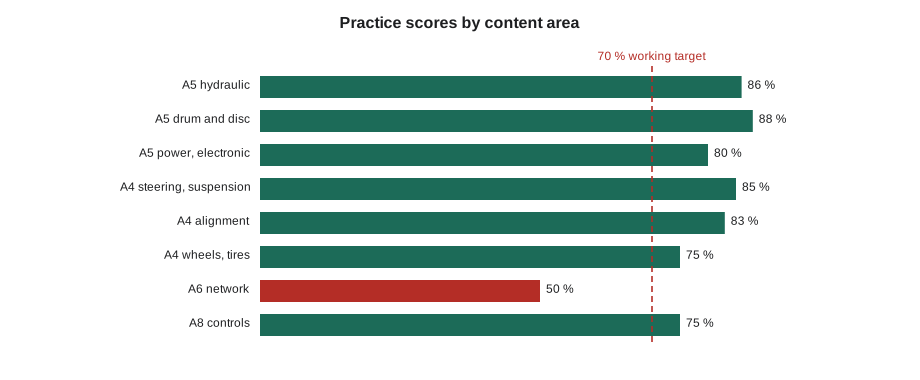
Kiran answered 42 of 50 on A5 and 33 of 40 on A4, 84 and 83 percent, both clear passes by the group's 70 percent working target. She then ran the same scoring on her earlier practice sets for A6 and A8, the tests she had booked for May. The score by content area was more useful than the totals, and one area stood out at the bottom.
| Test and content area | Questions | Correct | Per cent |
|---|---|---|---|
| A5 hydraulic system | 14 | 12 | 86 |
| A5 drum and disc brakes | 16 | 14 | 88 |
| A5 power assist and electronic brakes | 15 | 12 | 80 |
| A5 wheel bearings and parking brakes | 5 | 4 | 80 |
| A4 steering and suspension | 20 | 17 | 85 |
| A4 alignment | 12 | 10 | 83 |
| A4 wheels and tires | 8 | 6 | 75 |
| A6 practice: network communication | 8 | 4 | 50 |
| A8 practice: computerized controls | 12 | 9 | 75 |
# Score practice sets by content area and find the weakest areas
results = {"A5 hydraulic": (14, 12), "A5 drum and disc": (16, 14), "A5 power and electronic": (15, 12),
           "A4 steering and suspension": (20, 17), "A4 alignment": (12, 10), "A4 wheels and tires": (8, 6),
           "A6 network": (8, 4), "A8 computer controls": (12, 9)}
ranked = sorted(results.items(), key=lambda kv: kv[1][1] / kv[1][0])
for area, (q, c) in ranked[:3]:
    print(f"study next: {area:<28}{c}/{q} = {c / q * 100:.0f}%,  {q - c} marks available")
a5 = sum(c for k, (q, c) in results.items() if k.startswith("A5"))
print(f"A5 total {a5}/45 scored = {a5 / 45 * 100:.0f}%")study next: A6 network 4/8 = 50%, 4 marks available study next: A4 wheels and tires 6/8 = 75%, 2 marks available study next: A8 computer controls 9/12 = 75%, 3 marks available A5 total 38/45 scored = 84%
Sorting the errors
Kiran's error log for the practice exam had 21 entries. She sorted them by reason, as lesson 2 taught. Eight were knowledge gaps, five of them in network diagnosis. Seven were reasoning errors, almost all of the same kind: she had chosen a correct but unusual cause over the common one. Four were misreads, two of them missed the word except. Two were careless slips in calculations, one a unit error between kilopascals and megapascals and one a torque wrench setting where she multiplied by the adapter ratio instead of dividing.
| Reason | Count | Where | Fix for the last three weeks |
|---|---|---|---|
| Knowledge gap | 8 | Five in network diagnosis | Two evenings on CAN, gateway and network fault finding with the AUTO-220 notes and the training board |
| Reasoning error | 7 | Spread across areas | For each question, ask: what is the most common cause, and what test proves it? |
| Misread | 4 | Two missed reversing words | Second read of every stem for except, least, not, first |
| Careless slip | 2 | Units and a formula | Write units on every step; check the formula direction |
# Error log summary and the expected gain from fixing each reason
log = [("knowledge", "network")] * 5 + [("knowledge", "other")] * 3 + [("reasoning", "mixed")] * 7
log += [("misread", "mixed")] * 4 + [("slip", "calculation")] * 2
from collections import Counter
by_reason = Counter(r for r, a in log)
recover = {"knowledge": 0.6, "reasoning": 0.5, "misread": 0.9, "slip": 0.9}   # share likely recovered
gain = 0
for reason, n in by_reason.most_common():
    g = n * recover[reason]
    gain += g
    print(f"{reason:<10}{n:3}  likely recovered {g:4.1f}")
print(f"expected extra correct answers: about {gain:.0f}")knowledge 8 likely recovered 4.8 reasoning 7 likely recovered 3.5 misread 4 likely recovered 3.6 slip 2 likely recovered 1.8 expected extra correct answers: about 14
The arithmetic made the plan obvious. The misreads and slips were almost free: six marks for slowing down and writing units. The network gap was the biggest single block of lost marks and the one most likely to hurt on the real exam, where a few unlucky questions could push the area lower. And the reasoning errors needed a habit, not more facts.
The last three weeks
Kiran spent the last three weeks on three things. Two evenings went to network diagnosis on the shop's training board, measuring terminating resistance, reading CAN signals on the scope and finding a deliberately open CAN low wire that Marty had set up. Every study session ended with twenty mixed practice questions, read twice, with the most-common-cause question asked before choosing. And she wrote one last timed set of 50 questions under exam conditions a week before the exam, then stopped studying new material, reviewed her error log and her spaced-repetition cards, and slept.
# Pacing on exam day: checkpoints against the clock
for test, q, mins in (("A5", 55, 75), ("A4", 50, 60)):
    review = 10
    pace = (mins - review) * 60 / q
print(f"{test}: {pace:.0f} s per question; halfway check at question {q // 2} by {(mins - review) / 2:.0f} min")A5: 71 s per question; halfway check at question 27 by 32 min A4: 60 s per question; halfway check at question 25 by 25 min
Exam day
Kiran took A5 and A4 at a testing center on the same Saturday morning in March, using the two-pass plan from lesson 2, and passed both. Over the season she passed A6 and A8 in May, after two more evenings on network diagnosis, A1 and A7 in August, and A2 and A3 in October; A2 was her closest result, and she retook nothing. With her documented work experience accepted, she reached Master Automobile Technician status in November. Theo passed A5 and A4 by the end of the season, his first two certifications.
Planning a career
Certification is a start, not an end. The night after her result, Marty took Kiran for dinner and asked her to write down three things: what kind of work she wanted to be doing in five years, what she would need to learn for it, and what it would earn. They talked through the paths the trade offers.
| Path | What it involves | Typical next steps |
|---|---|---|
| Diagnostic specialist | Driveability, electrical and network diagnosis, programming | ASE L1 advanced engine performance |
| Electrified vehicle technician | Hybrid and electric vehicle diagnosis and high-voltage repair | ASE L3 and xEV safety certifications |
| Driver assistance and calibration | ADAS calibration, collision repair partnerships | ASE L4 |
| Dealer technician | One make in depth, warranty work, maker training | Maker certification levels |
| Shop foreman or service manager | Workflow, quality, training others, customers | Business and leadership courses |
| Shop owner | Everything, plus money and people | Business plan, financing, management experience |
| Instructor | Teaching apprentices | Instructor certification and experience |
# Comparing paths over ten years (illustrative pay index, certified technician today = 100)
paths = {"stay general": [100, 102, 104, 106, 108, 110, 112, 114, 116, 118],
         "diagnostic specialist": [100, 100, 108, 112, 116, 120, 124, 128, 132, 136],
         "EV specialist": [100, 98, 106, 112, 118, 124, 128, 132, 136, 140]}
for name, idx in paths.items():
    print(f"{name:<22} year 5: {idx[4]:3}  year 10: {idx[9]:3}  ten-year total: {sum(idx):5}")
print("BLS median for the occupation, May 2025: 50,620 USD a year")stay general year 5: 108 year 10: 118 ten-year total: 1090 diagnostic specialist year 5: 116 year 10: 136 ten-year total: 1176 EV specialist year 5: 118 year 10: 140 ten-year total: 1194 BLS median for the occupation, May 2025: 50,620 USD a year
Pay in the trade varies by state, by employer and by how a shop pays: hourly, flat rate or a mix. The Bureau of Labor Statistics reports a median of 50,620 USD a year, or 24.34 USD an hour, for automotive service technicians and mechanics in May 2025, with about 825,800 jobs and employment projected to grow about 5 percent from 2025 to 2035. Kiran's notes used an index rather than her own figures, because her wage would depend on Ridgeline's pay plan, her certifications and her productivity. What the index showed was the shape of the choice: specialization usually costs a year or two of training time and pays back over the following decade.
Keeping certification current
ASE certifications last five years. Kiran could renew each one by passing its shorter recertification test before it expired, or by using the ASE Renewal app, which for an annual subscription offers a question each month for each certification held and extends a certification by a year for each eight credits earned. She chose the app for the eight A-series certifications, because it spread the work across the year, and set reminders for the expiry dates in her calendar.
# ASE certification expiry tracker, with renewal app credits
from datetime import date
passed = {"A5": date(2027, 3, 13), "A4": date(2027, 3, 13), "A6": date(2027, 5, 22), "A8": date(2027, 5, 22),
          "A1": date(2027, 8, 14), "A7": date(2027, 8, 14), "A2": date(2027, 10, 9), "A3": date(2027, 10, 9)}
credits_per_year = 12          # one question a month per certification in the app
for test, d in passed.items():
    expiry = date(d.year + 5, d.month, d.day)
    extra = credits_per_year // 8          # years added per year of app use
print(f"{test}: passed {d}, expires {expiry}, each app year adds about {extra} year")A5: passed 2027-03-13, expires 2032-03-13, each app year adds about 1 year A4: passed 2027-03-13, expires 2032-03-13, each app year adds about 1 year A6: passed 2027-05-22, expires 2032-05-22, each app year adds about 1 year A8: passed 2027-05-22, expires 2032-05-22, each app year adds about 1 year A1: passed 2027-08-14, expires 2032-08-14, each app year adds about 1 year A7: passed 2027-08-14, expires 2032-08-14, each app year adds about 1 year A2: passed 2027-10-09, expires 2032-10-09, each app year adds about 1 year A3: passed 2027-10-09, expires 2032-10-09, each app year adds about 1 year
What the program built
Looking back at the record book, Kiran could trace the whole program in her own work. AUTO-110's first oil service and lift checks. AUTO-120's timing chain. AUTO-130's seized caliper and corroded rotors. AUTO-210's pothole season. AUTO-220's parasitic draw. AUTO-230's manifold leak and AUTO-330's no-code hesitation. AUTO-310's pinion angle. AUTO-320's cottonwood-packed condenser. AUTO-410's isolation fault and AUTO-420's glass bracket. Each was a lesson in the same method Marty had written on her first day: don't guess; look it up, test it, then fix it. The exam asked about all of it, and the method was what answered.
Marty's last advice was about the next apprentice. Ridgeline was hiring a first-year in the fall, and Bev had asked Kiran to be the new apprentice's mentor. "The best way to keep what you know is to teach it," he said. "And they'll ask you things you never thought to ask."
What the group learned
Looking back over the season, the study group wrote down the habits that had made the most difference, so that the next group at Ridgeline could start with them. Practice under exam conditions, not in comfort. Score every practice set by area. Log every error with its reason. Spend the most time where weight and weakness meet. Read every stem twice. Answer every question. Ask what is most common before choosing what is possible. And sleep.
Theo added one of his own: study with someone who knows a different part of the trade. His tires and Kiran's electrical had covered each other's gaps all winter, and Marty's experience filled in what neither of them had seen. The group's question bank, about four hundred original questions by the end, went into the shop's training binder for the next apprentice.
Worked problem
Planning the next certification
A year after reaching Master status, Kiran wants to take L3. ASE recommends experience with hybrid and electric vehicles, and the test covers high-voltage safety, battery systems, motors and inverters, and diagnosis. How should she prepare, and what does the plan look like?
Show solution
- Review AUTO-410 and her high-voltage work records from the last year.
- Rate herself on the L3 task list as she did for A1 to A8.
- Plan about 40 hours over ten weeks, with the same mix of study, cards and practice questions.
- Book the test when practice sets reach 80 percent in every area.
Answer: The same method that carried her through A1 to A8: rate, plan, practice, log and book when ready.
Bev's view of certification was practical. A certified technician is easier to sell to customers, easier to insure and easier to trust with the shop's most difficult work, and a technician who keeps learning is the one who stays when the trade changes. She had already set aside next year's training budget for Kiran's electrified vehicle course and for Theo's next two tests.
The last entry in Kiran's record book from her apprenticeship was the one Marty asked her to write on the day she got her result: the date, the result and the name of the next apprentice she would train. The record book went into the shop's binder beside the question bank, where the next group would find it.
Common mistakes
MistakeReading only the total score of a practice exam.
InsteadScore by area and sort errors by reason; that is the study plan.
MistakeStudying new material the night before the exam.
InsteadReview the error log and cards, then rest.
MistakeTreating certification as the end of learning.
InsteadPlan training for the growing areas: electrified vehicles, networks, calibration.
MistakeLetting certifications expire unnoticed.
InsteadTrack expiry dates and use recertification tests or the renewal app.
MistakeChoosing a career path by this year's pay alone.
InsteadCompare paths over ten years, including training time.
Summary and key terms
- A full timed practice exam, scored by area, shows where the remaining marks are.
- Sorting errors by reason separates cheap fixes from real study.
- The last weeks go to the weakest area, mixed practice and rest.
- Kiran passed A1 to A8 over one season and reached Master Automobile Technician status.
- Career paths include diagnostic, electrified vehicle and driver assistance specialties, dealer work, leadership, ownership and teaching.
- Renew certifications every five years by retesting or through the renewal app.
- Practice exam
- A full, timed set of questions written in the exam style and weighting.
- Score breakdown
- A result broken down by area of the exam.
- Flat rate
- A pay system in which technicians are paid by the labor time set for each job.
- Specialist certification
- An advanced certification in a narrow area beyond the basic credential.
- Mentor
- An experienced technician who trains and supports an apprentice.
Practice problems
Work each problem on paper first, then reveal the answer to check.
Kiran scored 4 of 8 on A6 network questions. What share is that, and how many marks were available?
Show answer
50 percent; four marks.
Which kinds of errors are usually cheapest to fix?
Show answer
Misreads and careless slips.
Why did Kiran stop studying new material in the last week?
Show answer
To consolidate with review and rest; new material at the end adds little and adds stress.
Name two specialist paths that were growing at Ridgeline.
Show answer
Electrified vehicle work and driver assistance calibration.
Lesson quiz · 5 questions
Score 60% or more to complete this lesson.
Create a free account to save your progress, take quizzes and earn a certificate.