
ARCH-501 · Lesson 8 of 12 · 22 min
Writing the thesis document
The thesis document is the permanent record of the thesis. Boards come down and models go into storage, but the document goes into the school's archive and, increasingly, into a public online collection, where future students, researchers and practitioners will find it for decades. It must stand on its own: a reader who never saw the final review should be able to follow the question, the research, the design and the findings from the document alone. Leclerc tells the students that the document is where the thesis becomes knowledge rather than a performance.
At Elmhurst the document is about 20,000 words with figures, written over the term and submitted in full draft to the committee on Monday 22 March, two and a half weeks before the final review, so that the committee can read it before they see the boards. A revised version is deposited after the review, by the end of April.
Structure
Most architectural thesis documents share a structure that grows from the proposal. An introduction states the question, the claim and why they matter. A context chapter sets out what is known: the literature, the precedents and the gap the thesis occupies. A methods chapter explains how the research and design were done, with the ethics of any work with people. One or more chapters present the fieldwork or research findings. One or more chapters present the design and how it was tested. A findings chapter states what the thesis has shown, its limits and what others can use. A conclusion returns to the question.
Ingrid's document has eight chapters, with a word budget for each set at the start of term. In the first week of March she compares her drafts with the budget.
# Writing the thesis document: a word budget for about 20,000 words, against the drafts so far
budget = {  # chapter: (target words, words drafted by 1 March)
    "1 introduction: the question and the claim": (1500, 1900),
    "2 context: cold, outages and the district": (2500, 3600),
    "3 methods and ethics": (2000, 2100),
    "4 the district and its people (fieldwork)": (3000, 2600),
    "5 the network: design and testing": (5500, 1800),
    "6 the pavilion and the gym: technical resolution": (3000, 600),
    "7 findings, limits and what others can use": (1500, 0),
    "8 conclusion": (1000, 0),
}
target = sum(t for t, _ in budget.values())
drafted = sum(d for _, d in budget.values())
print(f"target {target:,} words, drafted {drafted:,} ({drafted / target:.0%})")
for ch, (t, d) in budget.items():
    flag = "over: cut" if d > 1.15 * t else ("to write" if d < 0.5 * t else "")
    print(f"{ch:52s} {d:5,} / {t:5,}  {flag}")
days = 21                                   # writing days left before the full draft goes to the committee
to_write = sum(max(t - d, 0) for t, d in budget.values())
to_cut = sum(max(d - t, 0) for t, d in budget.values())
print(f"still to write {to_write:,}, to cut {to_cut:,}; in {days} days that is about {(to_write + to_cut) / days:.0f} words a day of work")target 20,000 words, drafted 12,600 (63%) 1 introduction: the question and the claim 1,900 / 1,500 over: cut 2 context: cold, outages and the district 3,600 / 2,500 over: cut 3 methods and ethics 2,100 / 2,000 4 the district and its people (fieldwork) 2,600 / 3,000 5 the network: design and testing 1,800 / 5,500 to write 6 the pavilion and the gym: technical resolution 600 / 3,000 to write 7 findings, limits and what others can use 0 / 1,500 to write 8 conclusion 0 / 1,000 to write still to write 9,000, to cut 1,600; in 21 days that is about 505 words a day of work
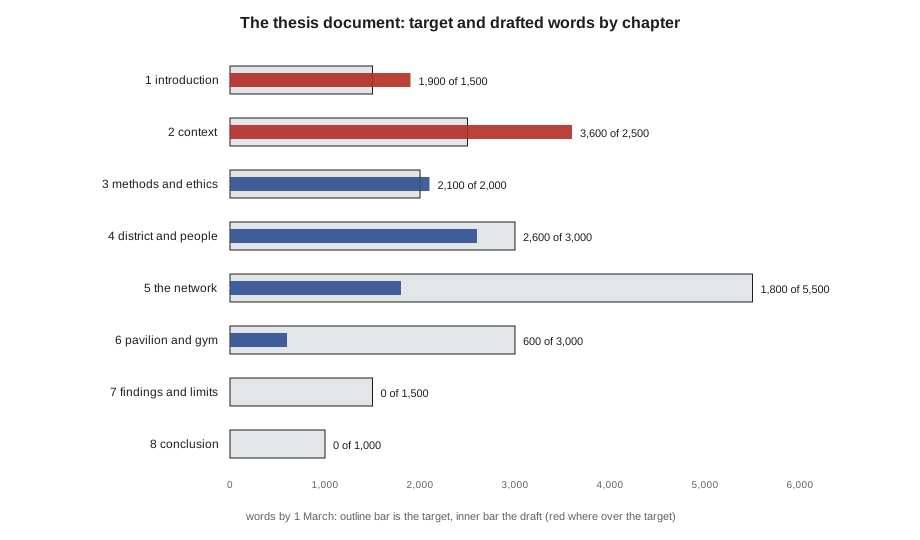
The pattern is common, and Leclerc has seen it in almost every thesis she has supervised: the early chapters, written in the autumn when there was time, are too long, and the design chapters, which carry the thesis, are barely begun. Ingrid has about 9,000 words to write and 1,600 to cut in three weeks, about 500 words of work a day. She plans to write the design chapters first, from her design log, while the work is fresh, and to cut the context chapter last, when she knows which parts of it the design actually draws on.
Writing from the design log
The design log Ingrid began in the autumn is now the most valuable thing she owns. It holds every move she made, with its date, what it showed and why the next move followed, including the failures. Chapter five, on the network, is largely written from it: the first gym model that lasted six hours; the retrofit that bought a day; the claim that failed at about 66 hours and the store that closed the gap; the church hall model that cooled a third faster than predicted; the mid-term reframing; the 100-person test. Written as a story of decisions with their evidence, the chapter shows a reader how the design came to be what it is, which is exactly what a thesis must show.
Leclerc warns against two failures in writing about design. One is the catalog: a chapter that describes the finished building room by room without explaining why any of it is so. The other is the diary: a chapter that records everything that happened, in order, without saying which events mattered. A good design chapter does neither. It is organized by the design's main decisions, each stated as a question, answered with the alternatives considered and the evidence that settled it.
Writing about people
Ingrid's document reports what residents told her, and she writes it under the rules of her ethics approval and her results-return protocol. Participants are not named unless they asked to be; quotations are short and checked with the people who said them; zones replace addresses. Margaret Flett, who asked to be named, appears by name as her reader from outside, and Ingrid sends her every passage that quotes or describes her before the draft goes to the committee. Flett corrects one passage, where Ingrid had written that the fire circle was 'requested for cultural reasons'. 'It is for the people who will sit at it,' Flett writes. 'Say that.'
She also writes the methods chapter so that another researcher could repeat her work: how the survey was distributed and who it missed, how the interviews were coded and how she and Callum checked their agreement, how the loggers were placed and how the models were calibrated. A methods chapter that cannot be repeated is not a methods chapter.
Figures and captions
The figures in the document are not the boards shrunk to fit the page. A board is read standing, at a distance, often with the student explaining; a page is read alone, close up, often weeks later. Ingrid redraws her key figures for the page: simpler, with fewer labels, and with captions that do what Leclerc taught last term, stating what each figure shows as a claim rather than naming it. The survivability chart's caption reads: 'With the store, the gym stays above the habitable limit for 96 hours even with only 100 people inside; without it, the gym falls below the limit before the third day.'
Every figure is numbered, cited in the text before it appears, and credited if it is not her own, with permission noted where needed. Photographs of people are used only with their written consent, which her ethics approval required her to collect.
Citation and voice
Ingrid uses the author-date citation style from the Chicago Manual of Style, as the school prefers, with a reference list at the end; Joon-ho, whose committee includes historians, uses Chicago's notes and bibliography system. Each student uses one style consistently. Leclerc does not mind which style; she minds consistency and completeness, because a reference a reader cannot find is no reference at all.
Students often ask whether they may write 'I'. Leclerc's answer is yes, where the thesis reports what the student did or decided: 'I placed two loggers in the hall'; 'I chose the ell because...'. Hiding the author behind the passive voice ('loggers were placed') makes it harder for the reader to know who decided what, which in a design thesis is often the point. But the findings are stated as findings, not as opinions: 'the hall stays habitable for about 14 hours', not 'I feel the hall is not warm enough'.
The abstract and the findings chapter
The abstract is written last and read first. Leclerc asks for about 250 words in four parts: the question and why it matters; what was done; what was found and designed; and what it means for others. Ingrid's first draft spends half its words on context. She cuts it to two sentences and gives the space to her findings: the calibrated survivability results, the store, the network that supports about 335 people on the worst night, and the method another district could use.
The findings chapter is the one most often rushed, because it comes last, and the one committees read most closely. Ingrid writes it before the conclusion and gives it three sections: what the thesis has shown, stated with numbers and their uncertainty; its limits, stated plainly, including the households her survey under-represented and the western blocks the buildings cannot reach; and what others can use, chiefly her method of sorting a district's buildings by a calibrated model of how long each stays habitable.
Worked problem
A word budget in trouble
Wren's target is 20,000 words. With three weeks to the committee draft she has written 11,500 words, of which 1,200 are over budget in her context chapter. How many words of work remain, and how many a day over 18 writing days?
Show solution
- Words still to write: 20,000 − (11,500 − 1,200) = 9,700.
- Words to cut: 1,200.
- Total work: 9,700 + 1,200 = 10,900 words.
- Per day: 10,900 ÷ 18 = about 606 words.
Answer: About 10,900 words of work, or about 600 a day.
Exercise 8: write the document
- Set a word budget for each chapter and compare your drafts with it every week.
- Write the design chapters first, from your design log, organized by the main decisions.
- Write the methods so that another researcher could repeat them.
- Redraw the key figures for the page, with captions that make claims.
- Write the findings chapter before the conclusion, and the abstract last.
Self-check
- Could a reader who never saw your review follow your thesis from the document alone?
- Have the people you quote seen and approved what you wrote about them?
Revising the draft
The committee returns the full draft within ten days with comments in the margins, and the last week before the review is spent revising. Leclerc's advice is to sort the comments as Ingrid sorted the mid-term feedback: corrections, which are made at once; suggestions, which are considered; challenges, which are answered in the text or in the review; and anything that would change the thesis itself, which is discussed with the adviser before any rewriting.
Abernathy's comments on Ingrid's draft are mostly corrections of units and figures, and two requests: that the methods chapter say how many hours the loggers recorded and at what interval, and that the findings chapter give the uncertainty of the survivability results as a range rather than a single number. Morningstar asks for a paragraph in the conclusion on what the thesis means for districts with different histories and populations, and whether the method would need changing in a community where trust in public buildings is low. Okonkwo, the external, writes only one comment, on the first page: 'Shorter.' Ingrid takes him at his word and cuts the context chapter by another 500 words, which brings it within its budget at last.
Revising also means reading the whole document aloud, or having it read aloud by a computer, which catches the sentences that are too long, the words repeated three times in a paragraph and the places where the argument jumps. Ingrid reads chapter five aloud to Wren over two evenings, and Wren stops her eleven times to ask what a sentence means. Each stop becomes a revision.
Common mistakes
MistakeWriting the early chapters too long and the design chapters too late.
InsteadBudget words by chapter and write the design chapters while the work is fresh.
MistakeDescribing the finished design room by room.
InsteadOrganize the design chapter by its main decisions and their evidence.
MistakeRecording everything that happened in order.
InsteadSay which events mattered and why.
MistakeShrinking the boards to fit the page.
InsteadRedraw figures for close reading, with claim captions.
MistakeRushing the findings and limits at the end.
InsteadWrite the findings chapter before the conclusion and give it real time.
Summary and key terms
- The thesis document is the permanent record; it must let a reader follow the thesis without having seen the review.
- A typical structure runs from introduction, context and methods through findings and design to a findings chapter and conclusion.
- Ingrid's early chapters ran over budget and her design chapters were barely begun; she writes the design first, from her log.
- A design chapter is organized by its main decisions, not as a catalog or a diary.
- People are written about under the ethics approval and the results-return protocol, and those quoted check what is written.
- Figures are redrawn for the page with claim captions; the findings chapter states results, limits and what others can use.
- Thesis document
- The written and illustrated record of a thesis, deposited in the archive.
- Word budget
- A target word count for each chapter, used to plan and track writing.
- Design log
- A dated record of design moves, what they showed and why the next move followed.
- Abstract
- A short summary of the question, methods, findings and their meaning, written last.
- Author-date citation
- A style that cites sources in the text by author and year, with a reference list.
- Findings chapter
- The chapter stating what a thesis has shown, its limits and what others can use.
Practice problems
Work each problem on paper first, then reveal the answer to check.
When is the full draft due to the committee, and why then?
Show answer
On 22 March, so that the committee can read it before the final review.
How many words of work did Ingrid have left on 1 March?
Show answer
About 9,000 to write and 1,600 to cut, about 500 words a day over three weeks.
What are the two failures in writing about design?
Show answer
The catalog, describing rooms without reasons, and the diary, recording everything without saying what mattered.
What did Flett correct in Ingrid's draft?
Show answer
That the fire circle was 'for cultural reasons'; she asked that it say it is for the people who will sit at it.
When should a thesis writer use 'I'?
Show answer
To report what the student did or decided; findings are stated as findings, not opinions.
What are the three sections of Ingrid's findings chapter?
Show answer
What the thesis has shown, its limits, and what others can use.
Lesson quiz · 5 questions
Score 60% or more to complete this lesson.
Create a free account to save your progress, take quizzes and earn a certificate.