
ARCH-501 · Lesson 3 of 12 · 24 min
Mid-term review
The mid-term review falls on Friday 12 February, the end of the sixth week. It is shorter than the proposal presentation and less formal than the final review: each student has forty minutes with their committee, the coordinator and one or two guests, pinned-up work on the wall and a table for models. Leclerc describes its purpose in one sentence: 'The mid-term is the last moment when the committee can change your thesis cheaply.' After it, every change costs time the term does not have.
This lesson follows the four students through the review: what they brought, how they presented it, what they heard and what they did with it in the week that followed.
What to bring
Students often treat the mid-term as a smaller final review and try to show a finished-looking design. That wastes the review. What a committee can help with at the mid-term is decisions, so the work on the wall should make the open decisions visible. Leclerc asks each student to bring the strategy sentence, the chosen scheme with the options it beat, the evidence so far, and a short list headed 'what I need from you today': two or three questions the student cannot answer alone.
Ingrid brings the district plan with the network, the pavilion at early design development, as her term plan required, the gym fit-out in plan and section, the church hall retrofit, and her first full survivability run of the network with stored heat. Her list asks three questions. Should the pavilion's charging room serve the whole district or only the gym? Is the check-in team part of the architecture or part of the program? And how should she show the network's limits: the western blocks the buildings cannot reach, and the households her survey missed?
Callum brings the result of his condition: the twenty specimens of the final finger joint, broken in the fourth week, with their failure loads and where each one broke.
# Callum's 20-specimen bending test of the final finger joint
import statistics as st
mpa = [38.2, 44.5, 33.9, 47.0, 39.7, 45.8, 31.1, 40.3, 48.6, 35.8,
       42.1, 37.0, 50.2, 34.4, 41.9, 36.6, 46.2, 29.8, 43.8, 39.9]   # failure stress of each specimen, MPa
k = 145.04                                   # unit factor: 1 for MPa, 145.04 for psi
vals = [m * k for m in mpa]
mean, sd = st.mean(vals), st.stdev(vals)
f05 = mean - 1.645 * sd                   # characteristic strength (95 in 100 exceed it), assuming a normal distribution
low = sorted(vals)[0]
target = 4060                         # target from published values for laminated aspen
print(f"specimens {len(vals)}, mean {mean:.0f} psi, standard deviation {sd:.0f} psi")
print(f"characteristic strength {f05:.0f} psi (target {target} psi), weakest specimen {low:.0f} psi")
print("coefficient of variation", f"{sd / mean:.2f}")
print("meets target" if f05 >= target else "below target")
fails = {"wood": 14, "finger joint": 5, "glue line": 1}
print("failure location:", ", ".join(f"{n} {w}" for w, n in fails.items()))specimens 20, mean 5851 psi, standard deviation 837 psi characteristic strength 4474 psi (target 4060 psi), weakest specimen 4322 psi coefficient of variation 0.14 meets target failure location: 14 wood, 5 finger joint, 1 glue line
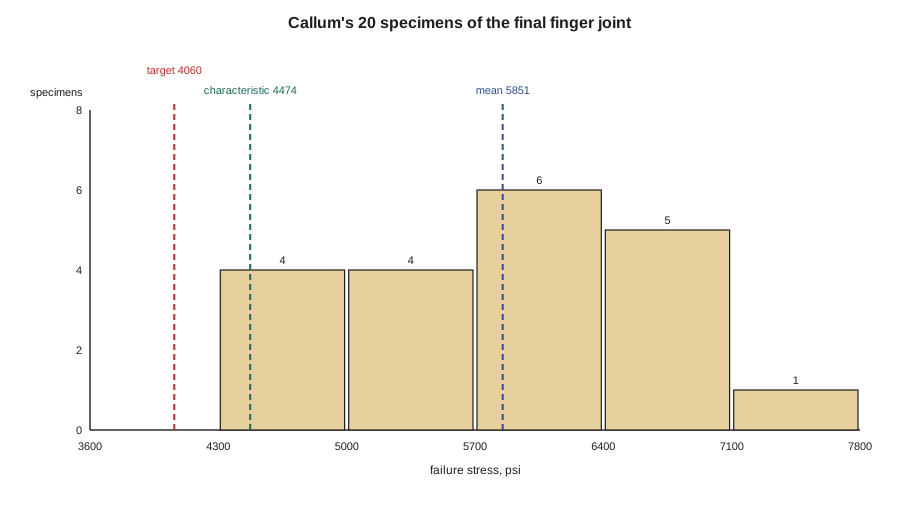
The numbers meet the condition. The characteristic strength, the strength that 95 of every 100 such beams would exceed, is above the target he set from published values for laminated aspen, and fourteen of the twenty specimens broke in the wood rather than at the joint. That second fact matters as much as the first: it shows that the joint is no longer the weak link, which was the problem with his first five specimens in the autumn.
Presenting at the mid-term
Leclerc's advice for the presentation itself is to spend a third of the time talking and two thirds listening. A student who talks for thirty-five of the forty minutes has used the committee as an audience rather than as advisers. Ingrid times her opening at twelve minutes: the strategy in one sentence, the network on the district plan, the pavilion and the gym as the two places where heat is made and kept, the survivability result, and then her three questions, read out and left on the screen.
She also brings Margaret Flett, her reader from outside, who sits beside the committee rather than beside Ingrid. Leclerc approves: 'A reader from outside who sees the work for the first time at the final review cannot help you. One who sees it at the mid-term can.'
What they heard
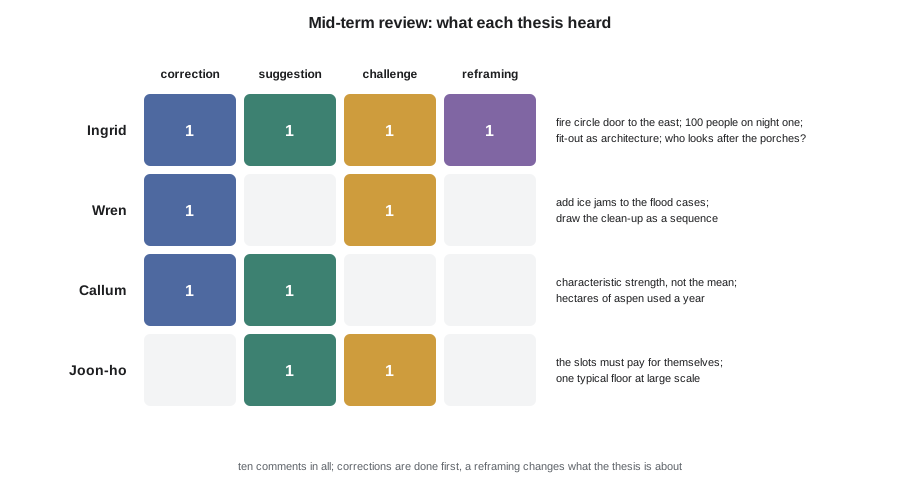
The committee's comments arrive fast, and Ingrid has asked a classmate, Joon-ho, to write them all down with the name of the person who said each one, so that she can listen rather than write. Last term she learned to sort feedback into four kinds: corrections, which fix errors; suggestions, which offer options; challenges, which question a decision; and reframings, which change what the thesis is about. She sorts the comments that evening.
Flett gives a correction: the door from the pavilion to the fire circle should face east, toward the morning, as is usual for a gathering place of this kind. It is a small change in plan and a large one in meaning, and Ingrid makes it the same night.
Abernathy gives a suggestion: test the network with only 100 people in the gym on the first night, before word of the warm room spreads, because fewer people means less body heat and a faster drop in temperature. Ingrid had tested the gym alone with fewer people last term, but not the network with stored heat.
Okonkwo gives a challenge: 'The gym fit-out is drawn as furniture, not as architecture.' He points out that her screened rooms, cots and kitchen hatch could be bought from a catalog. If the gym is the largest warm room in the network, it deserves design: how the stage stores the screens, how the light falls at night, how a family finds its place, how the street between the rooms works when 155 people are sleeping.
Morningstar gives a reframing, in the form of a question. 'Who looks after the warm porches when the organizers are tired? Your network has buildings that will be there in five years. Will the people be?' She points out that the check-in team and the warm porches depend on volunteers, and that volunteer networks in many communities fade after their first crisis or after the person who started them moves on. A network that relies on them must say how they are kept up. Ingrid realizes that her third question, whether the check-in team is architecture or program, has been answered in a way she did not expect: it is neither, it is an institution, and the thesis must design how it lasts.
The other reviews
Wren's reader from outside, the city hydrologist, makes a correction that unsettles her. Her flood cases include the two springs she has measured from the corrected gauge and a design flood, but not ice. On northern rivers, the highest water in some years comes not from the volume of the flood but from ice jams: broken ice piles up at a bend or a bridge, dams the river and raises the water upstream quickly and far above the level the flow alone would give. Her site, on a bend, is exactly where that can happen. Desrosiers adds a challenge: the spring clean-up, which her proposal promised to design as architecture, is still a single note. 'Draw it as a sequence,' she says, 'day by day, with the people and the hoses in it.'
Szymańska gives Callum a correction he expected: report the characteristic strength, not the mean, wherever he states the strength of his system, because a structure must be designed for the weak members, not the average ones. His reader from outside, a state forester, suggests he estimate how much aspen the factory would use in a year, in hectares of forest, so that the committee can judge whether the supply is real.
Joon-ho's committee includes the developer who doubted his affordability case last term. The developer challenges him again: the light slots must pay for themselves. If two slots remove a fifth of the floor, the extra homes they make possible must be worth more than the floor they cost and the construction of cutting them. Bérubé suggests that he draw one typical floor at large scale, so that the quality of the homes, not just their number, can be judged.
The tracker
Comments that are not tracked are forgotten, and comments that are tracked without owners and dates are not done. Ingrid enters every comment from all four reviews into a shared tracker that the four students keep together, so that each can see what the others heard and help where they can.
# Mid-term feedback tracker: sort every comment, give it an owner and a date, and count what is open
comments = [  # (student, from, kind, comment, status)
    ("Ingrid", "Okonkwo", "challenge", "the gym fit-out is drawn as furniture, not as architecture", "open"),
    ("Ingrid", "Morningstar", "reframing", "who looks after the warm porches when the organizers are tired?", "open"),
    ("Ingrid", "Flett", "correction", "turn the fire circle door to the east", "done"),
    ("Ingrid", "Abernathy", "suggestion", "test the network with only 100 people on night one", "open"),
    ("Wren", "hydrologist", "correction", "add ice jams to the flood cases", "open"),
    ("Wren", "Desrosiers", "challenge", "show the spring clean-up as a drawn sequence", "open"),
    ("Callum", "Szymanska", "correction", "report the characteristic strength, not the mean", "done"),
    ("Callum", "forester", "suggestion", "say how many hectares of aspen the factory would use a year", "open"),
    ("Joon-ho", "developer", "challenge", "the light slots must pay for themselves", "open"),
    ("Joon-ho", "Berube", "suggestion", "draw one typical floor at large scale", "open"),
]
kinds = ["correction", "suggestion", "challenge", "reframing"]
for k in kinds:
    rows = [c for c in comments if c[2] == k]
    left = sum(1 for c in rows if c[4] == "open")
    print(f"{k:11s} {len(rows)} comment{'' if len(rows) == 1 else 's'}, {left} still open")
print()
for who in ["Ingrid", "Wren", "Callum", "Joon-ho"]:
    mine = [c for c in comments if c[0] == who and c[4] == "open"]
print(f"{who:8s} open: " + "; ".join(c[3] for c in mine))correction 3 comments, 1 still open suggestion 3 comments, 3 still open challenge 3 comments, 3 still open reframing 1 comment, 1 still open Ingrid open: the gym fit-out is drawn as furniture, not as architecture; who looks after the warm porches when the organizers are tired?; test the network with only 100 people on night one Wren open: add ice jams to the flood cases; show the spring clean-up as a drawn sequence Callum open: say how many hectares of aspen the factory would use a year Joon-ho open: the light slots must pay for themselves; draw one typical floor at large scale
The tracker makes the shape of the week visible. Corrections are almost done: two of three were fixed by the Monday, and Wren's ice-jam case needs data from the hydrologist. The suggestions and challenges are still open, and they are the larger work. Ingrid's reframing is the largest of all, and Leclerc advises her not to answer it in a hurry. 'A reframing deserves a week of thinking and an hour of writing,' she says. 'Write down what changes in your question, your strategy and your deliverables. Then decide.'
Answering a reframing
Ingrid's week of thinking ends with three changes, written as a one-page note to her committee. Her question gains a clause: a network that keeps the district's most vulnerable residents warm through a 96-hour outage 'and that the community can keep up between outages'. Her strategy gains a third measure, beside 'last longer' and 'reach further': 'stay alive between crises'. That measure explains something she had sensed without stating: the pavilion's laundry is not a convenience added to an emergency building but the everyday use that keeps the building, and the people around it, active. And her deliverables gain one item: a protocol for the check-in team and warm porches, written with the community organization, that says how members are recruited, how the list is kept up each autumn, and how the team practices once a year.
Morningstar's reply is a single line: 'Now the thesis is about a network, not a set of buildings.'
Worked problem
Is the condition met?
Callum's condition was a twenty-specimen test of the final joint, with a characteristic strength at or above his target of 4,060 psi. His results give a mean of 5,851 psi and a standard deviation of 837 psi. Is the condition met?
Show solution
- Compute the characteristic strength, the value 95 of every 100 exceed, assuming a normal distribution: mean − 1.645 × standard deviation.
- 5,851 − 1.645 × 837 = 5,851 − 1,377 = 4,474 psi.
- Compare with the target: 4,474 psi is above 4,060 psi.
- Check the failure mode: fourteen of twenty specimens broke in the wood, so the joint is no longer the weak link.
Answer: Yes: the characteristic strength, about 4,470 psi, clears the target, and most failures are now in the wood.
Exercise 3: use the mid-term
- Bring the strategy, the chosen scheme with its rivals, the evidence so far and a list of two or three questions you need answered.
- Keep your opening to about a third of the time, and leave your questions on the screen.
- Ask someone else to record every comment with its source, so that you can listen.
- Sort the comments into corrections, suggestions, challenges and reframings, and enter them in a tracker with owners and dates.
- Answer a reframing in writing: what changes in your question, strategy and deliverables.
Self-check
- Did the committee spend most of the review helping you decide, or watching you present?
- Is every comment in your tracker either done, scheduled or answered with a reason?
Common mistakes
MistakeTreating the mid-term as a small final review.
InsteadShow open decisions and ask for help with them.
MistakeTalking for most of the review.
InsteadPresent for about a third of the time and listen for the rest.
MistakeWriting notes while trying to listen.
InsteadAsk a classmate to record every comment and its source.
MistakeAnswering a reframing in a hurry, or not at all.
InsteadTake a week, then write what changes in the question, strategy and deliverables.
MistakeReporting the mean strength of a material.
InsteadReport the characteristic strength, which 95 of every 100 members exceed, because structures are designed for weak members.
Summary and key terms
- The mid-term is the last point at which the committee can change a thesis cheaply; it should be used for decisions.
- Bring the strategy, the scheme and its rivals, the evidence and a short list of questions you need answered.
- Callum's twenty specimens give a characteristic strength above his target, and most now fail in the wood.
- Ingrid heard one comment of each kind; Morningstar's question about who keeps the volunteers going reframed the thesis.
- A tracker with owners and dates turns comments into work; a reframing is answered in writing after a week of thought.
- Ingrid's question, strategy and deliverables each gained a part: keeping the network alive between outages.
- Mid-term review
- A review partway through the thesis term, used to test decisions while they can still change cheaply.
- Characteristic strength
- The strength that 95 of every 100 members exceed; used for design.
- Ice jam
- Broken river ice piled at a bend or bridge, damming the water and raising levels upstream.
- Feedback tracker
- A shared list of review comments with their kind, owner, date and status.
- Institution
- A lasting arrangement of people and rules, such as a volunteer team with yearly routines.
- Reader from outside
- A person outside the school who reads and comments on a thesis from experience.
Practice problems
Work each problem on paper first, then reveal the answer to check.
What does Leclerc say the mid-term is for?
Show answer
Changing the thesis while it is still cheap to change; it should be used for decisions.
What fraction of the mid-term should the student spend talking?
Show answer
About a third; the rest is for listening.
What did Okonkwo mean by 'furniture, not architecture'?
Show answer
The gym fit-out could be bought from a catalog; as the largest warm room it deserves design: storage, light, finding a place, the street between rooms.
What is an ice jam, and why does it matter to Wren?
Show answer
Broken ice that dams the river at a bend or bridge and raises water quickly; her site is on a bend.
How did Ingrid answer Morningstar's reframing?
Show answer
She added to her question, strategy and deliverables the aim of keeping the network alive between outages, including a protocol for the volunteers.
Why must Callum report the characteristic strength and not the mean?
Show answer
Structures are designed for the weak members, not the average ones.
Lesson quiz · 5 questions
Score 60% or more to complete this lesson.
Create a free account to save your progress, take quizzes and earn a certificate.