
ARCH-501 · Lesson 1 of 12 · 25 min
Design strategy
Thesis Studio II opens on the first Monday of January in the same studio where the proposals were pinned up a month earlier. The boards from December are still on the walls, with the committee's conditions written on yellow cards beside them. Professor Margot Leclerc, the thesis coordinator, takes the cards down one by one as the students report on the winter break. 'In September you asked a question,' she says. 'In December you proposed how to answer it. This term you answer it, in drawings, models and words, and in thirteen weeks you defend the answer in front of people who know more than you about parts of it. The first thing you need is not a drawing. It is a strategy.'
This course follows the four students of the final M.Arch year at Elmhurst School in Minneapolis through their winter term, from the return in January to the final review in April, the graduate exhibition and the portfolio that carries the work into practice. Ingrid's thesis, The Warm Network, is the main thread; Wren's A Room on the River, Callum's Prairie Wood and Joon-ho's Second Lives run beside it. Each lesson covers one stage of a thesis design term and the skills it demands.
Meeting the conditions
Three of the four proposals were approved with conditions, and Leclerc insists that conditions are met before any new design work is shown. A condition is not a suggestion; it is the committee's statement of what the thesis must fix to be defensible, and meeting it early clears the ground for everything else.
Ingrid had two conditions. The first was to calibrate her model of the church hall, the overnight room for older residents, as she had calibrated the gym. Over the break she placed two temperature loggers in the hall, with the permission of the congregation's caretaker, and recorded a cold week in late December when the hall was closed and its heating set back. The record surprised her. The hall cooled faster than her model predicted, by almost a third. Walking the basement with the caretaker, she found the reason: the floor of the hall sits over an unheated, uninsulated crawl space, and her model had treated the floor as if it lost almost nothing. With the floor corrected, the model matched the loggers within half a degree over the week. The corrected result is less comfortable: the hall as it stands stays habitable for about 14 hours after the power fails in design cold with sixty people inside, not the 20 she had claimed in December. With insulation in the attic, storm windows and the crawl space sealed and insulated, it lasts about 52 hours. 'The finding is better than the claim,' Abernathy tells her. 'Now you know what the hall needs, and you know it because you measured it.'
Her second condition was a protocol for returning results to the community before any more fieldwork. She wrote it with the hub's community organization in the first week of January: results go first to the people who took part, in plain language and in the main languages of the district, at a meeting in the hub before anything is shown at school; the organization keeps its own copy of the data its members gave; nothing that could identify a household leaves the zones on her maps. The organization's board approved it on 8 January, and Margaret Flett, her reader from outside the school, signed it as a witness.
Wren's condition was to use flood levels from the gauge downstream of her site. The first numbers came from a gauge upstream of a tributary, which misses the water the tributary adds. The corrected levels are higher, and she has raised the floor of her public room by 3 ft, to 21 ft above the normal summer level of the river. Callum's condition was a 20-specimen test of his final finger joint by the mid-term; he has booked the testing machine for the fourth week. Joon-ho had no conditions, which he admits makes him nervous.
What a design strategy is
A design strategy is the principle that decides, in advance, how the design will answer the thesis question. It is not the program, which says what the building must hold, and it is not the concept, which is usually an image or idea of what the building will be like. A strategy is closer to a rule of play: it tells the designer which moves are worth making and which are not. A thesis needs one because a thesis design makes thousands of decisions in thirteen weeks, and without a rule each decision is made separately, and the design drifts.
Leclerc asks each student to write the strategy as a single sentence with two parts: what the design is, as a kind of thing, and the rule by which every move will be judged. She calls the second part the test. 'If you cannot say what a move is for, under your strategy, you should not make it.'
Ingrid writes: 'The Warm Network is a network of small, familiar places, each doing one thing well; every move must make the whole network last longer or reach further.' The first half says that her design is not a building but a set of linked places: the gym, the church hall, the hub, a small new pavilion, the lit path between them, and the people on the check-in team who go to those who stay home. The second half gives her a test. A bigger pavilion fails it if the money would have kept the church hall warm longer. A beautiful canopy over the path fails it if three sheltered stops would serve as well for less. The test is not about beauty, but it does not forbid beauty; it asks what each move does for the network.
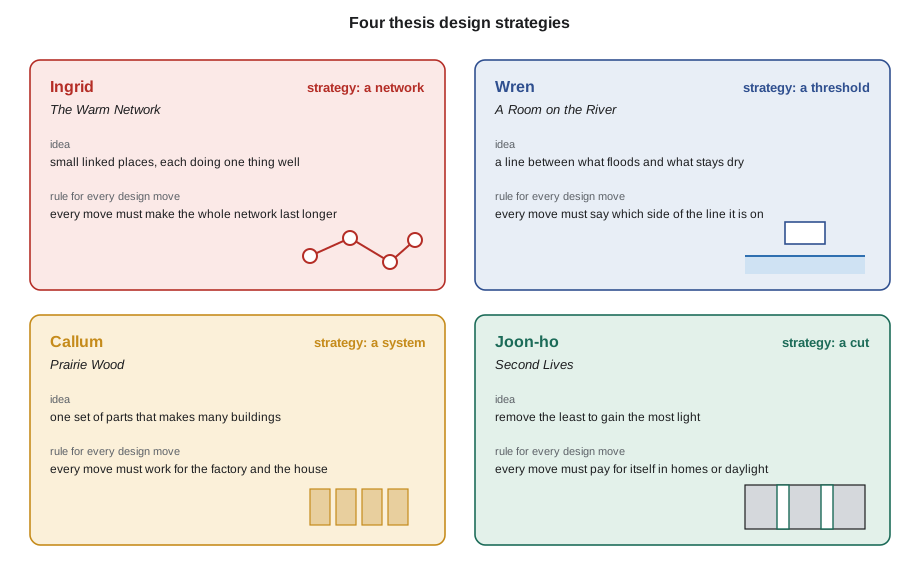
Wren's strategy is a threshold: 'A Room on the River draws one line between what floods and what stays dry; every move must say which side of the line it is on.' Below the line, the terrace, the boathouse and the lower path are built to be flooded, cleaned and reopened. Above it, the public room, the kitchen and the flood-watch room never get wet. Things that cross the line, like the stair and the lift, must be designed for both conditions.
Callum's is a system: 'Prairie Wood is one set of parts made from regional aspen that can build many buildings; every move must work for both the factory and the house.' A beautiful one-off connection fails the test if the factory cannot make it repeatedly. Joon-ho's is a cut: 'Second Lives removes the least of an office building to gain the most light; every move must pay for itself in homes or daylight.'
Strategy, concept and parti
Students often confuse three words. A concept is an idea about what the building will mean or be like, such as a warm lantern in the snow. A parti, a term from the French academic tradition of the nineteenth century, is the basic organization of a plan, such as a bar along the avenue with rooms off a corridor. A strategy sits above both: it is the reason for choosing one concept or parti over another. Ingrid's lantern image may survive in her pavilion, and her pavilion will have a parti, but both are chosen because they serve the network.
A thesis strategy also differs from a studio strategy because it must connect the design to the research. Ingrid's rule, 'last longer or reach further', comes straight from her question and her performance targets: a warm room above 54 °F through a 96-hour outage, medical charging within an hour, and the zones of greatest need within a ten-minute walk at an older person's pace. Her strategy turns those targets into a habit of mind for design.
Testing a strategy before using it
A strategy can be wrong, and the cheapest time to find out is in the first week. Leclerc asks the students to test their strategies against three hard decisions they already know they will face. If the strategy helps make each decision, it is useful; if it says nothing, it is too vague; if it gives an answer they know is wrong, it needs revising.
Ingrid's three hard decisions are where to put the stored heat, whether the path needs a continuous canopy, and how much of the budget goes to the gym rather than the new pavilion. Her strategy settles the second quickly: three sheltered stops, already in her refined proposal, serve the network as well as a canopy for a fraction of the cost. It helps with the first: stored heat should sit where it can reach the largest warm room, which is the gym, so the pavilion should be as close to the gym as the site allows. But it does not settle the third. A larger pavilion makes the network last longer through its heat store; a better gym retrofit does too. The strategy says both are good moves and gives no way to choose. She adds a measure to her rule: 'hours of habitable warmth gained for each dollar', which she will be able to estimate once the costs are known.
Wren tests her threshold against the stair, which must cross the line. The strategy forces a clear answer: the stair is concrete below the line and wood above, and the change of material marks the design flood level for every visitor. That turns a technical requirement into something people can read, which pleases her. Joon-ho tests his cut against the ground floor, where light is not the issue, and finds his strategy silent; he writes a second rule for the ground floor about public use.
Planning the term from the final review backward
A strategy also needs time, and the term is short. Leclerc asks each student to plan backward from the two fixed milestones: the mid-term review on Friday 12 February and the first day of final reviews on Wednesday 7 April. Ingrid's first plan, made the way she planned the autumn term, worked back from the final review alone. It put the mid-term review in late January, two weeks before the real date, and ignored reading week in February. She rewrote it with both milestones fixed.
# Backward planning with two fixed milestones: the mid-term review and the final review
from datetime import date
term_start, midterm, final = date(2027, 1, 4), date(2027, 2, 12), date(2027, 4, 7)
reading_week_days = 5                       # no studio from 15 to 19 February
before = [("design strategy and meeting the conditions", 1), ("schematic design", 2)]
after = [("mid-term response", 1), ("design development", 3), ("technical resolution", 2),
         ("final drawings, models and boards", 3), ("rehearsals and pin-up", 1)]

def window(a, b, lost_days=0):
    return round(((b - a).days - lost_days * 7 / 5) / 7, 1)   # working weeks available

for label, a, b, lost, tasks in [("before mid-term", term_start, midterm, 0, before),
                                 ("after mid-term", midterm, final, reading_week_days, after)]:
    have, need = window(a, b, lost), sum(w for _, w in tasks)
    print(f"{label}: {have} weeks available, {need} weeks of work, balance {have - need:+.1f} weeks")
# The second window is short, so some phases must overlap. Run technical resolution
# alongside design development and start the final drawings in its last week:
overlap = 2 + 1
print("weeks recovered by overlapping phases:", overlap)
print("balance after overlap:", f"{window(midterm, final, reading_week_days) - (sum(w for _, w in after) - overlap):+.1f}", "weeks")
# Still short, but the first window has spare time: begin design development before the mid-term
moved = 1.5
print("design development weeks moved before the mid-term:", moved)
print("balance before mid-term:", f"{window(term_start, midterm) - 3 - moved:+.1f}", "weeks; after mid-term:",
f"{window(midterm, final, reading_week_days) - (10 - overlap - moved):+.1f}", "weeks")before mid-term: 5.6 weeks available, 3 weeks of work, balance +2.6 weeks after mid-term: 6.7 weeks available, 10 weeks of work, balance -3.3 weeks weeks recovered by overlapping phases: 3 balance after overlap: -0.3 weeks design development weeks moved before the mid-term: 1.5 balance before mid-term: +1.1 weeks; after mid-term: +1.2 weeks
The program shows the problem plainly. Before the mid-term there is time to spare: more than five weeks for three weeks of work. After it there is not: under seven working weeks for ten weeks of work. Overlapping phases, running the technical resolution of the heat store beside design development and starting the final drawings while the details are still being finished, recovers three weeks but still leaves her short. The answer is to begin design development before the mid-term, using the spare time in January, so that she arrives at the mid-term with a pavilion already partly developed rather than with schematic options only. 'That is a strategy too,' Leclerc says. 'Most students arrive at the mid-term too early in their design and spend the rest of term catching up.'
Worked problem
Writing a strategy sentence
Joon-ho's first strategy sentence reads: 'Second Lives is about reusing offices as homes.' Is it a strategy, and if not, how should it be rewritten?
Show solution
- Check the first part: does it say what the design is, as a kind of thing? 'About reusing offices' names a topic, not a kind of design.
- Check the second part: is there a rule by which every move can be judged? There is none.
- Name the kind of design: his work is a set of cuts and additions to an existing frame, so the design is a cut.
- Write a rule from his question, which asks what a city could afford: every move must pay for itself in homes or daylight.
- Test it on a hard decision: a third light slot would add some daylight but remove more floor than it gives back in homes, so the rule says no.
Answer: Not yet a strategy. A better version: 'Second Lives removes the least of an office building to gain the most light; every move must pay for itself in homes or daylight.'
Exercise 1: a strategy you can test
- Write your design strategy as one sentence: what the design is, as a kind of thing, and the rule for every design move.
- List three hard decisions you know you will face, and test the strategy on each. Revise it if it is silent or gives an answer you know is wrong.
- Draw the strategy as a diagram small enough to fit on a card, and pin it above your desk beside your criteria from last term.
- Make a term plan from both fixed milestones, with reading week removed, and show where phases must overlap.
- Meet any conditions from your proposal review before you show new design work, and record how you met them.
Self-check
- Could a classmate use your strategy to make a design decision you have not yet made?
- Does your plan show what you will bring to the mid-term, not just when the mid-term is?
Common mistakes
MistakeWriting a topic or a mood instead of a strategy.
InsteadSay what kind of thing the design is and give a rule for judging every move.
MistakeConfusing the strategy with the concept image.
InsteadKeep the image, but choose it because it serves the strategy.
MistakeTreating proposal conditions as optional.
InsteadMeet them first and record how; they are the committee's terms for approval.
MistakePlanning backward from the final review only.
InsteadFix every milestone, remove holidays, and show where phases overlap.
MistakeArriving at the mid-term with schematic options only.
InsteadUse spare time early so that the mid-term sees developed work.
Summary and key terms
- A design strategy is a rule of play: it names what the design is and gives a test for every design move.
- Strategy sits above concept and parti; it explains why one concept or organization is chosen over another.
- A thesis strategy connects the design to the research question and its performance targets.
- Test a strategy against three known hard decisions before relying on it, and add measures where it is silent.
- Ingrid's calibrated church hall model shows about 14 hours of warmth as it stands and about 52 with a simple retrofit.
- A term plan must be built from all fixed milestones; Ingrid starts design development before the mid-term to fit the work.
- Design strategy
- The principle that decides how the design will answer the thesis question, with a rule for judging every move.
- Concept
- An idea or image of what a building will mean or be like.
- Parti
- The basic organization of a plan or building.
- Condition
- A requirement set by a review committee that the thesis must meet to be approved.
- Milestone
- A fixed date, such as a review, from which a plan is built backward.
- Results-return protocol
- An agreement on how research results go back to the people who took part.
Practice problems
Work each problem on paper first, then reveal the answer to check.
What are the two parts of a strategy sentence?
Show answer
What the design is, as a kind of thing, and the rule by which every move is judged.
Why did Ingrid's church hall model need correcting?
Show answer
It treated the floor over an uninsulated crawl space as losing almost no heat; the loggers showed the hall cooled about a third faster.
How long does the church hall stay habitable as it stands, and after a simple retrofit?
Show answer
About 14 hours as it stands and about 52 hours with the retrofit, with sixty people inside.
Which hard decision did Ingrid's strategy fail to settle, and what did she add?
Show answer
The split of money between the gym and the pavilion; she added a measure, hours of habitable warmth gained for each dollar.
Why did Wren raise her public room floor?
Show answer
Corrected flood levels from the downstream gauge were higher than the first numbers.
What did Ingrid's term plan show after the mid-term, and what was her answer?
Show answer
Under seven working weeks for ten weeks of work; she overlapped phases and began design development before the mid-term.
Lesson quiz · 5 questions
Score 60% or more to complete this lesson.
Create a free account to save your progress, take quizzes and earn a certificate.