
ARCH-501 · Lesson 12 of 12 · 22 min
Reflection and portfolio
The last lesson of the thesis year, and of the architecture program, is about looking back and carrying the work forward. In the week after the exhibition closes, Leclerc meets each student once more, alone, with two pieces of work to discuss: a reflection of about 1,500 words on what the thesis taught them, and a portfolio that will carry their work into practice. 'The thesis ends when you deposit the document,' she says. 'What you learned from it does not end. The reflection is how you find out what that was, and the portfolio is how you show it to the people you will work with.'
Why reflect
Reflection is not a summary of the thesis; the document already contains that. It is an account of what the student learned about designing, researching and working with people, written honestly enough to be useful to the student in five years. Donald Schön, whose idea of reflection-in-action the students met in the autumn, also described reflection-on-action: looking back at what one did, after the event, to understand the knowledge one used without knowing it. A thesis is a long piece of action, and a short piece of reflection on it is one of the most valuable things a graduating architect can write.
Leclerc asks the students to organize their reflection around four questions. What did you set out to do, and what did you actually do? What surprised you, and what did the surprise teach you? What would you do differently, and why? What will you carry into practice?
Ingrid's reflection
Ingrid's reflection begins with a confession: she set out to design a building and ended by designing a network that includes an institution of volunteers, and she resisted that change for weeks after the mid-term. 'I wanted the pavilion to be the thesis,' she writes, 'because it was the only thing I could draw from nothing. Morningstar's question about who looks after the warm porches took the pavilion's place at the center, and I was annoyed for a week before I was grateful.'
Her surprises are about evidence. The church hall model that cooled a third faster than predicted taught her that a calibrated model is only as good as the walk through the building that explains its errors; the uninsulated crawl space was found by a caretaker with a flashlight, not by a simulation. The 100-person case, which she had not thought to test until Abernathy suggested it, taught her that the hard case is often the one the designer does not want to run. And the comment book at the hub, where an older man wrote that he would go to the church hall, not the gym, taught her that her survey's numbers were right but did not tell her which places people trust.
What she would do differently: start the community report in January, not March, because writing for the people of the district made her thinking clearer than writing for the committee; and ask the utility in the autumn, as the emergency manager suggested at her review. What she will carry into practice: that a building's everyday use is part of its performance in a crisis; that limits stated plainly earn more trust than claims stated boldly; and that the people a project serves can be its readers, not just its subjects, if the architect gives them the work in a form they can read.
The other three write their own. Wren writes that she learned to design for time as well as space: her clean-up sequence was the moment her building stopped being an object on a bank and became a part of the river's year. Callum writes that his first five failed specimens were the most useful days of his thesis, because they told him where the system was weak while there was still time to change it. Joon-ho writes that he learned to trust a doubter, the developer who doubted him all year and whose doubt made his cost study good enough for the city to want it.
What a portfolio is for
A portfolio is a designed selection of a student's work, made for a particular reader: an employer, a graduate school, a client, a licensing body that wants to see experience. It is not an archive of everything the student made. Leclerc's rule is the same as for the boards: every page must be there because the reader needs it. An employer reading a portfolio wants to know three things quickly: can this person design, can they resolve a design technically, and can they work with others? The portfolio should answer all three in the first few pages.
A portfolio usually exists in two versions. The short version, about eight pages, goes with a first email or application and must be small enough to open on a phone. The full version, thirty to forty pages, follows when the reader asks for it, or is shown at an interview. Many firms say they spend less than a minute on the short version before deciding whether to ask for more, so its first page matters most.
Planning Ingrid's portfolio
Ingrid has an offer to interview at Eberle Moss Architects, the firm her professional practice course met through its principals, and the firm asks for a portfolio of no more than forty pages. She plans the pages before laying out any of them.
# Reflection and portfolio: plan the pages before laying out a single one
plan = [  # (section, pages)
    ("cover and one-line statement", 1),
    ("thesis: The Warm Network", 12),
    ("Design Studio VIII: the library and hall", 6),
    ("integrated design studio: Marlow Station", 5),
    ("comprehensive studio: Rail Yard Commons details", 4),
    ("housing studio", 3),
    ("technical work: envelope, simulation and specifications", 4),
    ("community report and engagement protocol", 3),
    ("cv and contact", 1),
]
pages = sum(p for _, p in plan)
limit = 40                                    # the firm's requested maximum
print(f"pages planned {pages} of {limit}")
thesis_share = dict(plan)["thesis: The Warm Network"] / pages
print(f"thesis share {thesis_share:.0%}")
# A short version for a first email: the 8 strongest pages
print("short version: cover, 5 thesis pages, 2 technical pages = 8 pages, about 6 MB as a compressed file")pages planned 39 of 40 thesis share 31% short version: cover, 5 thesis pages, 2 technical pages = 8 pages, about 6 MB as a compressed file
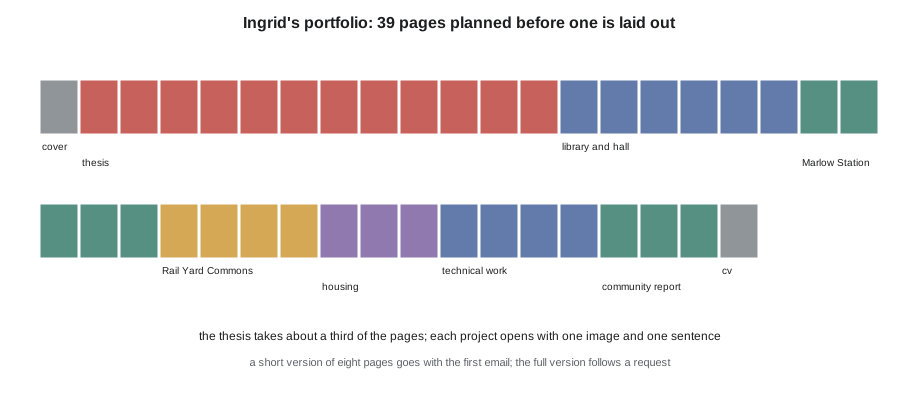
The plan fits the limit with one page to spare. The thesis takes about a third of the pages, which is right for a graduate: it is the best evidence of what she can do on her own. The rest shows range, from the public library and hall of her eighth studio to the integrated design studio's Marlow Station, where she led a team of engineering students, which answers the employer's question about working with others. The technical section gathers the work that shows she can resolve a design: the envelope details from her building envelope course, the simulation work from her performance course, and a page of specifications from her construction documents course.
Each project opens with one strong image and one sentence that says what the project is and what she did, so that a reader turning pages quickly understands each project in seconds. Team projects say exactly what she did and credit the others by name. The community report and engagement protocol take three pages near the end, because Eberle Moss works with non-profit housing providers and she expects them to value it.
Making the portfolio honest
Leclerc lists the commonest ways portfolios mislead, often without the student meaning to. Team work presented as individual work, with no credits. Images of a project that show a later, better version made for the portfolio, without saying so. Renderings that make a design look built. Technical drawings made by others presented as one's own. Each of these can end an interview when it is discovered, and in a small profession it often is. 'Your portfolio is the first piece of professional conduct an employer sees,' she says, 'before your work, before your interview. Make it honest, and make it easy to check.'
Ingrid's credits are specific: 'Marlow Station, integrated design studio, team of five: I led the architecture and the envelope; structure by Tomasz, mechanical by Adaeze, electrical by Rafael, civil by Hamid.' Her thesis pages credit Callum for the second coding of her interviews and her brother for cutting the base of the district model.
Next steps
The four students leave the program in May. Ingrid accepts a position at Eberle Moss Architects starting in June, and registers in the Architectural Experience Program with NCARB, the first step on the path to licensure she studied in her professional practice course. She also accepts an unpaid role as volunteer adviser to the community organization, which has applied for a grant to build a first version of the pavilion on the hub lot, and the city's emergency management office invites her to present the network to its staff in the autumn.
Wren joins a landscape and water design firm for two years, with the business plan for her own small practice from her practice management course in a drawer for later. Callum joins Szymańska's office as a junior designer and research assistant on a larger test series for a certified aspen product, with the forester and the mill as partners. Joon-ho takes a one-year contract with the city's housing office to extend his survey of office buildings to the whole downtown, under the supervision of a licensed architect, which also counts toward his experience hours.
Leclerc's last words to the class, at a small gathering in the studio on the last day, are brief. 'You asked a question in September and answered it in April. Most of the questions you meet in practice will not wait seven months for an answer, and most of the answers will be built. Keep the habits you learned here: say what you are trying to do, test it on the hard case, tell the truth about where it fails, and give the work back to the people it is for.'
Worked problem
Planning a short portfolio
Ingrid's full portfolio has 39 pages. Her short version must be no more than eight pages and about 6 MB. If she gives one page to the cover, how should she divide the rest to answer an employer's three questions: can she design, can she resolve, can she work with others?
Show solution
- One page for the cover leaves seven pages.
- Design: four pages of the thesis, her strongest independent work.
- Resolution: two pages of technical work, the store section and an envelope detail.
- Working with others: one page of Marlow Station with the team credited.
- Compress images so that the file stays near 6 MB and opens on a phone.
Answer: Cover, four thesis pages, two technical pages and one team project page: eight pages in all.
Exercise 12: reflect and carry forward
- Write a reflection of about 1,500 words around four questions: what you set out to do and did, what surprised you, what you would do differently, and what you will carry into practice.
- Identify the reader of your portfolio and what they need to learn in the first pages.
- Plan the pages of a full version and a short version before laying out any of them.
- Open each project with one image and one sentence, and credit every collaborator by name.
- Check every image and drawing for honesty: what was built, what was revised, who made it.
Self-check
- Would your reflection still be useful to you in five years?
- Could an employer check every claim in your portfolio?
Keeping the thesis alive
Leclerc also asks each student to write one short paragraph, separate from the reflection, on what should happen to their thesis next and who should do it. Ingrid's paragraph names three things: the community organization's grant application for the pavilion, the city's emergency office presentation, and a short paper on her survivability method, written with Abernathy for a building science conference, so that other districts can find and test it. She sets herself a date for each and puts them in her calendar, because a thesis without a next step usually stops on the day it is deposited.
Common mistakes
MistakeWriting the reflection as a summary of the thesis.
InsteadWrite what you learned about designing, researching and working with people.
MistakePutting everything you made in the portfolio.
InsteadSelect for the reader and what they need to see.
MistakeSending only a large full portfolio.
InsteadSend a short version first, small enough to open on a phone.
MistakePresenting team work without credits.
InsteadSay exactly what you did and name the others.
MistakeShowing revised or rendered work as if it were the original or built.
InsteadSay what was revised, rendered or built.
Summary and key terms
- Reflection-on-action looks back at the thesis to find what was learned; it is organized around what was intended, what surprised, what would change and what carries forward.
- Ingrid learned that a calibrated model is only as good as the walk that explains its errors, that the hard case must be run, and that the community can be the work's readers.
- A portfolio is a selection for a particular reader; a short version of about eight pages goes first, a full version on request.
- Ingrid's 39-page plan gives the thesis about a third and shows design, resolution and teamwork, each project opening with one image and one sentence.
- Portfolios must be honest: credit collaborators, and say what was revised, rendered or built.
- The four graduates move into practice, research and public service, carrying their theses forward on the path to licensure.
- Reflection-on-action
- Looking back at completed work to understand the knowledge used in it.
- Portfolio
- A designed selection of work for a particular reader, such as an employer.
- Short portfolio
- A version of about eight pages sent with a first email or application.
- Credit line
- A statement of who did what in a team project.
- Experience program
- A structured period of supervised work that counts toward licensure.
- Further work
- Questions a thesis names as beyond its scope but worth pursuing.
Practice problems
Work each problem on paper first, then reveal the answer to check.
What four questions organize Leclerc's reflection?
Show answer
What you set out to do and did; what surprised you; what you would do differently; what you will carry into practice.
What did the church hall model teach Ingrid?
Show answer
That a calibrated model is only as good as the walk through the building that explains its errors.
What three things does an employer want to learn from a portfolio?
Show answer
Whether the person can design, can resolve a design technically, and can work with others.
How much of Ingrid's portfolio is the thesis, and why?
Show answer
About a third; it is the best evidence of what she can do on her own.
Name two ways a portfolio can mislead without meaning to.
Show answer
Team work without credits; a later, better version shown as the original; renderings that look built; others' drawings shown as one's own.
What is Ingrid's first step toward licensure?
Show answer
Registering in the Architectural Experience Program with NCARB.
Lesson quiz · 5 questions
Score 60% or more to complete this lesson.
Create a free account to save your progress, take quizzes and earn a certificate.