
ARCH-440 · Lesson 6 of 12 · 21 min
Designing with communities
In the sixth week the seminar moves to the community hall of the hub building on Lowry Avenue, the building the students' classmates designed in ARCH-200 and that has since become the subject of every course. Ernest Kowalchuk, from the neighborhood association, is waiting with coffee. So is Beatrice Lafontaine of Greenway Homes, and so is a woman the students have not met, Margaret Flett, a Dakota elder who has lived in the neighborhood for forty years. Professor Morningstar introduces her and then sits down. Mrs. Flett speaks for a while about the neighborhood as it was when she arrived, the families she knew, the creek that used to run where the rail yard is and the times she was asked for her opinion by people who never came back. 'I will help you,' she says to the students at the end, 'if you will come back.' Ingrid writes the sentence at the top of her notebook.
Lesson 5 examined the ideas and methods of participation. This lesson is about the practice of designing with a community over the life of a project: building relationships, agreeing how to work together, sharing decisions, handling conflict and making sure the community benefits. It draws on the experience of community design practices, Indigenous-led design processes and the course's own neighborhood.
From participation to co-design
Co-design describes a process in which designers and community members design together as partners, each contributing different expertise. The community brings knowledge of its own life, needs, history and values; the designer brings knowledge of space, construction, codes, costs and possibilities. Neither knows enough alone. Co-design differs from consultation in that community members are present when decisions are made, not only before or after, and it differs from self-build in that professionals remain responsible for technical quality.
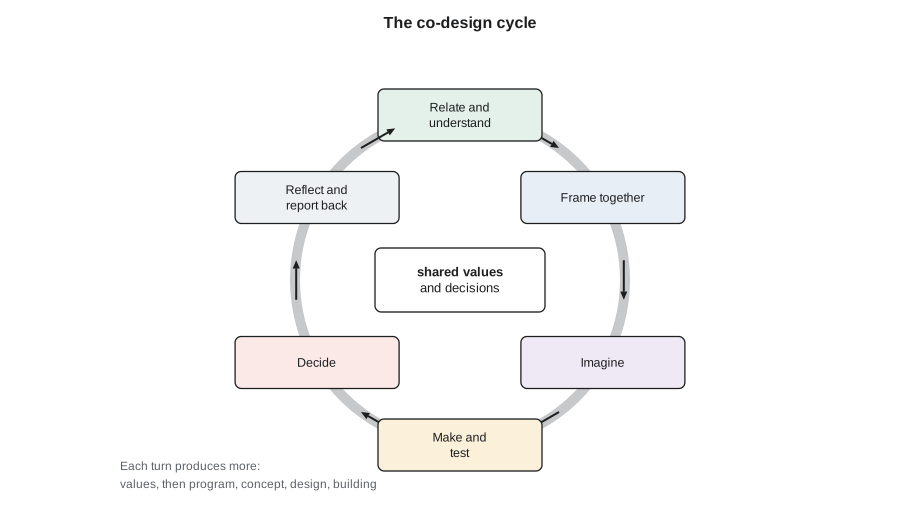
Co-design is a cycle rather than a line. Most processes move through phases that repeat as the project develops: building relationships and understanding; framing the problem together; imagining possibilities; making and testing proposals; deciding; and then reflecting and reporting back before the next round. Each turn of the cycle produces something more definite, from a shared statement of values to a program, a concept, a design and finally a building. The cycle continues after construction, when the community uses the building and teaches the designers what worked.
Relationships come first
Communities, especially those that have been harmed or ignored, judge designers by their behavior over time, not by their promises. Trust is built by showing up, listening, being honest about what you can and cannot do, doing what you said you would do and coming back, as Mrs. Flett asked. In practice this means spending time in the community before the project starts, attending events that have nothing to do with the project, meeting people individually as well as in groups and learning who the respected voices are. It also means acknowledging the history: if earlier projects or institutions broke promises, say so, and explain how this one will be different.
Every community has its own ways of deciding. A tenants' association may decide by vote; a First Nation by its council, often after consultation with members and Elders; an urban Indigenous organization by its board and its programs' participants; a faith community by its leaders and congregation. Ask how decisions are made, and design the process to fit. In many Indigenous communities, Elders and Knowledge Keepers hold particular authority on cultural matters, and protocols such as offering tobacco when asking for knowledge may apply. Learn these protocols from the community itself, and follow them.
Agreements and roles
Clear agreements protect both the community and the designer. A project charter or memorandum of understanding, written together at the start, can state the purpose of the project, the roles of each party, how decisions will be made, how disagreements will be resolved, how information will be shared, who owns the results and how community members will be paid or recognized for their time. For work with Indigenous communities, agreements increasingly address the ownership of cultural knowledge and data. The First Nations principles of OCAP, standing for ownership, control, access and possession, assert that First Nations own and control information about their communities. The CARE principles for Indigenous data governance, published by the Global Indigenous Data Alliance in 2019, ask that data use bring collective benefit, respect authority to control, carry responsibility and follow ethics.
Roles in a co-design process often include a steering or advisory group of community members with real authority over agreed decisions; community researchers or liaisons, paid to reach people the designers cannot; technical advisors such as engineers and cost consultants; and the design team. The architect often acts as a facilitator as well as a designer, which demands skills not always taught in school: running meetings, listening, translating between technical and everyday language and handling conflict.
| Agreement topic | Questions to settle |
|---|---|
| Purpose | What is the project for, and what is outside its scope? |
| Decisions | Which decisions does the community make, which are shared, which are technical? |
| Knowledge | Who owns stories, images and data shared during the project? |
| Compensation | How will community members be paid or recognized for their time and expertise? |
| Communication | How and how often will the team report back? |
| Conflict | How will disagreements be raised and resolved? |
| Benefits | What will the community gain beyond the building, such as jobs, training or ownership? |
Setting priorities together
Communities rarely want one thing. A neighborhood may want a building to provide childcare, a gathering hall, a kitchen, a youth space, offices for local organizations and green space, and the budget will not cover all of them. Setting priorities together is one of the most important and difficult parts of co-design. Simple voting by show of hands lets a majority overrule everyone else; ranking methods capture more information. In a Borda count, each person ranks the options, and each option receives points according to its rank, so that an option ranked second by everyone can beat one ranked first by a few and last by many. The following script compares a plurality vote with a Borda count for the priorities of a neighborhood workshop.
# Ranking community priorities: plurality vote versus Borda count
options = ["childcare", "kitchen", "youth space", "gathering hall", "garden"]
# each ballot ranks the five options from first to last; the number is how many people cast it
ballots = [
    (14, ["childcare", "kitchen", "gathering hall", "youth space", "garden"]),
    (11, ["youth space", "gathering hall", "kitchen", "garden", "childcare"]),
    (9,  ["garden", "kitchen", "gathering hall", "youth space", "childcare"]),
    (8,  ["gathering hall", "kitchen", "youth space", "childcare", "garden"]),
    (6,  ["kitchen", "gathering hall", "childcare", "garden", "youth space"]),
]
first = {o: 0 for o in options}
borda = {o: 0 for o in options}
for count, ranking in ballots:
    first[ranking[0]] += count
    for place, option in enumerate(ranking):
        borda[option] += count * (len(options) - 1 - place)
people = sum(c for c, _ in ballots)
print(f"{people} people ranked {len(options)} options")
print("plurality (first choices):", sorted(first.items(), key=lambda kv: -kv[1]))
print("Borda points: ", sorted(borda.items(), key=lambda kv: -kv[1]))48 people ranked 5 options
plurality (first choices): [('childcare', 14), ('youth space', 11), ('garden', 9), ('gathering hall', 8), ('kitchen', 6)]
Borda points: [('kitchen', 139), ('gathering hall', 129), ('youth space', 83), ('childcare', 76), ('garden', 53)]Childcare wins the plurality vote, because the largest single group put it first, but many others ranked it last. The kitchen and the gathering hall, ranked high by almost everyone, win the Borda count. Neither method is the right answer on its own. A Borda count can be gamed by people who rank a rival option last on purpose, and no voting method replaces discussion. But showing the community both results, and discussing why they differ, often leads to a better decision: here, perhaps, a shared kitchen and hall, with childcare provided elsewhere in the neighborhood or in a later phase.
Conflict and difference
Communities contain disagreement, and co-design brings it into the open. Long-time residents may want to keep a neighborhood as it is, while newcomers want change; parents may want quiet, while young people want a place to be loud; one group may want a building to look modern, another traditional. The designer's job is not to make conflict disappear but to make it productive: to help people understand one another's needs, to look for designs that serve several needs at once and, where choices must be made, to make them through the agreed process rather than by the loudest voice or the designer's taste.
Power differences inside the community matter too. Some members may be more confident, more educated or more connected to decision-makers than others. Methods that give everyone a turn, such as small groups, written or drawn responses and circles in which each person speaks in turn, help quieter people contribute. Talking circles, used in many Indigenous traditions, give each person uninterrupted time to speak, often while holding an object such as a feather or a stone, and they model a slower, more respectful way of deciding.
Community benefits
A building can benefit a community in more ways than its use. Construction contracts can include local hiring and training, especially for young people and people from groups excluded from the trades. Procurement can favor local and Indigenous-owned businesses. Community benefit agreements, negotiated between developers and community coalitions, can secure affordable housing, public space, jobs and funds in exchange for community support. Community ownership, through land trusts, co-operatives or Indigenous-led development corporations, can keep the value of a building in the community over the long term, as you saw with community land trusts in ARCH-340. Asking what a community gains beyond the building is part of designing with it.
A community engagement simulation
In the second half of the session, Professor Morningstar runs a simulation. Each student takes a role card: a long-time homeowner worried about traffic, a renter with three children, a teenager who plays basketball, an Elder who wants a quiet room and a garden for traditional plants, and the city's facilities manager with a fixed budget. Ernest Kowalchuk, Beatrice Lafontaine and Mrs. Flett play themselves. Together they must agree on the program for a small addition to the hub. After forty minutes, they have a list of six spaces, two arguments that are still unresolved and a promise from the city's role to report back on costs. In the debrief, Callum, who played the teenager, says he had not realized how easy it was to be ignored. Mrs. Flett says the students did better than many real meetings she has attended, because they listened.
Worked problem
Writing a co-design agreement
Wren's team is starting a design for a small community garden and gathering shelter with an urban Indigenous family-support organization. What should their first agreement with the organization cover?
Show solution
- Purpose and scope: a garden and shelter for programs, with a fixed budget and site.
- Decisions: the organization's program staff and participants decide the program and cultural content; the team proposes designs; both agree on the final design.
- Knowledge: any stories, plant knowledge or ceremonies shared belong to the organization and will not be published without its consent.
- Compensation: participants receive honoraria for workshops, and Elders are offered tobacco and an honorarium according to the organization's protocols.
- Reporting and benefits: the team reports back after every stage, and construction will hire through the organization's youth employment program where possible.
Answer: The agreement, signed by both parties, gives the organization authority over what matters most to it and makes the team's obligations explicit. It becomes the reference point when questions arise later.
Exercise 6: a priority workshop
This exercise takes about three hours.
- With classmates or friends playing community roles, run a priority workshop for a small public building with five possible spaces and a budget for three.
- Collect individual rankings and compute both a plurality result and a Borda count.
- Discuss the difference with the group and record the decision you reach and why.
- Deliverable: the rankings, both results and a 400-word reflection on what the process revealed.
Self-critique checklist
- Have I spent time building relationships before asking for decisions?
- Have I learned and followed the community's decision-making processes and protocols?
- Have I agreed in writing who owns the knowledge shared with me?
- Have I asked what the community gains beyond the building?
The simulation also showed how much depends on the facilitator. When the city's role announced the budget, the discussion narrowed at once to cost; when Mrs. Flett spoke about the garden, it widened again to meaning and memory. Good facilitators keep both conversations open, and they write down what each person says in their own words, so that the record belongs to the participants.
Common mistakes
MistakeStarting with a design proposal.
InsteadStart with relationships and shared understanding, then frame the problem together.
MistakeTreating the community as one voice.
InsteadCommunities contain disagreement and power differences; design the process so that quieter voices are heard.
MistakeUsing community knowledge without agreement.
InsteadAgree at the start who owns stories, images and data, following principles such as OCAP and CARE.
MistakeDisappearing after the consultation.
InsteadReport back on what changed, and come back after the building opens.
Summary and key terms
- Co-design is a partnership in which community members and designers make decisions together, each bringing different expertise.
- Co-design is a cycle of relating, framing, imagining, making, deciding and reporting back.
- Trust is built by behavior over time; learn and follow the community's decision-making processes and protocols.
- Agreements should cover purpose, decisions, knowledge ownership, compensation, communication, conflict and benefits.
- Ranking methods such as the Borda count, discussion and attention to community benefits help produce fair, lasting decisions.
- Co-design
- A process in which designers and community members design together as partners.
- OCAP
- First Nations principles of ownership, control, access and possession of information about their communities.
- Borda count
- A ranking method in which each option receives points according to its rank on each ballot.
- Community benefit agreement
- An agreement between a developer and a community coalition securing benefits such as jobs, housing or public space.
- Talking circle
- A practice in which each person speaks in turn without interruption, used in many Indigenous traditions.
Practice problems
Work each problem on paper first, then reveal the answer to check.
How does co-design differ from consultation?
Show answer
Community members are present when decisions are made and share them with designers, rather than only commenting before or after.
Name four topics a co-design agreement should cover.
Show answer
For example, purpose, decision-making, ownership of knowledge, compensation, reporting, conflict resolution and benefits.
What do the letters OCAP stand for?
Show answer
Ownership, control, access and possession.
Why can a Borda count give a different result from a plurality vote?
Show answer
It counts every ranking, so an option ranked high by most people can beat one ranked first by a large minority but last by many.
Give two ways a building project can benefit a community beyond its use.
Show answer
Local hiring and training, procurement from local and Indigenous businesses, community benefit agreements or community ownership.
Lesson quiz · 5 questions
Score 60% or more to complete this lesson.
Create a free account to save your progress, take quizzes and earn a certificate.