
ARCH-440 · Lesson 1 of 12 · 22 min
Architecture as cultural expression
The fourth-year seminar room at Elmhurst School has been rearranged. The tables are gone and the chairs form a circle, with a small table in the middle holding a bundle of sage, a piece of birchbark, a brick, a sheet of corrugated steel and a printed photograph of a glass office tower. Professor Tessa Morningstar waits until Wren, Callum, Ingrid and Joon-ho have sat down. She is an Ojibwe architect who grew up on a reservation in northern Minnesota, worked for twelve years in a practice that designs schools, clinics and housing with tribal nations across the Upper Midwest and the Plains, and now teaches and leads community design projects. 'Before we talk about buildings,' she says, 'I want each of you to tell me where you come from, not your address but the places and people that made you. Then pick up one thing from the table and tell me what it means to you.'
The introductions take most of an hour. Ingrid talks about her grandparents' farmhouse and picks up the corrugated steel, because the barns of her childhood were clad in it and to her it means work and weather. Joon-ho talks about the apartment block in Seoul where his parents grew up and the house his family bought later, and he picks up the brick. Callum says he never thought of himself as coming from anywhere in particular, which makes the others laugh, and then he talks about a cabin on a lake and picks up the birchbark. Wren picks up the photograph of the tower and says it means nothing to her at all, which, Professor Morningstar says, is exactly what its designers might have intended. 'Every one of these things means something,' she says, 'and the meaning is not in the material. It is in the people who made it, used it and remember it. That is what this course is about. Architecture is one of the ways people say who they are, and it is also one of the ways some people have told others who they must be.'
This course, ARCH-440, asks how architecture relates to culture, community and place. In ARCH-220 you studied theories of architecture as arguments made mostly by architects. Here the questions shift to the people for whom and with whom architects build. What does a building mean to the community that uses it? Who decides what a community needs? How has architecture been used to take land and erase cultures, and how is it being used to restore them? How should architects work with communities whose knowledge and values differ from their own? And how should we represent other people's places and lives in drawings, images and words? The course moves from ideas to practice and ends with a community design project.
What we mean by culture
Culture is one of the most difficult words in the language, and you will meet many definitions. For this course, a working definition is enough: culture is the shared ways of living, knowing, believing and making that a group of people learns, passes on and changes over time. It includes language, beliefs, customs, stories, kinship, law, ways of making a living and ways of building. Culture is not fixed or pure. Every culture borrows, adapts and changes, and every person belongs to several cultures at once, through family, nation, religion, profession, city and generation.
Anthropologists have long studied how buildings express and shape culture. The architect and theorist Amos Rapoport, in House Form and Culture (1969), argued that the form of traditional houses around the world cannot be explained by climate, materials or technology alone. The same climate supports very different houses, and the same materials are used in very different ways. What determines form, he argued, is mainly culture: ideas about family, privacy, the sacred, the relationship between men and women, the relationship with neighbors and the place of the dwelling in the world. Climate and materials set limits, but culture chooses among the possibilities. Rapoport later added that buildings communicate meanings that people read, often without thinking about them, a theme you met in the semiotics of postmodernism in ARCH-220.
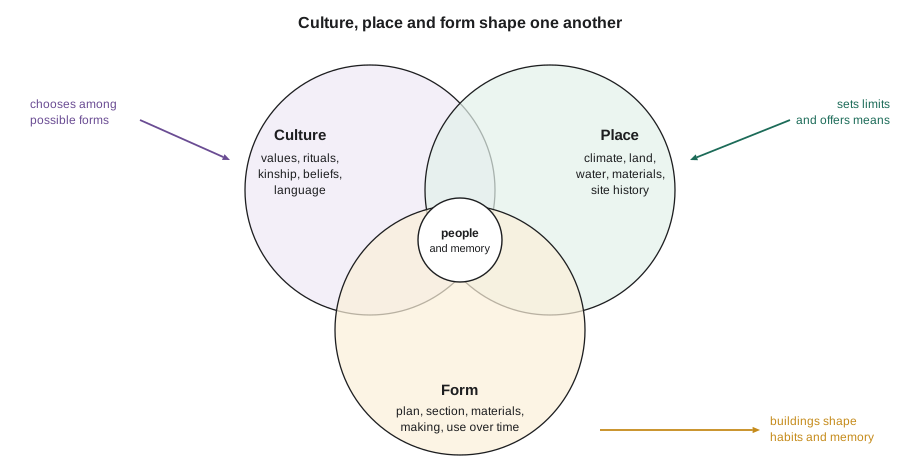
Buildings as cultural expression
At the scale of a whole society, buildings express what a culture values most. The great religious buildings of every civilization, from the temples of Egypt to medieval cathedrals and the mosques of Istanbul, show how much effort a society was willing to spend on its relationship with the sacred. Civic buildings, such as town halls, parliaments and courthouses, express ideas about authority and the public. Houses express ideas about family and privacy, and their arrangement into villages and cities expresses ideas about community. You studied many of these buildings in the history courses, ARCH-120 and ARCH-121, mostly through the eyes of the people who built them.
At the smaller scale of everyday life, culture appears in details that outsiders often overlook. Where people take off their shoes, where guests are received, which way a door faces, where the cooking happens and who is allowed in which room are all cultural choices. A Japanese house raises the floor and marks the step where shoes come off. Many houses in the Islamic world turn blank walls to the street and open onto inner courtyards that protect the privacy of the family. Many Anishinaabe and Diné traditions give importance to the east, the direction of the rising sun, and doors of traditional dwellings often face that way. When architects ignore these details, people adapt or suffer the building; when architects understand them, the building fits.
Culture also lives in how buildings are made. In many traditions, building is a communal act, with families and neighbors raising a frame or a roof together, as in the barn raisings of rural North America or the annual replastering of mud mosques in the Sahel. The process creates community as much as the product does. Industrialized construction separated the people who build from the people who use buildings, and modern architects rarely meet the people who will live in their work. Part of this course is about reconnecting those people.
Place and identity
Culture is always tied to place. The geographer Yi-Fu Tuan distinguished space, which is open and abstract, from place, which is space that has been given meaning through human experience and attachment. A place is somewhere that matters to someone. The Norwegian architect and theorist Christian Norberg-Schulz described the spirit of place, the genius loci, as the character that a location has through its landscape, light and history, and argued that good architecture helps people understand and belong to a place. The critical regionalism of Kenneth Frampton, which you studied in ARCH-220, drew on similar ideas.
For many Indigenous peoples, the relationship to place is deeper still. Land is not a resource or a backdrop but a relative, a teacher and the source of identity, law and language. Ceremonies, stories and names tie people to specific rivers, hills and trails over thousands of years. Bdote, the meeting of the Mississippi and Minnesota rivers near Fort Snelling, is a place of origin for many Dakota people, and it has been a gathering place for thousands of years, long before Minneapolis and Saint Paul existed. To design on such land without knowing its history is to repeat, in a small way, the erasures you will study in Lesson 4.
Place also shapes the identities of newer communities. Immigrant neighborhoods across North American cities show how people adapt inherited building cultures to new climates and lots: shopfronts become churches or temples, backyards become gardens of familiar plants, and porches become places to gather. Minneapolis's Cedar-Riverside neighborhood, settled successively by Scandinavian, Eastern European and East African immigrants, is full of such adaptations, from Lutheran churches to Somali malls in converted buildings along the avenues.
Architecture and power
Architecture does not only express culture; it also exercises power. Monumental buildings have always been used to impress and intimidate, from the palaces of kings to the government buildings of empires. In the colonial era, European powers built churches, forts, government houses and schools in a style imported from home, partly to make settlers feel at home and partly to show colonized peoples who was in charge. Cities were laid out in grids that ignored the land and the people who lived on it. Lesson 4 examines this history in detail.
Power also works through ordinary buildings and rules. Building codes, zoning bylaws, land surveys and housing programs decide what kinds of buildings are allowed and who may live where. In the twentieth century, governments built housing for Indigenous communities that ignored their ways of living, extended families and climate, and planned neighborhoods that excluded people by race and income. The French philosopher Michel Foucault, whom you met in ARCH-220, showed how institutions such as prisons, schools and hospitals use space to observe and control people. Seeing architecture as power does not mean that all architecture is oppressive, but it does mean that architects must ask whose interests a building serves.
Culture and the architect
Every architect brings a culture to the work: the culture of their upbringing, and the professional culture of architecture, with its own values, language and ways of seeing. Architects are trained to value originality, abstraction, visual composition and a particular kind of beauty. These values are not universal. A community may value continuity over originality, warmth over abstraction, and practical comfort over composition. The danger is not that architects have values, which is unavoidable, but that they mistake their values for everyone's.
Cultural humility is a useful term for the stance this course asks of you. Developed first in health care in the 1990s, it describes a lifelong commitment to self-reflection and learning, to recognizing the limits of your own knowledge and to sharing power with the people you serve. It differs from cultural competence, which suggests that you can master another culture by learning facts about it. You can learn facts, and you should, but humility means remembering that the community knows its own life better than you ever will.
| Approach | Assumption | Typical result |
|---|---|---|
| Universal design language | Good architecture is the same everywhere | Buildings that ignore local culture and climate |
| Stylistic borrowing | Culture is a set of shapes to apply | Buildings with symbols but little understanding |
| Cultural competence | Culture can be learned as facts | Better fit, but power stays with the architect |
| Cultural humility and co-design | The community knows its own life best | Buildings shaped by the people who use them |
Worked problem
Reading a building as cultural expression
Joon-ho is asked to write a short reading of a church in the North End of Minneapolis built by Ukrainian immigrants around 1915: a small timber building with three onion domes, a painted interior and a front porch facing the street. How should he read it as cultural expression?
Show solution
- Describe the building accurately: its plan, the domes, materials, decoration and its place on the street.
- Identify what the builders brought with them: the domed form and the arrangement of the interior follow Eastern Christian traditions from their homeland.
- Identify what they adapted: timber framing and siding, local materials and the city lot, which differ from the villages of Ukraine.
- Ask what the building meant to the community: a center of worship, language, mutual aid and memory for families far from home.
- Ask what it means now, a century later, to descendants, to newer neighbors and to the city.
Answer: The church is a cultural expression in its form, its making and its use. Reading it well means looking at what was carried, what was adapted and what it meant, then and now.
Exercise 1: a place that made you
This exercise takes about three hours.
- Choose a building or place that shaped who you are: a house, a school, a place of worship, a cabin, a street.
- Draw it from memory in plan or section, then write down what you remember about how it was used, by whom and when.
- Identify three cultural values that the place expressed or supported, and one that it suppressed or excluded.
- Deliverable: one sheet with the drawing and a 500-word reflection on what the exercise taught you about your own cultural assumptions as a designer.
Self-critique checklist
- Have I described culture as living and changing, not fixed?
- Have I separated what the building expresses from what I assume it expresses?
- Have I asked who was included and who was excluded?
- Have I noticed my own cultural and professional values in my judgment?
Common mistakes
MistakeTreating culture as a set of decorative symbols.
InsteadCulture is a whole way of living; it appears in plans, rituals, making and use, not only in ornament.
MistakeAssuming that climate and materials determine building form.
InsteadThey set limits, but culture chooses among many possible forms, as Rapoport showed.
MistakeSpeaking of a community's culture as if it were uniform and unchanging.
InsteadEvery community contains different views, and every culture adapts and borrows over time.
MistakeAssuming your own professional values are neutral.
InsteadArchitectural training carries its own culture; name your values so that you can test them against the community's.
Summary and key terms
- Culture is the shared and changing ways of living, knowing, believing and making that a group learns and passes on.
- Rapoport argued that culture, more than climate or materials, chooses the form of traditional houses.
- Place is space given meaning by human experience; for many Indigenous peoples land is a relative and a source of identity and law.
- Architecture expresses culture and also exercises power, through monuments, plans, codes and housing programs.
- Cultural humility asks architects to reflect on their own values, learn continuously and share power with communities.
- Culture
- The shared ways of living, knowing, believing and making that a group learns, passes on and changes over time.
- Place
- Space that has been given meaning through human experience and attachment.
- Genius loci
- The spirit or character of a place, in the writing of Norberg-Schulz.
- Cultural humility
- A commitment to self-reflection, continuous learning and sharing power with the people served.
- Cultural competence
- Knowledge and skills for working across cultures, sometimes criticized for suggesting that culture can be mastered.
Practice problems
Work each problem on paper first, then reveal the answer to check.
What did Amos Rapoport argue in House Form and Culture (1969)?
Show answer
That the form of traditional houses is chosen mainly by culture, with climate, materials and technology setting limits rather than determining form.
How did Yi-Fu Tuan distinguish space from place?
Show answer
Space is open and abstract; place is space given meaning through human experience and attachment.
Give two ways that culture appears in the everyday details of a house.
Show answer
For example, where shoes come off, where guests are received, which way doors face, and who may enter which rooms.
How can ordinary rules such as zoning and building codes exercise power?
Show answer
They decide what may be built and who may live where, and they have been used to impose ways of living and to exclude people.
How does cultural humility differ from cultural competence?
Show answer
Competence suggests culture can be mastered as facts; humility is an ongoing practice of self-reflection, learning and sharing power with the community.
Lesson quiz · 5 questions
Score 60% or more to complete this lesson.
Create a free account to save your progress, take quizzes and earn a certificate.