
ARCH-440 · Lesson 5 of 12 · 21 min
Participatory design
In the fifth week, Professor Morningstar sets the students a challenge before they have even sat down. On the table is a cardboard model of a small public library, glued together, with a sign reading Final design. 'Imagine you are a parent who lives across the street,' she says. 'The city has invited you to a public consultation about this library. You arrive, and this is what is on the table. What can you say?' Ingrid says she could say she likes it or does not. Callum says he could ask about parking. Joon-ho says he would probably say nothing and go home. 'Now imagine you arrive and the table holds a site plan, a pile of blocks the size of rooms, and the city's budget,' the professor says, sweeping the model aside and replacing it with exactly that. 'What can you say now?' After a moment, Wren says: 'Anything.'
Participatory design is design in which the people who will use, live near or be affected by a building or place take part in shaping it, not only in commenting on finished proposals. It ranges from simple consultation to full community control, and it has a history of ideas, methods and failures that every architect should know. This lesson traces that history, examines the main methods and asks the hard questions: who participates, who decides and what makes participation real rather than a show.
Why participation?
There are three main arguments for participation. The first is ethical: people have a right to shape the places that shape their lives, especially when public money or public land is involved. The second is practical: users know things about their needs, habits and neighborhood that no architect can learn from a brief, and buildings designed with them tend to work better and to be cared for. The third is political: participation can shift power toward communities that have been excluded from decisions, and it can build the skills, relationships and confidence that a community needs to act on its own behalf. Participation also has costs: it takes time, money and skill, and it can raise expectations that a project cannot meet.
The ladder of participation
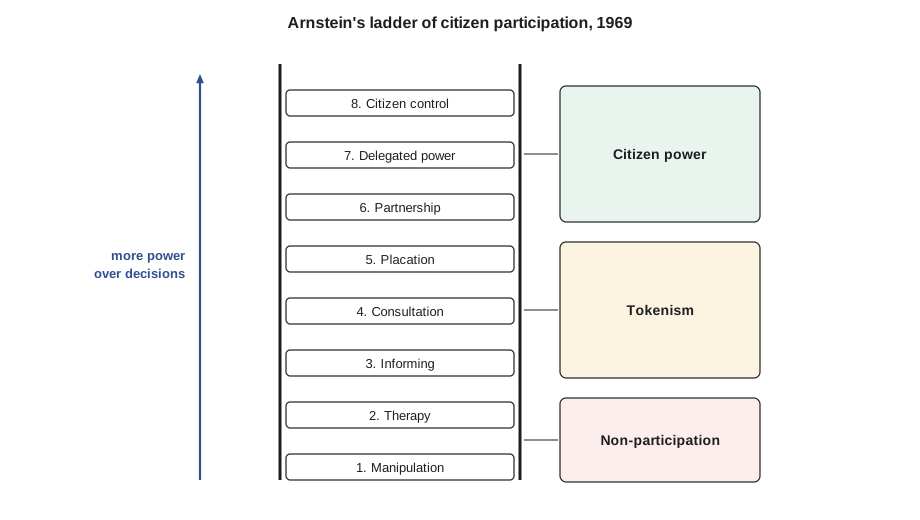
The most influential framework for thinking about participation was published in 1969 by Sherry Arnstein, who had worked on federal urban programs in the United States. Her article A Ladder of Citizen Participation described eight rungs. At the bottom, manipulation and therapy are not participation at all but attempts to persuade or pacify people. In the middle, informing, consultation and placation are degrees of tokenism: people may be heard but have no power to make their views count. At the top, partnership, delegated power and citizen control give people real power over decisions. Arnstein's point was blunt: participation without redistribution of power is an empty ritual.
In ARCH-340 you met a more recent framework, the spectrum of public participation from the International Association for Public Participation, which runs from inform through consult, involve and collaborate to empower. The spectrum is useful for planning engagement, because it asks you to state honestly what promise you are making to participants at each level. Its weakness, from Arnstein's point of view, is that it presents all levels as legitimate choices, while Arnstein treated the lower rungs as failures of democracy. In practice, many projects mix levels: a community might control the program, collaborate on the design and be informed about technical decisions.
A history of participation in architecture
Participation in architecture grew out of the social movements of the 1960s and the failures of top-down planning that you studied in ARCH-220 and ARCH-340. In 1965 the planner Paul Davidoff called for advocacy planning, in which professionals would represent communities that lacked a voice. In the United States, community design centers, often linked to universities, began to offer free design help to low-income neighborhoods. In the Netherlands, John Habraken's book Supports (1961) proposed that mass housing should provide a permanent structural support within which residents could build and change their own dwellings. The English architect John F. C. Turner, after working in the self-built settlements of Lima, argued in Freedom to Build (1972) and Housing by People (1976) that housing works best when residents control it, and that housing should be judged by what it does for people, not by what it looks like.
Several European projects of the period became famous. In Terni, Italy, Giancarlo De Carlo designed the Villaggio Matteotti (1969 to 1975), housing for steelworkers, through long discussions with the future residents, who rejected the company's standard designs and shaped new ones. In Newcastle, England, Ralph Erskine's office set up in a shop in the Byker neighborhood during the design of the Byker Wall estate (1969 to 1982), so that residents could drop in, see plans and argue. In Belgium, Lucien Kroll designed student housing at Louvain with students taking part, producing a deliberately varied, untidy building as an argument against uniformity. In the United States, Christopher Alexander and his colleagues published A Pattern Language (1977), a set of 253 design patterns intended to let ordinary people design their own buildings and towns, after testing the method at the University of Oregon.
In Scandinavia, a different strand of participatory design emerged in the 1970s and 1980s, as trade unions and researchers worked with workers to shape the computer systems being introduced into their workplaces. This tradition, sometimes called the Scandinavian approach, developed many of the methods, such as mock-ups, design games and workshops, that are now used in architecture and in the design of digital services. Today participatory methods are common in public projects, from parks and libraries to social housing, and community design organizations work in many North American cities.
| Project or idea | Who | Date | Contribution |
|---|---|---|---|
| Advocacy planning | Paul Davidoff | 1965 | Professionals representing excluded communities |
| Supports | John Habraken | 1961 | Permanent structure, changeable dwellings |
| Housing by People | John F. C. Turner | 1976 | Resident control of housing |
| Villaggio Matteotti, Terni | Giancarlo De Carlo | 1969 to 1975 | Housing shaped by steelworkers' families |
| Byker Wall, Newcastle | Ralph Erskine | 1969 to 1982 | Architects' office in the neighborhood |
| A Ladder of Citizen Participation | Sherry Arnstein | 1969 | Participation measured by power |
| A Pattern Language | Christopher Alexander and others | 1977 | Design patterns usable by non-architects |
Methods
Participation uses many methods, and good practice chooses them to suit the people, the project and the stage. Early in a project, when the questions are open, listening methods work best: interviews, small group conversations, walks through the neighborhood with residents, photovoice, in which participants photograph places that matter to them and explain why, and community mapping. Once there is a program, hands-on methods let people shape space directly: building models with blocks or cardboard, arranging cut-out room plans on a site plan, playing design games with cards that represent rooms, budgets or choices, and full-scale mock-ups marked out with tape or cardboard. As the design develops, review methods let people test proposals: open houses, exhibitions, online models and comment maps.
A charrette, a word taken from the cart in which nineteenth-century Paris students rushed their drawings to the school, is an intensive workshop over a few days in which designers, residents and officials work together and produce proposals on the spot. Charrettes are efficient and energizing, but they favor people who can attend for several days and speak confidently. Digital tools, such as online surveys and interactive maps, reach people who cannot come to meetings, but they can exclude those without internet access or who are less comfortable with technology. No single method reaches everyone, so good engagement combines several.
Who participates?
The hardest problem in participation is that the people who show up are rarely representative. Public meetings tend to attract homeowners, older people, people with time and confidence and people who oppose change. Renters, young people, shift workers, newcomers, people with disabilities and people who do not speak the dominant language are often missing, though they may be most affected. Good practice goes to people rather than waiting for them: meeting in places people already gather, at times that suit them, with childcare, food, interpretation and accessible formats, and paying people for their time and expertise when appropriate.
It is useful to compare who participated with who lives in the area. The following script compares the participants in a set of workshops with the population of the neighborhood and calculates a weight for each group, so that the views of under-represented groups count fairly when results are summarized.
# Who took part in the workshops, compared with who lives in the area?
area = {"homeowners": 0.38, "renters": 0.62}               # share of households
ages = {"under 30": 0.31, "30 to 64": 0.50, "65 and over": 0.19}
took_part = {"homeowners": 71, "renters": 29}               # participants
took_part_ages = {"under 30": 9, "30 to 64": 58, "65 and over": 33}

def compare(pop, part):
    n = sum(part.values())
    print(f"{'group':12s} {'area':>6s} {'took part':>10s} {'weight':>7s}")
    for g in pop:
        share = part[g] / n
        print(f"{g:12s} {pop[g]:6.0%} {share:10.0%} {pop[g] / share:7.2f}")

compare(area, took_part)
print()
compare(ages, took_part_ages)
# support for a proposal among each group, from a show of hands
support = {"homeowners": 0.35, "renters": 0.80}
raw = sum(took_part[g] * support[g] for g in support) / sum(took_part.values())
weighted = sum(area[g] * support[g] for g in support)
print(f"\nsupport as counted in the room: {raw:.0%}")
print(f"support weighted to the area: {weighted:.0%}")group area took part weight homeowners 38% 71% 0.54 renters 62% 29% 2.14 group area took part weight under 30 31% 9% 3.44 30 to 64 50% 58% 0.86 65 and over 19% 33% 0.58 support as counted in the room: 48% support weighted to the area: 63%
The result shows how much the room can mislead. Homeowners and older people were heavily over-represented, so a proposal that most renters supported appeared to have only minority support. Weighting is a crude correction, and it cannot replace the views of people who were never asked. The lesson is to plan outreach so that the people in the room resemble the people in the area, and to report honestly who took part.
Tokenism, fatigue and the limits of participation
Participation fails in familiar ways. Tokenism invites people to comment when the decisions have already been made, as in the parent's visit to the finished library model. Consultation fatigue sets in when communities, especially marginalized ones, are asked the same questions repeatedly by different agencies and never see results. Capture happens when a small, organized group dominates and speaks for everyone. Participation can also be used to delay or block needed projects, such as affordable housing, when nearby residents use the process to protect their own interests. Architects need to be honest about the scope of each process, report back to participants on what changed because of their input, and recognize that some decisions, such as whether to build housing for people who do not yet live in an area, cannot be left only to those who already do.
Worked problem
Moving up the ladder
The city has asked Joon-ho's studio team to run engagement for a new neighborhood park. The city's draft plan proposes two public meetings to present three design options and collect comments. Where is this on Arnstein's ladder, and how could it move higher?
Show solution
- Place the plan: presenting finished options and collecting comments is consultation, a form of tokenism, unless comments clearly change the outcome.
- Ask what decisions are genuinely open: the program, the location of features, the budget split, the name, the planting.
- Propose earlier involvement: walks and mapping with residents before any options exist, to shape the program.
- Propose collaboration on design: workshops where residents arrange elements on a site model within the real budget.
- Propose shared decision-making: a resident advisory group with an agreed role in choosing the final design, and a report back showing how input changed the plan.
Answer: The revised plan moves the process from consultation toward partnership. It costs more time, but it gives residents real influence and the city a park people feel is theirs.
Exercise 5: design a participation process
This exercise takes about four hours.
- Choose a real public project in your city that is in planning or design.
- Identify who is affected and who has taken part so far, using public records and meeting reports.
- Design a participation process for the next stage, stating the level of influence promised at each step and the methods for reaching under-represented groups.
- Deliverable: a one-page process diagram, a budget and timeline, and a 500-word rationale.
Self-critique checklist
- Have I stated honestly what decisions are open?
- Have I planned to reach people who do not come to meetings?
- Have I planned to report back to participants?
- Have I considered the people who will live in or use the project in future but are not here yet?
Common mistakes
MistakePresenting a finished design and calling it participation.
InsteadWhen decisions are already made, comment is tokenism; involve people while choices are still open.
MistakeAssuming the people in the room represent the community.
InsteadCompare participants with the population and plan outreach to reach those who are missing.
MistakePromising more influence than the project can deliver.
InsteadState the level of influence honestly at the start and keep to it.
MistakeTreating participation as a one-time event.
InsteadReal participation runs through the project and reports back on what changed.
Summary and key terms
- Participatory design involves people affected by a project in shaping it, from consultation to community control.
- Arnstein's ladder (1969) measures participation by the power it gives people over decisions.
- Pioneers included Davidoff, Habraken, Turner, De Carlo, Erskine, Kroll and Alexander, and the Scandinavian participatory design tradition.
- Methods range from listening and mapping to hands-on model building, design games, charrettes and digital tools.
- Participation often fails through tokenism, unrepresentative participants, fatigue and capture; honest scope and reporting back are essential.
- Participatory design
- Design in which people affected by a project take part in shaping it.
- Tokenism
- Inviting people to comment without giving their views real power over decisions.
- Charrette
- An intensive workshop in which designers and community members develop proposals together over a few days.
- Photovoice
- A method in which participants photograph places that matter to them and explain their meaning.
- Consultation fatigue
- Weariness when communities are asked repeatedly for input without seeing results.
Practice problems
Work each problem on paper first, then reveal the answer to check.
What are the three groupings of rungs in Arnstein's ladder?
Show answer
Non-participation (manipulation, therapy), tokenism (informing, consultation, placation) and citizen power (partnership, delegated power, citizen control).
What did John Habraken propose in Supports (1961)?
Show answer
That mass housing provide a permanent structural support within which residents build and change their own dwellings.
Why did Ralph Erskine's office set up in a shop in Byker?
Show answer
So that residents could drop in, see plans and argue during the design of the estate.
Why are public meetings often unrepresentative?
Show answer
They attract people with time, confidence and property, while renters, young people, shift workers and newcomers are often missing.
What is consultation fatigue, and how can architects reduce it?
Show answer
Weariness from repeated requests without results; coordinate with other agencies, ask only what can be acted on and report back on outcomes.
Lesson quiz · 5 questions
Score 60% or more to complete this lesson.
Create a free account to save your progress, take quizzes and earn a certificate.