
ARCH-320 · Lesson 4 of 12 · 22 min
Heat pumps and electrification
In week four, Carvalho takes the students to the roof of the Elmhurst School building on a cold, bright October morning. Two years ago the school replaced one of its gas boilers with a bank of air-source heat pumps, which now sit on a steel frame behind a louvered screen, fans turning slowly. Frost has formed on the fins of one unit, and as the students watch, it stops, gives a hiss and sends a cloud of steam into the air. 'Defrost,' says Carvalho. 'It is pulling heat out of air that is below freezing, and every so often it has to clear the ice it makes. That is the miracle and the problem of heat pumps in a cold climate.' Ingrid's environmental strategy for the community hub chose air-source heat pumps; this lesson explains how they work, how well they work in Minneapolis winters, and what electrification means for the design of buildings.
How a heat pump works
A heat pump moves heat from a cold place to a warm place, the opposite of the natural direction, by using work. It does so with a refrigerant that circulates in a closed loop through four components. In the evaporator, outdoors in winter, the refrigerant is colder than the outdoor air, so it absorbs heat and evaporates. The compressor squeezes the vapor, raising its pressure and temperature. In the condenser, indoors, the hot vapor gives up its heat to the building's air or water and condenses to a liquid. The expansion valve drops the liquid's pressure, cooling it so that it can absorb heat again. A reversing valve lets the same machine run backwards in summer, as an air conditioner.
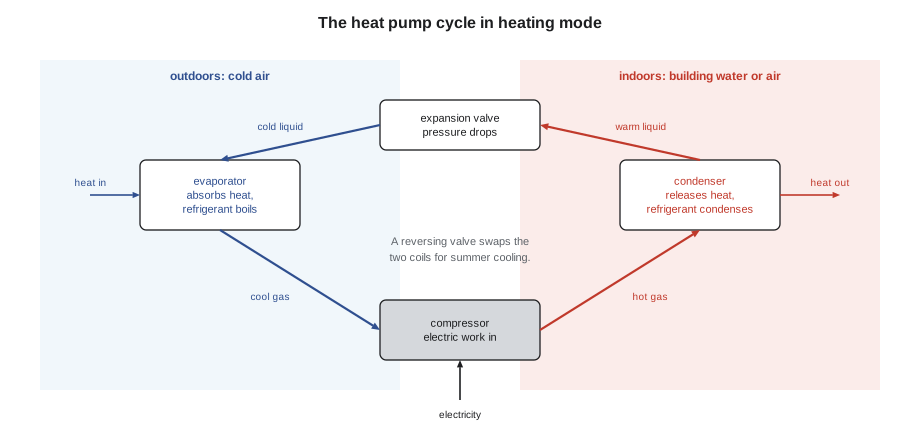
The performance of a heat pump is measured by its coefficient of performance (COP): the heat delivered divided by the electricity used. A COP of 3 means three units of heat for each unit of electricity, two of them taken from the outdoor air. An electric resistance heater, such as a baseboard, has a COP of exactly 1, and a gas boiler, which burns fuel, delivers less than one unit of heat for each unit of fuel energy.
The second expression is the theoretical limit, the Carnot COP. It shows why heat pumps get worse as it gets colder outside: the bigger the temperature lift between the outdoor air and the indoor water or air, the more work each unit of heat needs. Delivering heat at 95 °F, as a radiant floor can, from outdoor air at −13 °F is a lift of 60 degrees Celsius; real machines achieve perhaps a third to a half of the theoretical limit. That is why low-temperature heat distribution, radiant floors and large fan coils, suits heat pumps much better than old radiators designed for very hot water.
Cold-climate heat pumps
Twenty years ago, air-source heat pumps lost most of their capacity below about 14 °F and needed full backup heat. Cold-climate heat pumps, with variable-speed compressors and refrigerant circuits designed for low temperatures, now keep a large share of their rated capacity down to −13 °F and run at even lower temperatures, with COPs well above 1. Testing in Prairie and northern climates has shown them working through cold snaps, though at reduced capacity and efficiency. They still need defrost cycles when frost builds up on the outdoor coil, and they need some form of backup heat, or enough capacity, for the coldest days.
Ground-source heat pumps take heat from the ground through buried loops of pipe, either in vertical boreholes perhaps 300 to 500 feet deep or in horizontal trenches. The ground below a few meters stays at a steady temperature year round, about 45 to 50 °F in southern Minnesota, so a ground-source system keeps a steady COP through the winter and needs no defrost. Ground loops cost much more than outdoor units, and boreholes need space, often under a parking lot or courtyard, and drilling rigs during construction. On a tight urban site such as the Riverlot lot, there may be no room for enough boreholes.
Balance point and seasonal performance
A heat pump's capacity falls as the outdoor temperature drops, while the building's heat loss rises. The temperature at which the two lines cross is the balance point: below it, the heat pump alone cannot keep up, and backup heat or a second machine must make up the difference. Engineers choose the heat pump's size by deciding where the balance point should be. A larger heat pump lowers the balance point and reduces backup heat, but costs more and runs more of the year at low capacity.
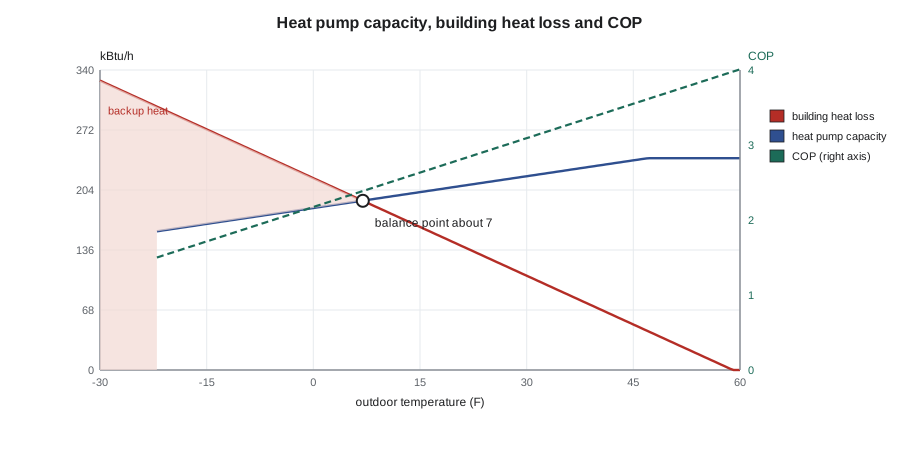
Priyanka Sethi helps Ingrid check whether the two air-source heat pumps she chose for the hub, with a combined rated capacity of 240,000 Btu/h in mild weather, can heat the building through a typical winter. They use temperature bins: the number of hours in a typical heating season that the outdoor temperature falls in each band. The bin hours and the heat pump's performance curves are approximate studio values.
# Seasonal performance of the hub's air-source heat pumps (approximate studio values)
design_load, t_design, t_zero = 269, -14, 59     # load (kBtu/h) at the design temperature; no load above t_zero
rated = 240                                      # heat pump capacity in mild weather (kBtu/h)
cutoff = -22                                       # below this the heat pumps stop
bins = {-30: 20, -20: 110, -10: 300, 0: 560, 10: 800, 20: 950, 30: 1050, 40: 950, 50: 850}                                      # outdoor temperature (F): hours per year

def load(t):
    return max(0.0, design_load * (t_zero - t) / (t_zero - t_design))
def capacity(t):
    return 0.0 if t < cutoff else rated * min(1.0, 0.7 + 0.005 * (t - (-13)))
def cop(t):
    return 1.5 + 0.0306 * (t - (-22))

heat = hp_heat = elec = backup = 0.0
for t, h in sorted(bins.items()):
    q = load(t)
    from_hp = min(q, capacity(t))
    extra = q - from_hp
    heat += q * h; hp_heat += from_hp * h; backup += extra * h
    elec += (from_hp / cop(t) + extra) * h      # backup heat is electric resistance
    print(f"{t:4d} F: load {q:6.1f}, heat pumps {from_hp:6.1f}, backup {extra:5.1f} kBtu/h, COP {cop(t):.2f}")
t = cutoff
while capacity(t) < load(t):
    t += 0.1
print(f"balance point about {t:.0f} F")
print(f"share of the season's heat from the heat pumps: {hp_heat / heat:.3f}")
print(f"seasonal COP including backup: {heat / elec:.2f}")-30 F: load 328.0, heat pumps 0.0, backup 328.0 kBtu/h, COP 1.26 -20 F: load 291.1, heat pumps 159.6, backup 131.5 kBtu/h, COP 1.56 -10 F: load 254.3, heat pumps 171.6, backup 82.7 kBtu/h, COP 1.87 0 F: load 217.4, heat pumps 183.6, backup 33.8 kBtu/h, COP 2.17 10 F: load 180.6, heat pumps 180.6, backup 0.0 kBtu/h, COP 2.48 20 F: load 143.7, heat pumps 143.7, backup 0.0 kBtu/h, COP 2.79 30 F: load 106.9, heat pumps 106.9, backup 0.0 kBtu/h, COP 3.09 40 F: load 70.0, heat pumps 70.0, backup 0.0 kBtu/h, COP 3.40 50 F: load 33.2, heat pumps 33.2, backup 0.0 kBtu/h, COP 3.70 balance point about 7 F share of the season's heat from the heat pumps: 0.911 seasonal COP including backup: 2.25
The heat pumps meet the whole load down to a balance point of about 7 °F and part of it below that, until they stop at the cut-off temperature. Over a typical season they deliver about 91 of every 100 units of the hub's heat, and the backup heaters supply the rest during the coldest hours. The seasonal COP, including the backup, is about 2.2, so the hub uses less than half as much energy for heating as it would with electric baseboards. Sethi points out that the backup heat, though a small share of the season's energy, decides the peak electrical demand on the coldest night: the heat pumps chosen for the hub stop below −22 °F, so on the design night the backup heaters must carry the whole load, about 270,000 Btu/h, and resistance heat at a COP of 1 needs far more power than the heat pumps. That peak sets the size of the electrical service, lesson 8.
There are several ways to reduce the backup: a better envelope, which lowers the design load; larger or more heat pumps; a ground-source system; thermal storage, such as a large tank of hot water heated in milder hours; or, for buildings with gas service, a small gas boiler kept only for the coldest days, a hybrid that some utilities encourage. Each has a cost, and the choice depends on the climate, the grid and the client's carbon goals.
Heat pumps for hot water
Water heating is often the second largest energy use in housing, after space heating. Heat pump water heaters work on the same cycle, taking heat from the surrounding air or from outdoors. Central heat pump water heaters for apartment buildings, some using carbon dioxide as a refrigerant, can heat water to 140 to 150 °F efficiently even in cold weather, and store it in large tanks that also let the system run when electricity is cheapest. Their tanks are larger than those of gas water heaters, so the plant room must be planned for them; lesson 6 sizes them for the Riverlot building.
Refrigerants
Refrigerants are chosen for their thermodynamic properties, but they also affect the climate if they leak, because many are powerful greenhouse gases. Their warming effect is measured by global warming potential (GWP), relative to carbon dioxide. The common refrigerant of recent decades, R-410A, has a GWP of about 2,000. Since January 1, 2025, rules under the American Innovation and Manufacturing Act have required most new residential and light commercial air conditioners and heat pumps to use refrigerants with a GWP of 700 or less, which in practice means R-454B or R-32. These refrigerants are classed A2L: of low toxicity but mildly flammable. They bring new rules for the amount of refrigerant in a system, leak detection and ventilation in rooms where refrigerant pipes or indoor units sit, which matter for systems such as VRF that run refrigerant through occupied rooms. Natural refrigerants, such as carbon dioxide, propane and ammonia, have very low GWPs and are used in some heat pump water heaters, grocery refrigeration and large plants.
Electrification and the building
Replacing fuel-burning equipment with electric heat pumps changes a building's architecture in ways that should be planned from the start.
- No chimneys, flues, gas meters or combustion air openings, and no gas piping through the building.
- Outdoor units that need space, airflow, snow clearance, drainage for defrost water and screening, usually on the roof or at grade.
- Larger electrical rooms, transformers and service capacity, and attention to the peak demand on the coldest night.
- Low-temperature heat distribution, with larger emitters or radiant surfaces, which favors good envelopes.
- Larger hot water storage for heat pump water heaters.
- Kitchens with induction cooking, which needs adequate electrical circuits but improves indoor air quality.
The federal tax credit for home heat pumps ended for equipment placed in service after December 31, 2025. Minnesota's planned rebate program for income-qualified households, funded by the federal government, would offer up to 8,000 dollars for a cold-climate heat pump, but as of 2026 it was still waiting for federal approval to launch. Utility rebates continue, so designers check the current offers at the start of each project.
Worked problem
A hybrid or all-electric hub?
The community hub's board asks whether it should keep a small gas boiler for the coldest nights, which would avoid the electric backup heaters and reduce the peak electrical demand. How should Ingrid answer?
Show solution
- A gas boiler for backup would cut the peak electrical demand on the coldest nights and might allow a smaller electrical service.
- But it would bring back a gas service, a meter, a flue through the roof, combustion air, carbon monoxide detection and annual maintenance, all for a few dozen hours a year.
- In Minnesota, where the grid is getting cleaner every year, the carbon comparison will tip further toward electricity over the building's life, so a gas backup would look worse each year.
- A larger heat pump plant, a third heat pump on the roof, or a hot water storage tank charged in the hours before a cold night could reduce the backup heat without gas.
- Ingrid recommends staying all-electric, adding a storage tank of about 800 gallons to the heating loop and a third heat pump sized for future growth, and asks the engineer to check the electrical service with that peak.
Answer: Electrification decisions balance peak electrical demand, carbon, complexity and maintenance; storage and better envelopes can replace backup fuels.
Exercise 4: heat pump strategy
This exercise takes one week.
- Choose a heat pump strategy for the Riverlot building: air-source, ground-source, or a combination with storage.
- Estimate the design heating load of the whole building and size the heat pump plant for a chosen balance point.
- Draw the rooftop or ground-level plant area, showing clearances, screening, snow and defrost drainage.
- Estimate the seasonal COP and the peak electrical demand on the coldest night.
Self-critique checklist
- Have I chosen a low-temperature heat distribution system?
- Have I planned for defrost water and snow around outdoor units?
- Do I know the balance point and what happens below it?
- Have I considered refrigerant type and where refrigerant pipes run?
Common mistakes
MistakeAssuming heat pumps do not work in cold climates.
InsteadUse cold-climate heat pumps, size them for a chosen balance point and plan backup.
MistakeFeeding heat pumps into high-temperature radiators.
InsteadUse low-temperature distribution such as radiant floors or large fan coils.
MistakeIgnoring the peak electrical demand of backup heat.
InsteadCheck the coldest-night demand and reduce it with storage or more capacity.
MistakePlacing outdoor units where snow drifts or defrost water freezes on walkways.
InsteadRaise units, provide drainage and keep them clear of paths and windows.
MistakeRunning refrigerant pipes through rooms without considering A2L safety rules.
InsteadPlan refrigerant routes, charges and leak detection with the engineer.
Summary and key terms
- A heat pump moves heat with a refrigerant cycle of evaporator, compressor, condenser and expansion valve.
- Its COP falls as the temperature lift grows, so low-temperature distribution helps.
- Cold-climate air-source heat pumps work in Prairie winters with some backup; ground-source systems give steady performance but cost more.
- The balance point decides how much backup heat is needed and the peak electrical demand.
- Electrification changes plant rooms, roofs, electrical services and refrigerant choices.
- Heat pump
- A machine that moves heat from a cold place to a warm place using work.
- COP
- Coefficient of performance: heat delivered divided by electricity used.
- Balance point
- The outdoor temperature at which heat pump capacity equals the building heat loss.
- Defrost cycle
- A period when a heat pump reverses to melt frost on its outdoor coil.
- GWP
- Global warming potential of a gas relative to carbon dioxide.
- A2L refrigerant
- A low-toxicity, mildly flammable refrigerant class, such as R-454B and R-32.
Practice problems
Work each problem on paper first, then reveal the answer to check.
A heat pump delivers 12 kW of heat while using 4 kW of electricity. What is its COP?
Show answer
3.
Why does a heat pump's COP fall in colder weather?
Show answer
The temperature lift between outdoor air and indoor heat grows, so more work is needed per unit of heat.
What happens below the balance point?
Show answer
The heat pump cannot meet the load alone, so backup heat or more capacity is needed.
Give two architectural consequences of electrifying a building.
Show answer
Any two of: no chimneys or gas meters, outdoor units to place and screen, larger electrical rooms, larger hot water tanks.
Why do A2L refrigerants bring new rules for occupied rooms?
Show answer
They are mildly flammable, so charges, leak detection and ventilation must be controlled.
Lesson quiz · 5 questions
Score 60% or more to complete this lesson.
Create a free account to save your progress, take quizzes and earn a certificate.