
ARCH-310 · Lesson 4 of 12 · 24 min
Vapor control
For the fourth lesson, Professor Ruth Abernathy, who taught the environmental systems course the previous spring, joins Lavoie in the studio. On the screen is the temperature profile Abernathy drew for the community hub's wall: a line falling steeply across the insulation, and a dashed line for the dew point of the indoor air. 'Last term we found that the sheathing in this wall sits below the dew point on a design night,' Abernathy says. 'At minus 14 °F, even with exterior insulation, the sheathing is warmer than it would otherwise be, but not warm enough. We concluded that the warm-side air barrier and vapor retarder must keep indoor moisture away from it.' Lavoie adds the question this lesson answers: 'How tight must that retarder be, where should it go, and what happens if we put a vapor-tight layer in the wrong place?' Vapor control is the most misunderstood of the four control functions. It is also the one where well-meant rules of thumb, applied in the wrong climate or the wrong assembly, cause the most damage.
Vapor, humidity and diffusion
Air always contains some water vapor. Its amount can be described by the vapor pressure, the part of the air pressure due to the water molecules, or by the humidity ratio, the mass of water per mass of dry air. Warm air can hold more vapor than cold air before it becomes saturated; the saturation vapor pressure roughly doubles with every 20 °F rise in temperature. Relative humidity is the ratio of the actual vapor pressure to the saturation pressure at the same temperature. When moist air touches a surface colder than its dew point, the temperature at which it would be saturated, vapor condenses as liquid or, below freezing, as frost.
In a heated building in winter, the indoor air at 70 °F and 35 of every 100 parts of saturation has a vapor pressure of about 870 pascals, while the outdoor air on a January day might have a vapor pressure of a hundred or so, even near saturation, because it is so cold. Vapor therefore moves outward through the envelope in winter, from high vapor pressure to low, by two mechanisms. The first, air leakage, was the subject of the previous lesson and is by far the larger. The second, vapor diffusion, is the slow movement of water molecules through solid materials, independent of any airflow. Diffusion depends on the vapor pressure difference and on the vapor permeance of the materials, the rate at which they let vapor through.
Permeance and vapor retarders
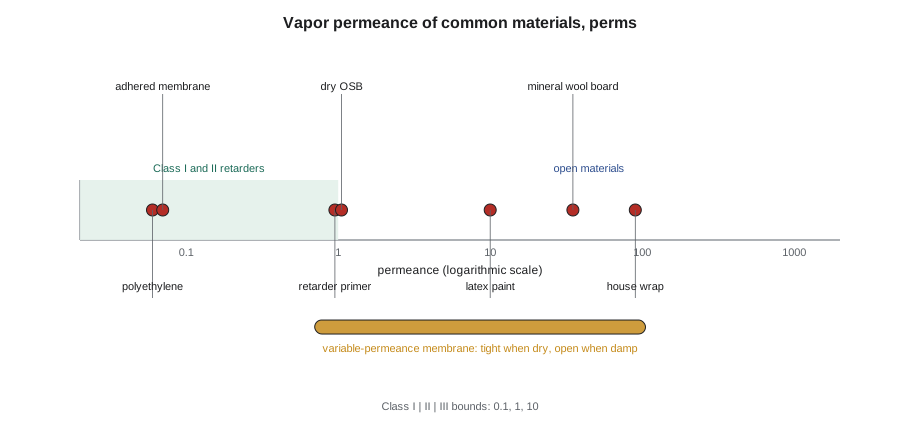
Vapor permeance is measured in perms; one perm is about 57 nanograms per pascal per second per square meter. The International Residential Code divides vapor retarders into three classes: Class I at 0.1 perm or less, Class II from 0.1 to 1.0 perm, and Class III from 1 to 10 perms. Materials span an enormous range. Polyethylene sheet and foil are almost impermeable. Some materials, such as plywood, oriented strand board and closed-cell foam, are fairly vapor-tight when dry but become more permeable as they get damp. Others, such as gypsum board, mineral wool, cellulose and house wraps, are very open. Paint can change a surface's permeance greatly, from the open finish of an ordinary latex paint to vapor-retarder primers that bring gypsum board close to the code's limit.
| Material | Approximate permeance | Behavior |
|---|---|---|
| Polyethylene, 6 mil | 0.06 perm | Vapor barrier; almost impermeable |
| Self-adhered sheet membrane | 0.03 to 0.1 perm | Impermeable unless specified as permeable |
| Vapor-retarder primer on gypsum | 0.8 to 1 perm | Meets the code limit for a retarder |
| Variable-permeance membrane | under 1 perm dry, over 10 damp | Tight in winter, open in summer |
| Plywood or OSB, 7/16 to 1/2 in | about 0.7 to 2 perms dry, over 5 damp | Moderate; opens up as it gets wet |
| Extruded polystyrene, 2 in | 0.6 to 1 perm | Retarder in thick layers |
| Latex paint on gypsum board | 5 to 20 perms | Open |
| Mineral wool board, 3 in | about 35 perms | Very open |
| Spun-bonded house wrap | over 50 perms | Very open |
Where to put the retarder in a cold climate
The principle is simple: a cold-climate assembly should be more vapor-tight on the warm side than on the cold side, so that any vapor that enters the wall from inside can leave it toward the outside faster than it arrived. A low-permeance layer on the warm side slows vapor entering in winter; open layers toward the outside let the assembly dry outward. Problems arise when a vapor-tight layer sits on the cold side of most of the insulation, because vapor that reaches the back of that layer cannot pass and condenses there. The classic example is a wall with polystyrene or foil-faced boards of only modest thickness on the outside of the sheathing: the boards are too thin to keep the sheathing warm, and tight enough to trap moisture behind them.
The way out of this trap is to make the cold-side layer warm. If enough of the insulation is outside the vapor-tight layer, the layer stays above the dew point of the indoor air for most of the winter and condensation cannot form on it. The International Residential Code allows a Class III retarder, such as latex paint, in climate zone 6 if the wall has enough continuous insulation outside the sheathing, roughly R-11 or more over 2×6 framing; with less exterior insulation, a Class I or II retarder is required on the warm side. The perfect wall takes this to its logical end: all the insulation outside the membrane, so that the membrane and the structure stay at room temperature all winter.
The Glaser method
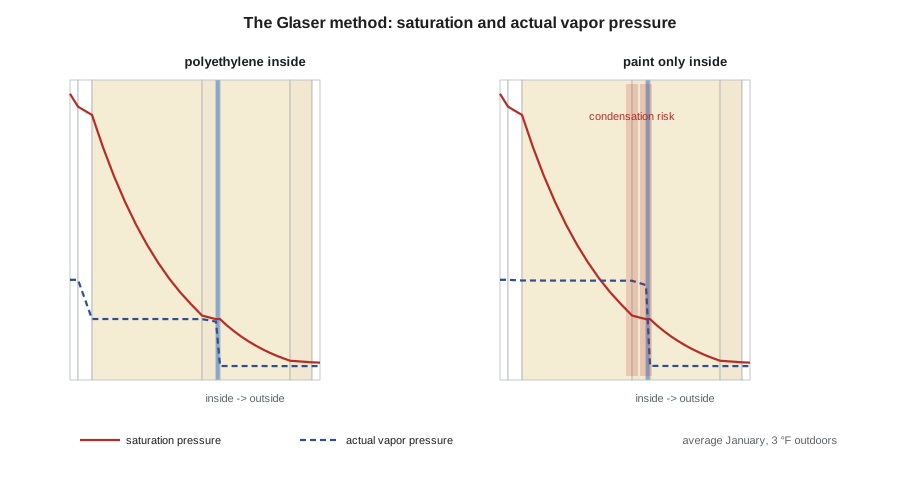
Designers check an assembly for condensation risk with a simple steady-state calculation, called the Glaser method after the German engineer who published it in the late 1950s. It uses the same series calculation as heat flow. The temperature drop across each layer is proportional to its thermal resistance, which gives the temperature at each interface and therefore the saturation vapor pressure there. The vapor pressure drop across each layer is proportional to its vapor resistance, the reciprocal of its permeance, which gives the actual vapor pressure at each interface if no condensation occurs. Wherever the actual vapor pressure exceeds the saturation pressure, condensation is possible. The calculation below applies the method to four versions of the hub's wall in an average January, with the same studs, sheathing and 3 in of exterior mineral wool, varying only the interior retarder, the membrane on the sheathing and the position of the insulation.
# Glaser method: temperature and partial pressure of water through a wall in January
import math
t_in, t_out = 70, 3              # indoor and mean January outdoor temperature (F)
rh_in, rh_out = 0.35, 0.80
def to_c(t): return (t - 32) * 5 / 9
def psat(t):                              # saturation pressure, Pa
    c = to_c(t)
    return 611.2 * math.exp(22.46 * c / (272.62 + c)) if c < 0 else 611.2 * math.exp(17.62 * c / (243.12 + c))
def wall(name, layers):
    rt = sum(r for _, r, _ in layers)
    zt = sum(1 / m for _, _, m in layers)
    pv_in, pv_out = rh_in * psat(t_in), rh_out * psat(t_out)
    print(name)
    r_sum = z_sum = 0
    for layer, r, m in layers[:-1]:
        r_sum += r; z_sum += 1 / m
        t = t_in - (t_in - t_out) * r_sum / rt
        pv = pv_in - (pv_in - pv_out) * z_sum / zt
        ps = psat(t)
        flag = "  <-- condensation risk" if pv > ps else ""
        print(f"  outer face of {layer:18s} {t:6.1f} F  pv {pv:4.0f} Pa  psat {ps:4.0f} Pa{flag}")
# layer, thermal resistance (R), permeance (perm)
base = [("inside film", 0.68, 1e6), ("gypsum board", 0.45, 0), ("stud cavity", 19, 21),
        ("sheathing", 0.62, 0.96), ("membrane", 0.0, 0), ("exterior board", 12, 35),
        ("cladding and air", 0.85, 175), ("outside film", 0.17, 1e6)]
def build(inner_perm, membrane_perm, cavity=19, board=12):
    out = [list(x) for x in base]
    out[1][2] = inner_perm; out[4][2] = membrane_perm
    out[2][1] = cavity; out[5][1] = board
    return [tuple(x) for x in out]
wall("A: polyethylene inside, adhered membrane outside", build(0.06, 0.05))
wall("B: paint only inside, adhered membrane outside", build(6.1, 0.05))
wall("C: paint only inside, permeable membrane outside", build(6.1, 26))
wall("D: paint only, adhered membrane, all insulation outside it", build(6.1, 0.05, 0.85, 31))A: polyethylene inside, adhered membrane outside outer face of inside film 68.7 F pv 874 Pa psat 2385 Pa outer face of gypsum board 67.8 F pv 541 Pa psat 2313 Pa outer face of stud cavity 30.1 F pv 540 Pa psat 559 Pa outer face of sheathing 28.8 F pv 520 Pa psat 528 Pa outer face of membrane 28.8 F pv 120 Pa psat 528 Pa outer face of exterior board 5.0 F pv 119 Pa psat 165 Pa outer face of cladding and air 3.3 F pv 119 Pa psat 152 Pa B: paint only inside, adhered membrane outside outer face of inside film 68.7 F pv 874 Pa psat 2385 Pa outer face of gypsum board 67.8 F pv 868 Pa psat 2313 Pa outer face of stud cavity 30.1 F pv 867 Pa psat 559 Pa <-- condensation risk outer face of sheathing 28.8 F pv 830 Pa psat 528 Pa <-- condensation risk outer face of membrane 28.8 F pv 121 Pa psat 528 Pa outer face of exterior board 5.0 F pv 119 Pa psat 165 Pa outer face of cladding and air 3.3 F pv 119 Pa psat 152 Pa C: paint only inside, permeable membrane outside outer face of inside film 68.7 F pv 874 Pa psat 2385 Pa outer face of gypsum board 67.8 F pv 781 Pa psat 2313 Pa outer face of stud cavity 30.1 F pv 754 Pa psat 559 Pa <-- condensation risk outer face of sheathing 28.8 F pv 161 Pa psat 528 Pa outer face of membrane 28.8 F pv 139 Pa psat 528 Pa outer face of exterior board 5.0 F pv 123 Pa psat 165 Pa outer face of cladding and air 3.3 F pv 119 Pa psat 152 Pa D: paint only, adhered membrane, all insulation outside it outer face of inside film 68.7 F pv 874 Pa psat 2388 Pa outer face of gypsum board 67.8 F pv 868 Pa psat 2318 Pa outer face of stud cavity 66.2 F pv 867 Pa psat 2190 Pa outer face of sheathing 65.0 F pv 830 Pa psat 2100 Pa outer face of membrane 65.0 F pv 121 Pa psat 2100 Pa outer face of exterior board 5.0 F pv 119 Pa psat 165 Pa outer face of cladding and air 3.3 F pv 119 Pa psat 152 Pa
The four walls tell the story of this lesson. Wall A, with a sealed polyethylene retarder on the warm side, stays just below saturation at the back of the sheathing in an average January; on a design night it would cross the line briefly, as Abernathy's profile showed, but the amount of vapor reaching the sheathing through polyethylene is tiny and dries in the spring. Wall B, with only latex paint inside and an impermeable membrane on the sheathing, accumulates moisture at the back of the sheathing all winter, because vapor enters easily and cannot leave. Wall C replaces the adhered membrane with a vapor-permeable one; the outside of the sheathing is now safe, but the sheathing itself is fairly tight when cold and dry, and this conservative model still shows moisture building up behind it. In reality the sheathing becomes more permeable as it absorbs moisture, and walls like C usually work if their interiors have at least a vapor-retarder primer, but they have little margin. Wall D moves all the insulation outside the membrane; the sheathing and studs sit near room temperature, and nothing can condense inside the wall, whatever the interior finish. It is the perfect wall of Lesson 1, and it is the safest choice for a building with high indoor humidity.
The limits of the Glaser method
The Glaser method is a useful first check but a crude model. It assumes steady conditions, while real walls see temperatures and humidities that change by the hour. It ignores the moisture that materials store: wood, gypsum and cellulose absorb and release large amounts of water and buffer short periods of condensation. It ignores liquid water moving by capillarity, rain absorbed by claddings and solar heating. And it ignores air leakage, which, as the previous lesson showed, usually carries far more moisture than diffusion. For important assemblies, such as walls of buildings with high humidity, unusual combinations of materials or novel products, designers use hygrothermal simulation, computer programs that model heat, air and moisture transport hour by hour over several years with real weather data. The results are judged against criteria such as those in ASHRAE Standard 160, which ask whether surfaces stay wet long enough to grow mold or decay.
Summer, sun and inward vapor drive
In summer the vapor drive reverses in air-conditioned buildings: hot humid outdoor air has a higher vapor pressure than cooled indoor air, and vapor moves inward. A polyethylene sheet behind the drywall then becomes a cold surface for vapor coming from outside, and condensation can form on its outer face, wetting the stud cavity. In Minneapolis, summers are short and moderately humid, and the problem is limited, but it becomes serious when absorptive claddings are involved. Brick, stone, stucco and some fiber cement boards soak up rain; when the sun comes out, it heats the wet cladding, raising the vapor pressure in it far above the indoor level, and drives vapor inward through the wall. This inward vapor drive explains many failures behind brick veneers and stucco: wet sheathing, mold on drywall and stained wallpaper in buildings that never had a winter problem. The remedies are a well-ventilated cavity behind the cladding, which carries the vapor away, a water-resistive barrier that is not too vapor-open, and, in some cases, a variable-permeance retarder on the inside instead of polyethylene.
Variable-permeance membranes, often called smart vapor retarders, were developed for this kind of problem. Their permeance depends on the humidity around them: in winter, when the air on their warm side is dry, they are tight and limit vapor entering the wall; in summer, or whenever the wall behind them becomes damp, they open up and let it dry inward. They give assemblies two drying directions instead of one, which adds margin against both winter condensation and summer drive.
Indoor humidity
The vapor load depends on the indoor humidity, which the architect and the mechanical engineer set together. Houses and offices in a cold climate run dry in winter without humidification, often between 20 and 35 of every 100 parts of saturation, which is why winter condensation in their walls is uncommon if the air barrier is good. Apartments with many people, cooking and showers run more humid. Some buildings are humidified deliberately: hospitals, museums, archives, swimming pools, laboratories and some manufacturing. A museum that keeps its galleries at about 50 parts in 100 all winter, as many collections need, puts several times the vapor load of an office on its envelope, and needs walls, roofs and windows designed for it, usually with the perfect wall approach, very tight air barriers and windows whose frames stay above the indoor dew point. Swimming pools are the most demanding buildings of all; their envelopes are typically designed with hygrothermal simulation and reviewed by a specialist.
Worked problem
Choosing the retarder for a gallery
Callum's mixed-use building includes a small art gallery on the ground floor, which the owner wants humidified to about 45 parts in 100 at 70 °F all winter. The rest of the building is apartments and offices. His gallery walls are steel studs with mineral wool in the cavities, sheathing, an adhered membrane and 2 in of exterior board. Is this suitable?
Show solution
- Indoor vapor pressure at 45 parts in 100 is about 1,120 pascals, with a dew point near 48 °F.
- With most of the insulation in the stud cavity, the sheathing on a January day sits near or below freezing, far below that dew point, and the adhered membrane outside it traps any vapor that arrives.
- Steel studs make it worse: they conduct cold inward and create cold lines on the inside surface, raising the risk of condensation and staining there too.
- Redesign the gallery walls as perfect walls: empty stud cavities, the adhered membrane on the sheathing as the air, vapor and water control layer, and all the insulation, about 6 in of mineral wool board on isolated clips, outside it.
- Check the windows: specify frames and glass whose inside surface temperatures stay above the dew point on a design night, a topic for Lesson 7.
Answer: The original wall would accumulate moisture behind the membrane all winter. Moving all the insulation outside the membrane keeps the sheathing near room temperature and makes the wall robust against the gallery's humidity.
Exercise 4: condensation check
This exercise takes about one week.
- List the layers of each wall and roof of your mixed-use building with their thermal resistance and vapor permeance.
- Run the Glaser method for an average January and for a design night; mark every interface at risk.
- Check whether any vapor-tight layer sits on the cold side of the insulation, and if so whether enough insulation lies outside it.
- Identify any absorptive claddings and describe how inward vapor drive is managed.
- Set the indoor humidity for each occupancy with your mechanical consultant and adjust the assemblies where needed.
Common mistakes
MistakeAdding polyethylene to every wall out of habit.
InsteadChoose the retarder for the climate, the cladding and the indoor humidity; polyethylene can cause summer problems behind absorptive claddings.
MistakePutting thin foam boards or foil outside the sheathing.
InsteadEither make the outboard insulation thick enough to keep the sheathing warm, or use a vapor-open layer outside.
MistakeTreating the vapor retarder as the main moisture defense.
InsteadThe air barrier matters far more; the retarder handles diffusion only.
MistakeTrusting a Glaser calculation for a humid building.
InsteadUse hygrothermal simulation for high humidity, novel assemblies and absorptive claddings.
MistakeForgetting the humidity indoors.
InsteadSet it with the mechanical engineer; humidified buildings need much more robust envelopes.
Summary and key terms
- Vapor moves from high to low vapor pressure by air leakage and, much more slowly, by diffusion.
- Permeance ranges over several orders of magnitude; codes set limits for vapor retarders.
- In a cold climate, assemblies should be tighter on the warm side and open on the cold side, unless enough insulation keeps the cold-side layer warm.
- The Glaser method finds where condensation is possible; hygrothermal simulation is needed for demanding cases.
- Sun on wet absorptive claddings drives vapor inward in summer; ventilated cavities and smart retarders manage it.
- Vapor pressure
- The part of the air pressure due to water vapor.
- Dew point
- The temperature at which moist air becomes saturated and vapor condenses.
- Vapor permeance
- The rate at which a material lets water vapor diffuse through it, per unit pressure difference.
- Vapor retarder
- A material of low permeance that slows vapor diffusion.
- Glaser method
- A steady-state calculation of temperatures and vapor pressures through an assembly to find condensation risk.
- Inward vapor drive
- Vapor driven inward when the sun heats a wet absorptive cladding.
- Variable-permeance membrane
- A retarder that is tight when dry and opens when humid.
Practice problems
Work each problem on paper first, then reveal the answer to check.
Why does vapor move outward through walls in winter?
Show answer
Warm indoor air has a much higher vapor pressure than cold outdoor air.
What makes an impermeable membrane on the outside of the sheathing safe?
Show answer
Enough insulation outside it to keep it above the dew point of the indoor air for most of the winter.
In the Glaser method, what determines the temperature drop and the vapor pressure drop across each layer?
Show answer
Its thermal resistance and its vapor resistance, the reciprocal of its permeance.
Name two limitations of the Glaser method.
Show answer
It assumes steady conditions and ignores moisture storage, liquid flow, sun and air leakage.
What causes inward vapor drive?
Show answer
Sun heating a rain-wetted absorptive cladding such as brick or stucco, raising its vapor pressure above indoors.
Lesson quiz · 5 questions
Score 60% or more to complete this lesson.
Create a free account to save your progress, take quizzes and earn a certificate.