
APT-210 · Lesson 7 of 12 · 25 min
Cycle counts and physical inventories
▶ Video coming soon A video version of this lesson is on the way.
At 7:30 on Tuesday, November 3, before the counter opened, Talia stood in aisle C with a handheld scanner and a short list on its screen: 74 bin locations to count before nine o'clock. The list was the day's cycle count. Nobody had told her what quantity the system expected in each bin, and that was deliberate. "You count what's there," Sasha said, "not what the computer hopes is there. If you know the answer before you count, you'll find it."
Every inventory decision in this course depends on one thing: the system's on-hand quantity matching what is really on the shelf. Reorder points, suggested orders, fill rates, turns and the value on the balance sheet are all only as good as that match. This lesson covers how parts departments check it, through cycle counts during the year and physical inventories at year-end, and what to do when the count and the system disagree.
Why counts are needed
In theory, if every receipt, sale, return, transfer and adjustment were recorded perfectly, the system would never be wrong. In practice, errors creep in every day. A part is put away in the wrong bin. A counter person sells one number and pulls the box for another. A receiving clerk keys 10 instead of 1. A technician takes a part from the shelf without a ticket. A damaged part is thrown out without an adjustment. Some parts are stolen (lesson 8).
Each error makes the book quantity (what the system says) differ from the physical quantity (what is on the shelf). If the book shows more than the shelf, the system will not reorder in time, and a customer will be told a part is in stock when it is not. If the book shows less, the system will order parts the department already has. Either way, the department loses money and credibility.
| Error | Effect on the book | Typical result |
|---|---|---|
| Part sold under the wrong number | One number too high, one too low | A stock-out and an extra order |
| Receiving keyed wrong | Book too high or too low | Missed or extra reorder |
| Part taken without a ticket | Book too high | Stock-out the system does not see |
| Part put in the wrong bin | Book correct, part not found | A "lost" part and a lost sale |
| Damage not recorded | Book too high | Stock-out of a "good" part |
Inventory accuracy
Inventory accuracy is the share of counted locations where the count matches the book quantity, sometimes within a small tolerance for very cheap parts sold in bulk. It is the clearest measure of how well the department's records reflect reality.
Worked problem
Measuring accuracy
In one week of cycle counts, Linmore Tessaro counted 200 part numbers. The count matched the book for 186 of them. What is the accuracy?
Show solution
- Accuracy:
- \[\dfrac{186}{200} = 0.93\]
Answer: Accuracy is 93 in 100. Rolf's target was 95 in 100 or better. Many dealer groups aim for 95 or higher; the right target depends on the department.
Accuracy is a better measure than the total value difference. A department can have many errors that cancel out in value (one part too high, another too low), giving a small total difference that hides poor records. Counting matches by part number reveals the errors.
Cycle counting
A cycle count is a count of a small part of the inventory, done regularly during the year while the department keeps working. Instead of counting everything once, the department counts a little every day or every week, so that over the year every part is counted at least once and the most important parts are counted several times.
The usual way to choose what to count is by ABC class (lesson 2). A parts, the small group with the most sales, are counted most often, because an error on an A part affects many sales. C parts are counted less often.
Worked problem
Planning the year of counts
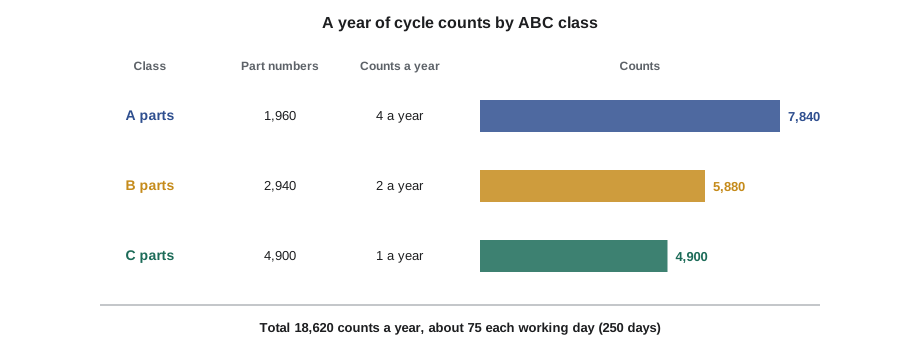
Linmore Tessaro has 1,960 A part numbers, 2,940 B part numbers and 4,900 C part numbers in stock. Rolf's plan counts A parts four times a year, B parts twice and C parts once. How many counts is that a year, and how many a working day over 250 days?
Show solution
- Counts per year:
- \[1{,}960 \times 4 + 2{,}940 \times 2 + 4{,}900 \times 1 = 7{,}840 + 5{,}880 + 4{,}900 = 18{,}620\]
- Counts per working day:
- \[18{,}620 \div 250 = 74.48\]
Answer: The plan needs 18,620 counts a year, or about 75 a working day. That is why Talia's list had 74 locations. At a minute or two each, it is about two hours of work a day for one person.
Other ways to choose what to count can be added to the ABC plan:
- Counts by location: count a whole bay or aisle at once, which also finds parts in the wrong bins.
- Counts triggered by events: count a part whenever its on-hand quantity reaches zero or goes negative, or when someone cannot find a part the system says is there.
- Counts of high-risk parts: parts that are expensive, small and easy to steal, or often mixed up, can be counted more often.
- Counts after problems: after a receiving error or a supersession, count the parts involved.
How to count well
Counting looks easy, and that is why it is often done badly. Sasha's rules were:
- Count blind. The counter does not see the book quantity before counting, so they count what is there.
- Count when it is quiet. Count before the counter opens or after it closes, or freeze the location briefly, so parts are not sold or received while the count is happening.
- Count every place the part is kept: the primary bin, overflow locations, the will-call shelf, open returns, and parts staged for delivery.
- Count in the selling unit. If a part is sold one at a time but stored in boxes of ten, count individual pieces, not boxes.
- Check the part number on each package, not just the bin label, to catch parts in the wrong bin.
- Recount differences before adjusting, ideally by a second person.
Open transactions are the most common cause of false differences. A part sold on a repair order but not yet pulled from the bin, a part received on the shelf but not yet received in the system, or a part on a return waiting to ship can all make a correct book look wrong. Before adjusting, the counter checks for open documents on the part.
Investigating and adjusting differences
When a count does not match, the job is not just to change the number; it is to find out why. Each difference is a clue to a process that is failing.
Worked problem
A count difference
Talia counts 3 of a brake caliper bracket that costs 41.20 dollars. The book shows 5. A recount by Sasha also finds 3. What is the value of the difference?
Show solution
- Difference in units:
- \[3 - 5 = -2\]
- Difference in value:
- \[-2 \times 41.20 = -82.40\]
Answer: The book is 2 units, or 82.40 dollars, too high. Before adjusting, Sasha checked the part's recent history and found that two brackets had been sold to the shop the day before under a similar number. The fix was a correction to the shop ticket, not a write-down.
The usual steps are:
- Recount to confirm the difference.
- Check open documents: unposted sales, unreceived orders, open returns, transfers, will-call.
- Check for mixed-up numbers: a similar part number with the opposite difference often explains both.
- Review the part's history since its last correct count.
- Adjust the book quantity only once the reason is known or the search is finished, and record the reason.
- Report patterns to the parts manager, such as repeated errors in one aisle or with one type of transaction.
Adjustments change the inventory value and therefore the department's profit, so they are usually approved above a set value. Large or repeated adjustments are also a sign to look for theft or fraud (lesson 8).
The physical inventory
A physical inventory is a count of everything in stock at one time, usually at the end of the financial year. Many dealerships still do one, because the dealership's accountant or the manufacturer requires it, and because it sets the value of inventory on the balance sheet. Departments with a strong cycle count program and high accuracy can sometimes reduce or replace the full count, if their accountants agree.
A physical inventory takes planning, because the department must stop selling, or keep selling under strict rules, while everything is counted. The usual steps are:
| When | Step |
|---|---|
| Weeks before | Set the date, book outside counters if used, plan teams and areas |
| Days before | Clean and organize bins, put away all receipts, process returns, label any unlabeled stock |
| Cut-off | Stop receiving and selling, or record every movement separately; post all open documents |
| Count | Count each area in teams of two, using tags or scanners; check high-value parts twice |
| Reconcile | Compare counts to the book, recount differences above a set value |
| Post | Post the final counts, record adjustments, report the results |
The cut-off is the most important part. Every part must be in exactly one place: either on the shelf and counted, or out of stock and not counted. A part received but not yet entered, or sold but not yet pulled, can be counted twice or not at all. Many dealerships use an outside inventory service for the count, so that the people who handle the stock are not the only people who count it.
Valuing inventory at year-end
Inventory is a major asset on the dealership's balance sheet, and its value affects the profit reported for tax. For US federal income tax, the IRS generally lets a business value inventory either at cost or at the lower of cost or market, applied consistently. The cost of goods sold also depends on the cost flow method. First in, first out (FIFO) treats the oldest parts as sold first. Last in, first out (LIFO) treats the newest parts as sold first; a business must elect it with the IRS, and LIFO inventories must be valued at cost. Many auto dealers have long used LIFO, because when prices rise it gives a higher cost of goods sold and a lower taxable profit. This is why obsolete parts matter at year-end: under the lower of cost or market, a part worth less than it cost may be written down, which reduces the inventory value and the year's profit.
Parts technicians do not choose the valuation method; the dealership's accountant does. But the parts department supplies the facts the accountant needs: accurate counts, a list of obsolete and damaged parts, and records of returns and write-offs. A sloppy count can change the dealership's profit and tax by thousands of dollars.
Accuracy as a habit
Counting finds errors, but the real goal is to stop making them. Rolf kept a list of the causes of each adjustment for three months. More than half came from two sources: parts sold under the wrong number and receipts put away before they were received in the system. Fixing those two habits, by scanning parts at the counter and receiving before putting away, did more for accuracy than doubling the count would have done.
Talia finished her 74 counts by 8:50. Seventy matched. Of the four that did not, three were explained by open documents, and one, the caliper bracket, led to the corrected shop ticket. "So the count was right and the book was wrong," Talia said. "The count was right," Sasha said, "and now the book is too."
Tracking accuracy over time
A single week's accuracy can be high or low by chance. What matters is the trend. Rolf kept a simple chart of accuracy by week on the wall of the warehouse office, next to the cycle count schedule. When the line dipped, the team looked at the differences found that week to see whether one cause, one aisle or one kind of transaction was behind it. When it rose, he said so at the Monday meeting, because the people who keep the inventory accurate rarely hear about it when things go well. Over the autumn, the weekly figure moved from the low 90s toward his target of 95 in 100.
Accuracy also depends on the whole team, not only the people who count. Counter staff who scan every part, receiving clerks who count every carton and technicians who never take a part without a ticket all make the next count easier. Rolf made sure the counter staff saw the weekly accuracy chart too, because most of the errors began at the counter.
Common mistakes
MistakeShowing the book quantity to the person counting.
InsteadCount blind, then compare.
MistakeAdjusting the book as soon as a difference is found.
InsteadRecount and check open documents first.
MistakeCounting only the primary bin.
InsteadCount every location where the part is kept.
MistakeCounting boxes when the part is sold in pieces.
InsteadCount in the selling unit.
MistakeMeasuring accuracy only by total value difference.
InsteadMeasure the share of part numbers that match.
Summary and key terms
- The book quantity must match the physical quantity for every inventory decision to work.
- Inventory accuracy is the share of counted part numbers that match the book.
- Cycle counts check a small part of the stock regularly, with A parts counted most often.
- Count blind, at quiet times, in every location and in the selling unit.
- Investigate differences before adjusting, and record the reason for each adjustment.
- A physical inventory counts everything at once, usually at year-end, with a careful cut-off.
- Year-end valuation rules affect profit and tax; the parts department supplies accurate counts and lists of obsolete stock.
- Book quantity
- The quantity on hand according to the system.
- Physical quantity
- The quantity actually on the shelf.
- Inventory accuracy
- The share of counted locations where the count matches the book.
- Cycle count
- A regular count of a small part of the inventory during the year.
- Physical inventory
- A count of all stock at one time, usually at year-end.
- Cut-off
- The point that separates movements before and after a count.
- Count blind
- Counting without seeing the expected quantity.
Practice problems
Work each problem on paper first, then reveal the answer to check.
In a week, 240 part numbers were counted and 228 matched. What is the accuracy?
Show answer
228 ÷ 240 = 0.95, or 95 in 100.
A part costing 18.50 dollars counts 7 against a book of 4. What is the value of the difference?
Show answer
+3 × 18.50 = +55.50 dollars.
A department has 1,000 A parts counted 4 times a year and 2,000 C parts counted once. How many counts a year?
Show answer
6,000.
Name two open documents that can make a correct book look wrong.
Show answer
An unposted sale, an unreceived order, an open return or a transfer.
Why is a careful cut-off needed for a physical inventory?
Show answer
So every part is counted once: either on the shelf and counted, or out and not counted.
Lesson quiz · 5 questions
Score 60% or more to complete this lesson.
Create a free account to save your progress, take quizzes and earn a certificate.