
APT-210 · Lesson 2 of 12 · 21 min
Bin locations and stock layout
▶ Video coming soon A video version of this lesson is on the way.
On Tuesday, September 15, her second day, Talia was sent to the warehouse to pull a cabin air filter for the back counter. The screen said the filter was in stock, quantity 6, location C-07-2-14. She walked up and down aisle C twice before Sasha Esparza came over and showed her how to read the code. "Aisle C, section 7, shelf 2, bin 14," Sasha said, pointing to the labels on the end of the aisle, the upright, the shelf edge and the bin. Talia found the filter in ten seconds. "Every part has an address," Sasha said. "If it's not at its address, it doesn't exist."
A parts warehouse can hold thousands of different parts. Linmore Tessaro stocked about 9,800 different part numbers, from 30-cent clips to engine assemblies that needed a forklift. Without a system for where each part lives, finding them would depend on memory, and memory fails. This lesson covers bin locations and location codes, how the warehouse is laid out, how fast-moving parts are placed for quick picking, and how locations are kept accurate.
What a bin location is
A bin location is the exact place in the warehouse where a part is stored. The location is recorded in the inventory software against the part number, so the screen tells the parts technician where to go. A good location system means anyone, including a new apprentice on her second day, can find any stocked part without asking.
Most parts departments use a location code built from the largest area down to the smallest. A common pattern, and the one Linmore Tessaro used, has four parts:
- Aisle: a letter for each aisle, such as A to H.
- Section: a number for each section of shelving along the aisle, counting from the front.
- Shelf: a number for each shelf level, counting from the floor up.
- Bin: a number for each bin, box or slot on that shelf, counting from left to right.
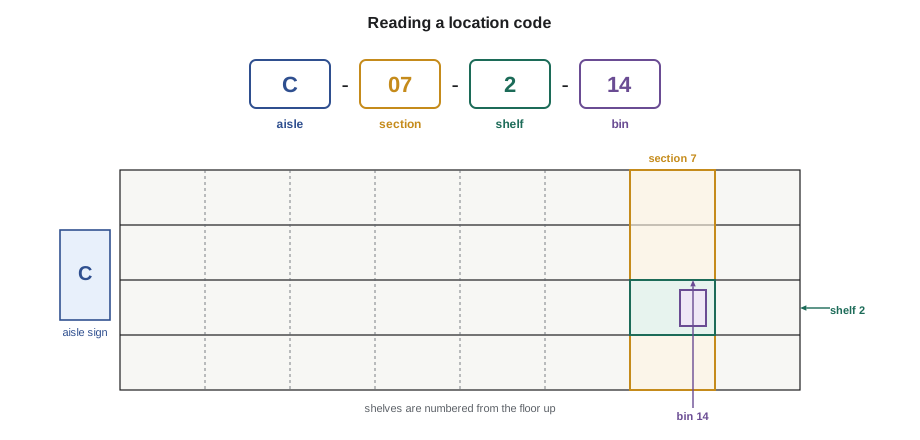
The exact format varies from one department to another, and some add a zone or building code for a second warehouse or a mezzanine. What matters is that the code is consistent, every location is labeled, and the labels match the system. A location that exists in the computer but has no label on the shelf causes the same confusion Talia had.
Kinds of storage
Parts come in every shape and size, so a parts warehouse uses several kinds of storage. Matching each part to the right storage protects it and makes it easier to pick.
| Storage type | Typical parts |
|---|---|
| Small-parts bins and drawers | Clips, fasteners, bulbs, fuses, seals and small sensors |
| Shelving with boxes | Filters, brake pads, ignition coils, belts and most boxed parts |
| Long-part racks | Exhaust pipes, wiper arms, trim moldings and driveshafts |
| Hanging storage | Belts, hoses and wiring harnesses |
| Pallet racking | Batteries, fluids by the case, engines and transmissions |
| Flat storage | Body panels, hoods and doors, often stored on edge in padded racks |
| Locked cage | High-value parts, key blanks, electronic modules and airbags (APT-110) |
Heavy parts belong on low shelves or pallet racking, never on high shelves where they must be lifted overhead (APT-110 lesson 4). Fragile parts such as glass and lamps need padding and space. Hazardous parts such as batteries, aerosols and airbag modules have their own storage rules covered in APT-110. Body panels are easily dented and are usually stored on edge in racks designed for them.
Fast movers near the front: ABC slotting
Not all parts sell at the same rate. In most parts departments a small share of part numbers accounts for most of the sales and picks. A common rule of thumb, sometimes called the 80/20 rule or Pareto principle, says that about 20 in 100 of the part numbers produce about 80 in 100 of the activity. The real figures vary from store to store, but the pattern holds: a few parts sell all the time, and many sell rarely.
ABC analysis sorts parts into classes by how much they sell or how often they are picked:
- A parts: the small group of fastest-moving or highest-value parts. Oil filters, popular brake pads, wiper blades and cabin filters are typical A parts at a dealership.
- B parts: a middle group that sells regularly but less often.
- C parts: the large group of slow movers, often most of the part numbers in the warehouse.
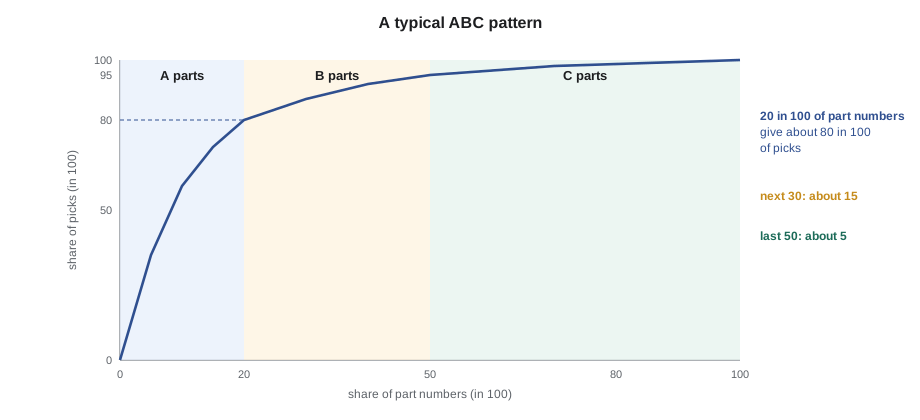
Slotting is the job of deciding which location each part gets. Good slotting puts A parts in the easiest places to reach: near the counter, at waist height, close to the main aisle. B parts go a little further back, and C parts go to the far aisles, high shelves and low shelves. This cuts the walking and reaching that make up most of a picker's time.
Worked problem
How much walking does slotting save?
Linmore Tessaro's picks for A parts averaged about 60 a day. Before slotting, a typical A part was 100 ft from the counter; after slotting, it was 26 ft. Each pick is a round trip. How much walking does slotting save in a day?
Show solution
- Distance saved per trip, each way:
- \[100 - 26 = 74\ \text{ft}\]
- Round trip:
- \[74 \times 2 = 148\ \text{ft}\]
- Per day:
- \[148 \times 60 = 8{,}880\ \text{ft} \approx 1.7\ \text{miles}\]
Answer: Slotting saves about 8,880 ft, or about 1.7 miles, of walking a day for the A parts alone. Over a year of about 250 working days, that is hundreds of miles and many hours of picking time. The distances are sample values.
Slotting is not done once and forgotten. Parts move between classes as vehicles age, models change and seasons turn. Wiper blades and batteries are A parts in late fall; air conditioning parts move up in spring. Many departments review slotting a few times a year using the sales report from the inventory software (lesson 9).
Laying out the warehouse
The layout of the whole warehouse follows the same idea: put the work that happens most often in the easiest places. A typical dealership parts warehouse is arranged around a few fixed points:
- The counters: the front and back counters, where most picks end.
- Receiving: the dock where shipments arrive, near the delivery door (APT-220).
- Staging areas: shelves for orders waiting for pickup, delivery or the technician, and for special orders (lesson 10).
- Returns and cores: a separate, labeled area so returned parts and cores never mix with saleable stock.
- The main aisles: wide enough for carts and, where needed, the forklift, with clear sight lines and no stored stock in the aisle.
Stock that has been received should flow one way: from the dock, through checking, into its bin, and out to the counter. Parts that move backwards, such as returns, follow their own path to the returns area and are never put straight back on the shelf without being checked. Lesson 6 covers returns, and APT-220 covers receiving and put-away in detail.
Fixed and random locations
There are two main ways to assign locations. With fixed locations, each part number has its own permanent bin, and the bin is reserved for it even when it is empty. Staff learn where things are, and the system and the shelf stay simple. Most dealership parts departments use fixed locations for most stock.
With random locations, also called floating locations, a part goes into any empty location, and the software records where it went. This uses space more efficiently, especially for bulky items, but it depends completely on the software, because no one can learn where things are. Large distribution centers often use random locations with barcode scanning. Many dealerships use a mix: fixed bins for most parts, and an overflow area with random locations for extra quantities of bulky items such as batteries or fluid cases.
When a part has stock in two places, such as a bin and an overflow pallet, the system should show both locations. A common source of errors is the overflow stock that nobody remembers, so the counter reports a part as out of stock while a full case sits on a pallet at the back.
Labeling and keeping locations accurate
Locations are only useful if they are accurate. Every bin needs a label showing its location code, and many departments also show the part number and a barcode. When a part is moved, the system must be updated at the same time; a part moved without updating the system is effectively lost until the next count.
Sasha's rules for locations were simple and strict:
- One part number per bin, unless the bin is clearly divided and labeled.
- Never put a part in a bin without checking the part number on the box against the label.
- Move parts only with a location change entered in the system at the same time.
- Keep superseded parts with the new number until the old stock is sold, with the bin label showing both (APT-120 lesson 6).
- Report empty bins, damaged labels and parts in the wrong place as soon as you see them.
Mistakes in put-away cause two problems at once. The part that was put away wrongly cannot be found, so the system shows stock that the counter cannot sell. And if it went into another part's bin, the next person may pick the wrong part, which leads to a comeback, a return or, at worst, a wrong part installed on a customer's car. Lesson 7 shows how cycle counts catch these errors.
New parts and empty bins
When the department starts stocking a new part, it needs a location. The parts technician or warehouse lead chooses one based on the part's size and expected sales, labels the bin and enters the location before the part arrives. Many departments keep a few empty bins in each aisle for this purpose, so new parts can be slotted sensibly instead of squeezed wherever there is room.
When a part is no longer stocked (lesson 6), its bin should be cleared and the location removed or reassigned. Old labels left on empty bins confuse everyone and waste space. Rolf liked to say that a warehouse full of empty, labeled bins was a sign of a department that had stopped paying attention.
Labels and signs
A location system only works if people can read it quickly. Most dealers use printed labels from the dealer system, with the part number, a short description and the bin code, often with a barcode that can be scanned at picking and counting. Labels go on the front edge of the shelf or the face of the bin, at the same place every time, so the eye learns where to look.
The end of each aisle carries a large sign with the aisle letter, readable from the counter end of the warehouse. Each upright or section carries its number, and each shelf its level. Sasha's team checked labels whenever they counted a bin, and replaced any that were torn, faded or wrong the same day. "A missing label costs ten seconds every time someone looks for that part," she told Talia. "A wrong label costs a sale."
Some parts are hard to label in the usual way: long parts such as exhaust pipes and moldings, body panels stored on edge, tires in racks, and fluids on pallets. For these, the location label goes on the rack or the floor marking, and the part itself carries its own part number label from the manufacturer. A picker should always check the part number on the package, not just the location, before taking a part to the counter.
Changing a location
Locations change when parts are re-slotted, when a part outgrows its bin, or when a new part is phased in. Every change follows the same order: update the location in the system, print the new label, move the stock, put up the new label and remove the old one. If the stock moves before the system is updated, the part disappears for everyone who looks it up in between. Sasha kept a short list of the day's moves on a clipboard so the counter staff knew which parts were in transit.
Moving many parts at once, as in a full re-slot, is best done at a quiet time, such as a Saturday afternoon or before opening, with the moves planned in advance on a printed list. Each move is checked off as it is done, and the list is kept until the next cycle count of those locations confirms that the stock and the system agree.
Common mistakes
MistakePutting a part in the nearest empty bin without recording it.
InsteadUse the assigned location, or enter the new location in the system at once.
MistakeStoring fast movers on high shelves at the back.
InsteadSlot A parts near the counter at waist height.
MistakeForgetting overflow stock.
InsteadRecord every location for a part, including overflow areas.
MistakeMixing returns with saleable stock.
InsteadKeep returns and cores in their own labeled area until checked.
MistakeLeaving old labels on empty bins.
InsteadClear and relabel locations when parts are discontinued.
Summary and key terms
- A bin location is a part's exact address in the warehouse, recorded in the system and labeled on the shelf.
- Location codes usually run from aisle to section to shelf to bin.
- ABC analysis sorts parts by activity; slotting puts A parts in the easiest places to reach.
- The warehouse is laid out around the counters, receiving, staging and a separate returns area.
- Fixed locations suit most dealership stock; random locations save space but depend on the software.
- Accurate locations depend on one part per bin, checking part numbers and updating the system with every move.
- Bin location
- The exact place in the warehouse where a part is stored, recorded against its part number.
- Location code
- A code such as C-07-2-14 that gives the aisle, section, shelf and bin.
- ABC analysis
- Sorting parts into classes by how much they sell or how often they are picked.
- Slotting
- Deciding which location each part gets, usually putting fast movers in the easiest places.
- Fixed location
- A permanent bin reserved for one part number.
- Random location
- Any empty location, chosen at put-away and recorded in the software.
Practice problems
Work each problem on paper first, then reveal the answer to check.
What does the location B-12-4-03 mean in Linmore Tessaro's system?
Show answer
Aisle B, section 12, shelf 4, bin 3.
Where should an A part usually be slotted?
Show answer
Near the counter, at waist height, close to the main aisle.
Why must a location change be entered when a part is moved?
Show answer
Otherwise the system points to the wrong place and the part is effectively lost.
What is the main risk of random locations?
Show answer
They depend completely on the software; no one can find parts from memory.
Where do returned parts go before they are checked?
Show answer
To the separate returns area, never straight back to a bin.
Lesson quiz · 5 questions
Score 60% or more to complete this lesson.
Create a free account to save your progress, take quizzes and earn a certificate.