
APT-210 · Lesson 6 of 12 · 23 min
Obsolete stock and returns to suppliers
▶ Video coming soon A video version of this lesson is on the way.
On Wednesday, November 11, Talia spent the morning with Sasha Esparza in aisle G, the back aisle where slow parts lived. They had a printed list of 214 parts that had not sold in more than twelve months, worth about 38,400 dollars at cost. Some of the boxes were faded and dusty. One held a radio faceplate for a model Tessaro had stopped building eight years earlier. "Every one of these was a good idea once," Sasha said. "Our job today is to decide what each one is worth now, and get as much of that money back as we can."
Even well-run parts departments end up with parts that stop selling. Models are replaced, parts are superseded, a customer cancels a special order, or a part that seemed likely to sell never did. This lesson covers how departments find these parts, the stages of a part's life in stock, the options for getting money back through returns and sales, and how to prevent obsolescence in the first place.
Non-moving and obsolete stock
Non-moving stock is stock that has not sold for a set period, often 9 or 12 months. Obsolete stock is stock that is unlikely ever to sell at its normal price, because the vehicles it fits are rare, the part has been replaced, or it is damaged or outdated. The two overlap but are not the same: a non-moving part may still sell one day, while an obsolete part almost certainly will not.
Most dealer systems track the date each part last sold and the date it was last received, and can sort the inventory by these dates. A common way to look at the inventory is by aging: how long since each part last sold.
| Months since last sale | Typical status | Typical action |
|---|---|---|
| 0 to 6 | Active | Keep, review stocking settings as usual |
| 6 to 9 | Slowing | Check settings; lower the maximum |
| 9 to 12 | At risk | Stop reordering; consider for return |
| Over 12 | Non-moving | Return, sell to other dealers, discount or write off |
At Linmore Tessaro, the parts not sold in more than twelve months were worth about 38,400 dollars, about 6 in 100 of the 640,000-dollar inventory. Rolf considered anything under about 5 in 100 healthy for a dealership that sold parts for older models, and anything over 10 in 100 a problem. These thresholds are sample values; manufacturers and dealer groups often publish their own.
Worked problem
What dead stock costs to keep
The department has 38,400 dollars of non-moving stock. At the sample carrying rate of 25 in 100 a year, what does it cost to keep it for another year?
Show solution
- Carrying cost:
- \[38{,}400 \times 0.25 = 9{,}600\]
Answer: Keeping the non-moving stock costs about 9,600 dollars a year, money spent on parts that are not earning anything. That is why getting rid of them, even at a loss, is often the right decision.
A part's life in stock
Every stock part goes through a life cycle. It is phased in when demand justifies stocking it (lesson 3). It sells steadily while the vehicles it fits are common and of an age to need it. Then, as the vehicles age and leave the road, or as the part is superseded, its sales slow and stop. Good inventory control follows this cycle and adjusts the stocking settings at each stage, so that the department is not still buying a part as its demand fades.
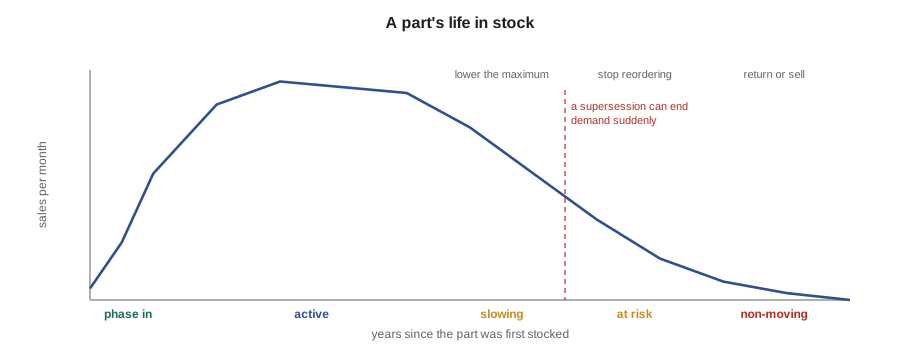
Phase-out is the planned removal of a part from stock. The usual steps are to stop reordering it (set the minimum and maximum to zero), sell the remaining stock, and then clear the bin and its location (lesson 2). Some systems do this automatically: a part with no sales for a set period is marked as non-stock, and its settings are cleared. The parts technician then decides what to do with the stock still on the shelf.
Supersessions deserve special care (APT-120 lesson 6). When a part number is replaced by a new one, the system should sell the old stock first if the parts are interchangeable both ways. If the new part replaces the old one only one way, old stock may still fit older vehicles, but the new number will be used for all new orders. Old stock of a superseded part is a common source of obsolescence, and many manufacturers allow it to be returned.
Returning parts to the manufacturer
Most vehicle manufacturers run a parts return program that lets dealers send back some unsold stock for credit. The details differ between manufacturers and change over time, but most programs share some features:
- A return allowance: a limit on how much can be returned, often a share of the dealer's recent purchases, especially stock order purchases.
- Eligible parts: usually current, saleable parts in original packaging, bought from the manufacturer within a set period. Electrical parts, special-order parts, damaged or opened parts, and parts that are no longer listed are often excluded.
- A restocking or handling charge: a share of the part's value that the dealer does not get back.
- Return windows: set times of the year when returns are accepted, sometimes once or twice a year.
- Rules for superseded parts: some programs accept superseded parts that the manufacturer has replaced, sometimes without counting them against the allowance.
In this course, Tessaro's sample program allows each dealer to return up to 4 in 100 of the previous year's stock order purchases, twice a year, with a 10 in 100 handling charge. Real programs vary; the parts manager must follow the current terms exactly.
Worked problem
How much can be returned?
Linmore Tessaro's stock order purchases last year were 2,950,000 dollars at cost. The sample return allowance is 4 in 100. Sasha's list of eligible parts is worth 31,200 dollars at cost, and the handling charge is 10 in 100. What is the allowance, and how much credit will the return bring?
Show solution
- Allowance:
- \[2{,}950{,}000 \times 0.04 = 118{,}000\]
- Return fits within the allowance:
- 31,200 is less than 118,000
- Credit after the handling charge:
- \[31{,}200 \times 0.90 = 28{,}080\]
Answer: The allowance is 118,000 dollars, so the whole list can go back, bringing a credit of 28,080 dollars. The 3,120-dollar handling charge is far less than another year of carrying cost on the same parts. All terms are sample values.
Not everything on Sasha's list qualified. Of the 214 parts, 131 were eligible for return. The rest were too old, no longer listed by Tessaro, opened or damaged, or electrical parts that could not be returned once they had left the original sealed packaging. Those parts needed another plan.
Preparing a return
A return has to be prepared carefully, because the manufacturer inspects returned parts and refuses or charges back parts that do not meet the rules. Sasha's process was:
- Run the eligible list from the system, using the program's current rules.
- Pull each part and check it: original packaging, labels intact, no damage, no missing pieces, correct quantity.
- Remove anything that fails the check and record why.
- Create the return in the dealer system, which reserves the parts and removes them from saleable stock.
- Pack and label the parts as the program requires, with the return authorization number on each carton.
- Ship and track the return, then check that the credit received matches the return.
Parts being returned must not be sold while they wait to ship. If a customer needs one of them, the part should be removed from the return and the return adjusted, not sold out of the carton. Every part that leaves the building must leave the system at the same time, or the inventory will be wrong.
Other ways to recover value
Parts that cannot go back to the manufacturer still have some value. The options, roughly in order of how much they usually recover, are:
| Option | How it works | Typical recovery |
|---|---|---|
| Return to the manufacturer | Credit under the return program, less handling | Highest, if eligible |
| Transfer to a sister store | Move the part to a store where it sells | Full cost, within the group |
| Sell to other dealers | List the part on a dealer locator or parts exchange | Often cost or a discount from cost |
| Sell at a discount | Clearance pricing to wholesale or retail customers | Part of cost |
| Sell to a surplus buyer | A company that buys dealer surplus in bulk | A small share of cost |
| Scrap and write off | Remove from stock and recycle | Scrap value only |
Many dealer groups move slow parts between their stores, because a part that sits in one store may sell in another with more older vehicles in its area. Manufacturers' dealer locators and some independent parts exchanges let dealers list surplus parts for other dealers to buy. Selling a slow part at cost to another dealer, or even at a discount, usually beats keeping it for another year.
When a part cannot be sold or returned, the last step is to write it off: remove it from the inventory, record the loss and dispose of it properly. Hazardous parts such as batteries, airbags and fluids must be disposed of under the rules covered in APT-110. Writing off stock affects the department's profit, so it is usually approved by the parts manager or the dealership's accountant, and the reasons are recorded.
Preventing obsolescence
The cheapest obsolete part is the one never bought. Rolf's list of habits that prevent obsolescence was short:
- Review stocking settings so that parts with fading demand are not reordered at old levels.
- Watch one-time sales in the suggested order, so a single sale does not create permanent stock (lesson 4).
- Use phase-in rules so parts are stocked only after proven demand.
- Handle supersessions promptly, selling old stock first and returning what the program allows.
- Use the return windows every time, even when the list is short.
- Collect deposits on special orders, and apply the special-order return policy, so canceled orders do not become stock (lesson 10).
- Check aging reports monthly, not once a year (lesson 9).
By the end of the morning, Sasha and Talia had 131 parts packed for return, 23 parts set aside to transfer to Linmore Parts Supply, 41 parts listed on the dealer locator, and 19 parts marked for write-off, including the eight-year-old radio faceplate. "It hurts to write things off," Sasha said. "It hurts less than paying to keep them."
Transfers within a dealer group
Transfers between stores in the same group are usually the quickest way to move a slow part to where it will sell. The dealer system at each store can usually see the other stores' stock and sales, so a part that has not sold in Columbus for a year might be selling every month at a store in an area with more older vehicles. A transfer moves both the part and its cost from one store's inventory to the other's, with a transfer document that both stores record.
Transfers have rules of their own. The receiving store must actually want the part, at a quantity it can sell, or the problem simply moves. Freight and handling cost money, so very cheap parts are often not worth moving. And every transfer must be recorded at both ends on the same day, or both stores' counts will be wrong. At Linmore, the group's parts managers agreed a short monthly list of parts to offer each other, which kept transfers planned rather than random.
Recording the decision
Every decision about non-moving stock should be recorded: which parts went back, which were transferred, which were sold at a discount and which were written off, with the value and the reason. The record helps in three ways. It shows management and the accountant where the money went. It shows which kinds of parts became obsolete, which helps prevent the same mistake. And it protects the staff who made the decisions, because the reasons are written down. Sasha's list from the morning in aisle G went into a folder in Rolf's office, with a summary line on the monthly report.
Talking to customers about old parts
Sometimes a customer asks for a part that the department has on the shelf but has marked for return or write-off. The part should be sold, of course, at its normal price unless a clearance price has been set, and the return or write-off list updated. A sale is always better than a return. Sasha's team kept the list current so the counter could see which parts were set aside, and a part was never refused to a customer because it was waiting in a carton.
Common mistakes
MistakeKeeping non-moving parts in case they sell one day.
InsteadCompare the chance of a sale with a year's carrying cost.
MistakeMissing the manufacturer's return window.
InsteadPlan returns for every window, even small ones.
MistakeReturning parts without checking packaging and condition.
InsteadInspect each part against the program's rules first.
MistakeSelling a part out of a packed return.
InsteadRemove it from the return in the system first.
MistakeWriting off hazardous parts in the general trash.
InsteadDispose of them under the hazardous materials rules.
Summary and key terms
- Non-moving stock has not sold for a set period; obsolete stock is unlikely ever to sell at normal price.
- Aging reports sort stock by time since last sale; act at each stage instead of waiting.
- Phase-out stops reordering, sells remaining stock and clears the location.
- Manufacturer return programs usually have an allowance, eligibility rules, a handling charge and return windows.
- Other options include transfers, sales to other dealers, discounts, surplus buyers and write-off.
- Prevent obsolescence with good settings, phase-in rules, prompt supersession handling and regular returns.
- Non-moving stock
- Stock that has not sold for a set period, such as 12 months.
- Obsolete stock
- Stock unlikely ever to sell at its normal price.
- Aging
- Sorting stock by how long since each part last sold.
- Phase-out
- The planned removal of a part from stock.
- Parts return program
- A manufacturer program that lets dealers return some unsold stock for credit.
- Write-off
- Removing a part from inventory as a loss when it cannot be sold or returned.
Practice problems
Work each problem on paper first, then reveal the answer to check.
A department has 25,000 dollars of non-moving stock. What does it cost to carry for a year at 25 in 100?
Show answer
6,250 dollars.
Purchases were 1,500,000 dollars and the allowance is 4 in 100. What is the return allowance?
Show answer
60,000 dollars.
A 12,000-dollar return has a 10 in 100 handling charge. What is the credit?
Show answer
10,800 dollars.
Name three reasons a part might not be eligible for return.
Show answer
Damaged or opened packaging, no longer listed, electrical or special-order parts, too old.
What is the first step in phasing out a part?
Show answer
Stop reordering it by setting its minimum and maximum to zero.
Lesson quiz · 5 questions
Score 60% or more to complete this lesson.
Create a free account to save your progress, take quizzes and earn a certificate.