
APT-210 · Lesson 1 of 12 · 27 min
Why inventory control matters
▶ Video coming soon A video version of this lesson is on the way.
In Talia's first week at Linmore Tessaro, Rolf Ingvaldsen walked her down the main aisle of the parts warehouse and stopped beside a shelf of brake rotors. "Everything on these shelves was paid for with the dealership's money," he said. "Some of it will sell this week. Some of it will sit here for two years. My job, and soon yours, is to have the first kind on the shelf and as little as possible of the second." He tapped a rotor box. "That's inventory control. It isn't glamorous, but it decides whether this department makes money."
Inventory is the stock of parts a business owns and holds for sale. Inventory control is the set of decisions and routines that decide which parts to stock, how many of each, where to keep them, when to reorder and when to get rid of parts that no longer sell. This course, APT-210, covers those decisions from the shelf to the monthly report. Lesson 1 explains why they matter: what good inventory control gives customers and the business, what poor control costs, and the numbers a parts department uses to keep score.
The basic tension: too much or too little
Every stocking decision balances two risks. If a part is not on the shelf when a customer or technician needs it, the department loses the sale, or keeps the customer waiting while the part is ordered. If too many parts are on the shelf, the money spent on them is tied up, the parts take up space, and some of them will never sell. A good parts department stocks enough to serve most requests from the shelf, without carrying stock that does not earn its keep.
| Too little stock | Too much stock |
|---|---|
| Customers wait or go elsewhere | Cash is tied up in parts that are not selling |
| Technicians stand idle and repair orders stall | Storage space fills up and picking slows down |
| Emergency orders cost more in freight and time | Parts become obsolete, damaged or superseded |
| Lost sales and lost customer trust | Carrying costs eat into profit every month |
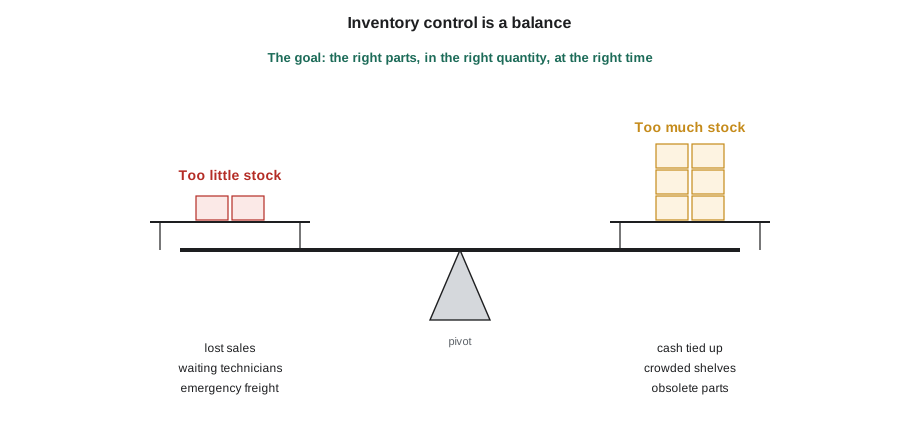
Rolf summed it up in a phrase that many parts managers use: the right part, in the right quantity, in the right place, at the right time, at the right cost. Each part of that phrase matches a topic in this course. The right part depends on what the department chooses to stock (lessons 3 and 6). The right quantity depends on stock levels and reorder points (lesson 3). The right place depends on bin locations and layout (lesson 2). The right time depends on ordering (lesson 4). The right cost depends on turns, carrying cost and control of losses (lessons 5, 7 and 8).
What customers and technicians notice
Customers never see a reorder point or a turns figure. What they notice is simpler: was the part there, was it the right one, and how long did it take? For the service department, the cost of a missing part shows up as a car on a hoist with no work being done, a technician waiting, and a customer told that the car will not be ready today. Priyanka Rautela, the service manager, put it plainly at her Monday meeting with Rolf: "Every part you have on the shelf is a car I can finish today."
The measure that captures this is the fill rate: the share of requests filled from stock on the shelf at the time of the request. In the week Talia started, the counter received 412 part line requests and filled 371 of them from stock, a fill rate of about 90 in 100. The other 41 lines had to be ordered, sourced from another dealer or lost. Lesson 11 shows how fill rate is calculated and what affects it.
Worked problem
Calculating the fill rate
In one week the counter received 412 part line requests. 371 were filled from stock on the shelf. What was the fill rate?
Show solution
- Fill rate:
- \[\dfrac{371}{412} \approx 0.90\]
- As a share:
- about 90 in 100
Answer: The fill rate was about 90 in 100: nine requests in ten were filled from the shelf. The numbers are the department's sample figures used throughout this course.
A fill rate of 100 in 100 sounds ideal, but chasing it would mean stocking every part that might ever be needed, including parts that sell once in five years. Most dealership parts departments aim for a fill rate somewhere in the high 80s to low 90s out of 100 on stocked parts, and accept that rare parts will be ordered when needed. The target is a business decision, set by the parts manager and the dealership.
The money side: inventory is cash on a shelf
Inventory is usually one of the largest assets a parts department controls. At Linmore Tessaro, the parts inventory was worth about 640,000 dollars at cost, the price the dealership paid for it. That money could have been in the bank, paying down a loan or spent on new equipment for the service department. Instead it was sitting on the shelves in the form of filters, brake pads, sensors and thousands of other parts.
Holding inventory also costs money every year, even if nothing happens to the parts. The money tied up has a cost, the building and shelving cost money, parts get damaged or lost, and some parts become obsolete and have to be sold at a loss or thrown away. Together these are called the carrying cost of inventory. Lesson 5 breaks carrying cost into its parts. A figure often used for planning is 20 to 30 in 100 of the inventory's value each year; this course uses 25 in 100 as a sample rate.
Worked problem
The yearly cost of holding the inventory
Linmore Tessaro's inventory is worth 640,000 dollars at cost. Using a sample carrying cost of 25 in 100 a year, what does it cost to hold that inventory for a year?
Show solution
- Carrying cost:
- \[640{,}000 \times 0.25 = 160{,}000\]
- Per month:
- \[160{,}000 \div 12 \approx 13{,}333\]
Answer: Holding the inventory costs about 160,000 dollars a year, or about 13,300 dollars a month, at the sample rate. Cutting the inventory by parts that do not sell lowers this cost without hurting service.
This is why parts managers watch the inventory value so closely. If the department can serve customers just as well with 10 in 100 less stock, it frees 64,000 dollars of cash and saves about 16,000 dollars a year in carrying cost at the sample rate. If it carries 10 in 100 more stock that does not sell, the opposite happens.
Turns: how hard the inventory works
The most common single measure of inventory performance is inventory turns, or turnover: how many times a year the department sells and replaces its average inventory. It is calculated from the cost of the parts sold in a year and the average value of the inventory at cost.
Linmore Tessaro sold parts that had cost it about 3,840,000 dollars in the past year, with an average inventory of 640,000 dollars at cost. That is 6.0 turns a year: on average, the stock on the shelf was sold and replaced six times. Another way to say the same thing is that the department held about two months of supply. Lesson 5 explains turns in detail, and lesson 11 shows how to calculate the related measures.
Worked problem
Turns and months of supply
The department's cost of parts sold for the year was 3,840,000 dollars and its average inventory at cost was 640,000 dollars. Find the turns and the months of supply.
Show solution
- Turns:
- \[3{,}840{,}000 \div 640{,}000 = 6.0\]
- Months of supply:
- \[12 \div 6.0 = 2.0\]
Answer: The inventory turned 6.0 times a year, which is about two months of supply on hand. More turns with the same fill rate means the same service from less money.
Higher turns are usually better, but only up to a point. A department that turns its inventory 12 times a year by stocking almost nothing will have a poor fill rate and unhappy customers. The goal is to raise turns while keeping the fill rate at its target, by stocking more of what sells and less of what does not.
Lost sales: the cost you cannot see
When a part is not in stock, the department sometimes still makes the sale: the customer waits for the part to arrive, or the shop's job waits until tomorrow. Other times, the customer buys from a competitor, the shop calls another supplier, or the technician moves on to a different job. A sale lost this way leaves no invoice behind. Unless someone records it, the department never knows it happened.
That is why good parts departments keep a lost sales record. Whenever a request cannot be filled from stock, the parts technician records the part number, the quantity and whether the customer waited or went elsewhere. Over time, this record shows which parts the department should start stocking. Lesson 3 uses lost sales records to set stock levels, and lesson 9 shows the lost sales report in the inventory software.
Worked problem
What the unfilled lines might have been worth
In the week Talia started, 41 part line requests could not be filled from stock. Suppose the average line was worth 58 dollars, and about half the customers went elsewhere. Roughly how much in sales was lost that week?
Show solution
- Value of all unfilled lines:
- \[41 \times 58 = 2{,}378\]
- About half lost:
- \[2{,}378 \div 2 = 1{,}189\]
Answer: About 1,190 dollars of sales went elsewhere that week, using these sample assumptions. Over a year that adds up, which is why the lost sales record matters.
Who does inventory control
In a small parts department, inventory control is part of everyone's job. Rolf, as parts manager, sets the policies: what to stock, the reorder rules and the targets for turns and fill rate. Sasha Esparza, the warehouse lead, runs receiving and makes sure parts go into the right bins. Imani Grantham and the counter staff record lost sales, sell from stock and report problems. Talia, as the newest person in the department, would learn every step, starting with the bin locations in lesson 2.
Larger dealership groups often have an inventory specialist or a group parts director who reviews stock across several stores. Linmore had one such person who visited each store a few times a year, and lesson 12 follows Rolf to another Linmore store whose stock had fallen into poor shape.
The parts technician's daily habits matter as much as the manager's policies. A part put in the wrong bin is as good as lost. A sale entered under the wrong part number makes the computer's stock count wrong for two parts at once. A lost sale that is not recorded hides a part the department should stock. Inventory control is built from many small, careful actions.
| Daily habit | Why it matters |
|---|---|
| Put parts in their assigned bin | The system and the shelf agree, and the part can be found |
| Sell and return under the correct part number | Stock counts stay accurate for every part |
| Record every lost sale | The department learns which parts to stock |
| Report damaged or missing parts at once | Problems are fixed before they grow |
| Check the bin quantity when picking | Errors are caught before the next count |
Inventory and the business
Inventory control also matters to people outside the parts department. The dealership's accountant needs an accurate inventory value at year-end for the financial statements and taxes (lesson 7). The general manager, Walter Bisset, compares the parts department's results with other Linmore stores. The manufacturer, Tessaro, offers better pricing and return terms to dealers who order on a regular schedule and keep their inventory current (lessons 4 and 6). Inventory is not just a warehouse matter; it is part of how the whole business is judged.
Rolf finished the walk at his office door. "In a year," he said, "I want you to be able to look at any part on these shelves and tell me whether it should be there, how many we should have, and what to do if we have too many." Talia thought that was a lot to learn. By the end of this course, she would know how.
Common mistakes
MistakeThinking a full shelf means good service.
InsteadGood service comes from stocking the parts that sell, not from stocking everything.
MistakeIgnoring requests that could not be filled.
InsteadRecord lost sales so the department learns what to stock.
MistakeTreating inventory as free once it is paid for.
InsteadHolding stock costs money every year in carrying cost.
MistakeChasing turns by stocking almost nothing.
InsteadRaise turns while keeping the fill rate at its target.
MistakeLeaving inventory control to the manager.
InsteadEvery parts technician's daily habits keep stock accurate.
Summary and key terms
- Inventory control decides which parts to stock, how many, where, when to reorder and when to remove them.
- Every stocking decision balances the cost of running out against the cost of holding too much.
- Fill rate is the share of requests filled from stock; turns measure how many times a year the inventory is sold and replaced.
- Carrying cost is the yearly cost of holding inventory; this course uses a sample rate of 25 in 100.
- Lost sales leave no invoice, so they must be recorded to be seen.
- Policies come from the parts manager, but accurate stock depends on everyone's daily habits.
- Inventory
- The stock of parts a business owns and holds for sale.
- Inventory control
- The decisions and routines that keep the right parts in stock in the right quantities.
- Fill rate
- The share of requests filled from stock on the shelf at the time of the request.
- Inventory turns
- How many times a year the average inventory is sold and replaced; cost of parts sold divided by average inventory at cost.
- Carrying cost
- The yearly cost of holding inventory, including the cost of money, storage, loss and obsolescence.
- Lost sale
- A request that could not be filled from stock and went elsewhere.
Practice problems
Work each problem on paper first, then reveal the answer to check.
A counter fills 450 of 500 requests from stock. What is the fill rate?
Show answer
450 ÷ 500 = 0.90, or 90 in 100.
Cost of parts sold is 2,400,000 dollars and average inventory at cost is 480,000 dollars. What are the turns?
Show answer
2,400,000 ÷ 480,000 = 5.0 turns.
What is the carrying cost of 300,000 dollars of inventory at 25 in 100 a year?
Show answer
300,000 × 0.25 = 75,000 dollars a year.
Why record a lost sale if the customer simply left?
Show answer
It shows a part the department might need to stock.
How many months of supply does a department with 4.0 turns hold?
Show answer
12 ÷ 4.0 = 3 months.
Lesson quiz · 5 questions
Score 60% or more to complete this lesson.
Create a free account to save your progress, take quizzes and earn a certificate.