
APP-420 · Lesson 9 of 12 · 28 min
Review: electronic controls
▶ Video coming soon A video version of this lesson is on the way.
On the evening of Thursday, October 8, Dee and Eamon met at the shop to review electronics with a box of failed boards from Penfold's returns shelf. Eamon admitted that boards were the part of the trade he trusted least. "Most technicians feel that way," Dee said. "The exam doesn't expect you to repair a board. It expects you to prove whether the board is the problem before anyone spends money on one. Inputs, outputs, power, communication. If those four are right and the board still doesn't do its job, then it's the board."
This lesson reviews APP-320 (electronic controls, sensors and diagnostics) and the electronic parts of APP-210, APP-220, APP-230 and APP-330, including microwave ovens. Electronic controls appear on the NASTeC Basic Skills exam and in every specialty, and microwave ovens are part of the Cooking specialty.
The board as a black box
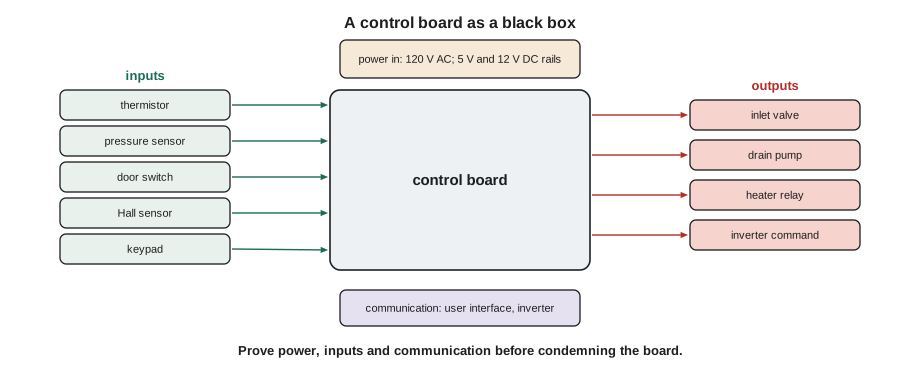
APP-320's method treats a control board as a box with four kinds of connection, each of which can be checked from outside:
- Power in. The board's supply, often 120 V AC at the line input, and the low-voltage DC rails it makes for itself, such as 5 V and 12 V, which can be measured at test points or connectors when the service information shows them.
- Inputs. Sensors and switches: thermistors, pressure sensors, door and lid switches, Hall sensors, keypads. Each has a value the board expects.
- Outputs. The loads the board drives: valves, pumps, relays to heaters and motors, inverter commands.
- Communication. Data links to other boards, such as a user interface, an inverter or a motor control board.
If the board has power, its inputs are correct and its communication works, and yet it does not drive an output it should, the board is at fault. If an input is wrong, the board may be doing exactly what it was designed to do with bad information. APP-320's Tamberlane case is the classic exam example: a refrigerator thermistor reading 9,800 Ω because of water in its connector made the board think the fresh food section was at about 25 °C, so the board ran the system hard; the board was fine.
Power supplies and stored charge
Most appliance boards use a switch-mode power supply. On a 120 V supply the rectified bulk capacitor charges to about the peak of the supply, about 170 V DC; on 240 V, about 340 V DC. APP-320 stressed that these capacitors, and the bigger ones on inverter and induction boards, can hold a dangerous charge after the appliance is unplugged. They discharge through bleeder resistors, but slowly.
Worked problem
How long a bus takes to bleed down
APP-320's sample inverter board had a 470 µF bus capacitor charged to 340 V, with a 100 kΩ bleeder resistor. What is the time constant, how long until the bus is below 50 V, and how much energy did it store?
Show solution
- Time constant:
- \[\tau = RC = 100{,}000 \times 470 \times 10^{-6} = 47 \text{ s}\]
- Time to fall from 340 V to 50 V:
- \[t = \tau \ln\frac{340}{50} = 47 \times \ln 6.8 \approx 90 \text{ s}\]
- Energy stored at 340 V:
- \[E = \tfrac{1}{2} C V^2 = 0.5 \times 470 \times 10^{-6} \times 340^2 \approx 27 \text{ J}\]
Answer: 47 seconds per time constant, about a minute and a half to fall below 50 V, and about 27 J at full charge, enough for a serious shock. The bus is measured before the board is handled, every time; if the bleeder has failed, it may never discharge on its own.
Low-voltage rails are checked against the service information. A missing 5 V rail usually means a failed supply section, often after a power surge or water damage, as in APP-320's Gaillard dishwasher, whose board was corroded at the line input by water from a torn door gasket. The exam may ask what else must be fixed when a board is replaced after water damage: the source of the water, or the new board will fail the same way.
Sensors and their checks
APP-320 and the appliance courses covered the sensors most often examined:
- NTC thermistors read by a voltage divider. On the β 3950 sample curve, a 10 kΩ sensor is 10,000 Ω at 25 °C and about 28,700 Ω at 3 °C. With a 10 kΩ fixed resistor on a 5 V supply, the divider gives 2.50 V at 25 °C and about 3.71 V at 3 °C. A sensor can be checked by resistance at a known temperature or by the voltage at the board.
- Pressure sensors for washer water level, often giving a frequency that falls as the level rises (the sample 25.6 kHz empty, 23.6 kHz at wash level).
- Hall-effect sensors for motor rotor position and drum speed, which need a supply voltage and give a switching signal; an unplugged Hall connector gave a motor fault in APP-320's training washer (the sample Northwind code F51).
- Reed switches and door switches, checked for continuity with the magnet or door in each position.
- Turbidity sensors in dishwashers, which shine light through the wash water to judge how dirty it is.
Worked problem
A thermistor through a voltage divider
A 10 kΩ NTC thermistor (β 3950) is in a divider with a 10 kΩ fixed resistor on 5 V, with the board reading the voltage across the thermistor. What voltage does the board see at 25 °C and at 3 °C?
Show solution
- At 25 °C, the thermistor is 10,000 Ω:
- \[V = 5 \times \frac{10{,}000}{10{,}000 + 10{,}000} = 2.50 \text{ V}\]
- At 3 °C, it is about 28,700 Ω:
- \[V = 5 \times \frac{28{,}700}{28{,}700 + 10{,}000} \approx 3.71 \text{ V}\]
Answer: 2.50 V at 25 °C and about 3.71 V at 3 °C. A reading near 5 V means the thermistor is open; near 0 V means it is shorted. Those are the two readings that set most sensor fault codes.
Inverter compressors and brushless motors
Variable-speed refrigerators use an inverter board that drives a three-phase brushless compressor at a speed set by the main control. The inverter converts the supply to DC and then to three-phase AC at a variable frequency. A compressor that will not start is checked in a set order: is the main board sending a command, does the inverter have its supply, does the inverter attempt to start the compressor (often visible as repeated current spikes), and are the three compressor windings equal to each other and open to ground?
Worked problem
Equal windings and a winding fault
APP-320's Thistlewood compressor read 11.8 Ω, 11.8 Ω and 14.6 Ω between its three terminals. Wrenfield's, two months later, read 11.9 Ω on all three and above 20 MΩ to ground. Which compressor has a winding fault?
Show solution
- On a three-phase brushless compressor, the three readings should match closely.
- Thistlewood's high reading is above the others by:
- \[\frac{14.6 - 11.8}{11.8} \approx 0.24\]
- That is about 24 in 100, far too large an imbalance.
- Wrenfield's readings are equal and well insulated from ground.
Answer: Thistlewood's compressor had the winding fault, and the maker approved a replacement refrigerator under the sealed-system warranty. Wrenfield's compressor was good, the inverter was making no attempt to start it, and the inverter board was replaced.
Direct-drive washer motors follow the same logic: three equal stator windings (APP-320's Delahunt washer read 7.4 Ω on each), no path to ground, a working Hall sensor and its connector, and then the motor control board. Many motor faults are connectors and harnesses rather than motors, such as Valcourt's chafed communication harness and Fanthorpe's half-unplugged connector after a move.
Microwave ovens
Microwave ovens belong in this review because their controls are electronic and their high-voltage circuit is the most dangerous circuit in any household appliance. APP-330 taught the parts: a high-voltage transformer (about 2,000 V AC on its secondary, typically), a high-voltage capacitor and diode that double it to about 4,000 V DC at the magnetron, which makes the 2,450 MHz microwaves, and a bleeder resistor across the capacitor. The high-voltage circuit is never measured with a meter while running; it is checked with power off and the capacitor discharged and tested. The door has a primary and secondary interlock and a monitor switch that blows the fuse if the interlocks fail, and the interlocks and monitor are replaced as the maker specifies. The federal limit (21 CFR 1030.10) is 1 mW/cm² at about 2 in before sale and 5 mW/cm² afterwards, and Penfold's rule, after any repair, is a leakage survey with a calibrated meter: below 1 returns the oven to service.
Worked problem
A microwave water test
A water test heats 1 kg (1 L) of water from 20 °C to 32.5 °C (68 °F to 90.5 °F) in 60 seconds. What output power does that show, and what share of a 1,000 W rating is it?
Show solution
- Temperature rise:
- \[32.5 - 20 = 12.5\ ^\circ\text{C}\]
- Power:
- \[P = \frac{m c \Delta T}{t} = \frac{1 \times 4{,}187 \times 12.5}{60} \approx 872 \text{ W}\]
- Share of the rating:
- \[872 \div 1{,}000 \approx 0.87\]
Answer: About 872 W, about 87 in 100 of the rating, which APP-330 described as normal for a field water test (typically 80 to 90 in 100, because the test is not done in a laboratory). A much lower result points to a weak magnetron or a high-voltage fault.
Service modes, fault codes and connected appliances
Most boards have a service or diagnostic mode, entered by a key sequence from the service information, that shows stored fault codes and runs each output in turn. Fault codes are clues, not answers: a code says what the board saw, not why. APP-220's and APP-310's sample Northwind codes (F21 long drain, F51 motor, F60 communication; E1 fill, E2 drain, E5 flood) each had several possible causes. Stored codes from weeks earlier may not relate to today's complaint, which is why codes are read, recorded and then cleared, and the appliance is run to see which codes return.
Connected appliances add Wi-Fi modules and apps, and APP-320 described the Matter standard's growing list of appliance types. A common call with no fault at all is a washer that has dropped off the network after the customer changed routers, as in APP-320's Amadi case. The exam is more likely to ask about the safe procedure for board replacement: confirm the diagnosis, check the part number and revision (a superseded board, such as the sample NW-7742 replaced by NW-8810, may come with a new harness or instructions), wear an ESD wrist strap grounded to the appliance chassis, handle boards by their edges, keep them in their shielding bags until fitted, transfer any configuration settings, and return the old board in the new board's bag if there is a core charge.
Before you order a board
Boards are expensive, often non-returnable, and sometimes take a week to arrive, so ordering one on a wrong diagnosis costs the customer money and the company a callback. Penfold's checklist before any board order, which APP-320 introduced, is short: the fault is confirmed and repeatable; power, inputs and communication have been checked and are correct; the board's outputs have been checked where the service information allows; the connectors have been inspected for corrosion, burned pins and backed-out terminals; the part number has been looked up from the model and serial number, including any revision; and the customer has agreed to the price, including any core charge and the fact that electronic parts may not be returnable. Questions that ask what should be done before replacing a board usually have one of these steps as the answer.
Common mistakes
MistakeReplacing a board because it shows a fault code.
InsteadProve power, inputs and communication first; a code says what the board saw.
MistakeTouching an inverter or induction board as soon as it is unplugged.
InsteadMeasure the DC bus and wait for it to bleed down.
MistakeMeasuring a microwave's high-voltage circuit with a meter while running.
InsteadCheck high-voltage parts with power off and the capacitor discharged.
MistakeReplacing a water-damaged board without finding the water.
InsteadFind and repair the source, such as a torn door gasket.
MistakeHandling a new board without ESD protection.
InsteadWear a grounded wrist strap and keep the board in its shielding bag until fitted.
Summary and key terms
- Check a board's power, inputs, outputs and communication before condemning it.
- Bulk capacitors charge to about 170 V DC on 120 V and 340 V DC on 240 V and can hold a dangerous charge.
- A 470 µF capacitor with a 100 kΩ bleeder has τ = 47 s and takes about 90 s to fall from 340 V to 50 V.
- A 10 kΩ NTC with a 10 kΩ divider on 5 V gives 2.50 V at 25 °C; near 5 V is open, near 0 V is shorted.
- Brushless compressors and motors have three equal windings, open to ground; a large imbalance is a winding fault.
- Check that an inverter receives a command and power and attempts a start before replacing it.
- Microwave high-voltage parts are checked dead and discharged; interlocks and monitor are replaced as the maker specifies; leakage is surveyed after every repair.
- A water test of 1 kg heated 12.5 °C in 60 s shows about 872 W.
- Fault codes are clues; read, record, clear and rerun. Replace boards with ESD protection.
- Switch-mode power supply
- A board supply that rectifies the line voltage and switches it at high frequency to make low-voltage DC rails.
- Bleeder resistor
- A resistor across a capacitor that slowly discharges it after power is removed.
- Voltage divider
- Two resistances in series across a supply; the board reads the voltage at their junction.
- Inverter board
- A board that drives a variable-speed compressor or motor with variable-frequency three-phase power.
- Monitor switch
- A microwave door switch that blows the fuse if the interlocks fail closed.
- ESD
- Electrostatic discharge, which can damage electronic parts without any visible sign.
Practice problems
Work each problem on paper first, then reveal the answer to check.
Practice: A refrigerator board reports a high fresh food temperature, but a thermometer shows 3 °C. The thermistor reads 9,800 Ω. What is the fault?
Show answer
The thermistor circuit, not the board: about 28,700 Ω is expected at 3 °C, so something (often water in the connector) is pulling the reading down.
Practice: A thermistor divider reads 4.98 V at the board. What does that suggest?
Show answer
An open thermistor or connection.
Practice: Three compressor windings read 11.9, 11.9 and 11.9 Ω and more than 20 MΩ to ground, and the inverter shows no start attempts. What is next?
Show answer
Check the inverter's supply and the command from the main board; if both are present, the inverter board is at fault.
Practice: Why is a microwave's monitor switch replaced along with a failed primary interlock?
Show answer
The monitor is designed to blow the fuse when the interlocks fail, and the maker specifies replacing the set so the safety system works as designed.
Practice: A water test heats 1 kg of water 10 °C in 60 s. About what output power is that?
Show answer
1 × 4,187 × 10 ÷ 60 ≈ 698 W.
Practice: What should be done with the old board when there is a core charge?
Show answer
Return it in the new board's shielding bag.
Lesson quiz · 5 questions
Score 60% or more to complete this lesson.
Create a free account to save your progress, take quizzes and earn a certificate.