
APP-420 · Lesson 3 of 12 · 30 min
Review: electrical theory and schematics
▶ Video coming soon A video version of this lesson is on the way.
On Sunday, September 27, Eamon arrived with a page of Ohm's law questions he had got wrong in his diagnostic test. All four were the same mistake: he had worked out resistance from the rated wattage at 240 V and then used it at 208 V without changing anything else. "You know this," Dee said. "You've measured a hundred elements. The exam isn't checking whether you can measure one. It's checking whether you can predict what it should read, and what it will do on a different supply."
This lesson reviews APP-120 (electrical circuits and schematics) with a little of APP-320. Electrical theory is a large part of the NASTeC Basic Skills exam and appears in every specialty, because every appliance fault ends up being diagnosed with a meter and a schematic.
Ohm's law and power
Four quantities and two equations do almost all the work in appliance electrical questions:
Voltage (V) is in volts, current (I) in amperes, resistance (R) in ohms and power (P) in watts. The resistance of a heating element stays nearly constant, so if the supply voltage changes, the current and the power change with it. Power changes with the square of the voltage, which is why a 240 V element on a 208 V supply gives only about three-quarters of its rated power.
Worked problem
An element on 240 V and on 208 V
A bake element is rated 3,000 W at 240 V. What resistance should it measure, what current does it draw at 240 V, and what power does it give on a 208 V supply in a condominium?
Show solution
- Resistance from the rating:
- \[R = \frac{V^2}{P} = \frac{240^2}{3{,}000} = 19.2\ \Omega\]
- Current at 240 V:
- \[I = \frac{V}{R} = \frac{240}{19.2} = 12.5 \text{ A}\]
- Power at 208 V, with the same resistance:
- \[P = \frac{208^2}{19.2} \approx 2{,}253 \text{ W}\]
Answer: The element should read about 19.2 Ω cold (a little less than when hot), draws 12.5 A, and gives about 2,250 W on 208 V, about 75 in 100 of its rating. That is normal; it is not a fault, as APP-120's condominium call showed.
Exam questions also use small loads. A water inlet valve coil of about 900 Ω on 120 V draws only about 0.13 A and uses about 16 W. A reading of 0 Ω on such a coil means a short; OL (open) means an open coil; and a reading far outside the maker's range means the coil is suspect even if it still clicks.
Series, parallel and combination circuits
In a series circuit there is one path: the same current flows through every part, the voltages add up to the supply, and one open part stops everything. Safety devices are wired in series with the load they protect, such as a thermal fuse and high-limit thermostat in a dryer's heater circuit or the door switch in a dishwasher. In a parallel circuit each branch has the full supply voltage, the branch currents add up, and one open branch does not stop the others, as with the bake and broil elements fed together during preheat, or two lamps in an oven.
Worked problem
Series and parallel lamps
Two 40 W, 120 V lamps are each about 360 Ω hot. What happens if they are mistakenly wired in series across 120 V, and what current do they draw in parallel?
Show solution
- Each lamp at its rating:
- \[R = \frac{120^2}{40} = 360\ \Omega\]
- In series the resistances add:
- \[I = \frac{120}{720} \approx 0.167 \text{ A}, \quad P = \frac{120^2}{720} = 20 \text{ W total}\]
- In parallel each lamp gets 120 V:
- \[I = 2 \times \frac{40}{120} \approx 0.67 \text{ A}\]
Answer: In series each lamp gets only half the voltage and glows dimly (in practice a little brighter than the calculation, because a cooler filament has lower resistance). In parallel both light fully and the circuit draws about 0.67 A.
Combination circuits mix the two: a thermal fuse in series with a cycling thermostat, with the heater element and its high limit in series again, all fed from one leg while the motor is fed from the other leg and neutral. The exam often shows such a circuit and asks which part, if open, gives a stated symptom, for example a dryer that runs but does not heat (open thermal fuse, high limit, cycling thermostat or element) against one that does not run at all (door switch, start switch, motor or thermal fuse in the motor circuit, depending on the design).
Reading a schematic
APP-120 taught the ladder diagram: supply rails on each side, each rung a complete path from one side to the other, switches and contacts shown in their de-energized, door-open or cold state unless the legend says otherwise, and loads at the end of each rung. Contacts belonging to one device carry the same label wherever they appear. Exam questions usually give a fragment of a schematic and a set of readings and ask which part has failed. The method that works every time is:
- Trace the rung for the load that is not working, from one supply rail to the other.
- List every switch, contact, fuse and connector in that path, and decide what state each should be in for the load to run.
- Use the readings given, or decide which reading you would take next, to find the point where voltage is present on one side and absent on the other. That is the open part.
- Check the answer against the symptom: does an open part there explain everything the customer reported, and nothing it should not?
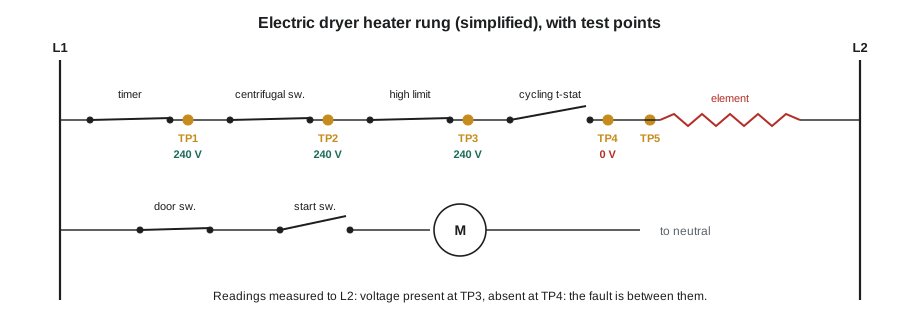
Worked problem
Finding the open part on a rung
On the dryer rung in the figure, Eamon measured to L2 and read 240 V at TP1 (after the timer), 240 V at TP2 (after the centrifugal switch), 240 V at TP3 (after the high limit) and 0 V at TP4 (after the cycling thermostat). The dryer runs but does not heat. Where is the fault, and what is the next check?
Show solution
- Voltage is present on the supply side of the cycling thermostat (TP3) and absent on the far side (TP4).
- So the cycling thermostat is open, or the connection at its terminal is.
- Next check: power off, disconnect the thermostat and measure it cold. A cycling thermostat should be closed at room temperature, near 0 Ω.
Answer: The fault is the cycling thermostat or its connection. A cold thermostat that reads OL is replaced, and the vent is checked, because a blocked vent is the usual reason a thermostat or high limit fails.
Motors, capacitors and start devices
APP-120 described the motors found in appliances. A shaded-pole motor (small fans) has no start winding and low starting torque. A PSC (permanent split capacitor) motor keeps a run capacitor in circuit all the time, as in many fan and compressor motors. A universal motor has brushes and a commutator and runs on AC or DC, as in older washers and mixers, and its brushes wear out (APP-220's washer had brushes worn to 7 mm against a 10 mm limit). A split-phase motor uses a start winding switched out by a centrifugal switch, as in many dryer drive motors. Modern washers, refrigerators and dishwashers increasingly use brushless DC and inverter motors, which APP-320 covered.
Compressors in household refrigerators start with a PTC relay or a current relay and are protected by an overload. A PTC starter has a cold resistance of a few ohms and heats up to cut the start winding out within a second or two. A PTC that measures open is replaced. Compressor terminals are identified by measuring between the three pins: the highest reading is start to run, and it equals the sum of the other two (common to start plus common to run). A reading from any pin to the compressor shell means a grounded compressor.
Worked problem
Identifying compressor terminals
Hiro's bench compressor in APP-210 read 9.6 Ω, 14.1 Ω and 23.7 Ω between its three pins, and 180 kΩ from one pin to the shell. Which pair is start to run, and is the compressor safe to run?
Show solution
- The highest reading is start to run: 23.7 Ω.
- Check that it is the sum of the other two:
- \[9.6 + 14.1 = 23.7\ \Omega\]
- So 9.6 Ω is common to run and 14.1 Ω is common to start.
- A reading of 180 kΩ to the shell is a path to ground; a good compressor reads well above 1 MΩ, effectively open.
Answer: Start to run is 23.7 Ω, but the compressor is grounded and is condemned. It must not be put back in service.
Grounding, GFCI and 120/240 V supplies
Household 240 V appliances in Canada and the United States are fed from a split-phase supply: two hot legs at 240 V between them, each at 120 V to neutral, and an equipment ground. APP-120 taught that new range and dryer circuits have been four-wire since the 1996 National Electrical Code, while older homes may still have three-wire connections where the neutral bonds the frame. NEC 2023 requires GFCI protection for kitchen and laundry receptacles up to 250 V and for appliances such as dishwashers, ranges and dryers. GFCIs trip at about 5 mA of leakage, so a dishwasher heater with leakage to its sheath can trip a GFCI even though the heater still works, as in APP-120's renovated kitchen.
Exam questions about grounding usually test three ideas: that the equipment ground carries current only during a fault, that a missing ground can leave a metal cabinet live (APP-110's washer that gave a tingle on an ungrounded two-prong receptacle), and that a technician does not alter house wiring: problems with receptacles, breakers or circuits are referred to a licensed electrician.
Watts, volt-amperes and motor loads
Heating elements are resistive, so their power is simply volts times amps. Motors, transformers and electronic supplies are not purely resistive, and their current is often larger than their wattage would suggest, because some current flows back and forth without doing work. The exam rarely asks for power factor calculations, but it may ask why a motor draws more current at start than when running, or why a clamp reading on a compressor is higher than its wattage divided by the voltage. The answers are that a motor's start current (locked-rotor current) is several times its running current until it reaches speed, and that the running current includes a reactive part.
Two practical rules follow. First, compare motor current with the nameplate's rated amps, not with a figure worked out from watts. Second, a motor that draws locked-rotor current for more than a second or two and then trips its overload has not started; the cause may be a failed capacitor, a failed start device, a seized mechanism or low voltage. APP-120's dryer that hummed without turning had an open start winding circuit, found by measuring the start winding and the centrifugal switch.
Worked problem
Two loads on one leg
A dryer's 5,400 W element is fed from both legs at 240 V and its drive motor from one leg and neutral at 120 V, drawing 4.5 A. What current flows in each supply leg?
Show solution
- Element current, in both legs:
- \[5{,}400 \div 240 = 22.5 \text{ A}\]
- The leg that also feeds the motor:
- \[22.5 + 4.5 = 27.0 \text{ A}\]
- The other leg carries only the element current, 22.5 A; the neutral carries the motor current, 4.5 A.
Answer: 27.0 A in one leg, 22.5 A in the other, 4.5 A in the neutral. A clamp meter on each conductor would show exactly that, which is a quick way to see whether the element and the motor are both working.
Schematic questions also test symbols. The ones most often used are switches (normally open and normally closed), relay coils with their contacts, thermostats (with a temperature symbol), thermal fuses, motors, capacitors, resistors and heaters, diodes, ground symbols and connector numbers. Service information for each brand adds its own conventions, which is why lesson 9 recommends reading the legend on every schematic before tracing it.
Common mistakes
MistakeUsing an element's 240 V wattage at 208 V without recalculating.
InsteadWork out the resistance first, then use P = V²/R at the new voltage.
MistakeMeasuring a component's resistance in circuit with power on.
InsteadPower off, disconnect at least one lead, then measure.
MistakeFollowing a schematic without checking the state the contacts are drawn in.
InsteadRead the legend: contacts are usually drawn de-energized, cold and door-open.
MistakeTaking the lowest compressor reading as start to run.
InsteadThe highest reading is start to run, and it equals the sum of the other two.
MistakeCorrecting a missing ground or wrong receptacle on the call.
InsteadRefer house wiring problems to a licensed electrician.
Summary and key terms
- V = IR and P = VI = V²/R = I²R; power changes with the square of voltage.
- A 3,000 W, 240 V element is 19.2 Ω, draws 12.5 A and gives about 2,250 W at 208 V.
- Series parts share one current and one open stops the circuit; parallel branches each get full voltage and their currents add.
- Read a schematic rung by rung, list every device in the path, and find where voltage is present on one side and absent on the other.
- Compressor start-to-run is the highest reading and equals the sum of the other two; any reading to the shell condemns it.
- PTC starters read a few ohms cold; an open PTC is replaced.
- GFCIs trip at about 5 mA; heater sheath leakage can trip them without a working fault.
- House wiring problems go to a licensed electrician.
- Ohm's law
- The relation V = I × R between voltage, current and resistance.
- Rung
- One complete path from supply to supply on a ladder diagram, with its contacts and load.
- Split-half method
- Testing at the middle of a path to find which half holds the fault, then repeating.
- PSC motor
- Permanent split capacitor motor, with a run capacitor always in circuit.
- PTC relay
- A starting device whose resistance rises as it heats, cutting the start winding out.
- GFCI
- Ground-fault circuit interrupter, which trips when leakage to ground reaches about 5 mA.
Practice problems
Work each problem on paper first, then reveal the answer to check.
Practice: A 5,400 W, 240 V dryer element is installed on a 208 V supply. About what power does it give?
Show answer
R = 240² ÷ 5,400 ≈ 10.67 Ω; P = 208² ÷ 10.67 ≈ 4,056 W.
Practice: A 900 Ω inlet valve coil on 120 V draws what current?
Show answer
120 ÷ 900 ≈ 0.13 A.
Practice: On a rung, voltage is present after the door switch but not after the thermal fuse. What is open?
Show answer
The thermal fuse or its connection.
Practice: Compressor readings are 4.2, 6.0 and 10.2 Ω. Which is common to start?
Show answer
Start to run is 10.2 (= 4.2 + 6.0); common to start is 6.0 Ω, common to run 4.2 Ω.
Practice: Why can a working dishwasher heater trip a GFCI?
Show answer
Leakage from the element to its sheath reaches the GFCI's trip level of about 5 mA.
Practice: What is the capacitive reactance of a 5 µF capacitor at 60 Hz?
Show answer
Xc = 1 ÷ (2π × 60 × 5 × 10⁻⁶) ≈ 530.5 Ω.
Lesson quiz · 5 questions
Score 60% or more to complete this lesson.
Create a free account to save your progress, take quizzes and earn a certificate.