
APP-420 · Lesson 4 of 12 · 30 min
Review: refrigeration and sealed systems
▶ Video coming soon A video version of this lesson is on the way.
On Sunday, October 4, Hiro Nakashima came in for the afternoon. Sealed systems were Eamon's weakest area on the diagnostic test, and Hiro runs Penfold's sealed-system work. He brought the cut-away refrigerator from his Tuesday evening classes and a shoebox of failed parts: a filter-drier, a PTC starter, a defrost termination thermostat and a length of capillary tube with a kink in it. "Every question about a refrigerator that isn't cold comes down to four questions," Hiro said. "Is the compressor running? Is heat getting out at the condenser? Is the evaporator getting the refrigerant? And is air getting across the evaporator? If you can answer those from the readings in the question, you can answer the question."
This lesson reviews APP-210 (refrigerators and freezers), the sealed-system parts of APP-330, and the refrigeration theory from RAC-110 and RAC-120. It is the core of the NASTeC Refrigeration and Air Conditioning specialty, and sealed-system questions also appear in the EPA Section 608 Core and Type I sections, which lesson 5 covers.
The cycle in four sentences
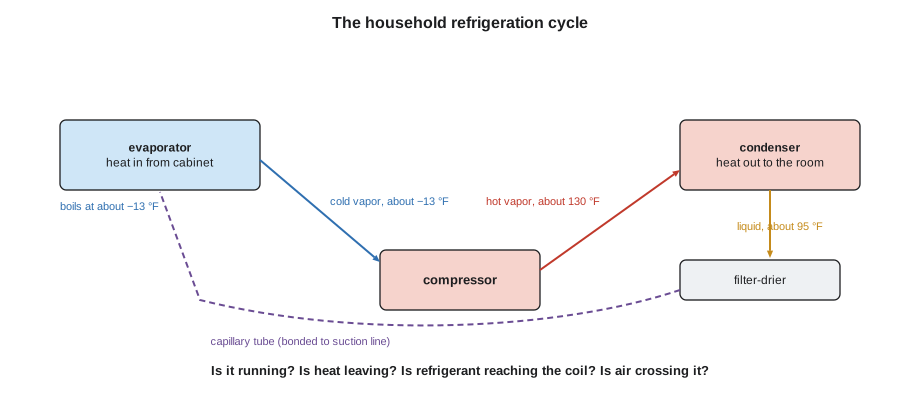
The compressor draws in low-pressure refrigerant vapor from the evaporator and pumps it out as high-pressure, high-temperature vapor. In the condenser the vapor gives up its heat to the room and condenses to a liquid. The liquid passes through the metering device, which in household refrigerators is a capillary tube, and its pressure drops so that it boils at a low temperature. In the evaporator it boils, absorbing heat from the cabinet air, and returns to the compressor as vapor.
Every diagnosis question can be placed somewhere on that loop. A household refrigerator has a few extra parts that the exam likes to ask about: the filter-drier before the capillary, which traps moisture and debris; the suction line heat exchanger, where the capillary is soldered to the suction line so that each warms or cools the other; the hot-wall or yoder loop condenser tubing in some cabinets, which keeps the door flange dry; and the process tubes used to service the system.
Diagnosing without opening the system
APP-210 stressed that most refrigerators have no service valves, and that a technician diagnoses the sealed system from the outside before ever fitting a piercing valve. The outside readings are:
- Temperatures: fresh food about 36 to 39 °F and freezer about −4 to 3 °F are typical targets. A thermometer in a glass of water in the fresh food section gives a steadier reading than air.
- Compressor current or wattage compared with the rating. A compressor running well below its normal wattage is not doing much work, which points to a low charge or a restriction. One running high may be fighting a dirty condenser or an overcharge.
- The frost pattern on the evaporator. An evenly frosted evaporator means the refrigerant reaches the whole coil. Frost only at the inlet, with the rest bare, means too little refrigerant is getting through.
- Line temperatures: a warm condenser and a warm discharge line mean heat is being rejected. A filter-drier that is much colder than the condenser outlet line beside it means it is restricted and the refrigerant is expanding there.
- Run time. A refrigerator that runs all the time without reaching temperature has a capacity problem; one that cycles normally but is warm in one compartment has an airflow or damper problem.
Worked problem
Reading a low-wattage compressor
APP-210's chest freezer was at about 21 °F with its compressor running continuously. The compressor drew 58 W against a normal of about 95 W, frost covered only the first part of the evaporator, and the hot-wall condenser in the cabinet walls was barely warm. What do the readings point to?
Show solution
- Wattage as a share of normal:
- \[58 \div 95 \approx 0.61\]
- A compressor doing about 61 in 100 of its normal work is not moving much refrigerant.
- Frost only at the inlet means refrigerant boils off in the first part of the coil.
- A cool condenser means little heat is being rejected.
Answer: All three point to a low charge from a leak. In a chest freezer the condenser is in the walls, so the leak is likely in the cabinet and not repairable at a sensible cost. APP-210's customer was advised to replace the freezer.
Worked problem
A restricted filter-drier
In another of Dee's cases a refrigerator was warm, the compressor ran, the evaporator had very little frost, and the condenser outlet line read 93 °F while the filter-drier read 48 °F. What does the temperature drop across the drier mean?
Show solution
- Drop across the drier:
- \[34 - 9 = 25\ ^\circ\text{C}\]
- In Fahrenheit:
- \[93 - 48 = 45\ ^\circ\text{F}\]
- Liquid refrigerant should pass through a drier with almost no temperature change. A large drop means the refrigerant is expanding at the drier, so it is partly blocked.
Answer: The drier is restricted. The repair is to recover the refrigerant, replace the drier, evacuate the system and weigh in the nameplate charge.
Starting components and the defrost system
A compressor that does not start may have a failed starter, overload or compressor, or no command from the control. Lesson 3 reviewed the compressor pin readings and the PTC starter. APP-120 and APP-210 also taught the defrost system, which is behind many "warm refrigerator" calls. In a frost-free refrigerator, a defrost heater under the evaporator melts the frost at intervals, controlled by a timer or an adaptive defrost board, and a termination thermostat (bimetal) clipped to the evaporator ends the heating when the coil warms. The water runs down a drain to a pan under the cabinet.
Worked problem
Checking a defrost heater
A 120 V defrost heater is rated 450 W. What should it measure, and what current should a clamp meter show during a forced defrost?
Show solution
- Resistance:
- \[R = \frac{120^2}{450} = 32\ \Omega\]
- Current:
- \[I = \frac{450}{120} = 3.75 \text{ A}\]
Answer: About 32 Ω cold and about 3.75 A during defrost. A reading of 0 A during a forced defrost means the heater, the termination thermostat or the wiring is open, or the control is not calling for defrost. APP-210's French-door case found an open heater this way.
The typical defrost failures on the exam are an open heater, a termination thermostat that never closes (it should close when the coil is cold, below about −7 °C or 19 °F, and open when it warms above about 10 °C or 50 °F), a timer or board that never starts a defrost, and a frozen drain that refreezes water around the evaporator fan. A packed evaporator with a silent fan or a fan grinding on ice is the classic picture. APP-210's case files used a steamer to clear frost from a hydrocarbon system, because no flame or heat gun goes near those lines.
Sensors, fans and airflow
Most refrigerators now use thermistors read by a control board. A typical 10 kΩ NTC sensor reads 10,000 Ω at 77 °F and more as it gets colder: on the β 3950 sample curve that APP-210 and APP-320 used, about 33,600 Ω at 32 °F and about 93,000 Ω at 0 °F. A thermistor is tested by measuring it at a known temperature, such as in ice water, and comparing with the maker's table.
Airflow problems mimic sealed-system problems. A failed evaporator fan leaves the fresh food section warm even when the freezer is cold. A failed condenser fan or a condenser blocked with lint raises the head pressure and the compressor's wattage, and the refrigerator runs long and stays warm. APP-110's first lead call for Kiran was exactly that: an open condenser fan motor and a clogged condenser. On the exam, always rule out airflow before blaming the sealed system.
Repairing a sealed system
When the diagnosis says the sealed system must be opened, APP-210's procedure was:
- Identify the refrigerant and charge from the nameplate. A modern household refrigerator usually holds R-600a (isobutane) in a charge well under 100 g, or R-134a in an older model.
- Recover the refrigerant as the rules require (lesson 5), using a piercing valve on the process tube.
- Make the repair. On R-134a systems, brazing is done with nitrogen flowing through the tubing to prevent oxide scale inside. On R-600a and other hydrocarbon systems, no flame is used near the system unless the maker's procedure and full safety precautions allow it; mechanical crimp connectors such as Lokring-type fittings are the usual method, as in APP-210's warranty evaporator.
- Always replace the filter-drier whenever the system is opened.
- Evacuate the system with a vacuum pump to a deep vacuum, commonly about 500 microns, and hold it to check for leaks and moisture.
- Weigh in the exact nameplate charge with an accurate scale. Household systems have such small charges that adding refrigerant "by pressure" or by feel will almost always be wrong.
- Pinch off or seal the process tubes, leak test, and label the system with the service details.
Worked problem
Weighing in a small charge
APP-210's R-600a evaporator repair needed a 62 g charge, and 2 g stayed in the charging hose. How much should leave the cylinder, and how much is that in ounces?
Show solution
- From the cylinder:
- \[62 + 2 = 64 \text{ g}\]
- In ounces:
- \[64 \div 28.35 \approx 2.26 \text{ oz}\]
Answer: 64 g leaves the cylinder so that exactly 62 g reaches the system. Two grams is more than 3 in 100 of the charge, which is enough to matter in a small system.
Pressures, temperatures and superheat in household work
Household refrigerators are rarely diagnosed by pressure, because most have no service valves and fitting a piercing valve opens a path for a leak. But pressure and temperature still matter, and exam questions ask about the relationship. A refrigerant boiling in the evaporator does so at a temperature set by its pressure; the lower the pressure, the colder it boils. A refrigerant condensing in the condenser does so at a temperature set by its higher pressure. Each refrigerant has its own pressure-temperature chart, and readings from a system are compared with the chart for that refrigerant.
Two terms come up on exams. Superheat is how far a vapor's temperature is above the boiling temperature at its pressure; a high superheat at the evaporator outlet means the evaporator is short of refrigerant. Subcooling is how far a liquid's temperature is below the condensing temperature at its pressure; it shows how much liquid is backed up in the condenser. In capillary-tube household systems, these are used less than the outside readings in this lesson, but an exam question may describe a system with high superheat and ask what it means: too little refrigerant reaching the evaporator, from a low charge or a restriction.
Worked problem
Run time as a clue
A refrigerator's compressor ran 72 minutes in a 110-minute observation, in a warm kitchen, and both compartments were at their set temperatures. Is that run time a fault?
Show solution
- Run share:
- \[72 \div 110 \approx 0.65\]
- About 65 in 100 run time in a warm room, with both compartments at temperature, is within the normal range for many refrigerators.
- A refrigerator that ran 100 in 100 of the time and was still warm would point to a capacity problem.
Answer: Not a fault. Long run times on their own do not prove a problem; modern variable-speed refrigerators may run almost continuously at low speed by design. The exam wants run time judged together with temperatures.
Room air conditioners and dehumidifiers, which APP-330 covered, are also sealed systems, and most of this lesson applies to them. A window unit that runs but does not cool is checked for airflow first (filter, coil, fan), then for a failed run capacitor (APP-330's Brackwell unit had a 35 µF capacitor reading 21.4 µF), then for a refrigerant problem. Coil temperature drop is a useful check: APP-330's Tregarthen unit cooled the room air by about 20 °F after its filter and iced coil were dealt with, which is normal.
Common mistakes
MistakeBlaming the sealed system before checking fans, condenser and defrost.
InsteadRule out airflow and defrost faults first; they cause most warm-refrigerator calls.
MistakeAdding refrigerant by pressure to a household refrigerator.
InsteadRecover, evacuate and weigh in the exact nameplate charge.
MistakeReusing the filter-drier after opening the system.
InsteadReplace the drier every time the system is opened.
MistakeUsing a torch on a hydrocarbon system.
InsteadFollow the maker's procedure; mechanical connectors and no flames near R-600a lines.
MistakeTesting a thermistor without knowing its temperature.
InsteadMeasure at a known temperature and compare with the maker's table.
Summary and key terms
- Every diagnosis asks: is the compressor running, is heat leaving the condenser, is refrigerant reaching the evaporator, is air crossing it?
- Diagnose from outside: temperatures, wattage, frost pattern, line temperatures and run time.
- Low wattage, inlet-only frost and a cool condenser point to a low charge; a large temperature drop across the drier points to a restriction.
- A 450 W, 120 V defrost heater is 32 Ω and draws 3.75 A; zero current in a forced defrost means an open circuit or no call.
- A 10 kΩ NTC reads about 33,600 Ω at 0 °C and 93,000 Ω at −18 °C on the β 3950 sample curve.
- Airflow faults mimic sealed-system faults and are ruled out first.
- A sealed-system repair: recover, repair, replace the drier, evacuate to about 500 microns, weigh in the nameplate charge, seal and label.
- No flames near hydrocarbon systems without the maker's full procedure.
- Capillary tube
- A small-bore tube that acts as the metering device in most household refrigerators.
- Filter-drier
- A filter with desiccant that traps moisture and debris before the metering device.
- Frost pattern
- How far frost extends across the evaporator, a clue to how much refrigerant reaches it.
- Termination thermostat
- A bimetal switch on the evaporator that ends defrost heating when the coil warms.
- Process tube
- A short tube on the compressor or system used for recovery, evacuation and charging.
- Micron
- A unit of very low pressure used to measure vacuum; 500 microns is a common evacuation target.
Practice problems
Work each problem on paper first, then reveal the answer to check.
Practice: A refrigerator's freezer is cold but the fresh food section is warm, and the compressor runs normally. What should be checked first?
Show answer
The evaporator fan, the air damper and the airflow paths, and the evaporator for frost blocking the air.
Practice: A compressor draws 72 W against a normal running figure of 110 W. What share is that, and what might it suggest?
Show answer
About 65 in 100; a compressor doing too little work suggests a low charge or a restriction.
Practice: A 400 W, 120 V defrost heater should measure about what resistance?
Show answer
120² ÷ 400 = 36 Ω.
Practice: Why is the filter-drier replaced every time a sealed system is opened?
Show answer
It has absorbed moisture and debris from the open system and from the old charge, and a fresh drier protects the capillary and compressor.
Practice: A 10 kΩ thermistor in ice water reads 33,500 Ω. Is it in range on the β 3950 sample curve?
Show answer
Yes; about 33,600 Ω is expected at 0 °C.
Practice: What is the first step before recovering refrigerant from a household refrigerator?
Show answer
Read the nameplate for the refrigerant type and charge.
Lesson quiz · 5 questions
Score 60% or more to complete this lesson.
Create a free account to save your progress, take quizzes and earn a certificate.