
APP-420 · Lesson 1 of 12 · 25 min
How the certification exams work
▶ Video coming soon A video version of this lesson is on the way.
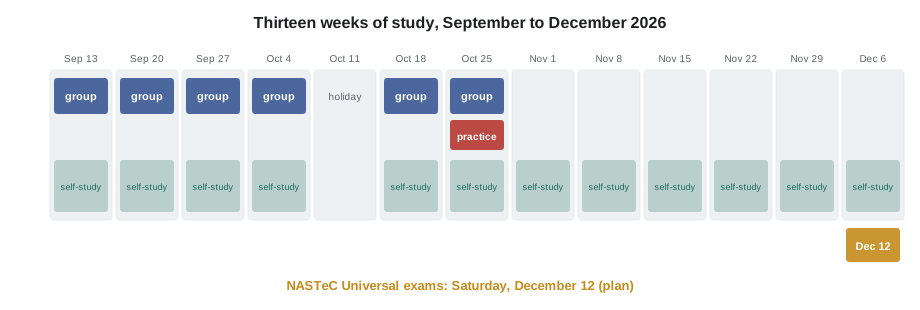
On Sunday afternoon, September 13, 2026, Dee Szymanska unlocked Penfold's shop on Schrock Road, made a pot of coffee and set two chairs at the bench beside the training bay. Her only student that day was Eamon Quinlivan, 26, who was finishing the fourth and final year of Penfold's apprenticeship training plan. He already held his EPA Section 608 certification, and he was booked to sit the NASTeC Universal Technician exams on Saturday, December 12, 2026, at a proctored test site in Columbus. "Thirteen weeks," Dee said, opening a binder with a blank calendar in the front. "That's plenty if we use them. The first thing we're going to do is understand exactly what the exams are, because most people who fail them didn't study the wrong things so much as study the right things in the wrong proportions."
This course is Dee's study group, written up as twelve lessons. It does not teach new material. It reviews the whole program, from safety and meters to sealed systems, laundry, cooking, water-using appliances and electronic controls, and it rehearses the way certification exams ask about that material. Every review lesson points back to the course where the topic was taught, uses the same numbers and the same Penfold rules, and ends with practice questions written in the exam's style. All of the practice questions in this course are original. None is taken from a real exam, and none should be treated as a prediction of what a real exam will ask.
Why certification matters
In Ohio there is no state license for household appliance repair, as APP-110 explained, so the credentials that matter are the ones employers, manufacturers and customers recognize. The most widely recognized appliance credential in the United States is NASTeC, the National Appliance Service Technician Certification. Federal law adds one credential that is not optional: anyone who opens a sealed refrigeration system or recovers refrigerant from a refrigerator, freezer, room air conditioner or dehumidifier must hold EPA Section 608 certification, at least Type I for small appliances. Manufacturer training and certifications, needed for authorized warranty work, sit on top of those.
Why bother with a voluntary certificate? Harriet Penfold's answer is the one most employers give. The certificate tells customers, manufacturers and future employers that someone outside the company has tested the technician on the whole trade. Penfold's three brand authorizations ask for certified technicians, NASTeC-certified technicians at Penfold move up the pay scale, and the certificate goes with the technician if they move to another state. And the preparation itself is valuable: studying for the exams fills in the corners of the trade that a technician may not have seen much of on the job.
What the exam covers
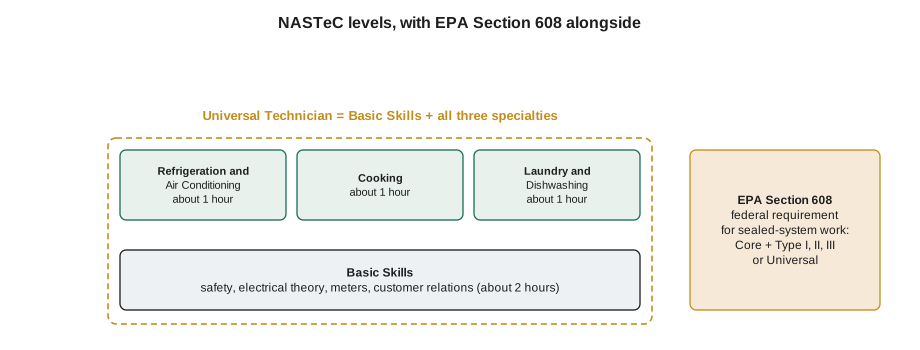
NASTeC is run by ISCET, the International Society of Certified Electronics Technicians, and the exams are given by approved proctors, such as technical schools and testing centers. The certification is built in levels. Every candidate writes a Basic Skills exam that covers safety, electrical theory, meters, customer relations and the common knowledge every appliance technician needs. Candidates then write one or more specialty exams:
| Level | What it covers |
|---|---|
| Refrigeration and Air Conditioning | refrigerators, freezers, ice makers, room air conditioners, dehumidifiers; sealed system diagnosis |
| Cooking | electric and gas ranges, ovens and cooktops, microwave ovens, induction |
| Laundry and Dishwashing | washers, dryers, dishwashers and related water-using appliances |
| Universal Technician | Basic Skills plus all three specialties |
The Basic Skills exam takes about two hours, and each specialty adds about an hour, so a candidate writing all three specialties for Universal Technician should plan on a long day of about five hours of writing, with breaks. Eamon chose Universal because Penfold's work covers every appliance type, and because Universal is the credential Dee holds. A candidate can also earn one specialty at a time and add the others later. NASTeC does not test gas appliance installation procedures in depth; gas work is governed by codes, local rules and, at Penfold, the rule that Hiro does all gas work. Lesson 7 still reviews gas safety, because every technician needs it.
The questions are multiple choice. Like most trade exams, NASTeC asks some questions that test plain recall, such as a definition, but more that test procedures and judgment: the next step in a diagnosis, which reading points to which fault, what to do when a customer's appliance is unsafe. That mix matters for studying. Memorizing facts is not enough. Most questions describe a situation and ask what it means or what to do.
Booking, sitting and results
NASTeC exams are booked with an approved proctor. On the day, candidates bring photo identification and arrive early. The exams are closed-book; check with the proctor whether a basic calculator is allowed. Results come from ISCET after the papers are scored. A candidate who does not pass one exam can retake it without redoing the ones already passed; check the current fees, pass marks and retake rules with ISCET or the proctor before booking, rather than relying on a colleague's memory. The EPA Section 608 exams work differently, and lesson 5 covers them in detail: each section has 25 questions and a passing score of 70 in 100 when taken proctored and closed-book.
Worked problem
The arithmetic of the pass mark
An EPA Section 608 section has 25 questions and a proctored pass mark of 70 in 100. How many correct answers does a candidate need, and how many can they miss?
Show solution
- Correct answers needed:
- \[0.70 \times 25 = 17.5\]
- Scores are whole numbers, so the candidate needs 18 correct.
- Questions that can be missed:
- \[25 - 18 = 7\]
Answer: At least 18 correct, so up to 7 can be missed in a section. Each section is scored on its own, so a strong Type I score cannot make up for a weak Core score.
Making a study plan
Dee's study method has three parts, and the rest of the course follows it.
- Map the exam to the program. Each block or level is matched to the courses that taught it. Electrical theory and schematics come from APP-120, sealed systems from APP-210 and the refrigeration courses, laundry from APP-220, cooking from APP-230, water-using appliances from APP-310, electronic controls from APP-320, and the specialty appliances from APP-330.
- Find the weak spots honestly. In the first session Eamon wrote a 30-question diagnostic test that Dee had written, covering every block. His results told them where to spend the weeks. Lesson 10 shows how to read such a result.
- Practice in the exam's style. Reading notes is not the same as answering questions. Each week Eamon answered about forty practice questions under a time limit and, more importantly, explained every wrong answer to Dee in his own words.
Worked problem
Turning weightings into study hours
Eamon had about 60 hours of study time between mid-September and early December, for Basic Skills and three specialties. Dee suggested 15 hours for Basic Skills, 15 for each specialty and 15 for practice exams and review. What share of the time goes to practice exams and review?
Show solution
- Practice and review:
- \[15 \div 60 = 0.25\]
- That is 25 in 100 of the time, a quarter.
Answer: A quarter of the time goes to practice exams and review. Dee insists on it: most of the learning happens when a wrong answer is explained, not when a chapter is reread.
Kiran's first steps
Kiran Beaulac, who started at Penfold on October 19, will not write the NASTeC exams for several years. His first certification is much closer: EPA Section 608 Type I, which he plans to take in early December so that he can recover refrigerant from refrigerators and room air conditioners under supervision. Dee invited him to the October 25 session, where he sat in on Eamon's practice exam and wrote the Core and Type I practice sections himself. Lesson 5 covers EPA Section 608.
What a certification exam can and cannot show
A written exam can test whether a technician knows the rules, can read a schematic, can reason from readings to a fault and knows the safe order of steps. It cannot test whether their hands are steady on a capacitor discharge tool, whether they listen to customers, or whether they leave a kitchen cleaner than they found it. That is why the certificate sits on top of the apprenticeship rather than replacing it. The hours on the job are where the practical skills are learned and checked, by a journeyworker who watched the apprentice work. The exam checks that the knowledge behind those skills is complete and correct.
That difference shapes how to study. The exam rewards a technician who can explain why a step comes before another, not one who has simply done it many times. A technician who always discharges the run capacitor before touching a compressor terminal may still miss a question about why, or about what reading would show that the capacitor has already bled down. The best preparation is to ask "why" about every routine: why the meter is checked on a known live source before and after a dead test, why a dishwasher's drain hose needs a high loop, why a refrigerator's charge is weighed in rather than added by pressure. Each answer is a likely exam question in a different form.
It also explains why experienced technicians sometimes do badly on exams. Long habits include shortcuts that are fine on a familiar brand but are not the textbook answer. Where an exam question and a habit disagree, the exam expects the procedure in the manufacturer's instructions and the codes, which is also the procedure a technician would have to defend if something went wrong. Dee tells her students: "On exam day, answer the way the service manual and the code would answer, not the way you'd do it on a Friday afternoon."
Exam day, step by step
Eamon wrote out the morning of December 12 in his binder so that nothing would be left to chance. He would sleep normally the night before rather than cram, eat breakfast, and leave home early enough to arrive at the test site 30 minutes before the start, with his photo identification, his booking confirmation and a calculator if the proctor allows one. Phones, notes, smart watches and bags stay outside or in a locker. He planned to read the instructions slowly, write his checkpoints on the scrap paper provided, take the break between the Basic Skills exam and the first specialty, and eat something before the afternoon. Lesson 10 explains pacing.
Most people find that the first ten minutes of an exam are the hardest, while nerves settle. Dee's advice is to answer the first question you are sure of, then the next, and to let the sense of progress do its work. If a question looks unfamiliar, it is usually a familiar topic described in an unfamiliar way. Read it again, identify the appliance and the system involved, and ask which lesson it belongs to.
Worked problem
Setting checkpoints
Eamon plans to finish a first pass through a two-hour Basic Skills exam with about 15 minutes to spare. If the exam has 100 questions, how many should he have answered at each half hour?
Show solution
- Time for the first pass:
- \[120 - 15 = 105 \text{ minutes}\]
- Questions per half hour:
- \[100 \times \tfrac{30}{105} \approx 28.6\]
- So about 29, 57 and 86 at the first three half hours, and all 100 by 105 minutes.
Answer: About 29, 57 and 86 questions at each half hour. The question count here is an example for planning; use the count and time your proctor gives you.
Common mistakes
MistakeStudying every topic equally.
InsteadWeight study time by the exam's blocks or levels, then add time to your weak areas.
MistakeRelying on a colleague's memory of exam rules and fees.
InsteadCheck with ISCET, your proctor and the EPA rules before you book.
MistakeTreating practice questions as predictions of the real exam.
InsteadUse practice questions to find gaps and to practice reasoning; real questions will be different.
MistakeOnly rereading notes.
InsteadAnswer timed practice questions and explain every wrong answer in your own words.
MistakeStudying gas installation procedures in depth for NASTeC.
InsteadReview gas safety, but put the hours where the questions are.
Summary and key terms
- Ohio has no state appliance license; NASTeC is the main voluntary credential, and EPA Section 608 is required for sealed-system work.
- NASTeC has a Basic Skills exam and three specialties; all four together make Universal Technician.
- Most questions test procedures and judgment rather than recall.
- Allow about two hours for Basic Skills and about an hour for each specialty; EPA sections are 25 questions with 70 in 100 to pass proctored.
- A study plan maps the exam to the program, finds weak spots with a diagnostic test, and rehearses in the exam's style.
- Study time is divided roughly by exam weight, with extra time for weak areas.
- Every practice question in this course is original; none predicts the real exam.
- Voluntary trade
- A trade in which a certificate is not required to do the work, but can be earned.
- Red Seal
- The interprovincial standard of excellence for skilled trades in Canada, earned by passing the interprovincial exam.
- Certificate of Qualification
- The certificate issued in Ontario to someone who has passed the exam for a trade.
- NASTeC
- National Appliance Service Technician Certification, a voluntary US appliance credential with Basic Skills and specialty levels.
- EPA Section 608
- The US federal certification required to service sealed refrigeration systems and handle refrigerant.
- Exam weighting
- The number or share of questions on an exam that come from each part of the trade.
- Diagnostic test
- A short test taken at the start of studying to find strengths and weaknesses.
Practice problems
Work each problem on paper first, then reveal the answer to check.
What are the four NASTeC levels?
Show answer
Refrigeration and Air Conditioning, Cooking, Laundry and Dishwashing, and Universal Technician (Basic Skills plus all three specialties).
Which US certification is required by law for sealed-system work?
Show answer
EPA Section 608, at least Type I for small appliances.
Why are most questions harder than plain recall?
Show answer
They describe a situation and ask what it means or what to do next, so they test procedure and judgment.
With 60 hours of study and an exam block worth 36 of 120 questions, how many hours would a proportional split give it?
Show answer
60 × 36 ÷ 120 = 18 hours.
What is the most valuable part of a practice session, according to Dee?
Show answer
Explaining every wrong answer in your own words.
Lesson quiz · 5 questions
Score 60% or more to complete this lesson.
Create a free account to save your progress, take quizzes and earn a certificate.