
APP-420 · Lesson 8 of 12 · 30 min
Review: dishwashers and water-using appliances
▶ Video coming soon A video version of this lesson is on the way.
Dee ran the water review on the evening of Thursday, October 1, at the cabinet training bay in the shop, before Kiran had started and before any of the autumn evening classes began. She filled a clear plastic jug with water from the dishwasher's drain hose, held it up to the light and asked Eamon what the gray film in it told him. "Undissolved detergent," he said, "so the water's not getting hot enough, or the dispenser's opening too late, or they're using too much." "Good. Now give me the next three things you'd check, in order." That, she said, is the shape of most water questions on the exam: a symptom, three or four possible causes, and a right order to check them.
This lesson reviews APP-310 (dishwashers, disposers and water-using appliances) and the water parts of APP-110 and APP-220. It covers the dishwashing half of the NASTeC Laundry and Dishwashing specialty, along with water heaters and other water-using appliances, which also appear on the Basic Skills exam.
How a dishwasher cleans
APP-310 described a dishwasher cycle as a sequence of fills, washes, drains and rinses, followed by drying. Each fill is small, about 0.85 gal in APP-310's example, and the same water is pumped through the spray arms over and over, then drained. A typical normal cycle runs four or more fills, so about 3.4 gal in all. The water is heated by an element or a flow-through heater controlled by a thermistor, and detergent is released from the dispenser at the start of the main wash. Rinse aid is released in the final rinse to help water sheet off the dishes and improve drying.
Drying is by heat from the final rinse and the element, by a fan, by condensation on the cool stainless tub walls, or by a zeolite mineral that releases heat when it absorbs moisture. Condensation-dry machines dry poorly without rinse aid, as APP-310's Mbatha case showed: an empty rinse aid dispenser, not a fault.
Worked problem
Heating the final rinse
In APP-310's example, the final rinse water entered at 49 °C (120 °F) and the sanitize option needed 65.5 °C (150 °F). With about 3.2 kg of water and a 1,100 W heater, how long would heating take, ignoring heat lost to the tub and dishes?
Show solution
- Temperature rise:
- \[65.5 - 49 = 16.5\ ^\circ\text{C}\]
- Energy needed:
- \[Q = m c \Delta T = 3.2 \times 4{,}187 \times 16.5 \approx 221{,}000 \text{ J}\]
- Time:
- \[t = \frac{221{,}000}{1{,}100} \approx 201 \text{ s} \approx 3.3 \text{ min}\]
Answer: About 3.3 minutes in theory; in practice longer, because the tub and dishes absorb heat. A machine fed with cool water takes much longer, which is why Penfold asks about the kitchen tap temperature on every poor-washing call. The sanitize temperature of 150 °F (65.5 °C) comes from NSF/ANSI 184, which APP-310 cited.
Fill, drain and leak detection
A dishwasher fills through a solenoid inlet valve with a flow washer that keeps the flow steady across normal house pressures, either for a set time or until a float switch, pressure sensor or flow meter says the level is reached. A flood switch under the tub, worked by a float in the base pan, stops the fill and runs the drain pump if water collects there. APP-310's Vantongeren dishwasher showed a flood code twice in a month from a cracked inlet valve outlet that leaked into the base, using the sample Northwind code E5.
Worked problem
A timed fill on low pressure
A dishwasher fills for 90 seconds. At its normal flow of 2.1 L/min it gets about 3.15 L. How much does it get if a clogged inlet screen cuts the flow to 1.4 L/min?
Show solution
- Normal fill:
- \[\tfrac{90}{60} \times 2.1 = 3.15 \text{ L}\]
- Restricted fill:
- \[\tfrac{90}{60} \times 1.4 = 2.1 \text{ L}\]
Answer: About 2.1 L, a third less water. The dishwasher may wash poorly, run its pump dry, or show a fill fault, depending on how it senses the level. Cleaning the inlet screen or replacing the valve restores the flow.
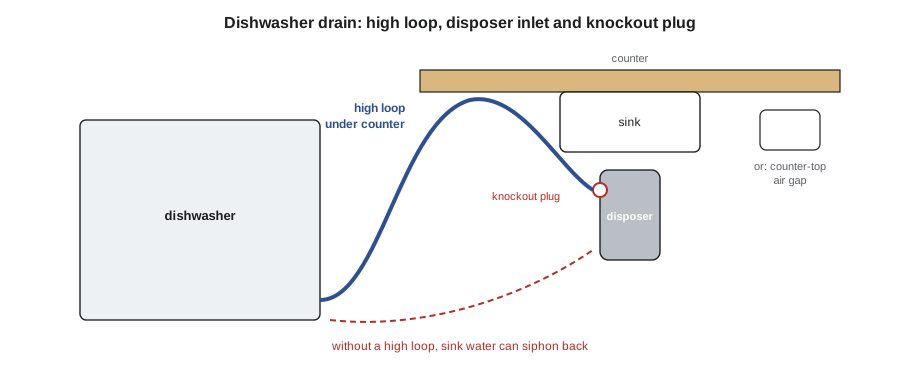
The drain side has a drain pump, a check valve to stop drain water flowing back, and the drain hose, which must have a high loop or an air gap so that sink water cannot siphon back into the dishwasher. The hose connects to a wye on the sink tailpiece or to the disposer's dishwasher inlet. APP-310's Ballantyne disposer had been installed by the homeowner with the disposer's knockout plug still in the dishwasher inlet, so the dishwasher could not drain at all; there was no high loop either.
Drain connection rules come from the plumbing code, which for Columbus follows the IRC and Ohio's plumbing rules: APP-310 cited IRC P2717, which requires the dishwasher drain to have a high loop or air gap and to connect to a tailpiece wye or a disposer. Penfold connects an appliance to an existing, valved water supply and an existing drain connection; new water lines and drains are work for a licensed plumber, and Columbus requires a plumbing permit to replace a water heater.
Disposers, compactors and built-ins
A food waste disposer grinds food with a spinning flywheel and swivelling lugs against a shredder ring; it does not have blades. Most household disposers are continuous-feed, switched from a wall switch; batch-feed models run only when a stopper is turned in the drain. The common faults are a jam, cleared with power off by turning the flywheel from below with the hex wrench and then pressing the reset button on the motor (APP-310's Okwuosa case: a peach pit), a hum with no turning (jam or failed motor), and leaks from the sink flange, the dishwasher inlet or the drain connection. A half-horsepower disposer draws about 6.2 A at 120 V, so a disposer and a dishwasher sharing one 15 A circuit, as APP-310's Ballantyne kitchen did, can overload it when both run: about 10.5 + 6.2 = 16.7 A.
Trash compactors and other built-ins (warming drawers, built-in coffee systems) appear less often. APP-310's Tremlett compactor jammed from an overfilled bin that had bent the drawer safety switch bracket. Installation of any built-in follows the maker's cut-out dimensions, anchoring and electrical requirements.
Water heaters
Electric water heaters usually have two elements, upper and lower, that do not heat at the same time. The upper thermostat heats the top of the tank first, then passes power to the lower thermostat. A high-limit (ECO) switch above the upper thermostat cuts both elements if the water overheats and must be reset by hand. APP-310's Dragomir water heater had an open lower element: plenty of hot water for a short time, then lukewarm. Elements are tested with power off, by resistance and by a check for continuity to the tank.
Worked problem
A water heater element
A 4,500 W, 240 V water heater element should measure about what resistance and draw what current? What power would it give on a 208 V supply?
Show solution
- Resistance:
- \[R = \frac{240^2}{4{,}500} = 12.8\ \Omega\]
- Current:
- \[I = \frac{4{,}500}{240} = 18.75 \text{ A}\]
- Power on 208 V:
- \[P = \frac{208^2}{12.8} \approx 3{,}380 \text{ W}\]
Answer: 12.8 Ω, 18.75 A, and about 3,380 W on 208 V. APP-310's element read 12.8 Ω on the upper element and OL on the lower one.
Every water heater has a temperature and pressure relief (T&P) valve, which opens at about 99 °C or about 1,030 kPa (150 psi), the figures APP-310 and GAS-210 used, piped down to a safe discharge point. Gas water heaters add a burner, pilot or igniter, a thermocouple or thermopile, a flame-arrestor system that resists igniting flammable vapors near the floor (FVIR), and a vent. APP-310's Renfrew water heater had a lint-blocked FVIR arrestor from a nearby dryer, which had tripped its thermal cutoff. Gas water heater work at Penfold is Hiro's.
Water heater tank replacement is plumbing work: in Columbus it requires a plumbing permit and a licensed plumber, so Penfold's water heater work is limited to diagnosis and component repair on existing units.
Water quality: hardness, softeners and filters
Hard water leaves scale in dishwashers, water heaters and ice makers and reduces detergent performance. Hardness is measured in milligrams per liter (mg/L) as calcium carbonate or in grains per gallon (gpg); one grain per gallon is about 17.1 mg/L. A water softener exchanges hardness minerals for sodium on a resin bed, which it regenerates with salt brine. A salt bridge, a crust of salt over an empty space in the brine tank, stops regeneration, as in APP-310's Ferncastle case. Refrigerator water filters, reverse osmosis systems and instant hot water dispensers complete the water-using appliances APP-310 covered.
Worked problem
Converting hardness units
APP-310's well water had a hardness of 300 mg/L. What is that in grains per gallon?
Show solution
- Grains per gallon:
- \[300 \div 17.1 \approx 17.5 \text{ gpg}\]
Answer: About 17.5 gpg, which is very hard water. A softener's capacity in grains, divided by the household's daily hardness load, tells how often it must regenerate.
Diagnosing poor washing
Poor washing is the most common dishwasher complaint, and the exam's favorite way of testing order. APP-310's method runs from the cheapest and most likely causes to the least:
- Water temperature at the sink. If the kitchen tap does not reach about 120 °F after running, the water heater setting, the distance from the heater or a mixing valve may be the cause. APP-310's Strathdee kitchen tap reached only 106 °F because the water heater had been turned down.
- Loading and detergent. Items blocking the spray arms or the detergent door, too much or too little detergent, old detergent, and pre-rinsing dishes so much that enzyme detergents have nothing to work on.
- Filters and spray arms. A clogged filter or blocked spray arm ports, often with lemon seeds, glass or scale, as in APP-310's Strathdee and Vreeland cases.
- Fill volume. A short fill from low pressure or a blocked inlet screen (lesson 12's mock dishwasher).
- Heating and dispensing. An open heater or thermistor fault, or a dispenser that does not open.
- Wash pump. A pump that runs weakly or not at all, or a cracked impeller.
Writing the order down is useful because exam options usually include a part from the bottom of the list, such as the wash motor, alongside a check from the top, such as the water temperature. The right answer to "what should be checked first" is almost always the cheaper, quicker check that explains the symptom.
Worked problem
A shared circuit
In APP-310's Ballantyne kitchen, the dishwasher drew about 10.5 A while heating and the disposer about 6.2 A, both on one 15 A circuit. What is the combined load, and what is the problem?
Show solution
- Combined:
- \[10.5 + 6.2 = 16.7 \text{ A}\]
- That is above the 15 A rating of the circuit.
Answer: 16.7 A, enough to trip the breaker when both run together. The technician notes it for the customer and refers the circuit to an electrician; separate circuits are a common installation requirement for these appliances.
Water questions on any exam also come back to leaks, and the method for a leak is the same on every water-using appliance: dry everything, run the appliance with the panels off where it is safe to do so, and watch, with a flashlight and a paper towel, for the first drop. Water travels along wires, hoses and the underside of tubs before it drips, so the place where water collects is rarely the place it starts. APP-320's Gaillard dishwasher is the reminder: the board that failed was only where the water ended up, and the real fault was a torn door gasket above it.
Common mistakes
MistakeBlaming the dishwasher for poor washing without checking the incoming water temperature.
InsteadCheck the kitchen tap temperature and run it until hot before starting a cycle.
MistakeInstalling a dishwasher drain without a high loop or air gap.
InsteadFit a high loop or air gap as the code and maker require.
MistakeConnecting a dishwasher to a new disposer without removing the knockout plug.
InsteadKnock out the plug before connecting the drain hose.
MistakeTesting water heater elements with power on.
InsteadLock out both legs, then test resistance and continuity to the tank.
MistakeTreating a condensation-dry dishwasher's wet dishes as a heater fault.
InsteadCheck the rinse aid dispenser first.
Summary and key terms
- Dishwashers fill, wash, drain and rinse several times; detergent dispenses in the main wash and rinse aid in the final rinse.
- Sanitize cycles reach 150 °F (65.5 °C) under NSF/ANSI 184.
- Inlet valves have a flow washer; timed fills give less water when the flow is restricted.
- Flood switches stop the fill and drain the base when water collects under the tub.
- Drain hoses need a high loop or air gap; disposer knockout plugs must be removed for a dishwasher connection.
- Disposers jam; clear with power off using the hex wrench, then reset.
- Two-element electric water heaters heat one element at a time; a 4,500 W, 240 V element is 12.8 Ω.
- T&P valves open at about 99 °C or about 1,030 kPa (150 psi); gas water heaters have FVIR protection.
- One grain per gallon is about 17.1 mg/L; salt bridges stop softener regeneration.
- Flow washer
- A rubber washer in an inlet valve that keeps the flow steady across a range of pressures.
- Flood switch
- A float switch in a dishwasher base that stops the fill and drains if water collects there.
- High loop
- A section of drain hose raised under the counter to prevent siphoning and backflow.
- Knockout plug
- A plug in a new disposer's dishwasher inlet that must be removed before connecting a dishwasher.
- T&P valve
- Temperature and pressure relief valve on a water heater.
- FVIR
- Flammable vapor ignition resistant design for gas water heaters.
- Salt bridge
- A hard crust of salt in a softener's brine tank that stops brine forming.
Practice problems
Work each problem on paper first, then reveal the answer to check.
Practice: A dishwasher shows a flood code and there is water in the base pan. What should be found before the code is cleared?
Show answer
The source of the leak, such as an inlet valve, a pump seal, a hose or the door gasket.
Practice: A homeowner's new disposer is installed and the dishwasher will not drain. What is the first check?
Show answer
Whether the knockout plug was removed from the disposer's dishwasher inlet.
Practice: A water heater gives hot water briefly, then lukewarm. Which element is most likely open?
Show answer
The lower element.
Practice: What is 12 gpg in mg/L?
Show answer
12 × 17.1 ≈ 205 mg/L.
Practice: A dishwasher drains 3.2 L at 15 L/min. About how long should the drain take?
Show answer
3.2 ÷ 15 × 60 ≈ 12.8 seconds.
Practice: Why does a condensation-dry dishwasher need rinse aid?
Show answer
Rinse aid makes water sheet off the dishes so they dry by condensation on the cooler tub walls.
Lesson quiz · 5 questions
Score 60% or more to complete this lesson.
Create a free account to save your progress, take quizzes and earn a certificate.