
APP-420 · Lesson 12 of 12 · 29 min
Capstone: diagnosing a kitchen full of faults
▶ Video coming soon A video version of this lesson is on the way.
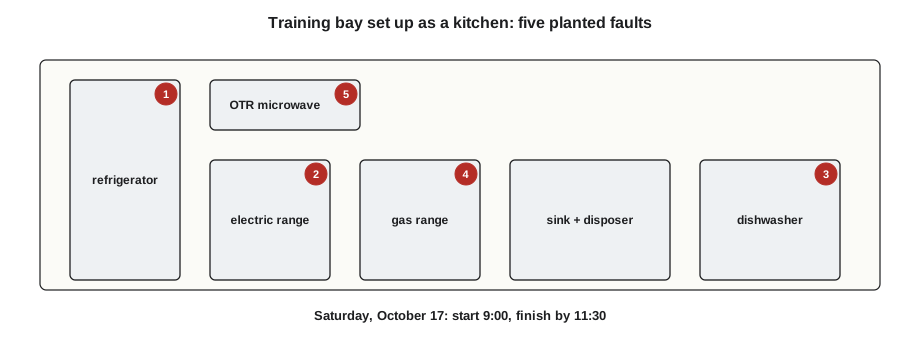
On Saturday, October 17, 2026, Penfold's cabinet training bay looked like a small kitchen: a bottom-freezer refrigerator, a free-standing electric range, a gas range on the bay's test gas connection, a built-in dishwasher, an over-the-range microwave above the electric range, and a disposer under the sink. Dee and Hiro had spent the Friday evening planting one fault in each of five appliances, using parts from the returns shelf and the scrap bin. Eamon arrived at 9:00 with his van tool bag, his meter and a clipboard. Dee gave him the rules: two and a half hours, the same safety steps as on a customer call, a written finding and repair for each appliance, and no gas work: "If you find something on the gas side, you diagnose it as far as you're allowed and you hand it to Hiro, exactly as you would on the road."
This lesson is that practical mock, written up as five diagnoses. It is the capstone of the program because each fault draws on several courses at once: safety and meters (APP-110), circuits and schematics (APP-120), sealed systems and defrost (APP-210), cooking and gas (APP-230), water systems (APP-310), electronic controls (APP-320) and microwave ovens (APP-330). Real certification exams are written, not practical, but a written exam's scenario questions are built from exactly these situations. A candidate who can work through a kitchen like this one can answer the scenario questions.
The setup and the scoring
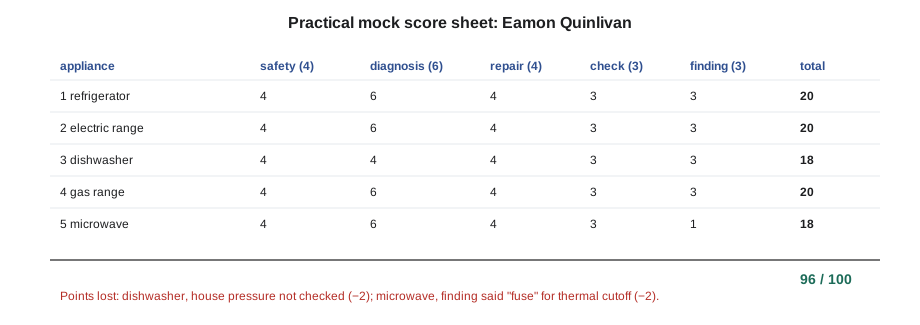
Dee's scoring sheet gave 20 points for each appliance: 4 for following the safety steps, 6 for a correct diagnosis supported by readings, 4 for the right repair, 3 for checking the repair and 3 for a clear written finding a customer could understand. A fault found by guessing scored no diagnosis points even if the guess was right. Eamon was allowed to open service information on his tablet, as on a real call.
Appliance 1: the refrigerator that was warm on top
The fresh food section was at about 52 °F, the freezer at about 5 °F. The compressor was running and the condenser fan was running. Eamon opened the freezer and removed the evaporator cover: the coil was packed with frost and the evaporator fan was turning slowly, scraping ice. Following lesson 4, he ruled out the sealed system first by the frost pattern (frost everywhere, not just at the inlet) and moved to defrost. He used the board's service mode to force a defrost and clamped the heater circuit: 0 A.
Worked problem
Tracing the defrost circuit
The heater is rated 450 W at 120 V. With power off and the board connector unplugged, Eamon measured 32 Ω across the heater's own terminals, and OL from the board connector's heater pins. The termination thermostat, packed in ice, read 0 Ω. What is the fault?
Show solution
- Expected heater resistance:
- \[\frac{120^2}{450} = 32\ \Omega\]
- The heater itself is good, and the termination thermostat is closed, as it should be when cold.
- So the open is in the wiring between them and the board: a harness or connector.
- Tracing the harness, he found the heater's connector at the evaporator with one pin pushed back out of its housing.
Answer: The fault was a backed-out pin at the heater connector, the fault Dee had planted. Eamon re-seated the pin and its lock, forced a defrost again and measured 3.75 A, then let the coil clear. A 22-minute defrost at 450 W uses about 165 Wh, normal for this design. Score: 20 of 20.
His written finding read: "Defrost heater not receiving power because a wire had pushed out of its connector. Reconnected and tested. Ice melted. The refrigerator should be back to temperature within a day; I'll call to check." Dee pointed out that he had also checked the drain was clear before leaving the coil to defrost, which is what stops the same complaint coming back in a week.
Appliance 2: the range that would not bake
The electric range's broil worked, but the bake element stayed cold and the oven took far too long to heat. Eamon locked out the range at the bay's breaker, proved his meter on the live test receptacle, confirmed 0 V at the terminal block, proved the meter again, and only then removed the oven floor. Following lesson 3, he expected the 3,000 W, 240 V bake element to read 19.2 Ω.
It read OL. There was no visible break, but the element had a small blister near one terminal. He checked the terminal connections for burning (none) and the wiring from the control (good). He replaced the element, checked it at 19.4 Ω before restoring power, then ran bake and clamped it at 12.4 A. The current expected at 240 V is 12.5 A, so the reading confirmed the repair. Score: 20 of 20.
Appliance 3: the dishwasher with a fill fault
The dishwasher showed the sample code E1, "fill", within the first minute of a cycle. Eamon read the code from service mode and recorded it before clearing it, as lesson 9 taught. He ran the fill test from service mode and caught the water in a measuring jug from the inlet: in the 90-second fill, about 0.9 L arrived, against the 3.15 L expected at the normal 2.1 L/min.
Worked problem
From a short fill to the cause
A 90-second fill delivered 0.9 L. What was the flow, and what does that point to?
Show solution
- Flow:
- \[0.9 \div 1.5 = 0.6 \text{ L/min}\]
- Expected:
- \[2.1 \text{ L/min, so } 0.6 \div 2.1 \approx 0.29\]
- The valve was opening (water flowed), so the coil and the board output worked.
- Less than a third of the normal flow points to a restriction: a nearly closed supply valve, a kinked supply line or a blocked inlet screen.
Answer: The supply valve was fully open and the line was straight; the valve's inlet screen was blocked with grit, which Dee had packed into it. Eamon cleaned the screen, flushed the supply line into a bucket and measured 2.1 L/min. Because grit had reached the screen once, he recommended fitting a new valve if the code returned. Score: 18 of 20; he lost two points for not checking the house water pressure before blaming the screen.
Appliance 4: the gas oven that was slow to light
The gas range's oven took over two minutes to light and sometimes did not light at all; the surface burners were fine. Under Penfold's rules, gas work is Hiro's. Following lesson 7, Eamon diagnosed as far as the electrical side allowed: with the oven calling for heat, he clamped the igniter circuit and read 2.4 A, rising slowly, against the 3.2 A the valve needs. He did not open the burner box or disconnect any gas component. He wrote up his finding, tagged the range for Hiro, and told Dee what Hiro would need to do. Hiro replaced the igniter (3.4 A), relit and checked the flame and CO, and completed the work under Penfold's gas procedures.
Worked problem
A weak igniter, measured
The igniter drew 2.4 A; the safety valve needs about 3.2 A to open. What share of the opening current was that?
Show solution
- Share:
- \[2.4 \div 3.2 = 0.75\]
Answer: 75 in 100, too little to open the valve reliably. Score: 20 of 20. Dee gave full marks because the diagnosis was correct and the hand-off was exactly right: a technician who finds a gas fault and stops at the edge of their scope has done the job well.
Appliance 5: the microwave with lights but no heat
The over-the-range microwave lit, its turntable turned and its fan ran, but a cup of water stayed cold. Eamon unplugged it, waited, removed the cabinet cover and discharged the high-voltage capacitor with his discharge tool, then measured across it to confirm 0 V, as lessons 2 and 9 required. He checked the parts the schematic put in the heating circuit with power off: the high-voltage fuse (good), the diode (tested by the maker's procedure, because an ordinary meter's diode test cannot push current through most high-voltage diodes), the capacitor (within its rating and not shorted), the magnetron filament (below 1 Ω, and open to its case) and the transformer windings (within the maker's figures).
Then he looked at what was left in the circuit: the magnetron's thermal cutoff, a small thermostat on the magnetron body that opens if the magnetron overheats. It read OL at room temperature, where it should be closed. Dee had swapped in an open cutoff from the scrap bin. He replaced it, and because a cutoff usually opens for a reason, checked the cooling fan and the air path (clear in the training unit; on a customer's microwave a blocked vent or failed fan would have to be fixed too).
Worked problem
Checking the repair
After the repair, Eamon ran a quick water test with 275 g of water in a microwave-safe cup for 20 seconds. The water rose from 20.0 °C to 35.8 °C (68.0 °F to 96.4 °F). About what output power is that, against a 1,000 W rating?
Show solution
- Temperature rise:
- \[35.8 - 20.0 = 15.8\ ^\circ\text{C}\]
- Power:
- \[P = \frac{0.275 \times 4{,}187 \times 15.8}{20} \approx 910 \text{ W}\]
Answer: About 910 W, about 91 in 100 of the rating, which is normal for a quick field test. He then ran a leakage survey with Penfold's calibrated meter: 0.2 mW/cm², below Penfold's limit of 1 for returning an oven to service. Score: 18 of 20; he lost two points because his written finding said "fuse replaced" when he meant the thermal cutoff, which would confuse the next technician.
The debrief
Eamon finished at 11:20, ten minutes early, with 96 of 100 points. Dee went through the sheet with him at the bench. The pattern of points told the same story as the practice tests: his diagnosis was sound wherever he followed a method, and he lost points on the edges: a check he skipped (house water pressure) and a word he wrote carelessly (fuse for cutoff). "On the written exam those are the questions you get wrong," she said. "Not the hard ones. The ones where you know the answer and don't read, or don't write it down properly."
Worked problem
The score sheet
Eamon scored 20, 20, 18, 20 and 18 on the five appliances, out of 20 each. What was his total, and what share of the available points?
Show solution
- Total:
- \[20 + 20 + 18 + 20 + 18 = 96\]
- Share:
- \[96 \div 100 = 0.96\]
Answer: 96 of 100. Dee's pass mark for the practical mock was 80, set higher than the written exams' because every fault was in an appliance type he had worked on.
What remained were the exams themselves. Eamon's plan for the last eight weeks was the one Dee set after lesson 11: weekly timed sets of 30 questions, a written sentence for every wrong answer, and the NASTeC Universal exams on Saturday, December 12. Kiran's EPA Section 608 Type I test would come in early December too. Dee wrote both on the shop whiteboard, under the heading "Penfold's next certificates".
From the practical to the written exam
Dee finished the morning by asking Eamon to turn each of his five diagnoses into a written multiple-choice question of his own, with one right answer and three distractors. It took him longer than the diagnoses had. Writing the distractors forced him to think about the mistakes a less careful technician would make, such as condemning the defrost heater without measuring it, or blaming the dishwasher valve without measuring the flow, and those are exactly the mistakes exam writers build their wrong options from.
Common mistakes
MistakeGuessing a fault and replacing the part to see.
InsteadFind the fault with readings that support it, so the diagnosis can be explained.
MistakeGoing beyond your scope when a fault is on the gas side.
InsteadDiagnose as far as you are allowed, then hand over to the certified technician.
MistakeBlaming a restriction on the appliance before checking the supply.
InsteadCheck the house water pressure and supply valve too.
MistakeReplacing a thermal cutoff or fuse without asking why it opened.
InsteadCheck the cooling, airflow or overload that caused it.
MistakeWriting a vague or wrong finding.
InsteadName the exact part and the reason, in words the next technician and the customer can follow.
Summary and key terms
- The capstone combined safety, meters, schematics, sealed systems and defrost, cooking and gas, water systems, electronics and microwaves.
- A packed evaporator with 0 A in a forced defrost and a good 32 Ω heater pointed to an open in the wiring: a backed-out connector pin.
- A bake element reading OL instead of 19.2 Ω was replaced and confirmed by current (12.4 A against 12.5 A expected).
- A dishwasher fill of 0.6 L/min against 2.1 pointed to a restriction: a blocked inlet screen.
- A glow-bar at 2.4 A against 3.2 A needed was a weak igniter; the gas repair was Hiro's.
- A microwave with no heat had an open magnetron thermal cutoff, found after the high-voltage capacitor was discharged; the repair was checked by a water test (about 910 W) and a leakage survey (0.2 mW/cm²).
- Points were lost on skipped checks and careless wording, the same causes as on written exams.
- Scenario questions on the certification exams are built from situations like these.
- Practical mock
- A hands-on practice exam with planted faults, scored against a sheet.
- Thermal cutoff
- A thermostat that opens to protect a part from overheating, such as on a magnetron.
- Hand-off
- Passing a job to a technician certified for the part of the work beyond your scope.
- Service mode
- A diagnostic mode, entered by a key sequence, that shows codes and runs outputs.
- Written finding
- The technician's written description of what was wrong, what was done and what to expect.
Practice problems
Work each problem on paper first, then reveal the answer to check.
Practice: A refrigerator's evaporator is packed with frost, a forced defrost draws 0 A, the heater reads 32 Ω and the termination thermostat in ice reads 0 Ω. What is left to check?
Show answer
The wiring and connectors between the heater circuit and the board, and the board's output.
Practice: A bake element reads 19.4 Ω and draws 12.4 A at 240 V. Is it working?
Show answer
Yes; about 19.2 Ω and 12.5 A are expected for 3,000 W at 240 V.
Practice: A dishwasher delivers 1.2 L in a 90-second fill. What is the flow?
Show answer
1.2 ÷ 1.5 = 0.8 L/min, well below the normal 2.1 L/min.
Practice: A technician without gas certification finds a weak glow-bar. What should they do?
Show answer
Record the diagnosis, tag the appliance, and hand the repair to a certified gas technician.
Practice: Why must the high-voltage capacitor be discharged and checked at 0 V before testing a microwave's diode?
Show answer
It can hold a lethal charge after the oven is unplugged.
Practice: A water test heats 275 g of water by 12 °C in 20 s. About what power is that?
Show answer
0.275 × 4,187 × 12 ÷ 20 ≈ 691 W.
Lesson quiz · 5 questions
Score 60% or more to complete this lesson.
Create a free account to save your progress, take quizzes and earn a certificate.