
APP-230 · Lesson 8 of 12 · 22 min
Range hoods and ventilation
▶ Video coming soon A video version of this lesson is on the way.
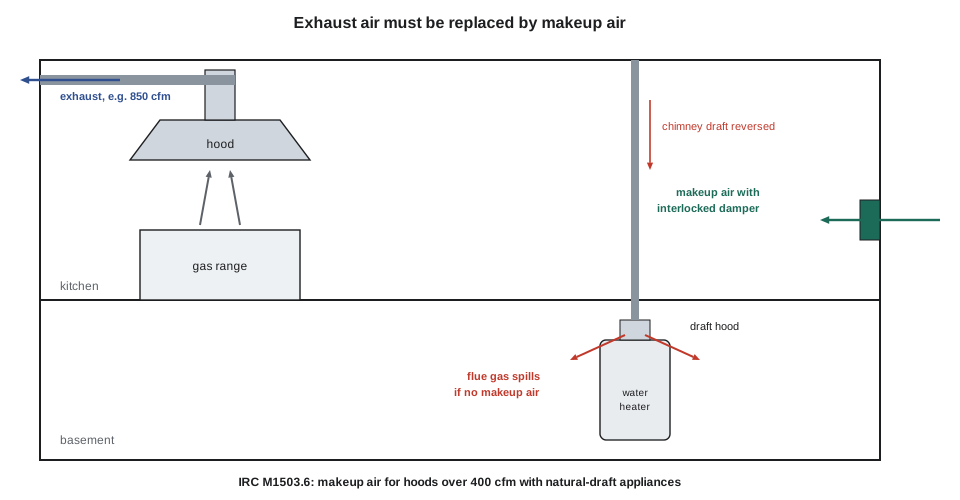
Dee's case from Thursday, September 10, started as a simple complaint. Marisa Quintal's renovated kitchen in Harrison West had a new pro-style gas range and a powerful new island hood, and the hood's fan was "weak". Dee checked the fan; it ran at full speed on every setting. Then she noticed the basement door swinging shut by itself when the hood was on high, and the carbon monoxide alarm in the basement hallway had been unplugged "because it kept beeping". Downstairs, the old natural-draft water heater's draft hood was spilling hot flue gas into the basement whenever the hood ran. Dee switched the hood off, plugged in the alarm, and called Hiro and the renovator. "The fan was fine," she said at the cooking night. "The house was the problem. That hood was pulling more air out than the house could let back in, and it was pulling it down the water heater's chimney."
This lesson covers range hoods and downdraft vents: what they do, how they are sized and ducted, recirculating hoods, fans and controls, and makeup air, the air that must come back into a house to replace what a hood removes. It explains why a powerful hood can make fuel-burning appliances spill dangerous flue gas, and what the codes in each country say about it in general terms. Most hood service is fans, lights, filters and controls; the ventilation questions are where an appliance technician can prevent a serious hazard.
What a range hood does
A range hood captures the heat, moisture, grease, smoke and odors rising from cooking, and the combustion products from a gas cooktop, and either exhausts them outdoors or filters and recirculates the air. Exhausting outdoors is far more effective: it removes moisture, heat and combustion products, which a recirculating hood cannot. A hood works best when it is wide enough to cover the cooktop, mounted at the height the instructions give above it, and has a deep enough canopy to hold the rising plume while the fan draws it in.
The main types are under-cabinet hoods mounted below a wall cabinet, wall-mount chimney hoods with a decorative flue cover, island hoods hung from the ceiling over an island cooktop, insert or liner hoods built into a custom canopy, downdraft vents that rise from or sit behind the cooktop and pull the plume down, and the over-the-range microwave with its built-in fan (lesson 1). Island hoods and downdrafts capture the plume less effectively than a wall hood of the same airflow, because there is no wall to guide the plume and air moves in from all sides.
How much air
A hood's airflow is rated in cubic feet per minute (cfm), usually at a low static pressure, so the airflow it delivers through real ductwork is less than its rating. Common rules of thumb size a hood by the cooktop. For an electric range under a wall hood, a common guideline is about 100 cfm for each foot of range width; for gas cooktops, a common guideline is about 100 cfm for each 10,000 Btu/h of total burner input (both rules of thumb; the hood and range instructions govern). Island hoods need more than wall hoods. These rules often point to hoods far larger than the house can supply air for, which is the makeup air problem below.
Worked problem
Sizing a hood for a gas range
A pro-style gas range has six burners with a total input of 100,000 Btu/h. Using the guideline of about 100 cfm for each 10,000 Btu/h of input, what airflow does the guideline suggest?
Show solution
- Number of 10,000 Btu/h steps: 100,000 ÷ 10,000 = 10.
- Airflow: 10 × 100 = 1,000 cfm.
Answer: The guideline suggests a hood of about 1,000 cfm. A hood that size removes a large volume of air from a house, so the makeup air question must be answered before it is installed, by the designer, the installer and, where gas appliances are involved, the gas technician.
The hood's duct must be the size the hood's instructions specify, smooth metal, as short and straight as possible, with as few elbows as possible, sealed at the joints, and ending at a wall or roof cap with a backdraft damper. Undersizing the duct or using a long run of flexible duct cuts the airflow sharply and makes the hood noisy. Range hood ducts never end in an attic, a soffit where the air can re-enter the attic, or a garage, and are never connected to a dryer or bathroom exhaust duct. A grease-laden duct in an attic is a fire risk.
The International Residential Code, on which Ohio's residential code is based, requires a ducted kitchen hood to discharge to the outdoors through a smooth, airtight duct of galvanized steel, stainless steel or copper, independent of other exhaust systems, with a backdraft damper. Flexible plastic, thin foil and corrugated ducts are not allowed for kitchen exhaust. Penfold follows the code and the hood's instructions.
Recirculating hoods
A recirculating or ductless hood draws air through a grease filter and a charcoal filter, which adsorbs some odor, and returns it to the kitchen. It removes some grease and odor but none of the heat, moisture or combustion products. It is used where ducting outdoors is impossible, and it must be listed for recirculating use and installed as its listing requires. The charcoal filter must be replaced on the schedule the use and care guide gives, often every few months of regular cooking; a saturated filter does nothing. A customer with a gas cooktop and a recirculating hood is told plainly that the hood does not remove combustion products, so the kitchen needs other ventilation when the cooktop is in use.
Makeup air and depressurization
Every cubic foot of air a hood exhausts must be replaced by air coming into the house from somewhere. In an older, leaky house, it leaks in around windows and doors. In a tight, modern or renovated house, there may not be enough leakage, so a powerful hood depressurizes the house: the indoor pressure falls below the outdoor pressure. The doors swing, the hood's airflow drops because it is working against the negative pressure, and, most seriously, air is drawn in backwards through any open path to the outdoors. The easiest path is often a chimney.
A natural-draft appliance, such as an older water heater, furnace or boiler with a draft hood, or a fireplace, relies on its warm flue gases rising up the chimney. A depressurized house can stop that draft or reverse it, so the flue gases, which contain carbon monoxide, spill out of the draft hood into the house, as they did in Marisa Quintal's basement. Sealed-combustion and direct-vent appliances, which take their combustion air from outdoors and vent through a sealed pipe, are much less affected. GAS-230 covered spillage and depressurization testing from the gas technician's side.
The International Residential Code, followed in Ohio, requires makeup air for a kitchen exhaust system able to exhaust more than 400 cfm in a house with fuel-burning appliances that are not direct-vent or mechanically vented inside its air barrier. The makeup air must be supplied at about the rate the hood exhausts beyond that, controlled automatically so that it opens or starts whenever the hood runs, with a damper that closes when it is off. The HVAC contractor or designer applies these rules; the appliance technician's job is to recognize the risk.
Worked problem
Checking whether makeup air is required
A customer wants to replace a 300 cfm under-cabinet hood with an 850 cfm island hood. The house has a natural-draft water heater. Should the technician raise makeup air before the new hood is installed?
Show solution
- New hood airflow: 850 cfm, more than double the 400 cfm threshold.
- The house has a natural-draft water heater, which is not direct-vent or mechanically vented.
- The code requires makeup air for a hood able to exhaust more than 400 cfm in this house.
Answer: Yes. The new hood exceeds 400 cfm and the house has a natural-draft water heater, so makeup air is required. Before installation, the customer is told that an HVAC contractor must provide interlocked makeup air under the code, and that the gas technician should test for spillage afterwards.
In Marisa Quintal's case, Hiro tested the water heater for spillage with the hood on high and off, confirmed that it spilled with the hood running, and tagged the water heater as an unsafe condition until the problem was corrected, as lesson 11 explains. The renovator's HVAC contractor added an interlocked makeup air unit with a motorized damper and a heater, and Hiro retested. The carbon monoxide alarm went back on the wall, and the hood's "weak" airflow improved too.
Fans, lights, filters and controls
Most hood service is simple. Hood fans are 120 V motors, usually permanent split capacitor or shaded-pole types with two or more speed windings, as APP-120 described, or, on newer hoods, electronically commutated motors driven by a control board. A fan that hums and does not turn may have a failed capacitor or seized bearings; one that runs only on some speeds has an open speed winding or a faulty switch or board. Lights are LED modules or halogen bulbs, and some hoods have a heat sensor that turns the fan on automatically when the cooktop gets too hot. Remote inline and exterior blowers, mounted in the duct or on the roof or wall, reduce noise in the kitchen and are serviced where they are mounted.
Grease filters are aluminum mesh or stainless baffle filters. Mesh filters are washed in hot water or a dishwasher as the guide allows; baffle filters are more efficient at catching grease and easier to clean. A saturated filter cuts the airflow and is a fire risk if a pan flares. Customers are reminded to clean them regularly, more often for heavy frying. A hood fan noise that started after a filter was cleaned is often a filter put back loose or the wrong way round.
| Complaint | Likely cause | Check |
|---|---|---|
| Weak airflow on all speeds | Clogged filter, undersized or crushed duct, stuck damper, depressurized house | Filter, duct, cap damper, doors swinging, makeup air |
| Fan hums, does not turn | Failed capacitor, seized bearings | Capacitor, turn by hand |
| Runs on some speeds only | Open speed winding, switch or board fault | Winding resistances, switch, board outputs |
| Fan runs by itself | Heat sensor operating, or stuck switch | Cooktop temperature, sensor, switch |
| Rattle or flap noise | Backdraft damper, loose filter, loose duct | Damper, filter seating, duct joints |
| Smell returns to kitchen | Recirculating hood with saturated charcoal filter | Replace charcoal filter |
Downdraft vents
A downdraft vent sits behind or in the middle of a cooktop and pulls the cooking plume sideways and down into a duct under the cabinet, so no hood is needed overhead. Some rise from the countertop when switched on; others are built into the cooktop surface. Because the plume naturally rises, a downdraft has to work against it, and it captures less of the plume from tall pots and from the burners farthest from it. Downdrafts need a duct run to the outdoors under the floor or through the cabinet base, and their installation instructions limit the duct length and the number of elbows closely. A downdraft fan that seems weak is often fighting a duct that is too long or partly collapsed.
Downdraft systems also have grease filters that must be cleaned, and the rising-vent types have a motor and a lift mechanism that can jam. On gas cooktops, a downdraft can pull the flames sideways and affect burner performance; the cooktop and the downdraft must be a combination the makers approve, as their instructions say.
Common mistakes
MistakeTreating weak airflow as a fan fault without looking at the house.
InsteadCheck the filter, duct and damper, and whether doors swing or the house is depressurized.
MistakeEnding a hood duct in the attic or soffit.
InsteadDuct to the outdoors through a cap with a backdraft damper.
MistakeTelling a gas cooktop owner a recirculating hood removes combustion products.
InsteadIt does not; the kitchen needs other ventilation.
MistakeInstalling a large hood without asking about makeup air.
InsteadRaise makeup air, and spillage testing, before installation.
MistakeIgnoring an unplugged carbon monoxide alarm.
InsteadPlug it back in, find out why it was alarming and test for spillage.
Summary and key terms
- Hoods capture cooking heat, moisture, grease and combustion products.
- Ducting outdoors is far more effective than recirculating.
- Rules of thumb size hoods by range width or gas input; the instructions govern.
- Ducts are smooth metal, sized as the hood requires, and end outdoors with a backdraft damper.
- Large hoods can depressurize a house and make natural-draft appliances spill.
- The IRC, followed in Ohio, requires interlocked makeup air for hoods over 400 cfm in houses with natural-draft appliances.
- Most hood service is fans, capacitors, lights, filters and controls.
- Saturated grease filters cut airflow and are a fire risk.
- Range hood
- A fan and canopy above a cooktop that captures cooking fumes.
- Recirculating hood
- A hood that filters air and returns it to the kitchen.
- Charcoal filter
- A filter that adsorbs odors in a recirculating hood.
- Backdraft damper
- A flap that lets exhaust out and closes when the fan stops.
- Makeup air
- Outdoor air brought in to replace the air an exhaust device removes.
- Depressurization
- Indoor pressure falling below outdoor pressure because more air is exhausted than supplied.
- Spillage
- Flue gas escaping from an appliance's draft hood into the house.
- Natural-draft appliance
- An appliance whose flue gases rise up a chimney by their own heat.
Practice problems
Work each problem on paper first, then reveal the answer to check.
Why is ducting outdoors better than recirculating?
Show answer
It removes moisture, heat and combustion products, which recirculating cannot.
What happens to a natural-draft water heater when a house is depressurized?
Show answer
Its flue gas can spill out of the draft hood into the house.
A hood is rated 850 cfm. Is it above the IRC makeup air threshold?
Show answer
Yes; the threshold is 400 cfm.
Where must a hood duct never end?
Show answer
In an attic, soffit or garage.
A customer's doors swing shut when the hood runs. What does that suggest?
Show answer
The house is being depressurized and may need makeup air.
Lesson quiz · 5 questions
Score 60% or more to complete this lesson.
Create a free account to save your progress, take quizzes and earn a certificate.