
APP-230 · Lesson 3 of 12 · 23 min
Ovens: bake, broil and convection
▶ Video coming soon A video version of this lesson is on the way.
The second page of Dee's case file for the October 26 cooking night was a call from Wednesday, October 7: Ottilie Brandt's convection wall oven in Victorian Village made a grinding noise and baked unevenly, with cookies burned on the back of the tray and pale at the front. "She thought the oven was running hot," Dee said. "The thermometer said the temperature was right. The fan was the problem: its motor bearings were dry, it was turning slowly and loudly, and without the air moving, the back element was cooking the back of the tray." A new convection fan motor, fitted from the back of the oven after the wall oven was slid out of its cabinet, fixed both complaints.
This lesson explains how an electric oven heats: the bake and broil elements, hidden bake, convection with and without a third element, preheat and the cycling that holds the temperature. It covers the oven cavity, the door, its gasket and hinges, the oven light and the cooling fan, and how to test the parts. The control and sensor that decide when the elements switch are in lesson 10, and the high-temperature self-clean cycle in lesson 4.
How an electric oven heats
An oven heats food in three ways at once. The hot elements and walls radiate heat to the food, the air in the cavity carries heat to the food by convection, and the pan conducts heat to the food sitting on it. In an ordinary oven without a fan, the air moves by natural convection only, so the oven has hotter and cooler zones and the position of the rack matters. A convection oven adds a fan to move the air, which evens out the temperature and transfers heat to the food faster.
The bake element is a sheathed element on the floor of the oven, typically about 2,500 to 3,400 W at 240 V. The broil element is a sheathed element at the top of the cavity, typically about 3,000 to 4,000 W. Both are fastened to the back wall with screws through a flange, and their terminals pass through the back wall to wires behind it; APP-120's November 12 case was a burned terminal on exactly this kind of bake element. In hidden bake ovens, the bake element sits under the oven floor, out of sight, so the floor is smooth and easy to clean. Hidden bake ovens heat the floor plate, which then heats the cavity; replacing the element means removing the floor or reaching it from below or behind, as the tech sheet describes.
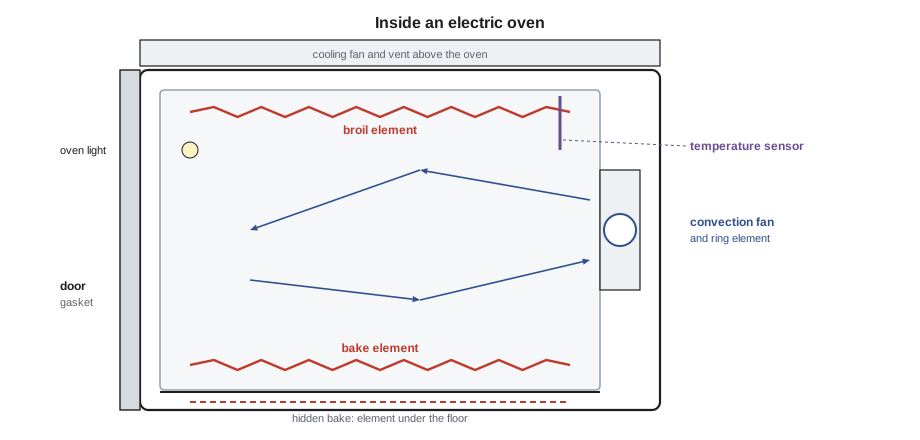
Bake, broil and preheat
On Bake, the control switches the bake element on and off to hold the set temperature, using the temperature sensor as its input. Many ovens also bring the broil element on for part of the time during bake, at reduced duty, to brown the top of the food and even the heat; some only use it during preheat. On Broil, the broil element runs, often continuously at Hi and cycling at Lo, and the bake element stays off; broiling cooks by radiation from the top, so the food goes close to the element and the door may be left partly open on some older models, as the use and care guide says.
Preheat brings the empty oven up to the set temperature as quickly as possible. Most ovens run the bake element continuously during preheat, with the broil element cycling, and some run the convection element as well. The control signals the end of preheat, usually with a tone, when the sensor reaches the set temperature. After that the oven cycles: the elements switch off when the temperature rises a few degrees above the set point and back on when it falls a few degrees below. A typical electric oven swings about ±20 °F around the set point, sometimes more, and the control averages that swing. A customer who puts an oven thermometer in and reads it at the top of a cycle may think the oven is running hot; lesson 10 explains how to test accuracy properly.
Worked problem
Preheat energy and time
An oven cavity of about 3.9 ft³ is preheated from room temperature to 350 °F. The bake element is rated 2,600 W and the broil element 3,600 W; during preheat the bake element runs continuously and the broil element runs at a duty cycle of 30 in 100. What is the average heating power during preheat, and if the oven reaches temperature in 12 minutes, how much energy did preheat use?
Show solution
- Average broil power: 0.30 × 3,600 = 1,080 W.
- Total average power: 2,600 + 1,080 = 3,680 W.
- Time: 12 min = 0.2 h.
- Energy:
- \[E = 3.68 \text{ kW} \times 0.2 \text{ h} = 0.736 \text{ kWh}\]
Answer: Preheat uses about 0.74 kWh, most of it heating the oven walls, racks and insulation rather than the air. That is why a door opened often, or a missing door gasket, makes an oven slow to recover and costs energy.
Convection
A convection oven has a fan on the back wall of the cavity, behind a perforated cover, that draws air from the center of the oven and blows it out around the edges, so the air circulates across every rack. In the simplest design, the fan only stirs the air heated by the bake and broil elements. In true convection (also called third-element or European convection), a ring-shaped convection element surrounds the fan behind the cover, so the air is heated as it leaves the fan. True convection gives the most even heat and is used for baking on several racks at once.
The convection fan motor is usually a 120 V shaded-pole or permanent split capacitor motor, as APP-120 described, mounted on the outside of the back wall with its shaft through a seal into the cavity. Its fan blade is inside the cavity, behind the cover. A fan that does not turn, or turns slowly and noisily as in Ottilie Brandt's oven, makes a convection oven bake unevenly. Most ovens stop the fan when the door opens, using the door switch, so the heated air does not blow out at the customer.
Convection recipes usually call for a lower temperature, often about 25 °F less, or a shorter time, because the moving air transfers heat faster. Many ovens make this convection conversion automatically when the customer selects a convection mode, and their displays show the converted temperature. A customer who converts the recipe manually as well ends up underbaking. This is a common call that needs explanation rather than parts.
Worked problem
Testing a convection element and fan motor
A true convection element is rated 2,500 W at 240 V. The convection fan motor runs on 120 V. With the power off and the leads disconnected, Kiran measured the element at 22.8 Ω and the fan motor winding at 41 Ω. Are these readings reasonable?
Show solution
- Expected element resistance:
- \[R = \frac{240^2}{2500} = \frac{57\,600}{2500} = 23.0 \ \Omega\]
- A cold reading of 22.8 Ω is within about 1 in 100 of that: the element is good.
- A shaded-pole fan motor winding typically reads tens of ohms; 41 Ω is in the range the tech sheet gives for this motor (35 to 50 Ω, typical).
- Neither part reads open or shorted, so the next check is whether the motor turns freely by hand and whether it receives 120 V when the control calls for convection.
Answer: Both parts read normally. A motor that reads correctly but is stiff to turn by hand has worn bearings and is replaced; one that turns freely but gets no voltage points to the control or the door switch.
The oven door
The oven door seals in the heat, insulates the outside of the oven and gives the customer a view of the food. It has an inner and outer panel with insulation and two or more layers of glass between them, a door gasket that seals against the front of the cavity, and hinges with springs that hold the door open or closed. On most ranges, the door lifts off its hinges when it is opened to a set position and the hinge locks are flipped, as the use and care guide shows; this makes cleaning and service easier. The hinges carry the door's weight on springs; a broken spring makes the door drop open or slam, and a bent hinge makes the door gap at one side.
The door gasket is a woven fiberglass tube on a wire frame, clipped into holes around the front of the oven cavity or the door. A torn, flattened or missing gasket lets heat escape, so the oven is slow to preheat, the knobs or control panel above the door get hot, and food near the door undercooks. Gaskets are replaced as a set and are pushed into their clips without stretching. Customers sometimes clean the gasket with oven cleaner, which damages it; the use and care guide says to leave it alone.
The door glass can trap moisture or grease between the panes. Most doors can be taken apart for cleaning with the door lying flat on a towel, following the tech sheet, which gives the order of screws and the orientation of each pane. A cracked inner pane must be replaced before the oven is used again, because it can shatter when heated.
Light, cooling fan and vent
The oven light is a high-temperature appliance bulb in a glass-covered socket, usually 25 to 40 W, switched by the door switch and a panel switch or the control. It must be the type and wattage the use and care guide specifies; an ordinary bulb can fail or break in oven heat. The cover is removed only when the oven is cool and off.
Many ranges have a cooling fan behind the control panel or above the oven that runs during and after high-temperature operation, to protect the electronics and keep the cabinet surfaces cool. It may keep running for some time after the oven is switched off. Customers sometimes report it as a fault; it is normal. A cooling fan that does not run, in contrast, can let the control board overheat, and some controls display a fault code if the fan or its thermal switch fails.
The oven vent releases the moisture and heat the oven produces. On a freestanding electric range it is usually under the rear element or at the back of the cooktop, and on a wall oven it is above or below the door. Blocking it with foil or a pot changes how the oven cooks and can overheat the cooktop. Foil on the oven floor is a related problem: on hidden-bake ovens it can trap heat and damage the floor's finish, and the use and care guide prohibits it.
| Part | Typical rating or value | Common fault |
|---|---|---|
| Bake element | 2,500 to 3,400 W at 240 V | Open element, burned terminal, sheath blister |
| Broil element | 3,000 to 4,000 W at 240 V | Open element |
| Convection element | 2,000 to 2,500 W at 240 V | Open element |
| Convection fan motor | 120 V shaded-pole or PSC | Worn bearings, no voltage from control or door switch |
| Door gasket | Woven fiberglass on wire frame | Torn, flattened or cleaned with oven cleaner |
| Door hinge | Spring-loaded, lift-off | Broken spring, bent hinge |
| Oven light | 25 to 40 W appliance bulb | Burned out; wrong bulb fitted |
| Cooling fan | 120 V | Seized; can trigger a control fault code |
Replacing a bake or broil element
Replacing a visible bake or broil element is one of the most common oven repairs. With the power off at the breaker and proven off, and the oven cool, the technician removes the racks, takes out the two screws holding the element's flange to the back wall, and pulls the element forward a few centimeters to reach its terminals. The wires are held on with push-on terminals or screws. If the terminals are discolored or the wire ends are brittle, the wire is cut back to clean copper and a new high-temperature terminal is crimped on, as APP-120's burned-terminal case showed. The wires must not be allowed to fall back through the wall, so they are held with a clip or a piece of tape while the new element is fitted.
The new element is the one the parts list gives for the model, with the same wattage and the same terminal spacing. After fitting, the technician restores power, runs bake or broil, and confirms with the clamp meter that the element draws the current its rating predicts, about 10.8 A for a 2,600 W element at 240 V. A new element that smokes briefly the first time is burning off its protective oil, which is normal; the customer is told so.
Common mistakes
MistakeCalling an oven faulty because a thermometer reads high at one moment.
InsteadThe oven cycles around the set point; average several readings, as lesson 10 shows.
MistakeIgnoring the convection fan when a convection oven bakes unevenly.
InsteadCheck that the fan turns freely and at speed; a slow fan gives uneven heat.
MistakeConverting a recipe for convection when the oven already does it.
InsteadCheck whether the oven's convection mode converts automatically.
MistakeCleaning the door gasket with oven cleaner.
InsteadLeave the gasket alone; replace it if it is torn or flattened.
MistakeFitting an ordinary bulb in the oven light.
InsteadUse the high-temperature appliance bulb the guide specifies.
Summary and key terms
- Bake heats from the floor, broil from the top; many ovens use both during bake and preheat.
- Hidden bake elements sit under the oven floor.
- Ovens cycle around the set point, typically about ±20 °F.
- Convection fans even out the heat; true convection adds a ring element around the fan.
- Many ovens convert convection recipes automatically.
- The door gasket, hinges and glass keep the heat in; a poor gasket makes the oven slow.
- Use the high-temperature bulb the guide specifies for the oven light.
- The cooling fan running after the oven is off is normal.
- Bake element
- The heating element on or under the oven floor.
- Broil element
- The heating element at the top of the oven cavity.
- Hidden bake
- An oven with its bake element under a smooth floor.
- Convection oven
- An oven with a fan that circulates the heated air.
- True convection
- Convection with a ring element around the fan; also called third-element convection.
- Preheat
- Heating the empty oven to the set temperature before cooking.
- Door gasket
- The woven fiberglass seal between the oven door and the cavity.
- Cooling fan
- A fan that cools the controls and cabinet during and after high-temperature use.
Practice problems
Work each problem on paper first, then reveal the answer to check.
Where is the bake element in a hidden bake oven?
Show answer
Under the oven floor.
What does true convection add to an ordinary convection oven?
Show answer
A ring element around the fan.
What resistance should a 2,500 W, 240 V convection element read?
Show answer
About 23 Ω.
Name two signs of a failed door gasket.
Show answer
Slow preheat and a hot control panel above the door.
Why might a customer's convection baking come out underdone?
Show answer
The oven converted the temperature automatically and the customer lowered it again.
Lesson quiz · 5 questions
Score 60% or more to complete this lesson.
Create a free account to save your progress, take quizzes and earn a certificate.