
APP-230 · Lesson 2 of 12 · 24 min
Electric ranges and surface elements
▶ Video coming soon A video version of this lesson is on the way.
Dee's case file from Monday, October 5, was a radiant glass-top range in a bungalow in Beechwold that had been bought new four years earlier. The customer, Philippa Greaves, said the right front element had stopped heating overnight. The other three worked. "Four years old, one element dead, the switch clicks normally," Dee read aloud at the October 26 cooking night. "What would you check first?" Kiran guessed the element. Dee turned the page. The element's ribbon read 26 Ω, about right for its rating, but a small device clipped to the element's edge, the limiter, read open. It had failed after the customer had been cooking with a warped pan for months. A new element with its limiter fixed it, and a new flat-bottomed pan stopped it happening again.
This lesson covers the surface units of electric ranges and cooktops: coil elements, radiant and halogen elements under glass-ceramic tops, dual and bridge elements, and warming zones. It explains the infinite switch that controls them, how to test elements, switches, limiters and terminal blocks, and how to recognize the problems that come from the installation or the cookware rather than the parts. Induction cooktops look similar but work on a different principle and are the subject of lesson 9.
Coil elements
The traditional coil element is a tubular sheathed element: a coiled nichrome resistance wire packed in magnesium oxide powder inside a metal sheath, bent into a flat spiral. The magnesium oxide conducts heat well but is an electrical insulator, so the sheath stays at ground potential while the wire inside it runs at 240 V. The element's two terminals plug into a receptacle block under the cooktop, or are screwed to terminals on older ranges. Common sizes are a 6 in element of about 1,250 to 1,500 W and a 8 in element of about 2,100 to 2,600 W at 240 V. Coil elements sit on a drip bowl and are easy to remove for cleaning; the drip bowl reflects heat back to the pan.
A coil element fails in one of three ways: it opens, so it no longer heats; it shorts to its sheath, so it trips a breaker or shocks; or its terminals or the receptacle block burn, so it works intermittently or not at all. The burned terminal in APP-120's November 12 case was on a bake element, but surface elements burn their terminals in the same way when the plug-in contacts lose their spring tension. A burned receptacle block must be replaced, along with the element whose terminals are pitted; a new element in an old, burned block soon fails again.
Radiant elements under glass
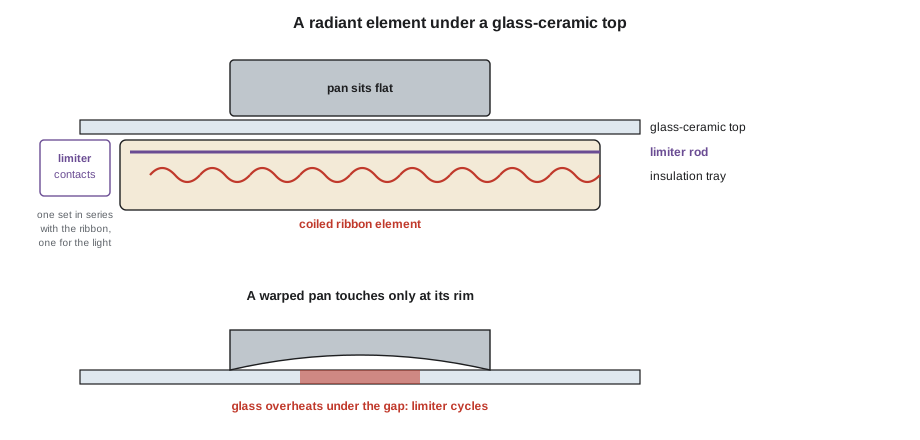
A radiant element is a flat, coiled ribbon of resistance alloy laid in a circular tray of insulating fiber, under a smooth glass-ceramic top. The ribbon glows when it heats, and most of its heat reaches the pan by radiation through the glass and by contact where the pan sits on the hot glass. Radiant elements heat faster than coil elements and the top is easy to clean, but the glass must not be struck, slid on with rough pans or cleaned with abrasives. A halogen element used a halogen lamp as the heat source; it is uncommon now.
Every radiant element has a limiter, a rod-type thermal switch that runs across the element tray just under the glass. Its job is to protect the glass: when the glass under the element gets too hot, typically above about 1,020 °F, the limiter opens and the element switches off until it cools. A pan with a warped or rough bottom that does not sit flat on the glass, a pan boiled dry or a pan too small for the element lets the glass overheat, and the limiter cycles the element off. A limiter that cycles too often eventually fails open, as Philippa Greaves's did. Most limiters also carry a second set of contacts that run the hot-surface indicator light, which stays lit until the glass has cooled enough to touch safely.
Dual elements have an inner and an outer ribbon so the same zone can heat a small or large pan; bridge elements join two zones into one long zone for a griddle. Each has extra contacts in its switch and extra terminals on the element. A warming zone is a low-wattage element, often around 100 W, controlled by its own switch or the control board.
The infinite switch
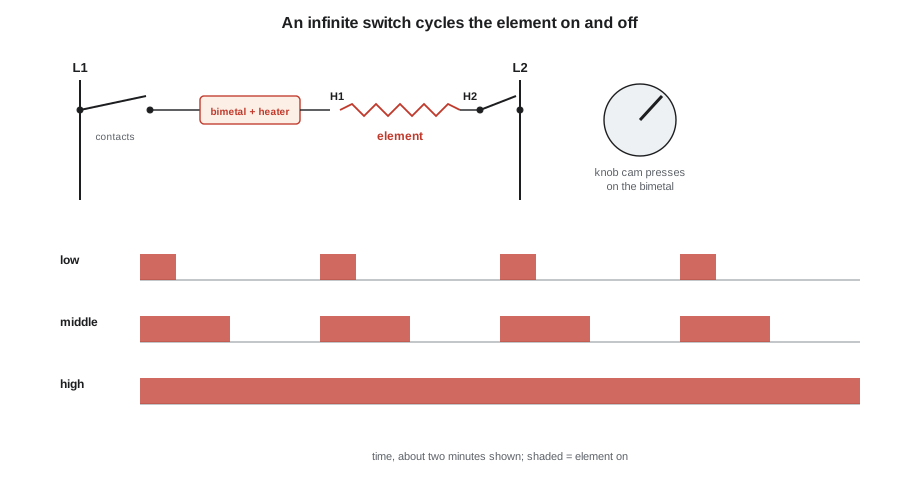
Most coil and radiant elements are controlled by an infinite switch, also called an infinite heat switch or simmerstat. Despite its name, it does not vary the current; it switches the element fully on and fully off in a repeating cycle. Inside it is a small bimetal strip with its own tiny heater wound around it, wired in series with the switch contacts. When the contacts close, the element and the little heater both heat up. The bimetal warps, opens the contacts, cools, and closes them again. Turning the knob moves a cam that presses on the bimetal, so a higher setting needs more heat to open the contacts and the element stays on for a larger share of each cycle. On High the cam holds the contacts closed and the element is on all the time.
The share of each cycle the element is on is its duty cycle. The average power the element delivers is its full power times the duty cycle. A typical cycle is somewhere between about 15 and 60 seconds long, and the technician can see it: the element glows, fades and glows again, and a clamp meter on one supply lead shows the current switching between full current and zero. An infinite switch usually has four terminals: L1 and L2 for the supply, and H1 and H2 to the element, with a pilot light terminal on some models. Wiring diagrams label them; the switch body often does too.
Worked problem
Average power from an infinite switch
A 2,500 W radiant element is set to a middle setting. Watching the clamp meter, Kiran timed 18 seconds on and 27 seconds off. What is the duty cycle, and what average power does the element give the pan?
Show solution
- Cycle length: 18 + 27 = 45 s.
- Duty cycle:
- \[D = \frac{18}{45} = 0.40\]
- Average power:
- \[P_{avg} = 0.40 \times 2500 = 1000 \text{ W}\]
Answer: The element delivers an average of 1,000 W, 40 in 100 of its full power, even though it runs at its full 2,500 W whenever it is on.
A switch that never cycles off, so the element stays on high at every setting, usually has welded contacts; one that never comes on, or cycles only on high, has an open bimetal heater or burned contacts. Both are replaced, not repaired. Before condemning the switch, though, the technician confirms that the element and the supply are good, because a switch blamed for a no-heat complaint is often innocent.
Testing elements, switches and blocks
Every test starts with the power off at the breaker and proven off, as APP-110 taught. The element is disconnected or unplugged for its resistance test. The expected resistance follows from the element's rating, as APP-120 showed: R = V² ÷ P at the rated voltage.
Worked problem
Expected resistance of a surface element
A coil element is rated 2,100 W at 240 V. What resistance should it read cold, and what would an open element read?
Show solution
- \[R = \frac{V^2}{P} = \frac{240^2}{2100} = \frac{57\,600}{2100} \approx 27.4 \ \Omega\]
- A cold element reads slightly less than its hot resistance, so a reading of about 25 to 28 Ω is normal.
- An open element reads OL (infinite resistance).
Answer: Expect about 27 Ω. A reading of OL means the element is open. A reading near zero means a short, and a reading from either terminal to the sheath of anything other than OL on the megohm range means the insulation has broken down.
The sheath test matters as much as the resistance test. With the element disconnected, the meter on its highest resistance range should read OL from each terminal to the sheath. A low reading means the element is leaking current to its sheath and will trip a breaker or a ground-fault device, or give a shock where the frame is poorly grounded. A cracked or blistered sheath is visible and also means replacement.
To test an infinite switch, check continuity across the L1–H1 and L2–H2 contacts with the switch turned to High: both should read close to zero. With the switch off, both should read OL. With power restored and the element connected, the clamp meter shows whether the switch cycles. On radiant tops, the limiter is tested with the element cold: its main contacts should read close to zero. An open limiter on a cold element is failed. Limiters are usually sold with the element as one assembly, as Dee's case showed.
The receptacle block and the element terminals are inspected for discoloration, pitting and loose spring contacts. A block that looks burned is replaced along with its element. On the wiring side, the technician checks the wires for heat damage at their crimped terminals; a range's surface element wiring is high-temperature wire, and any replacement must be the same type.
| Test | Expected result | What a bad result means |
|---|---|---|
| Element resistance (cold) | Close to V² ÷ P, e.g. about 27 Ω for 2,100 W at 240 V | OL: open element; near 0: shorted element |
| Element terminal to sheath | OL on the highest range | Any reading: insulation leakage, replace |
| Infinite switch, High | L1–H1 and L2–H2 near 0 Ω | OL: burned contacts |
| Infinite switch, Off | All contacts OL | Reading: welded contacts |
| Switch cycling (powered) | Current switches on and off at middle settings | Always on: welded; never on: open bimetal heater |
| Limiter (cold) | Main contacts near 0 Ω | OL: limiter failed open |
| Receptacle block | Clean, tight contacts | Burned or loose: replace block and element |
Glass tops: care and replacement
A cracked glass-ceramic top must not be used. Spilled liquid can reach the live elements through a crack, and a cracked top can shatter. The technician unplugs the range or switches off the breaker and tells the customer not to use the cooktop until the glass is replaced. Glass tops are expensive and specific to the model; they arrive with their gasket or adhesive, and the elements usually transfer from the old top to the new one. Two people handle a full-size top.
Most service calls about radiant tops are about care rather than parts. Sugary spills that are left to cool can pit the glass when they are scraped off; the use and care guide says to remove sugar spills while the top is still warm, with a scraper made for the purpose. Cast-iron and stoneware with rough bottoms scratch the glass, and copper or aluminum bottoms can leave marks that look like scratches but polish off. Pans with warped bottoms make limiters cycle and cook slowly. Explaining this, and testing a customer's pan by setting a straightedge across its bottom, often prevents a second call.
When the range has a control board
Many newer electric ranges replace infinite switches with electronic touch controls and a control board with relays or triacs that switch each element. The duty cycle principle is the same: the board switches the element on and off to give the selected power level. Testing changes, though. The technician uses the range's service or diagnostic mode, if it has one, to switch each element on and confirm the relay output, and checks the element and limiter the same way as before. A relay that clicks but sends no voltage to the element, or an element that has voltage at its terminals but does not heat, points to the board or the element respectively. Control boards are covered in APP-320.
Coil element drip bowls and supports
Coil elements sit on a drip bowl, a pressed steel or chrome bowl that catches spills and reflects heat back to the pan. Bowls that are blackened or covered in burned residue reflect less heat and can trap spills that reach the receptacle block. Some ranges have a support ring or trim ring under the element as well. Lining drip bowls with foil, which some customers do to keep them clean, can trap heat, short across the element terminals or cover the vent holes, and the use and care guide usually prohibits it. A coil element that wobbles because its support is bent heats a pan unevenly and can pull its terminals out of the block.
When a customer reports that a coil element works only when it is pushed down or wiggled, the cause is almost always the receptacle block or the element terminals, not the switch. The technician switches off the power, lifts the element, inspects the terminals and block for heat discoloration and loose contact springs, and replaces both together if either is damaged. On older ranges with screw terminals, a loose screw can do the same thing and burn the terminal over time.
Common mistakes
MistakeBlaming the element when a radiant zone cuts out.
InsteadCheck the limiter and the pan; a warped pan makes the limiter cycle and eventually fail.
MistakeReplacing an element but not its burned receptacle block.
InsteadReplace the block too; a burned block soon burns the new element's terminals.
MistakeSkipping the sheath test.
InsteadCheck each terminal to the sheath on the highest range; any reading means replacement.
MistakeExpecting an infinite switch to vary current.
InsteadIt cycles the element fully on and off; read the duty cycle with a clamp meter.
MistakeLetting a customer use a cracked glass top.
InsteadSwitch it off and keep it off until the glass is replaced.
Summary and key terms
- Coil elements are sheathed elements; the sheath must test open to both terminals.
- Radiant elements under glass have a limiter that protects the glass and runs the hot-surface light.
- Warped or rough pans make the glass overheat and the limiter cycle.
- An infinite switch cycles the element on and off; average power is full power times the duty cycle.
- Expected element resistance is V² ÷ P at the rated voltage.
- Burned terminals and receptacle blocks are replaced together with the element.
- Cracked glass tops must not be used until replaced.
- Touch-control ranges switch elements with board relays; use the diagnostic mode to test outputs.
- Sheathed element
- A resistance wire packed in magnesium oxide inside a metal tube.
- Radiant element
- A ribbon heating element in an insulated tray under a glass-ceramic top.
- Limiter
- A thermal switch in a radiant element that opens if the glass gets too hot.
- Infinite switch
- A bimetal switch that cycles an element on and off to set its average power.
- Duty cycle
- The fraction of each cycle that an element is switched on.
- Receptacle block
- The plug-in socket for a coil element's terminals.
- Hot-surface indicator
- A light that stays on until a cooking surface has cooled.
- Dual element
- A surface element with inner and outer sections for small and large pans.
Practice problems
Work each problem on paper first, then reveal the answer to check.
What does an infinite switch do on its middle settings?
Show answer
It cycles the element fully on and off.
A 2,500 W element is on 18 s out of every 45 s. What is its average power?
Show answer
1,000 W.
What should a 2,100 W, 240 V element read cold?
Show answer
About 27 Ω.
What protects a glass-ceramic top from overheating?
Show answer
The limiter in each radiant element.
What should a terminal-to-sheath test read on a good element?
Show answer
OL.
Lesson quiz · 5 questions
Score 60% or more to complete this lesson.
Create a free account to save your progress, take quizzes and earn a certificate.