
APP-230 · Lesson 1 of 12 · 24 min
Cooking appliance types
▶ Video coming soon A video version of this lesson is on the way.
On the evening of Monday, October 26, Hiro Nakashima pulled four appliances to the middle of the shop floor: a white freestanding electric range from a haul-away, a slide-in gas range still in its carton for a customer, a glass induction cooktop on a bench stand and a stainless wall oven on a cart. Dee Szymanska leaned on the parts counter with a coffee. "Cooking night," Hiro said to Kiran Beaulac. "Before you fix any of these you need to know which one you are standing in front of, what it runs on and who at this company is allowed to touch which part of it. Read me the plates."
Kiran found the first plate on the frame behind the storage drawer of the freestanding range: model, serial, 120/240 V, 12.2 kW at 240 V, 9.2 kW at 208 V. The gas range's plate was on the frame behind its drawer too, with a second label beside it that said the range was set up for natural gas and that a propane kit came in the carton. "That second label is the first thing I read on a gas range," Hiro said. "Gas work is mine. You'll watch, you'll learn it and you'll keep your hands on the electrical side until you hold a certificate."
This lesson surveys the cooking appliances an appliance service technician meets in homes: freestanding, slide-in and front-control ranges, cooktops and rangetops, wall ovens, dual-fuel and pro-style ranges, induction and microwave combinations. It explains how to read their ratings, what supply each one needs and how the work on them is divided between appliance technicians, gas technicians and electricians. Later lessons take each part of these appliances apart in detail.
Ranges, cooktops and wall ovens
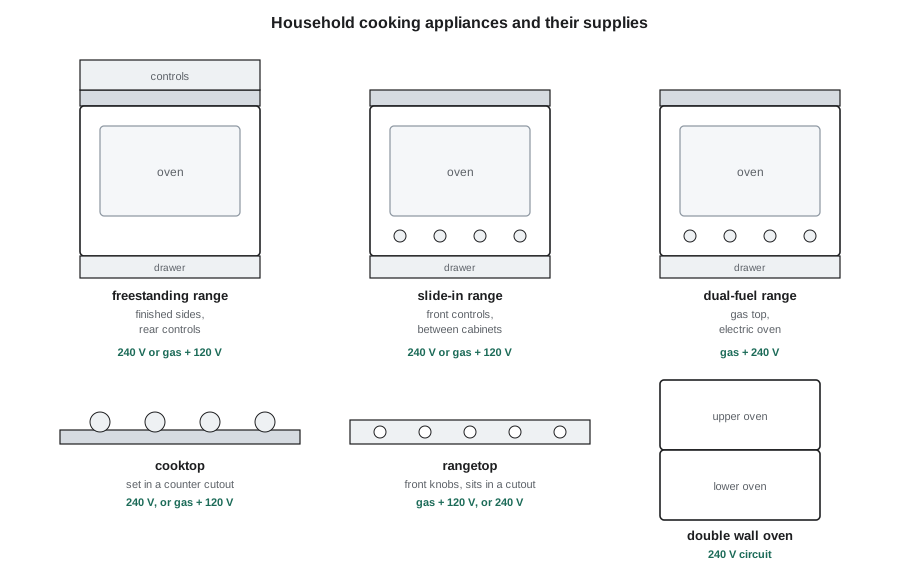
A range combines a cooktop and an oven in one appliance. A freestanding range has finished sides and a backguard with the controls on it, and it can stand alone or between cabinets. A slide-in range has unfinished sides, sits between cabinets and overlaps the countertop slightly at each side; its controls are on the front. A front-control range is the newer name for the same idea in a lower-cost model, and the older drop-in range sat on a cabinet base with no storage drawer. The difference matters for service: the access panels, the anti-tip bracket position and how the range comes out of its opening all depend on the style.
A cooktop is the cooking surface alone, set into a cutout in the countertop, with its controls on top or on the front edge. It may be electric coil, radiant glass-ceramic, induction or gas. A rangetop is a gas or induction cooking surface with front-mounted knobs that sits in a cutout like a slide-in range, common on pro-style kitchens. A wall oven is an oven alone, built into a cabinet at waist or eye height, single or double. Wall ovens are almost always electric in homes; gas wall ovens exist but are rare. A combination wall oven pairs a conventional oven with a microwave or speed oven above it.
A dual-fuel range has a gas cooktop and an electric oven, so it needs both a gas connection and a 240 V circuit. A pro-style range has heavier construction, higher-input sealed or open burners, often a griddle or grill, and sometimes two ovens; it can be gas, dual fuel or induction. Pro-style gas ranges often need more gas than an ordinary range, so the supply piping must be checked for capacity, which is gas technician work.
What each appliance runs on
Electric ranges, cooktops and wall ovens run on the 120/240 V split-phase supply described in APP-120. The heating elements run on 240 V between the two hot legs; the clock, lights, control board and oven fan usually run on 120 V between one hot leg and the neutral. A typical freestanding electric range draws its power through a 40 A or 50 A circuit and a range receptacle or a direct connection. In an apartment building, the supply may be 120/208 V instead, and the elements then produce about three-quarters of their rated power. A new range circuit is four-wire under the National Electrical Code, with the frame grounded through the equipment grounding conductor; existing three-wire circuits may remain, with the bonding strap installed as the range's instructions describe, as APP-120 explained.
Gas ranges and cooktops need a gas connection and, almost always, a 120 V receptacle for the igniters, clock, oven light and electronic controls. A gas range will not light its oven without power, because the oven igniter needs current. Top burners on many ranges can be lit with a match in a power failure if the use and care guide says so; the oven cannot. Induction cooktops and induction ranges need a 240 V circuit like an electric range, often a 40 A or 50 A circuit for a full-size unit. Microwave combinations and speed ovens add their own load, and a double wall oven may need its own 30 A to 50 A circuit, as its installation instructions specify.
The nameplate and the installation instructions give the supply each appliance needs. The technician reads them before installing or replacing anything, and checks the receptacle or connection against them. A range plugged into the wrong supply, or a dual-fuel range with its gas connected but its 240 V circuit undersized, is a call the technician can recognize but may not be allowed to correct. The electrical circuit belongs to an electrician; the gas supply belongs to a gas technician or, in the United States, the qualified installer the local rules require.
Reading the plates
A cooking appliance's rating plate (also called the serial plate or data plate) gives the model and serial numbers, the supply voltage and frequency, the rated power in kilowatts at 240 V and often at 208 V, and the certification marks. On a gas appliance it also gives the gas type the appliance is set up for, the manifold pressure, the input of each burner or the total input in kilowatts or Btu per hour, and the minimum clearances to combustible construction. The plate is usually behind the storage drawer, on the frame under the cooktop or inside the oven door frame of a wall oven. The service manual and tech sheet are matched to the model and serial numbers on it, as APP-110 explained.
| Plate item | What it tells the technician |
|---|---|
| Model and serial number | Which tech sheet, parts list and service bulletins apply; serial gives the build date. |
| Voltage and frequency | The supply the appliance needs: 120/240 V or 120/208 V, 60 Hz. |
| Rated power, kW | Total load at 240 V and at 208 V; sets the circuit size the instructions call for. |
| Gas type | Natural gas or propane, as built or as converted; a conversion label sits beside it. |
| Manifold pressure | The pressure the appliance regulator must deliver to the burners. |
| Burner inputs | Each burner's input, or the total input, used for piping and ventilation checks. |
| Clearances | The minimum spaces to combustible materials around and above the appliance. |
| Certification marks | UL, CSA or another nationally recognized testing laboratory. |
Worked problem
Reading an electric range plate
Kiran's freestanding range was rated 12.2 kW at 240 V. What current does it draw at full load on 240 V, and what power does it produce on a 208 V supply?
Show solution
- Current at 240 V:
- \[I = \frac{P}{V} = \frac{12\,200}{240} \approx 50.8 \text{ A}\]
- The elements are resistive, so their power varies with the square of the voltage:
- \[P_{208} = 12.2 \times (208 \div 240)^2 = 12.2 \times 0.751 \approx 9.2 \text{ kW}\]
- That matches the 9.2 kW printed on the plate for 208 V.
Answer: At full load with every element on, the range would draw about 51 A at 240 V. It never runs everything at once, which is why the code allows a demand factor and a 40 A or 50 A circuit, as the instructions specify. On 208 V the range produces about three-quarters of its rated power, so it heats more slowly; that is not a fault.
The gas range's plate gave a total input of 66,000 Btu/h on natural gas, with a manifold pressure of 5 in w.c.. Hiro explained that the gas technician uses that total input to check that the house piping can supply the range along with every other gas appliance in the house, as the gas program's piping courses teach. The appliance technician uses it to recognize when a customer's new pro-style range has a much larger input than the one it replaced.
Worked problem
Comparing gas range inputs
A customer's old gas range had a total input of 55,000 Btu/h. Her new pro-style range is rated 100,000 Btu/h. By how much has the gas demand of the kitchen gone up, and what should the technician do with that information?
Show solution
- Increase: 100,000 − 55,000 = 45,000 Btu/h.
- As a ratio: 100,000 ÷ 55,000 ≈ 1.82, so the new range needs about 1.8 times the gas.
Answer: The new range needs nearly twice the gas of the old one. Before it is connected, a gas technician must confirm that the piping, and the meter, can supply it with every other appliance running. At Penfold that check is Hiro's, and a range hood able to handle the higher output is part of the same conversation (lesson 8).
Who does what
Appliance service technicians repair and maintain the appliance itself. Gas work, including connecting, disconnecting, converting, repairing gas components and lighting a gas range, is done by a qualified person under the fuel gas code, the manufacturer's instructions and the local rules; in Columbus, gas piping and connections are covered by the building department's permit and licensing rules. At Penfold, only Hiro Nakashima, who is gas-trained and works under the company's rules and local permits, does gas work. Electrical work beyond the appliance, such as a new range circuit or receptacle, is for a licensed electrician.
Kiran's limits, as Harriet Penfold wrote them on his first day, are plain. He works on the electrical parts of every cooking appliance once the power is off and proven off. On a gas appliance, he may run the electrical tests Hiro asks for and help Hiro, but he does not open gas fittings, change orifices, adjust regulators or light a gas appliance after gas work. Penfold's rule is stricter than the minimum on purpose: an apprentice who is not yet certified for gas never takes apart the gas side of an appliance.
The division also matters for the customer. A customer who wants a gas range installed in place of an electric one needs a gas line, which is a gas technician's job and often needs a permit; the range circuit may then need to be removed or left safely, which is an electrician's. The appliance technician is often the first person to see the whole job, so the technician explains who will do what and in what order, and Fenna Vandermolen books it.
Microwave and speed oven combinations
Many kitchens have an over-the-range microwave, which combines a microwave oven with a range hood fan and cooktop light. It is installed above the range, on a wall plate, and vents either to the outdoors or back into the kitchen through a charcoal filter. A speed oven combines microwave heating with convection or a broil element in a wall-oven cavity. Both contain high-voltage microwave circuits, which are covered in APP-330; in this course they appear only as range hoods (lesson 8) and as part of a combination wall oven.
Dee added one warning. "An over-the-range microwave hangs right above the cooktop. When you are working on the range below it, look up. If the grease filter is soaked and the vent is plugged, that is part of the cooking safety story, and the customer should hear about it."
Age, brand and parts
Cooking appliances last a long time. A plain electric range may run for twenty years with a few elements, switches and an igniter or two along the way; a high-end range with a large control board may face an expensive repair sooner. The serial number gives the build date, and the age, the cost of the part and the condition of the appliance together decide whether a repair makes sense, as APP-410 covers. For a cooking appliance, the condition of the oven cavity, the door gasket and the glass top matter more than the cosmetic finish.
Ade Oyelowo keeps common cooking parts on the vans: bake and broil elements for the common brands, infinite switches, surface element terminal blocks, oven igniters, spark electrodes and a universal oven thermometer. Control boards, glass tops and lock motors are ordered for the specific model. Kiran learned to write the full model and serial number on every parts request, because a slide-in range and its freestanding sister can look alike and take different parts.
Working safely around cooking appliances
Cooking appliances combine high current, high temperature, glass, sharp sheet metal and, on gas models, fuel. Power is switched off at the breaker or the range is unplugged before panels come off, and the absence of voltage is proven with a meter, as APP-110 taught. Elements and oven cavities stay hot long after the appliance is turned off, and a self-clean cycle leaves the cavity hot for well over an hour. Glass cooktops are heavy and break if twisted or dropped on a corner. A range is pulled out only after the anti-tip bracket is released, and it is pushed back only after the bracket is engaged again and checked.
On a gas range, the gas supply is shut off at the appliance shutoff valve before any gas-side work, by the person qualified to do it. If anyone on a call smells gas, the work stops, nobody operates switches, and the customer and technician leave and call the gas utility from outside, as lesson 11 explains.
Common mistakes
MistakeAssuming a gas range needs no electricity.
InsteadA gas range needs 120 V for its igniters, clock and controls; the oven will not light without it.
MistakeTreating 208 V slow heating as a fault.
InsteadResistive elements produce about three-quarters of their rated power on 208 V; check the plate.
MistakeLetting an uncertified apprentice open a gas fitting.
InsteadGas work is for the qualified gas technician; at Penfold, Hiro does all of it.
MistakeOrdering parts by appearance.
InsteadOrder by the full model and serial number from the plate.
MistakePushing a range back without the anti-tip bracket.
InsteadEngage and check the bracket every time the range is moved.
Summary and key terms
- Ranges combine a cooktop and oven; cooktops, rangetops and wall ovens separate them.
- Freestanding, slide-in and front-control ranges differ in sides, controls and access.
- Electric cooking appliances run on 120/240 V; elements on 240 V and controls on 120 V.
- On 208 V, resistive elements give about three-quarters of their 240 V power.
- Gas ranges need gas and 120 V; dual-fuel ranges need gas and a 240 V circuit.
- The rating plate gives voltage, power, gas type, manifold pressure, inputs and clearances.
- Gas work is for the qualified gas technician; new circuits are for an electrician.
- Kiran works only on the electrical side until he holds a gas certificate.
- Freestanding range
- A range with finished sides and controls on a backguard that can stand alone.
- Slide-in range
- A range with unfinished sides and front controls that fits between cabinets.
- Cooktop
- A cooking surface set into a countertop cutout, with no oven.
- Rangetop
- A cooking surface with front knobs that sits in a cutout like a slide-in range.
- Wall oven
- An oven built into a cabinet, single or double.
- Dual-fuel range
- A range with a gas cooktop and an electric oven.
- Rating plate
- The label giving an appliance's model, serial, electrical and gas ratings.
- Manifold pressure
- The gas pressure the appliance regulator delivers to the burners.
Practice problems
Work each problem on paper first, then reveal the answer to check.
Where is the rating plate on most freestanding ranges?
Show answer
On the frame behind the storage drawer.
What does a dual-fuel range need for its supplies?
Show answer
A gas connection and a 240 V circuit.
A range is rated 12.2 kW at 240 V. About what power does it give on 208 V?
Show answer
About 9.2 kW.
Why will a gas range oven not light during a power failure?
Show answer
The oven igniter needs current to heat and open the safety valve.
Who does gas work at Penfold?
Show answer
Hiro Nakashima.
Lesson quiz · 5 questions
Score 60% or more to complete this lesson.
Create a free account to save your progress, take quizzes and earn a certificate.