
APP-230 · Lesson 5 of 12 · 23 min
Gas ranges: valves, orifices and burners
▶ Video coming soon A video version of this lesson is on the way.
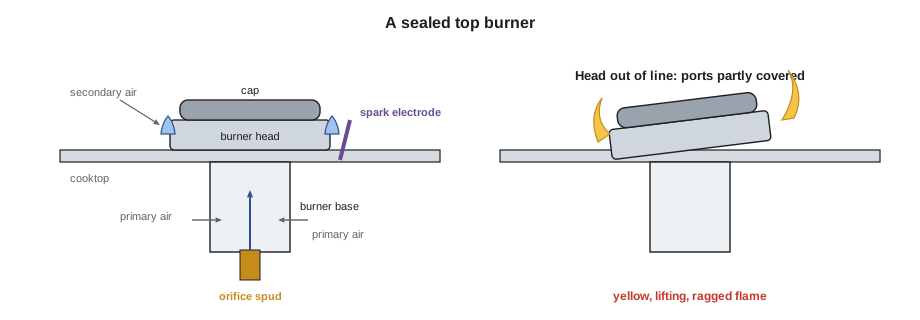
Hiro's case from Thursday, September 17, was a two-year-old gas range in Weinland Park. The customer, Cosimo Delisle, said the right rear burner burned with a lazy, yellow-tipped flame that lifted off the burner in places and left soot on his pots. Hiro had shut the range's gas valve, let the burner cool and lifted off the cap. The burner head had been put back a few degrees out of line after cleaning, so the cap sat crooked and some ports were half covered, and two ports were plugged with dried pasta water. He cleaned the ports with a wire the maker allows, not a toothpick that can break off, set the head and cap back square, and the flame came back sharp and blue. "No parts," Hiro said to Kiran on the October 26 cooking night. "Most gas burner calls are about cleaning, alignment and air. You only get to fix them if you understand how the burner works."
This lesson explains how a gas range delivers gas to its burners and burns it: the manifold and appliance regulator, the top burner valves, orifices, sealed and open burners, the oven and broil burners with their air shutters, and how to judge a flame. The ignition systems are in lesson 6, conversion between natural gas and propane in lesson 7 and leak testing and carbon monoxide in lesson 11. As lesson 1 explained, gas-side work at Penfold is Hiro's, and the apprentice watches, asks and runs the electrical tests he is given.
From the supply to the burners
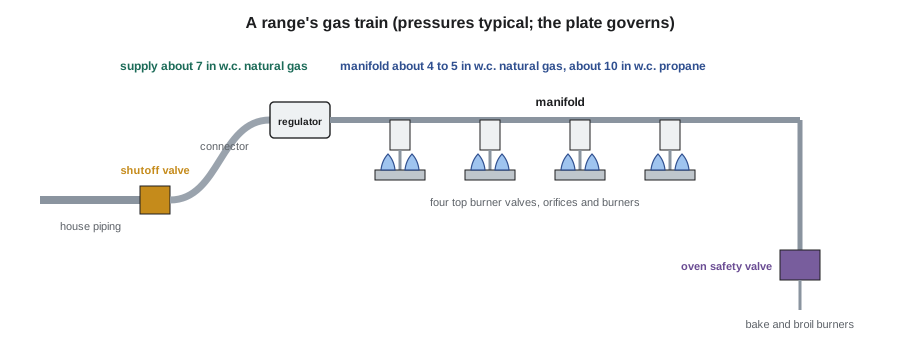
Gas reaches a range through the house piping, an appliance shutoff valve within reach behind the range, and a listed appliance connector, usually a coated flexible stainless steel connector, to the range's inlet. The connector must be the type and length the code and the range's instructions allow; it must not pass through a wall or floor and must not be kinked or stressed when the range is pushed back. At the inlet, the gas passes through the appliance regulator, which reduces the supply pressure to the steady manifold pressure printed on the rating plate. On natural gas, a range regulator is typically set for about 4 to 5 in w.c.; on propane, about 10 in w.c., with the supply pressures somewhat higher in each case (typical; the plate governs).
From the regulator, the gas fills the manifold, a pipe that runs across the front of the range behind the control panel. Each top burner valve and the oven control valve or safety valve screws or clamps onto the manifold. Because the regulator holds the manifold pressure steady, each burner receives its rated input no matter how many other burners are lit, as long as the supply pressure stays above what the regulator needs.
Top burner valves
A top burner valve is a rotary plug valve: turning the knob turns a tapered plug with a shaped slot or holes in it, so the valve opens gradually from a small flow at Lo to full flow at Hi. Most valves must be pushed in to turn from Off, a child-resistant feature, and most have a fixed or adjustable low-flame setting so that the burner stays lit on low. On ranges with spark ignition, each valve stem also operates a small igniter switch at the back of the control panel, which closes when the knob is turned to Lite and makes the spark module fire (lesson 6).
Valves are not field-repaired. A valve that is stiff, leaks at its stem, will not hold a low flame after its low-flame adjustment has been checked, or has a cracked igniter switch is replaced as a part, by the gas technician, followed by a leak test of the joint. The low-flame adjustment, a small screw inside the valve stem reached with the knob off, is set when the range is converted between gases (lesson 7), or when the low flame is too small to stay lit when the knob is turned down quickly from high.
Orifices
Each burner has an orifice, a small brass fitting with a precisely drilled hole that meters the gas into the burner. The orifice size is matched to the gas type, the manifold pressure and the burner's rated input. On many ranges the top burner orifices are separate orifice spuds screwed into the valve outlets or burner bases; on older ranges, an orifice hood screws over a fixed needle so that screwing it down reduces the opening for propane. The size is stamped on the orifice, as a drill number or as a diameter in hundredths of a millimeter, depending on the maker.
The flow through an orifice grows with its area and with the square root of the pressure across it, as GAS-210 showed for appliance conversions. So an orifice that is partly blocked by debris starves its burner, giving a small, weak flame, and an orifice that has been drilled out or is the wrong size overfires the burner. Orifices are never drilled or reamed in the field. A suspected orifice problem is checked against the parts list for the model and the gas type, and the correct orifice is fitted.
Worked problem
Gas use of a top burner
A range's large top burner is rated 18,000 Btu/h on natural gas. The gas has a heating value of about 1,000 Btu/ft³. How much gas does the burner use in an hour on high?
Show solution
- Gas volume in an hour:
- \[V = \frac{18\,000 \text{ Btu/h}}{1000 \text{ Btu/ft}^3} = 18 \text{ ft}^3 \text{ per hour}\]
- That is 0.3 ft³ a minute.
Answer: The burner uses 18 ft³ of gas an hour on high. A whole range with all burners and the oven on full uses several times that, which is why the gas technician checks the piping capacity for a high-input range.
Burners and how they mix air
A range burner is an atmospheric burner: the gas jet leaving the orifice draws in primary air through an opening around it, the gas and air mix in the burner's throat and head, and the mixture burns at the ports, where it draws in secondary air from the room. The proportions matter. Too little primary air gives a soft, yellow, smoky flame that makes soot and carbon monoxide; too much makes a hard, noisy flame that lifts off the ports and may blow out.
Most modern ranges have sealed burners: the burner base is sealed to the cooktop so spills cannot run down into the range, and the gas and primary air enter from below through the base. A removable burner head or spreader and a burner cap sit on top, and the flame comes out of ports around the edge of the head, under the cap. The head and cap must sit exactly as the maker designed; a misaligned head, as in Cosimo Delisle's range, or a cap upside down or from another burner, gives a ragged or lifting flame. Sealed burners usually have no adjustable air shutter; their air is set by design. Open burners, on older and some pro-style ranges, sit over an open drip pan, are easier to see and adjust, and often have an adjustable air shutter.
The oven burner and broil burner are long tubular or flat burners under the oven floor and at the top of the oven or in a separate broiler drawer. Each has its own orifice and, usually, an adjustable air shutter, a sleeve or plate at the burner inlet that the gas technician adjusts so the flame is correct. A dual-burner oven may have a single oven safety valve with two outlets.
Reading the flame
A good range flame is blue with a sharp, well-defined inner cone at each port, a slightly darker outer mantle, and little or no yellow. It sits on the ports without lifting and does not roar. Small orange flecks that come and go are usually dust or salt in the air burning and are harmless. A flame that is mostly yellow, soft and lazy, or that leaves soot, has too little primary air, too much gas, or blocked ports. A flame that lifts off the ports, blows out easily or is very noisy has too much primary air or too high a pressure. A flame that is very small for the setting has a blocked orifice, low pressure or a kinked connector.
| What the flame looks like | Likely causes | What the gas technician checks |
|---|---|---|
| Sharp blue inner cone, steady | Normal | Nothing |
| Yellow, soft, sooting | Blocked ports, misaligned head or cap, too little primary air, wrong orifice | Clean ports, seat head and cap, air shutter, orifice size |
| Lifting off the ports, noisy | Too much primary air, pressure too high, wrong orifice | Air shutter, manifold pressure, orifice for gas type |
| Very small at all settings | Partly blocked orifice, low supply or manifold pressure, kinked connector | Orifice, pressures, connector |
| Uneven around the burner | Some ports blocked, head damaged or misaligned | Clean ports, replace head if damaged |
| Goes out on low | Low-flame setting too low, draughts | Low-flame adjustment, conversion checks |
Hiro's rule for judging a flame is to look at it with the room lights dimmed, after the burner has run for a minute or two, with the pan or grate in place as it would be in use. He then checks the manifold pressure with a manometer at the test port the range provides, or at a test fitting the tech sheet describes, if the flames look wrong for no visible reason. A range running on the wrong gas, or converted badly, shows up as very yellow flames, or as tiny, lifting flames, on every burner at once; that is a case for lesson 7.
Worked problem
Checking the manifold pressure
A range plate gives a natural gas manifold pressure of 5.0 in w.c. Hiro's manometer reads 4.8 in w.c. at the test port with two burners on high. The maker allows plus or minus 0.3 in w.c. Is the pressure acceptable?
Show solution
- Allowed range: 5.0 − 0.3 = 4.7 in w.c. to 5.0 + 0.3 = 5.3 in w.c.
- The reading of 4.8 in w.c. is inside that range.
Answer: The manifold pressure is acceptable. If the flames still look wrong, the cause is at the burners: alignment, blocked ports, air or the orifices.
Cleaning and the customer
Many gas burner complaints come from cleaning. Burner heads and caps are removed for washing and put back in the wrong place or out of line; ports fill with spills; the spark electrode is knocked or covered with residue. The use and care guide shows how the heads and caps fit, often with notches or pins that locate them. The technician shows the customer how to put them back, how to dry them fully before relighting, and how to clean the ports with the method the maker allows. That one explanation often prevents the next call.
Grates, too, matter: a grate set wrong can sit the pan too low, touching the flame, which makes it smother and yellow and produces carbon monoxide. Pans much larger than the burner, or a wok without its proper ring, have a similar effect. Pans should sit on the grate as designed, with the flame touching the pan bottom but not curling up its sides.
Burner inputs and how a range is rated
Range top burners come in a range of sizes. A small simmer burner may be rated around 5,000 Btu/h, standard burners around 9,000 to 10,000 Btu/h, and power burners from about 16,000 Btu/h upward, with pro-style burners higher still (typical; the plate governs). The oven burner is usually around 17,000 to 18,000 Btu/h and the broil burner similar. The range's total input on its plate is the sum of every burner at full input, even though they rarely all run at once. That total is what the gas technician uses to size the supply, because a cooking appliance must be able to run at full input on a holiday.
A customer who complains that a new range's large burner is no hotter than the old one may be comparing different inputs, or may be using a small pan on a large burner, where much of the heat goes up around the sides. A burner's input is fixed by its orifice and the manifold pressure; it cannot be raised without changing the appliance's certification, and nobody tries.
Common mistakes
MistakeClearing burner ports with a toothpick.
InsteadUse the method the maker allows; a broken toothpick blocks the port.
MistakeDrilling out an orifice to fix a small flame.
InsteadFind the cause; fit the correct orifice for the model and gas type.
MistakeJudging a flame in bright light before it settles.
InsteadDim the lights, let it run a minute or two, with the grate and pan in place.
MistakeAdjusting gas parts as an uncertified apprentice.
InsteadLeave all gas adjustments to the qualified gas technician.
MistakeIgnoring the burner cap when a flame is ragged.
InsteadCheck that the head and cap are the right ones and sit square.
Summary and key terms
- Gas reaches the range through a shutoff valve, a listed connector and the appliance regulator.
- The regulator holds the manifold pressure steady; the plate gives the value.
- Top burner valves are rotary plug valves with a low-flame setting and an igniter switch.
- Orifices meter gas to each burner; they are matched to the gas and never drilled.
- Atmospheric burners mix primary air with gas; secondary air finishes the burning.
- Sealed burners rely on the head and cap sitting exactly as designed.
- A good flame is blue with sharp inner cones; yellow means too little air or blocked ports.
- Most burner calls are about cleaning, alignment and air rather than parts.
- Appliance regulator
- The regulator at a range inlet that holds the manifold pressure steady.
- Manifold
- The pipe that carries gas from the regulator to the burner valves.
- Top burner valve
- A rotary plug valve that controls one top burner's gas flow.
- Orifice
- A brass fitting with a precise hole that meters gas into a burner.
- Primary air
- Air drawn into a burner and mixed with the gas before it burns.
- Secondary air
- Air that reaches the flame from around the burner.
- Sealed burner
- A burner sealed to the cooktop so spills cannot run into the range.
- Air shutter
- An adjustable opening that sets a burner's primary air.
Practice problems
Work each problem on paper first, then reveal the answer to check.
What holds a range's manifold pressure steady?
Show answer
The appliance regulator.
What does a soft, yellow, sooting flame usually mean?
Show answer
Too little primary air, blocked ports or a misaligned head or cap.
Why are orifices never drilled in the field?
Show answer
They are matched to the gas, pressure and input; a drilled orifice overfires the burner.
Which burners usually have an adjustable air shutter?
Show answer
Oven and broil burners, and open burners.
An 18,000 Btu/h burner on gas of 1,000 Btu/ft³ runs for an hour. How much gas does it use?
Show answer
18 ft³.
Lesson quiz · 5 questions
Score 60% or more to complete this lesson.
Create a free account to save your progress, take quizzes and earn a certificate.