
APP-110 · Lesson 11 of 12 · 27 min
Recycling and disposing of old appliances
▶ Video coming soon A video version of this lesson is on the way.
On Monday, November 9, the back of the shop held five old appliances that Penfold had taken away from customers the week before: a chest freezer from 1992, a refrigerator from 2009, a refrigerator from 2021 with a cracked inner liner, a top-load washer and an electric range. A truck from Quarrington Metal Recovery, the scrap and appliance recycler Penfold uses, was due at two o'clock. "Before anything goes on that truck," Dee told Kiran, "we make it safe and we take out what doesn't belong in a scrap pile. Three of these have refrigerant in them, and one has a little mercury. That's the law and it's the right thing to do."
When a customer replaces an appliance, someone has to deal with the old one. Most of an appliance is steel, copper, aluminum, glass and plastic that can be recycled, but some appliances contain substances that harm the ozone layer or the climate, or are toxic, and must be removed before the rest is shredded or landfilled. Appliance technicians are often the last trained people to handle an old unit. This lesson covers what is inside an old appliance that needs care, the rules on refrigerant before disposal, and how Penfold handles haul-away units.
What is inside an old appliance
| Material | Where it is found | Why it needs care |
|---|---|---|
| Refrigerant | Sealed systems of refrigerators, freezers, air conditioners, dehumidifiers, heat pump dryers | Older refrigerants such as CFC-12 and HCFC-22 deplete the ozone layer; HFCs such as R-134a are strong greenhouse gases; hydrocarbons are flammable |
| Foam blowing agents | Insulation foam in refrigerator and freezer walls | Older foams were blown with CFC-11 or HCFC-141b, which are released when the foam is shredded |
| Compressor oil | Refrigerator and freezer compressors | Contains dissolved refrigerant; must not be dumped |
| Mercury | Tilt switches for lid or door lamps in some older chest freezers, washers and ranges | Toxic; switches are removed whole and kept as hazardous waste |
| PCB capacitors | Some motor capacitors in very old appliances, generally made before 1979 | Toxic and persistent; handled as hazardous waste |
| Circuit boards and electronics | Control boards, displays, inverter drives | Contain lead and other metals; recycled as electronic waste |
| Glass, metals, plastics | Most of the appliance | Recyclable once the hazardous parts are out |
Refrigerants are the main concern. Chlorofluorocarbons (CFCs) such as CFC-12 were used in household refrigerators until the early to mid 1990s, when they were phased out under the Montreal Protocol because they destroy stratospheric ozone. They were replaced by HFCs, mostly R-134a, which do not harm the ozone layer but are powerful greenhouse gases. Most refrigerators built in recent years use isobutane (R-600a), a hydrocarbon with a very low global warming potential, which is flammable.
Worked problem
The climate effect of one refrigerator
Global warming potential (GWP) compares a gas with carbon dioxide over 100 years. The 2009 refrigerator holds 150 g of R-134a, GWP about 1,430. The 1992 chest freezer holds 250 g of CFC-12, GWP about 10,900. What is each charge equivalent to in carbon dioxide if it escapes?
Show solution
- R-134a: 0.150 kg × 1,430 ≈ 215 kg of carbon dioxide equivalent.
- CFC-12: 0.250 kg × 10,900 = 2,725 kg of carbon dioxide equivalent.
Answer: About 215 kg and about 2,700 kg. The old freezer's small charge has the warming effect of several tons of carbon dioxide, on top of its damage to the ozone layer. Recovering it is worth far more than the scrap value of the freezer.
The rules on refrigerant at disposal
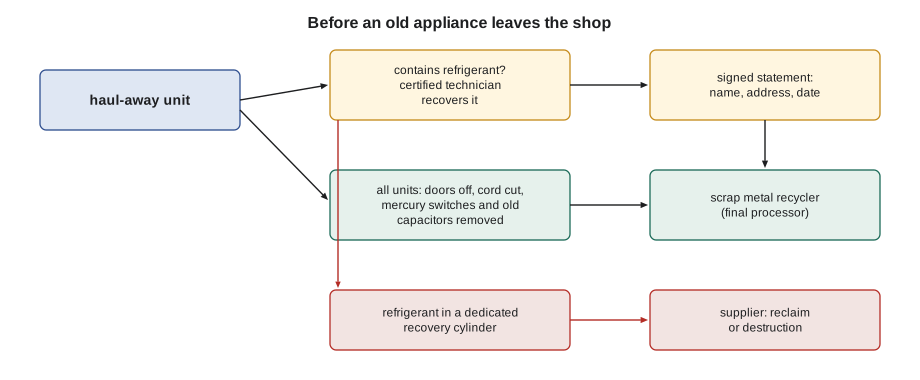
In the United States, the safe disposal rules under Section 608 of the Clean Air Act apply to small appliances such as refrigerators, freezers, window air conditioners and dehumidifiers. The last person in the disposal chain, usually the scrap recycler or landfill, called the final processor, must either recover the remaining refrigerant itself with certified equipment or get a signed statement from whoever recovered it earlier, giving that person's name and address and the date of recovery, and keep it for three years. A technician who recovers refrigerant from a small appliance must hold Section 608 Type I or Universal certification and use certified recovery equipment, and must recover at least 90 in 100 of the refrigerant (80 in 100 with recovery equipment made before November 15, 1993) or pull the system down to a vacuum of 4 inches of mercury. Federal rules treat the hydrocarbon refrigerants in newer household refrigerators differently from HFCs, but they are flammable and the manufacturer's and recycler's procedures for them must be followed. Kiran does not have his Type I certification yet, so he can watch and help, but Dee does the recovery.
Worked problem
How much refrigerant must be recovered?
Dee recovers the 2009 refrigerator's R-134a with Penfold's recovery machine. Its plate charge is 150 g, and after recovery the cylinder scale shows 141 g recovered. The rule requires at least 90 in 100 with equipment made after 1993. Does the recovery meet it, and what record goes with the refrigerator?
Show solution
- Fraction recovered: 141 ÷ 150 = 0.94, or 94 in 100.
- 94 in 100 is more than the required 90 in 100.
Answer: Yes. Dee fills in Penfold's signed recovery statement with her name, Penfold's address and the date, and Quarrington keeps a copy for three years as the final processor.
Recovered refrigerant goes into a recovery cylinder dedicated to that refrigerant, never mixed with other types. Penfold returns full cylinders to its refrigerant supplier, which sends the refrigerant for reclaiming to new-product purity or for destruction. CFC-12 recovered from the old freezer goes into its own cylinder.
Making old appliances safe
Refrigerant is not the only job. Before an old unit leaves Penfold, a technician:
- Removes the doors and lids from refrigerators, freezers and other airtight appliances, or the door gaskets and latches, so that a child playing in a scrap yard or a back lane cannot be trapped inside. Many municipalities require this, and Penfold does it on every unit, even those going straight onto a recycler's truck.
- Cuts off the power cord, so that nobody plugs in a unit that has been declared unsafe.
- Removes any mercury tilt switch whole, without breaking it, and stores it in a sealed container for household hazardous waste collection.
- Checks old motor capacitors for PCB markings on very old units, and sets aside any that may contain PCBs as hazardous waste.
- Drains water from washers and dishwashers, and removes any food from refrigerators.
- Removes glass shelves that could shatter in handling, and bins them with the glass recycling.
On the 1992 chest freezer, Kiran found the lid lamp switch: a small glass capsule with a bead of mercury inside a plastic housing. He unscrewed the housing, lifted the switch out whole and put it in the labeled mercury container on the shop shelf. Dee recovered the freezer's CFC-12 into its own cylinder. The newest refrigerator, with R-600a, was handled by Dee following the recycler's procedure for hydrocarbon units, away from any ignition source.
Where old appliances go
Several routes take old appliances in Columbus. Retailers and installers such as Penfold often take the old unit away when a new one is delivered. The City of Columbus's bulk collection takes some appliances, such as washers and dishwashers, but not refrigerated appliances such as refrigerators, freezers, dehumidifiers, water coolers and air conditioners, which must go through a private hauler or recycler. Scrap metal recyclers such as Quarrington take appliances by the truckload. Some utilities and retailers in the United States take part in EPA's voluntary Responsible Appliance Disposal program, which also recovers the foam blowing agents and recycles more of each unit.
Penfold's haul-away charge covers this work. Customers sometimes ask why taking away an old refrigerator costs money when it is full of scrap metal. Dee's answer is the refrigerant, the doors, the hazardous parts, the truck and the time.
Worked problem
Planning a load
Quarrington's truck takes up to 4,400 lb of appliances. Today's load is the chest freezer at 130 lb, two refrigerators at 190 lb and 165 lb, the washer at 120 lb and the range at 145 lb. What is the total, and how much capacity is left?
Show solution
- Total: 130 + 190 + 165 + 120 + 145 = 750 lb.
- Capacity left: 4,400 − 750 = 3,650 lb.
Answer: 750 lb, leaving 3,650 lb. Quarrington makes several shop stops on the same run, so Penfold's small load fits easily.
Repair, reuse and the customer's choice
Disposal is the last step in an appliance's life, and an appliance technician often helps decide when that step comes. A repair that keeps a sound appliance running for years is usually better for the customer and for the environment than replacing it. But an old refrigerator with a failing compressor and poor efficiency may cost more to run and repair than a new one. Technicians give customers honest information about the repair, its cost and the appliance's condition, and let them decide; APP-410 covers repair-or-replace decisions. When an appliance is replaced, the technician makes sure the old one is disposed of safely.
Foam insulation and modern recycling
Refrigerant is not the only ozone-depleting or climate-warming gas in an old refrigerator. The polyurethane foam insulation in its walls and door was made with a blowing agent, a gas that forms the bubbles and stays trapped in them for the life of the refrigerator. Older refrigerators were blown with CFC-11, later ones with HCFC-141b and then HFCs, and newer ones with hydrocarbons such as cyclopentane. A typical old refrigerator holds more blowing agent in its foam than refrigerant in its sealed system. When the cabinet is shredded in the open, most of that gas escapes.
The best appliance recyclers process refrigerators in sealed plants that recover the blowing agent as the foam is shredded, then separate the steel, aluminum, copper, plastic and foam for recycling. Not every recycler does this; many simply shred the cabinet once the refrigerant is out. Penfold chose Quarrington partly because it sends refrigerator cabinets to a plant that recovers foam gases. Customers who ask what happens to their old refrigerator deserve an honest answer.
Other appliances with refrigerant
Refrigerators and freezers are not the only household appliances with sealed systems. Window and portable air conditioners, dehumidifiers, water coolers, wine coolers, some ice makers and heat pump dryers all contain refrigerant, often R-410A or R-32 in air conditioners and R-134a, R-600a or R-290 in the others. The same rules apply to them: the refrigerant is recovered by a certified person before disposal, and units with flammable refrigerants are handled away from ignition sources. Heat pump dryers are new enough that some recyclers do not expect refrigerant in a dryer, so Penfold marks them clearly.
Records
Penfold keeps a refrigerant log: for every unit recovered, the date, the appliance, its refrigerant type and plate charge, the amount recovered, the technician and the cylinder it went into. The log shows that the company handled refrigerant properly, tracks how much is in each cylinder, and matches the paperwork that goes to the recycler and the refrigerant supplier. When Kiran helped Dee with the three refrigerated units on November 9, he filled in the log while she ran the recovery machine.
Worked problem
Filling a recovery cylinder
Penfold's R-134a recovery cylinder can safely hold up to 26 lb of refrigerant; recovery cylinders must never be filled past their safe limit, usually 80 in 100 of their liquid capacity, because liquid expands as it warms. The log shows 24.0 lb already in it. Today's recovery added 141 g. How much room is left?
Show solution
- Today's recovery: 141 g ÷ 453.6 ≈ 0.31 lb.
- New total: 24.0 + 0.31 ≈ 24.3 lb.
- Room left: 26 − 24.3 ≈ 1.7 lb.
Answer: About 1.7 lb, enough for a few more refrigerators. The cylinder will soon be full and go back to the supplier; a scale, not a guess, decides when.
Explaining it to the customer
Customers often ask whether they can leave an old refrigerator at the curb or take it to a scrap yard themselves. The honest answer depends on the local rules, but the technician can explain what has to happen to it: the refrigerant recovered by a certified person, the doors removed, and the unit taken somewhere that accepts refrigerated appliances. Many customers choose Penfold's haul-away once they understand the work involved, and those who do not at least know how to do it safely.
Common mistakes
MistakeVenting refrigerant from an old refrigerator before scrapping it.
InsteadA Type I or Universal technician recovers it with certified equipment, and the final processor keeps the signed statement.
MistakeMixing different refrigerants in one recovery cylinder.
InsteadUse a cylinder dedicated to each refrigerant.
MistakeLeaving the doors on an old refrigerator in the yard.
InsteadRemove doors or lids, or their gaskets and latches, so that nobody can be trapped.
MistakeBreaking a mercury switch to get it out.
InsteadRemove it whole and keep it sealed for hazardous waste collection.
MistakeTreating an R-600a refrigerator like any other scrap.
InsteadIt is flammable; follow the manufacturer's and recycler's procedures away from ignition sources.
MistakeTelling a customer haul-away should be free because of the scrap.
InsteadExplain the refrigerant recovery, hazardous parts, transport and time it pays for.
Summary and key terms
- Old appliances contain refrigerants, foam blowing agents, oil, sometimes mercury and PCBs, and electronics that need care.
- CFCs deplete ozone and HFCs warm the climate; even small charges have a large carbon dioxide equivalent.
- In the United States, the final processor must recover refrigerant or keep a signed statement for three years; recovery must reach 90 in 100 or 4 inches of mercury vacuum.
- Remove doors, cut cords, take out mercury switches and suspect capacitors, and drain water before scrapping.
- Recovered refrigerant goes in dedicated cylinders for reclaiming or destruction.
- Repair keeps sound appliances in service; safe disposal is the technician's last job on an old one.
- CFC
- Chlorofluorocarbon; an older refrigerant such as CFC-12 that depletes the ozone layer.
- HFC
- Hydrofluorocarbon; a refrigerant such as R-134a that does not harm ozone but is a strong greenhouse gas.
- Global warming potential
- A gas's warming effect compared with the same mass of carbon dioxide over 100 years.
- Recovery
- Removing refrigerant from a system into a cylinder without releasing it.
- Reclaiming
- Processing recovered refrigerant to new-product purity.
- Blowing agent
- The gas used to make foam insulation; older foams used CFC-11.
- Final processor
- The last person in the disposal chain, such as a scrap recycler or landfill.
- Mercury tilt switch
- A switch with a bead of mercury in a capsule, found in some older lamps and lids.
Practice problems
Work each problem on paper first, then reveal the answer to check.
What is the carbon dioxide equivalent of 150 g of R-134a with a GWP of 1,430?
Show answer
About 215 kg.
Why are refrigerator doors removed before disposal?
Show answer
So that a child cannot be trapped inside.
What is done with a mercury tilt switch?
Show answer
It is removed whole and kept sealed for hazardous waste.
Why is refrigerant never mixed in one recovery cylinder?
Show answer
Mixed refrigerant cannot be reclaimed easily and must be destroyed.
What recovery level is required from a small appliance with modern equipment?
Show answer
At least 90 in 100, or a vacuum of 4 inches of mercury.
Lesson quiz · 5 questions
Score 60% or more to complete this lesson.
Create a free account to save your progress, take quizzes and earn a certificate.