
APP-110 · Lesson 2 of 12 · 26 min
Electrical shock and safe work practices
▶ Video coming soon A video version of this lesson is on the way.
On Tuesday, October 20, Dee kept Kiran in the shop for the morning. On the bench was a countertop microwave oven that a customer had left for recycling, with its outer cover already off. Dee did not let Kiran touch it. "First lesson," she said, "is the one that keeps you alive. Every appliance we work on plugs into 120 or 240 volts. Some of them make thousands of volts inside, and some of them store a charge after you unplug them. Before you put a hand inside anything, you need to know where the energy is and how to get rid of it."
Electrical shock is the most serious everyday hazard in appliance service. Technicians work close to live parts, often in tight spaces behind or under appliances, sometimes on wet floors, and the temptation to take a reading with the panels off and the power on is constant. This lesson explains what electricity does to the body, the safe work rules that prevent shock, and the special hazards of capacitors and high-voltage circuits. APP-120 covers the electrical theory in depth; here the focus is staying safe.
What current does to the body
It is the current flowing through the body, not the voltage on its own, that injures. Voltage is the push; the body's resistance decides how much current that push can drive. Dry, unbroken skin has a high resistance, often many thousands of ohms. Wet or sweaty skin, a cut, a firm grip on metal or a wet floor can bring the resistance of the whole path down to about 1,000 ohms or less. Once the skin is broken down by the shock itself, resistance falls further.
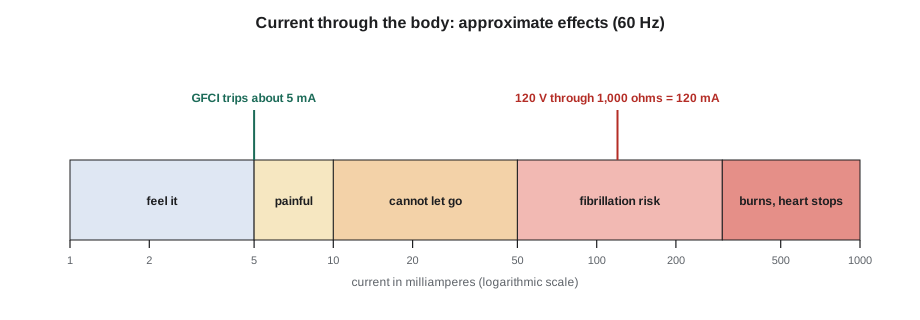
The effects of alternating current at 60 hertz depend on how much flows and for how long. The values below are approximate and vary from person to person, but they show why even small currents matter:
| Current through the body (about) | Typical effect |
|---|---|
| 1 mA | Faint tingle, the threshold of feeling |
| 5 mA | Painful shock; a household GFCI is designed to trip at about this level |
| 10 to 20 mA | Muscles clamp; the person may be unable to let go |
| 50 to 100 mA | Breathing difficulty; the heart may go into ventricular fibrillation |
| Several amperes | Heart stops, severe burns at the entry and exit points |
Worked problem
Current through a wet hand
Kiran kneels on a damp basement floor behind a washer and touches a live 120 V terminal with one hand while his other hand rests on a grounded water pipe. If the total resistance of the path through his body is about 1,000 ohms, about how much current flows?
Show solution
- Ohm's law: current = voltage ÷ resistance.
- I = 120 V ÷ 1,000 Ω = 0.12 A.
- 0.12 A = 120 mA.
Answer: About 120 mA, well into the range that can cause fibrillation. Hand-to-hand across the chest is the most dangerous path. This is why the power is always off before hands go inside an appliance.
The path matters as much as the current. Current that flows from one hand to the other, or from a hand to the feet, passes through the chest and the heart. A shock can also cause injury indirectly: a technician who jerks back from a shock may hit their head on a cabinet, cut a hand on sheet metal or fall off a step stool. Burns from an electrical arc, the flash when a short circuit happens, can occur even without a shock.
The first rule: de-energize and verify
Penfold's first safety rule is printed inside every van door: Unplug it, or switch it off and lock it, then prove it is dead. Most appliance repairs can and should be done with the appliance disconnected from power. That means:
- For a cord-and-plug appliance, pull the plug and keep it where you can see it and control it, so that nobody plugs it back in while you work. Turning the appliance off at its own control is not enough, because many parts stay live when the controls are off.
- For a hard-wired appliance, such as many dishwashers, built-in ovens and cooktops, switch off the breaker or disconnect, then lock it and tag it so that nobody switches it back on. Penfold vans carry breaker lockout devices that fit most household panels, padlocks and tags.
- Turn off the water, and for a gas appliance close the gas shutoff valve, if the work involves water or gas parts.
- Verify that it is dead with a working voltage tester or meter before touching anything. Test your meter on a known live source, test the circuit you will work on, then test the meter on the known source again. This live-dead-live check proves the meter was working when it said zero.
In the United States, OSHA's lockout/tagout standard (29 CFR 1910.147) covers servicing equipment that could start up or release stored energy. It allows a cord-and-plug appliance to be controlled by unplugging it, as long as the plug stays under the exclusive control of the person doing the work. OSHA's electrical safe work practice rules and NFPA 70E, the consensus standard for electrical safety in the workplace, set out how to work safely near energized equipment. Penfold's written lockout procedure follows both. Anything beyond the appliance itself, such as a faulty receptacle, breaker or branch circuit, is electrical work for a licensed electrician under the electrical code adopted locally, not for the appliance technician.
Stored energy: capacitors
Unplugging removes the supply, but some appliances store energy that can still shock you. The main source is capacitors. A capacitor stores charge between two plates and can hold it for minutes or longer after the power is removed. Appliances use capacitors in several places:
- Motor run and start capacitors on compressors, fan motors and some washer and dishwasher motors, typically a few microfarads to about 80 microfarads, rated 250 to 440 volts AC.
- Filter capacitors on electronic control boards and inverter drives, which can hold several hundred volts DC after power is removed. Inverter-driven compressors and motors are common in newer refrigerators, washers and dishwashers.
- The high-voltage capacitor in a microwave oven, the most dangerous of all.
Most capacitors have a bleeder resistor across them that drains the charge slowly after power is removed. But bleeders fail, and some boards take a minute or more to discharge. The rule is simple: treat every capacitor as charged until you have discharged it safely and measured zero.
To discharge a motor run capacitor, Dee uses a discharge tool: a resistor of about 20,000 ohms, rated for at least a few watts, in an insulated handle with two insulated leads. Touching the leads across the capacitor terminals drains the charge in a fraction of a second without the spark and pitting that a screwdriver shorted across the terminals would cause. She then measures across the terminals with her meter on DC volts to confirm there is no voltage left. For a control board, she follows the manufacturer's procedure, which usually says to wait a stated time after unplugging and then measure at named test points before touching the board.
Worked problem
Energy in a run capacitor
A compressor run capacitor of 10 µF is disconnected while charged to the peak of a 240 V supply, about 340 V. How much energy does it hold?
Show solution
- \[E = \tfrac{1}{2} C V^2\]
- E = 0.5 × 10 × 10⁻⁶ F × (340 V)².
- (340)² = 115,600.
- E = 0.5 × 10 × 10⁻⁶ × 115,600 ≈ 0.58 J.
Answer: About 0.6 joules. That is enough for a painful shock and a startle reaction that can cause a fall or a cut. Discharge it before touching the terminals.
The microwave oven: a special case
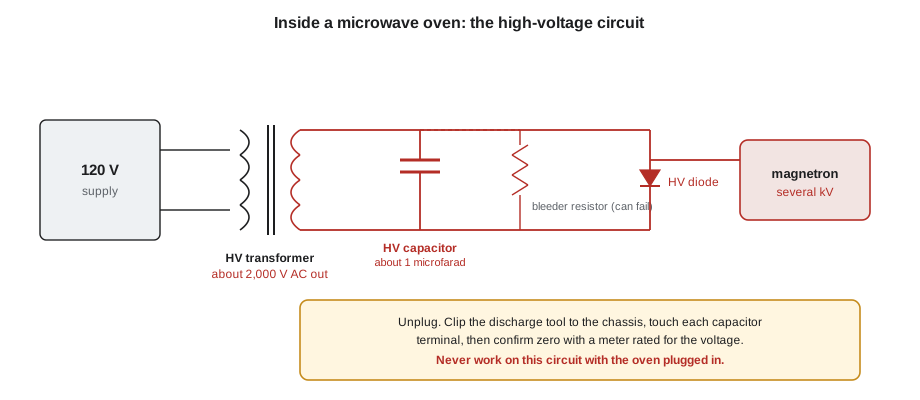
A microwave oven takes 120 V from the wall and makes about 2,000 volts AC or more in its high-voltage transformer. With the high-voltage diode and capacitor, the circuit that feeds the magnetron reaches several thousand volts, and the high-voltage transformer can drive enough current to kill. The high-voltage capacitor, typically just under 1 µF, can hold a lethal charge after the oven is unplugged if its bleeder resistor has failed. The outer cover of a microwave oven is the barrier between a person and that circuit.
Dee unplugged the microwave on the bench, waited, and then showed Kiran how she discharges the high-voltage capacitor: with an insulated, resistor-type discharge tool clipped to the chassis first, then touched to each capacitor terminal in turn, keeping her other hand away from the oven. She then confirmed zero with a meter rated for the voltage. She also showed him what she would never do: work on the high-voltage side with the oven plugged in, take a reading in the high-voltage circuit with an ordinary meter, or let anyone run the oven with the cover off.
Worked problem
Energy in a microwave capacitor
A microwave high-voltage capacitor of 0.95 µF can charge to about 2,800 V. How much energy can it hold, and how does that compare with the run capacitor in the last example?
Show solution
- \[E = \tfrac{1}{2} C V^2\]
- E = 0.5 × 0.95 × 10⁻⁶ F × (2,800 V)².
- (2,800)² = 7,840,000.
- E = 0.5 × 0.95 × 10⁻⁶ × 7,840,000 ≈ 3.7 J.
- Ratio to the run capacitor: 3.7 ÷ 0.58 ≈ 6.4.
Answer: About 3.7 joules at a voltage high enough to drive current through dry skin, roughly six times the energy of the run capacitor. Penfold trains technicians on microwave ovens only in a later level, under close supervision.
When live testing is necessary
Sometimes a technician must measure with power on, for example to check whether the control board is sending voltage to a heating element or a pump. Live testing is allowed only when it is needed to diagnose a fault, and only with precautions:
- Use a meter and leads rated for the job, at least CAT II for appliance work at a receptacle and CAT III at a panel, with intact insulation and finger guards. Lesson 5 explains the categories.
- Set up the test with the power off: attach alligator-clip leads or position the probes, step back, then restore power to read, and remove power before moving the leads.
- Keep one hand out of the work where you can, so that current has no path across your chest.
- Stand on a dry surface, remove rings, watches and metal jewelry, and wear safety glasses.
- Never defeat a door switch, interlock or safety device to make a test easier, unless the service manual tells you to and explains how.
Kiran asked Dee how often she tests live. "Every day," she said. "Probably five or six readings a day. But I set up every one with the power off, and I never put my hands in a live appliance to feel around."
Grounding and shock protection
Every appliance with a three-prong plug relies on the grounding conductor to carry fault current safely to the panel and trip the breaker if a live wire touches the metal cabinet. Cutting off the ground pin, using a cheater adapter in a two-prong receptacle, or leaving a ground strap disconnected after a repair removes that protection, and the next person to touch the cabinet becomes the path to ground. Always reconnect every ground wire and strap you removed, and check with a meter that the cabinet is bonded to the ground pin.
A ground fault circuit interrupter (GFCI) adds another layer. It compares the current going out on the hot conductor with the current returning on the neutral, and trips if they differ by about 5 mA, which means current is leaking somewhere else, perhaps through a person. GFCI protection is required by the electrical code in many wet locations, and some appliance instructions call for it. If an appliance keeps tripping a GFCI, it usually has a real leakage fault, often moisture in a heater or a pump, and the answer is to find the fault, not to replace the GFCI with an ordinary receptacle.
That afternoon, a customer told Dee her washer gave her a tingle when she touched the lid. Dee checked the receptacle with a plug-in tester: it was an old two-prong receptacle with a three-prong adapter and no ground. She explained to the customer that the washer had a leakage fault in its drain pump and no ground path to clear it, replaced the pump, and wrote on the invoice that the receptacle must be replaced by a licensed electrician before the washer was used again. She also unplugged the washer and taped a note on it.
Water, gas and other hazards
Shock is not the only hazard. Water from a washer, dishwasher or ice maker line can flood a floor in minutes if a valve or hose is opened by mistake, and wet floors make shocks worse. Gas appliances can leak if a connector is disturbed. Hot surfaces in ovens and dryers burn. Sharp sheet metal edges cut. Refrigerants can cause frostbite and, in the case of hydrocarbon refrigerants such as R-600a, can burn. Each later lesson and course deals with these, but the habit starts now: before you start, ask what energy is in this machine (electrical, stored, water pressure, gas, heat, refrigerant, springs, gravity) and how you will control each one.
Common mistakes
MistakeTurning the appliance off at its control panel and assuming it is safe.
InsteadUnplug it, or switch off and lock the breaker, then verify with a meter.
MistakeTesting for zero with a meter that might not be working.
InsteadUse the live-dead-live check: test the meter on a known source before and after.
MistakeShorting a capacitor with a screwdriver.
InsteadUse an insulated resistor discharge tool, then measure to confirm zero.
MistakeWorking on a microwave high-voltage circuit with the oven plugged in.
InsteadNever work on it live; discharge the capacitor and confirm zero first.
MistakeLeaving a ground strap off after a repair.
InsteadReconnect every ground and check that the cabinet is bonded to the ground pin.
MistakeReplacing a GFCI that keeps tripping with an ordinary receptacle.
InsteadFind the leakage fault in the appliance; receptacle work belongs to a licensed electrician.
Summary and key terms
- Current through the body injures; wet skin and firm contact let 120 V drive a dangerous current.
- Unplug or lock out, release stored energy, then verify with the live-dead-live check before touching anything.
- Capacitors can hold a charge after unplugging; discharge them with a resistor tool and measure zero.
- A microwave oven's high-voltage circuit can kill; it is never worked on live.
- Live tests only when needed, set up with power off, with rated meters and one hand out.
- Keep every ground connection and respect GFCI trips; receptacle and circuit work belongs to licensed electricians.
- Ohm's law
- Current equals voltage divided by resistance.
- Ventricular fibrillation
- A chaotic heart rhythm that stops the heart from pumping; it can be caused by currents of about 50 to 100 mA.
- Lockout
- Locking a breaker or disconnect in the off position so that nobody can switch it on while work is done.
- Live-dead-live check
- Testing a meter on a known live source before and after testing a circuit, to prove the meter was working.
- Bleeder resistor
- A resistor across a capacitor that drains its charge after power is removed.
- Discharge tool
- An insulated tool with a resistor used to drain a capacitor safely.
- GFCI
- Ground fault circuit interrupter; a device that trips when current leaks to ground, at about 5 mA.
- Grounding conductor
- The wire that connects the metal cabinet to ground so that a fault trips the breaker.
Practice problems
Work each problem on paper first, then reveal the answer to check.
What decides how much current flows through a body?
Show answer
The voltage and the resistance of the path through the body.
About how much current can a 120 V circuit drive through a 1,000 ohm body path?
Show answer
About 120 mA.
What are the three readings in a live-dead-live check?
Show answer
Known live source, the circuit being worked on, the known live source again.
Why is turning off an appliance at its controls not enough?
Show answer
Many parts stay live with the controls off; only unplugging or locking out removes the supply.
What energy does a 10 µF capacitor charged to 340 V hold?
Show answer
About 0.58 J.
Lesson quiz · 5 questions
Score 60% or more to complete this lesson.
Create a free account to save your progress, take quizzes and earn a certificate.