
APP-110 · Lesson 10 of 12 · 23 min
Water connections and leaks
▶ Video coming soon A video version of this lesson is on the way.
On Wednesday, November 4, the first call was a dishwasher in a semi-detached house in Bexley that left a puddle on the kitchen floor after every load and, the customer said, sometimes smelled like the kitchen sink. Kiran knelt, shone his headlamp under the kick plate and saw a drip forming at the brass elbow on the water inlet valve. Dee knelt beside him. "Good. Now find the other problem," she said. "She told you there were two." It took Kiran ten minutes to find it: the dishwasher's drain hose ran straight down to the sink drain with no high loop and no air gap, so dirty water from the sink could flow back into the dishwasher.
Water is the second most common cause of damage that appliances do to homes, after fire. Washers, dishwashers, refrigerators with water dispensers and ice makers, and even dehumidifiers all connect to water supplies or drains, and a small leak behind or under an appliance can rot a subfloor and grow mold for months before anyone sees it. This lesson covers water supply connections, drains and backflow protection, water hammer, and how to find and fix leaks.
The water supply
An appliance's installation instructions state the water supply it needs: hot or cold, the range of water pressure it is designed for, and the connection size. Typical values are:
| Appliance | Typical supply | Typical connection |
|---|---|---|
| Dishwasher | Hot water, often about 120 °F at the dishwasher; pressure in the range stated in the instructions | 3/8 inch compression or a 3/4 inch hose thread at the inlet valve, through an elbow |
| Clothes washer | Hot and cold; pressure in the stated range | 3/4 inch hose thread on two fill hoses |
| Refrigerator water and ice | Cold; often a higher minimum pressure for the filter to work well | 1/4 inch tubing, with a shutoff valve |
| Steam dryer | Cold, for the steam feature | 3/4 inch hose thread through a Y connector |
A common range in instructions is about 20 to 120 psi for washers and dishwashers. Below the minimum, an appliance may fill slowly and show a fault code; above the maximum, valves and hoses are stressed and a pressure-reducing valve may be needed in the house supply, which is plumbing work.
Every water-using appliance should have its own accessible shutoff valve, so that its supply can be turned off for service without shutting off the whole house. Quarter-turn ball valves are best; old multi-turn saddle valves, which pierce a copper pipe to feed a refrigerator line, are a common source of leaks and are not recommended by most manufacturers.
Worked problem
Fill time
A washer's inlet valve passes about 2 gal/min at normal pressure. Its wash fill is about 12 gal. How long should the fill take, and what would a fill of three times as long suggest?
Show solution
- Fill time: 12 ÷ 2 = 6 minutes.
- Three times as long is about 18 minutes.
Answer: About six minutes. A much longer fill points to low house pressure, a partly closed shutoff valve, a kinked hose or a clogged inlet screen in the valve or hose, which is the first thing to check.
Supply lines and fittings
Most appliance leaks start at a connection, not in the middle of a hose or pipe. Penfold's rules for supply connections are:
- Use new supply lines on every installation. Old hoses and lines have been under pressure for years and can be weakened or kinked.
- Use braided stainless steel hoses for washers rather than plain rubber ones; many manufacturers recommend replacing washer fill hoses every five years, whatever their type, and Penfold writes the installation date on a tag on each hose.
- Make compression connections with the right size of nut and ferrule, hand tight plus the turns the fitting maker specifies; overtightening crushes the ferrule and causes leaks.
- Use thread sealant or tape only on tapered pipe threads, such as the threads where the elbow screws into the dishwasher's inlet valve. Never put tape on a compression fitting or a hose washer connection; these seal on the ferrule or the washer, and tape stops them seating.
- Put new washers in hose connections, with the screen washer at the valve end if one is supplied.
- Route lines so they cannot be kinked or pinched when the appliance is pushed back.
At the dishwasher that morning, Kiran shut off the supply, opened the elbow and found the problem at once: someone had wrapped tape around the compression thread at the elbow and only hand-tightened the nut, so the ferrule had never seated. The tapered thread into the valve, where tape belongs, had none. He fitted a new elbow with sealant on its tapered thread, a new supply line, tightened the compression nut the specified amount, turned the water on and watched it with dry paper towel for five minutes. No drip.
Drains and backflow
Appliances that pump water out, such as washers and dishwashers, must drain into the house's drainage system without letting dirty water flow back into the appliance. Backflow can happen two ways: if the sink drain backs up, its water can flow down the drain hose into the dishwasher; and if the appliance's drain hose sits below the water in a trap or drain, water can siphon out of the appliance or back into it. Plumbing codes require protection at the dishwasher drain, by an air gap or a high loop as the local code and the instructions allow.
- An air gap device mounts on the sink or countertop. The dishwasher's drain hose runs up to it and the water falls through an open gap into a second hose that runs to the sink drain or disposer. Because the gap is open to the air, water from the sink drain cannot reach the dishwasher.
- A high loop is the drain hose looped up and fastened as high as possible under the countertop, to the height the instructions give, before it goes down to the drain. It keeps sink water from flowing back except in a severe backup.
- A washer's drain hose hooks into a standpipe or laundry tub with an air break around the hose, so that the drain can never siphon water out of the washer. The standpipe must be within the height range the instructions and the plumbing code allow; too short and water overflows, too tall and the pump may not lift the water.
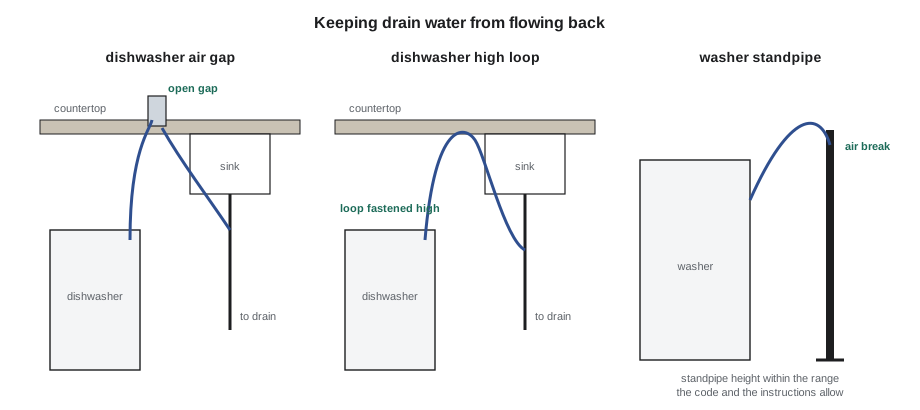
The dishwasher's drain hose had no loop at all. Kiran raised it and fastened it to the underside of the countertop with a strap at the height the instructions showed. Dee explained to the customer that the sink smell came from sink water flowing back into the dishwasher, and that the loop would stop it.
Changing the house's plumbing, such as adding a new drain, a standpipe, a shutoff valve on a pipe, or a pressure-reducing valve, is plumbing work, which in Columbus is done by licensed plumbers and often needs a permit. An appliance technician connects the appliance to an existing valve and drain and leaves changes to the house's piping to a licensed plumber.
Water hammer
Washer and dishwasher inlet valves are solenoid valves that close in a fraction of a second. When fast-moving water in a pipe is stopped suddenly, its momentum makes a pressure spike that travels back and forth along the pipe, often heard as a bang or a knock. Repeated water hammer stresses hoses, valves and pipe joints. The fix is a water hammer arrestor, a small chamber with a cushion of air or gas behind a piston, installed near the valve. Many come as screw-on fittings for washer hose connections. If a customer complains of banging when the washer fills, check for arrestors and loose pipes.
Finding leaks
A leak can show up far from where it starts, because water runs along the floor, along wiring or down the inside of a cabinet before it drips. Find it systematically:
- Ask when the leak happens: all the time, only during fill, only during drain, only during spin, or only after a long time.
- Turn off the power, remove the access panels or kick plate and dry everything with towels, so that new water shows.
- Start at the highest wet point and work down; water flows down and sideways.
- Run the appliance in service mode through the step that leaks, and watch with a flashlight; a strip of paper towel held against a joint shows a slow leak.
- Check the usual suspects for that appliance.
| Appliance | Common leak sources |
|---|---|
| Dishwasher | Inlet valve fitting, door gasket, drain hose clamps, pump seal, overfilling from a stuck valve or a faulty float, wrong detergent making suds |
| Front-load washer | Door boot seal, dispenser, drain pump filter cap, fill hoses, a torn bellows hose |
| Top-load washer | Fill hoses, tub seal, drain hose, overfilling |
| Refrigerator | Water line and valve, a clogged defrost drain freezing and overflowing, a cracked filter housing, ice maker fill tube |
| Dehumidifier or air conditioner | Clogged condensate drain, a full bucket switch that does not work |
Not every wet floor is a leak. A refrigerator in a humid basement may sweat on its outside; a front-load washer used with ordinary detergent may produce suds that escape; and a puddle under a dishwasher may come from a leaking sink trap above it. Check the surroundings before condemning the appliance.
Worked problem
How much water is a slow drip?
A dishwasher fitting drips about once a second, all day, behind the kick plate. If a drop is about 0.25 mL, how much water reaches the subfloor in a day and in a month of 30 days?
Show solution
- Drops per day: 60 × 60 × 24 = 86,400.
- Water per day: 86,400 × 0.25 mL = 21,600 mL, about 5.7 gal.
- Water per month: 5.7 × 30 ≈ 171 gal.
Answer: About 5.7 gal a day and about 170 gal a month, enough to rot a subfloor and grow mold. A drip that seems small is worth fixing on the first visit.
When there is water damage
If a leak has damaged the floor or cabinets, or there is mold, the technician fixes the appliance fault, photographs the damage, notes it on the work order and tells the customer. Wet subfloors, drywall and insulation may need a water damage restoration company, and the customer may want to call their insurer; the photographs and the work order help. Penfold technicians do not open walls or floors, and they do not say what caused damage they have not seen happen. If water has reached electrical parts or wiring, the appliance stays unplugged until it is dry and tested.
Refrigerator water lines and filters
Refrigerators with ice makers and water dispensers connect to the cold water supply through a small line, usually 1/4 inch tubing, and a shutoff valve. Copper and braided stainless lines are preferred; thin plastic tubing can crack, kink when the refrigerator is pushed back, or be chewed by pets and rodents. Leave a service loop of tubing behind the refrigerator so that it can be pulled out without stressing the connection, and route the line so it is not trapped under a wheel.
Most of these refrigerators have a water filter, which the use and care guide says to change at a stated interval, often every six months. After installing a new filter or a new line, the instructions call for flushing a quantity of water through the dispenser to remove air and fine carbon particles; a dispenser that spits and sputters usually has air in the line, and slow flow often means a clogged filter or low pressure. Customers sometimes use filters that are not approved for the model; a poorly fitting filter can leak inside the cabinet or let the water valve run constantly. When a refrigerator leaks inside, check the filter housing and the filter first.
Ice makers have their own common faults, such as a frozen fill tube, a stuck ejector, a full-bin arm in the wrong position or a water valve that does not open. Most are electrical or mechanical, and the tech sheet gives the test procedure. Ice maker repair is covered in APP-210.
Common mistakes
MistakeReusing old supply hoses on a new installation.
InsteadFit new supply lines and hoses every time, and tag washer hoses with the date.
MistakePutting tape on a compression fitting.
InsteadTape or sealant goes only on tapered pipe threads; compression fittings seal on the ferrule.
MistakeRunning a dishwasher drain hose straight down to the sink drain.
InsteadUse an air gap or a high loop, as the code and the instructions allow.
MistakeSearching for a leak with the appliance wet everywhere.
InsteadDry everything first, then watch from the highest wet point down.
MistakeBlaming the appliance for every wet floor.
InsteadCheck for sweating, suds and leaks from the sink or plumbing above.
MistakeAdding a standpipe or shutoff valve to the house piping.
InsteadChanges to house plumbing are for a licensed plumber.
Summary and key terms
- Every water-using appliance needs the supply temperature and pressure its instructions state, and its own accessible shutoff valve.
- Most leaks start at connections: use new lines, the right fittings and sealant only on tapered threads.
- Drains need backflow protection: an air gap or high loop for dishwashers, an air break at a washer standpipe.
- Fast-closing valves cause water hammer; arrestors near the valve absorb it.
- Find leaks systematically: ask when it leaks, dry everything, start at the highest wet point, watch the suspect step.
- A slow drip adds up to well over a hundred gallons a month; fix it on the first visit.
- Shutoff valve
- A valve that turns off the water to one appliance; quarter-turn ball valves are preferred.
- Compression fitting
- A fitting that seals by squeezing a ferrule onto a tube; it takes no tape.
- Air gap
- A device that lets drain water fall through an open gap so that it cannot flow back into the dishwasher.
- High loop
- A drain hose looped up and fastened under the countertop to limit backflow.
- Air break
- An open space around a drain hose in a standpipe so that the drain cannot siphon the appliance.
- Water hammer
- A pressure spike caused when a fast-closing valve stops moving water suddenly.
- Water hammer arrestor
- A small cushioned chamber near a valve that absorbs water hammer.
Practice problems
Work each problem on paper first, then reveal the answer to check.
Where should tape or thread sealant be used on a dishwasher connection?
Show answer
Only on the tapered pipe thread of the elbow into the inlet valve.
What does a high loop do?
Show answer
Keeps sink water from flowing back into the dishwasher through its drain hose.
What causes water hammer in appliances?
Show answer
Fast-closing solenoid inlet valves stopping moving water suddenly.
Where do you start looking for a leak?
Show answer
At the highest wet point, after drying everything.
About how much water does a drip of one drop per second deliver in a day?
Show answer
About 5.7 gal.
Lesson quiz · 5 questions
Score 60% or more to complete this lesson.
Create a free account to save your progress, take quizzes and earn a certificate.