
AERO-450 · Lesson 9 of 12 · 28 min
eVTOL and advanced air mobility
The third item on the Bluestem Air Medical contract is a feasibility study. The operator's board has read about electric air taxis and wants to know whether an eVTOL could take over some of its inter-hospital transfers, the scheduled, non-emergency flights that move stable patients between regional hospitals and the main trauma center, typically 40 to 80 km each way. Kenji Watanabe is keen; Élise is skeptical; Rachel Oduya points out that no eVTOL has yet received a full type certificate in North America. Élise asks Arjun to do what engineers do with a hopeful idea: put numbers on it.
Advanced air mobility
Advanced air mobility is the umbrella term for new forms of air transport made possible mainly by electric propulsion and automation: air taxis in and around cities, regional passenger and cargo flights with small electric or hybrid aircraft, medical and logistics flights, and drone delivery. Its promoters argue that distributed electric propulsion makes vertical flight quieter, cheaper to maintain and more reliable than the helicopter, so that short trips by air could become routine. Its critics point to battery energy, certification cost, infrastructure, noise acceptance and pilot supply. Both sides agree that the first services will be small and that the economics depend on high aircraft utilization.
eVTOL configurations
Most eVTOL designs fall into three families. Multicopters, such as wingless designs with many small rotors, are simple and hover efficiently for their size but carry hover-level power through the whole flight, so their range is short, typically 30 to 50 km. Lift-plus-cruise designs carry separate lift rotors for vertical flight, which stop and stay edgewise in cruise, plus one or more pusher propellers and a wing. They are mechanically simple and fly efficiently on the wing, but they carry the mass and drag of the stopped lift rotors and booms in cruise. Vectored-thrust or tilt designs tilt some or all of their rotors, or the whole wing, between hover and cruise. They use the same motors in both phases and can cruise fastest and farthest, but the tilt mechanisms are complex and the transition is the hardest flight phase to design and certify.
All of them use distributed electric propulsion: many motors and rotors, each fed by its own inverter and often by more than one battery, so that the loss of one does not cause a loss of control. This redundancy is the main safety argument for eVTOL: a conventional single-engine helicopter relies on autorotation after an engine failure, but an eVTOL with six or eight rotors can be designed to continue flight and land normally with one failed. It comes at a cost. Each rotor must be able to produce more than its normal share of thrust, so the motors, inverters and batteries are sized for the failure case, and the aircraft carries that extra capacity all the time.
Disk loading and the hover penalty
Lesson 1 showed that eVTOLs have disk loadings of 500 to 800 N/m², two to three times that of a helicopter, to keep their span small enough for city heliports. Hover power per unit thrust is correspondingly higher, and in a battery aircraft every second of hover costs a lot of energy. The design approach is to hover as little as possible: a short vertical take-off, a quick transition to wing-borne flight, and a quick transition back before landing. The energy for a given trip then depends mainly on the cruise lift-to-drag ratio, and the battery must be sized for the energy of the trip plus reserves, while the motors and inverters are sized for the peak power of hover, especially hover with one rotor failed.
A mission energy model
The mission model splits the flight into segments, each with a power and a duration, and adds the energies. Hover power comes from momentum theory with a figure of merit and drivetrain efficiency. Wing-borne cruise power comes from the aircraft's lift-to-drag ratio:
where \(\eta_d\) is the efficiency of motors, inverters and cables and \(\eta_p\) the cruise propeller efficiency. The battery mass follows from the total energy, including reserves, the pack specific energy and the usable fraction at end of life:
# Mission energy for a six-rotor lift+cruise eVTOL on a 60 km medical-transfer flight, with reserves.
import math
rho, g = 1.225, 9.81
m = 2200.0                                   # take-off mass (kg)
n_rot, R = 6, 1.5                            # lift rotors and radius (m)
FM, eta_drive = 0.72, 0.90                   # lift rotor figure of merit; motor, inverter and cabling efficiency
LD, eta_prop, V_cr = 11.0, 0.80, 60.0        # cruise lift-to-drag ratio, propeller efficiency, cruise speed (m/s)
spec_E, usable = 230.0, 0.85                 # pack specific energy (Wh/kg) and usable fraction at end of life
W = m * g; A = n_rot * math.pi * R**2
P_hover = W * math.sqrt(W / (2 * rho * A)) / FM / eta_drive
P_cruise = W * V_cr / LD / eta_prop / eta_drive
P_climb = P_cruise + W * 3.0 / eta_prop / eta_drive        # 3 m/s climb on the wing
print(f"Disk loading {W/A:.0f} N/m^2; hover {P_hover/1000:.0f} kW, wing-borne cruise {P_cruise/1000:.0f} kW, climb {P_climb/1000:.0f} kW")
print()
dist = 60e3                                     # mission distance (m)
seg = [("Take-off hover and transition", P_hover, 60),
       ("Climb to 450 m", P_climb, 150),
       ("Cruise", P_cruise, (dist - 150 * V_cr * 0.9 - 120 * V_cr * 0.9) / V_cr),
       ("Descent", 0.45 * P_cruise, 120),
       ("Transition and landing hover", P_hover, 75)]
E_trip = 0.0
print("Segment                           power kW   time s    energy kWh")
for name, P, t in seg:
    E_trip += P * t / 3.6e6
    print(f"  {name:31s} {P/1000:7.0f}   {t:6.0f}     {P*t/3.6e6:6.2f}")
print(f"  {'Trip total':31s} {'':7s}   {'':6s}     {E_trip:6.2f}")
print()
for label, minutes, extra_hover in (("20 min at cruise power", 20, 0), ("30 min at cruise power", 30, 0),
                                    ("30 min plus one extra 60 s hover (balked landing)", 30, 60)):
    E_res = P_cruise * minutes * 60 / 3.6e6 + P_hover * extra_hover / 3.6e6
    E_tot = E_trip + E_res
    m_batt = E_tot * 1000 / (spec_E * usable)
    print(f"Reserve {label}: reserve {E_res:5.2f} kWh, total {E_tot:5.1f} kWh, battery {m_batt:5.0f} kg ({m_batt/m:.0%} of take-off mass)")
print()
print(f"Peak power in hover is {P_hover/P_cruise:.1f} times cruise power: the pack is sized by energy, the motors by hover,")
print(f"and the hover C-rate at the 30 min reserve size is about {P_hover/1000/(E_trip + P_cruise*1800/3.6e6):.1f}C")Disk loading 509 N/m^2; hover 480 kW, wing-borne cruise 164 kW, climb 253 kW Segment power kW time s energy kWh Take-off hover and transition 480 60 8.00 Climb to 450 m 253 150 10.56 Cruise 164 757 34.38 Descent 74 120 2.45 Transition and landing hover 480 75 10.00 Trip total 65.39 Reserve 20 min at cruise power: reserve 54.50 kWh, total 119.9 kWh, battery 613 kg (28% of take-off mass) Reserve 30 min at cruise power: reserve 81.75 kWh, total 147.1 kWh, battery 753 kg (34% of take-off mass) Reserve 30 min plus one extra 60 s hover (balked landing): reserve 89.75 kWh, total 155.1 kWh, battery 794 kg (36% of take-off mass) Peak power in hover is 2.9 times cruise power: the pack is sized by energy, the motors by hover, and the hover C-rate at the 30 min reserve size is about 3.3C
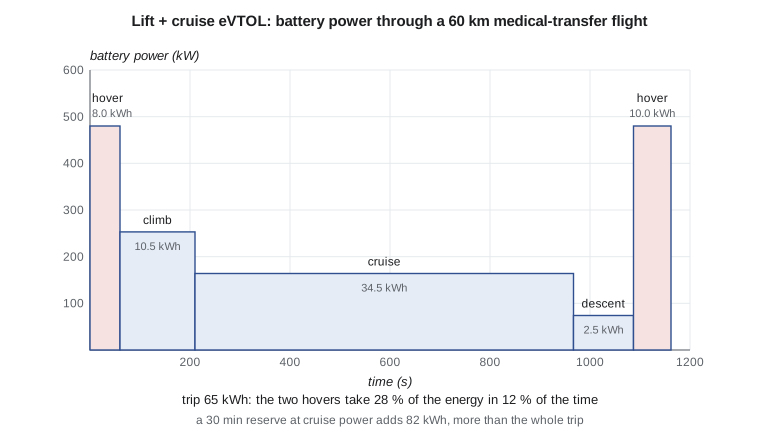
The code models a 2200 kg lift-plus-cruise aircraft with six lift rotors of 1.5 m radius, a cruise lift-to-drag ratio of 11 and a cruise speed of 60 m/s (117 knots). Hover needs 480 kW, cruise only 164 kW. On the 60 km trip the two hover segments, totaling 135 seconds, use 18 kWh of the 65 kWh trip energy: 28 percent of the energy in 12 percent of the time. The reserve dominates. A 30-minute reserve at cruise power adds 82 kWh, more than the trip itself, and the battery reaches 750 kg, a third of the take-off mass. That is consistent with the battery fractions published for current eVTOL designs.
Reserves and the regulations
Reserve rules for helicopters and airplanes were written for fuel, and they assume that fuel is cheap to carry. For visual flight, airplanes in North American rules need enough fuel to reach the destination and then fly 30 minutes by day or 45 minutes at night at normal cruise; helicopters need 20 minutes. Batteries make reserves heavy, which is why reserve rules for eVTOLs have been debated so intensely. In the United States, the FAA's special federal aviation regulation for powered-lift, issued in October 2024 and in force for an initial ten years, sets pilot certification and operating rules for these aircraft, including how much energy reserve they must carry. The proposed version used airplane-style reserves, and industry argued for helicopter-style reserves for aircraft that can land vertically almost anywhere. Arjun uses the 30-minute airplane-style figure as the conservative design case, and Rachel checks the current rule text before any figure goes into the report. The code shows why the choice matters: a 20-minute reserve saves 140 kg of battery on this aircraft, almost two passengers' worth.
There are also practical reserves that rules do not capture. A balked landing, where the pilot must go around because a heliport is occupied, costs a transition, a climb and a second approach. Battery capacity at end of life may be 80 percent of new. Cold days, of which Wichita has many, cut capacity further. A sound design adds margins for each, and the third line of the code's reserve table includes one extra minute of hover for a balked landing.
Peak power and the battery
Energy sizes the battery, but power can size it too. At 750 kg, the pack holds about 150 kWh, so 480 kW of hover is about 3.3C, and with one rotor failed the remaining motors may briefly need 30 to 50 percent more. The pack must deliver that power at the end of the flight, cold and nearly empty, when its voltage is lowest and its resistance highest, which is exactly when the landing hover happens. Designers therefore choose cells that balance energy against power, and size the pack for the landing case at end of life, not the take-off case when new. Heat generated during the final hover must also be managed, especially on rapid turnarounds, because a hot pack cannot be fast-charged immediately and ages quickly.
Certification
No existing airworthiness standard fits an eVTOL exactly: it is neither a helicopter nor an airplane, and its safety depends on software, power electronics and batteries more than on any traditional aircraft. Regulators have created new approaches. In Europe, EASA published a special condition for small VTOL aircraft in 2019, with an enhanced category for passenger-carrying commercial operations that requires the aircraft to continue safe flight and landing after any single failure. The FAA certifies eVTOLs as powered-lift in a special class, with airworthiness criteria developed for each design and published for public comment, and in October 2024 it issued its special federal aviation regulation for powered-lift operations and pilot training. Transport Canada works closely with both, and validation of a foreign type certificate is the usual route into Canada for an aircraft designed abroad.
As of late 2026, no eVTOL holds an FAA or Transport Canada type certificate. Joby Aviation reports that it is in the final stage of the FAA's five-stage type certification process, with conforming aircraft flying for-credit tests since early 2026. Archer Aviation reports that it is in the final phase of its own certification program. Beta Technologies, whose ALIA aircraft has a conventional-take-off version as well as an eVTOL version, received a special airworthiness certificate in October 2026 that allows demonstration flights for prospective customers, which is not a type certificate. Under the FAA's eVTOL Integration Pilot Program, launched in 2025, selected projects are also preparing early operations ahead of full certification. In China, the EHang EH216-S multicopter received a type certificate from the Civil Aviation Administration of China in 2023. Dates in this field change fast, and an engineer quoting certification status in a report must check it on the day.
| Question | Helicopter (medevac twin) | Lift + cruise eVTOL (model) |
|---|---|---|
| Hover power at take-off mass | 532 kW for 3000 kg | 480 kW for 2200 kg |
| Cruise power | 357 kW at 102 knots | 164 kW at 117 knots |
| Energy for a 60 km trip | About 45 kg of fuel, roughly 540 kWh of chemical energy | 65 kWh of electricity |
| Reserve | 20 minutes, about 45 kg of fuel | 30 minutes, about 82 kWh or 420 kg of battery |
| Range limit | Several hundred km | About 60 to 100 km with reserves |
| Engine or motor failure | Twin-engine Category A, autorotation | Distributed propulsion, continued flight |
Infrastructure, noise and operations
An eVTOL service needs vertiports with charging, which means large electrical connections: charging a 150 kWh pack in 15 minutes takes about 600 kW. Hospitals already have helipads, but rooftop pads may not carry the added weight of charging equipment, and fire protection for lithium batteries differs from that for fuel. Noise is a central promise: many small, slow-turning rotors and electric motors can be much quieter than a helicopter, especially in cruise, though the hover noise of highly loaded rotors is still significant. Airspace integration, discussed in lesson 10, and pilot training and supply are open issues; the first services will have pilots, with autonomy planned later.
Arjun's conclusion for Bluestem Air Medical is cautious. On the shortest transfer routes, an eVTOL of this class could carry a stretcher patient and one attendant with reserves, but not a full medical team, and not in deep winter without battery heating and longer charging times. Emergency scene response, with unknown landing sites, hoisting and long hovers, remains helicopter work. The recommendation is to watch certification and the first commercial services, and to revisit the case when pack specific energy at end of life reaches about 250 Wh/kg.
Worked problem
Hover energy per second
How much battery energy does the model eVTOL use per second of hover, and what range in cruise does one minute of hover cost?
Show solution
- Hover: 480 kW, so one second uses \(480/3600 = 0.133\ \mathrm{kWh}\) and one minute 8.0 kWh.
- Cruise: 164 kW at 60 m/s uses \(164/60 = 2.73\ \mathrm{kJ/m}\), or 0.76 kWh per km.
- \(8.0/0.76 = 10.5\ \mathrm{km}\).
Answer: One minute of hover costs as much energy as about 10 km of cruise.
Worked problem
Effect of lift-to-drag ratio
If stopped-rotor drag lowers the cruise lift-to-drag ratio from 11 to 9, how much does the cruise energy for the 60 km trip change?
Show solution
- Cruise power scales as \(1/(L/D)\): \(164 \times 11/9 = 200\ \mathrm{kW}\).
- Cruise energy: \(34.4 \times 11/9 = 42.0\ \mathrm{kWh}\), an increase of 7.6 kWh.
Answer: Cruise energy rises by 22 percent, and the 30-minute reserve at cruise power rises by the same proportion, so the battery grows by about 120 kg.
Worked problem
Charging power
The operator wants to turn the aircraft around in 20 minutes between transfers, recharging 75 kWh. What average charging power is needed?
Show solution
- \(75\ \mathrm{kWh}/(20/60\ \mathrm{h}) = 225\ \mathrm{kW}\).
Answer: 225 kW average, with the charger rated higher to allow for taper near full charge; at the start of the session the pack is also hot from the landing hover, which may force a slower rate.
Common mistakes
MistakeElectric aircraft need no reserves because they can land anywhere vertically.
InsteadThey need energy reserves for diversions, go-arounds and degraded batteries; the amount is set by rule and by sound engineering margins.
MistakeThe battery is sized by cruise energy alone.
InsteadHover segments, reserves, end-of-life capacity and peak power with a failed rotor all size the pack.
MistakeMore rotors always means a safer aircraft.
InsteadRedundancy helps only if the remaining rotors, motors and batteries can carry the load; that capacity costs mass.
MistakeeVTOLs are already certified and flying passengers in North America.
InsteadAs of late 2026, none holds an FAA or Transport Canada type certificate; certification status must be checked at the time of writing.
Summary and key terms
- Advanced air mobility covers electric and automated air transport such as air taxis, regional flights, medical transfers and drone delivery. eVTOLs are multicopters, lift-plus-cruise or vectored-thrust designs using distributed electric propulsion for redundancy.
- Their high disk loading makes hover energy-intensive, so missions minimize hover time.
- Mission energy is the sum of segment powers times durations; battery mass follows from trip energy plus reserves divided by usable pack specific energy.
- Reserves can exceed the trip energy, so reserve rules strongly affect design.
- Peak power at the end of flight, cold and with a failed rotor, also sizes the pack.
- Certification uses new special conditions and powered-lift rules; no eVTOL holds an FAA or Transport Canada type certificate as of late 2026.
- Advanced air mobility
- New air transport services enabled mainly by electric propulsion and automation.
- Distributed electric propulsion
- Many electrically driven rotors or propellers, giving redundancy and design freedom.
- Lift plus cruise
- An eVTOL with separate lift rotors for hover and propellers and a wing for cruise.
- Vectored thrust
- An eVTOL whose rotors tilt between hover and cruise.
- Powered-lift
- A heavier-than-air aircraft that takes off and lands vertically using engine-driven lift and is supported by fixed wings in horizontal flight.
- Vertiport
- An airport for vertical take-off and landing aircraft, usually with charging.
- Energy reserve
- Battery energy that must remain at planned landing for contingencies.
Practice problems
Work each problem on paper first, then reveal the answer to check.
What fraction of the trip energy did the two hover segments use?
Show answer
About 28 percent: 18 of 65 kWh.
Why must the pack deliver peak power at the end of the flight?
Show answer
The landing hover comes last, when the pack is nearly empty, cold or hot, and at its lowest voltage.
What is the C-rate of 480 kW from a 150 kWh pack?
Show answer
3.2C.
How much battery does a 20-minute instead of 30-minute reserve save in the model?
Show answer
About 140 kg, from 753 to 613 kg.
Name one reason medevac scene response remains helicopter work.
Show answer
Long hovers, hoisting, unknown landing sites and the need for a full medical team exceed current eVTOL energy.
Lesson quiz · 5 questions
Score 60% or more to complete this lesson.
Create a free account to save your progress, take quizzes and earn a certificate.