
AERO-450 · Lesson 7 of 12 · 27 min
Multirotor drones
The second contract now takes center stage. Before committing to a design for the wildfire mapping aircraft, Élise wants the group to understand the simplest vehicle that could do part of the job: a quadcopter for close-range inspection of transmission towers and lines for a regional power cooperative. Hélène Lavoie, who runs manufacturing, has bought two commercial inspection quadcopters to take apart, and Teresa Nakamura from propulsion has set up a thrust stand. Arjun's task is to size a 6 kg quadcopter from first principles and check the result against the bench data and the commercial machines.
Anatomy of a multirotor
A multirotor has four, six or eight fixed-pitch propellers, each driven directly by a brushless electric motor. The motors are mounted on arms around a central body that carries the battery, the flight controller, the radios, a satellite navigation receiver and the payload, typically a camera on a stabilized gimbal. Each motor has an electronic speed controller that converts the battery's direct current into the three-phase alternating current the motor needs, switching thousands of times per second. The flight controller is a small computer with gyroscopes, accelerometers, a magnetometer and a barometer. It runs the attitude control loops several hundred times per second, the navigation loops tens of times per second, and talks to the pilot's ground station over a radio link.
The design has no swashplate, no gearbox and no variable-pitch hub. Every control action is achieved by changing motor speeds. That is why multirotors are cheap and mechanically reliable, and why they appeared only when brushless motors, lithium batteries and microelectromechanical sensors became cheap enough. It is also why they need a computer to fly: a quadcopter is unstable in attitude, and no human could control four motor speeds directly.
Control by differential thrust
In an X-layout quadcopter, the four rotors sit at the corners of a square, diagonal pairs turning the same way. The sum of the four thrusts controls height. Speeding up the two rotors on the left and slowing the two on the right rolls the vehicle to the right; doing the same front to back pitches it. Each rotor also applies a reaction torque to the airframe, opposite to its rotation and proportional to its power. In hover the clockwise and counter-clockwise torques cancel. Speeding up the clockwise pair and slowing the counter-clockwise pair, while keeping total thrust constant, leaves an unbalanced counter-clockwise reaction torque that yaws the vehicle. The flight controller combines the pilot's commands and the stabilization loops into four motor speed commands through a mixing matrix.
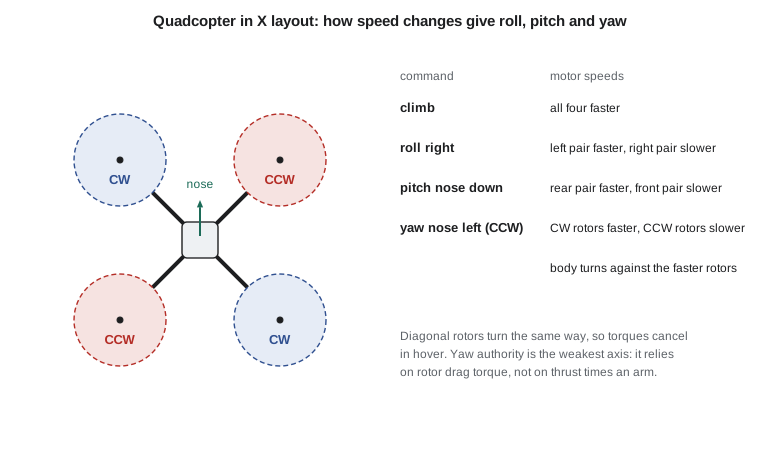
Yaw is the weakest axis. Roll and pitch moments come from thrust differences acting at the arm length, but yaw comes only from torque differences, which are smaller. A gust that yaws the vehicle can saturate the motors, and in strong wind a multirotor may lose heading control before it loses position. Hexacopters and octocopters have more yaw authority and some ability to continue after a motor failure: an octocopter can usually land after losing one motor, while a quadcopter cannot maintain controlled flight with three fixed-pitch rotors without giving up yaw control, and is normally lost. Some designs tilt each motor a few degrees so that part of its thrust contributes to yaw.
The scaling problem
Fixed-pitch rotors change thrust by changing speed, and the time to change speed depends on the rotor's rotational inertia compared with the motor torque. For geometrically similar rotors, inertia grows as the fifth power of diameter while the available motor torque grows more slowly, so control bandwidth falls quickly as the vehicle grows. A 0.25 m propeller on a racing drone changes speed in a few milliseconds; a 1.5 m rotor on a passenger-carrying vehicle takes a few tenths of a second, too slow for attitude control in gusts. Large multirotor and eVTOL designs therefore add variable-pitch rotors, tilting rotors, or control surfaces, or use many smaller rotors. This, more than anything else, is why the multirotor configuration dominates below about 25 kg and is rare above a few hundred.
Sizing from momentum theory
Arjun's quadcopter must carry a 1.0 kg camera, fly for at least 20 minutes and have enough control margin to hold position in a 12 m/s wind near a tower. Momentum theory gives the hover power per rotor; dividing by the figure of merit, then by motor and speed controller efficiencies, gives the electrical power drawn from the battery:
where \(N\) is the number of rotors, \(T_r\) and \(A_r\) the thrust and disk area of one rotor, \(E_{\text{batt}}\) the battery energy and \(f_u\) the fraction of it the operator plans to use. Small propellers have a figure of merit of about 0.55 to 0.65, motors 0.80 to 0.90, and speed controllers about 0.95.
# First-pass sizing of a quadcopter for close-range utility inspection.
import math
rho, g = 1.225, 9.81
m = 6.0                                    # take-off mass (kg), including a 1.0 kg camera payload
n_rot, D = 4, 0.381                        # four 15-inch propellers
FM, eta_m, eta_esc = 0.62, 0.85, 0.95      # rotor figure of merit, motor and speed-controller efficiencies
cells, V_cell = 6, 3.6                     # 6S lithium-ion or lithium-polymer pack
E_pack, usable = 432.0, 0.80               # pack energy (Wh) and the fraction we plan to use
TW = 2.0                                   # thrust-to-weight ratio for control margin and gusts
W = m * g; T_rot = W / n_rot
A = math.pi * (D / 2)**2
P_ideal = T_rot * math.sqrt(T_rot / (2 * rho * A))
P_shaft = P_ideal / FM
P_elec = n_rot * P_shaft / (eta_m * eta_esc)
V = cells * V_cell
print(f"Hover thrust per rotor {T_rot:.2f} N, disk loading {T_rot/A:.0f} N/m^2")
print(f"Ideal power per rotor {P_ideal:.1f} W, shaft power {P_shaft:.1f} W, battery power {P_elec:.0f} W")
print(f"Pack voltage {V:.1f} V, hover current {P_elec/V:.1f} A")
print(f"Hover endurance from {E_pack:.0f} Wh at {usable:.0%} usable: {E_pack*usable/P_elec*60:.1f} min")
print()
# propeller speed from a static thrust coefficient: T = C_T rho n^2 D^4, with n in rev/s
CT = 0.11
n_hover = math.sqrt(T_rot / (CT * rho * D**4))
n_max = math.sqrt(TW * T_rot / (CT * rho * D**4))
print(f"Propeller speed in hover {n_hover*60:.0f} rpm; at T/W = {TW:.1f}, {n_max*60:.0f} rpm")
# motor velocity constant: no-load speed per volt; allow about 20 % drop under load and battery sag
Kv = n_max * 60 / (0.80 * V * 0.90)
print(f"Required motor Kv about {Kv:.0f} rpm/V (choose the next standard size up)")
print(f"Maximum electrical power at T/W = 2 (power rises as thrust^1.5): {P_elec*TW**1.5:.0f} W, current {P_elec*TW**1.5/V:.0f} A")
print()
print("Endurance against take-off mass, battery fixed (heavier payload, same pack):")
for mm in (5.0, 6.0, 7.0, 8.0):
    Tr = mm * g / n_rot
    Pe = n_rot * Tr * math.sqrt(Tr / (2 * rho * A)) / FM / (eta_m * eta_esc)
    print(f"  {mm:3.1f} kg: {Pe:5.0f} W, {E_pack*usable/Pe*60:5.1f} min")
print()
print("Yaw comes from torque imbalance: speeding up the clockwise pair adds counter-clockwise reaction torque.")Hover thrust per rotor 14.71 N, disk loading 129 N/m^2 Ideal power per rotor 106.8 W, shaft power 172.3 W, battery power 853 W Pack voltage 21.6 V, hover current 39.5 A Hover endurance from 432 Wh at 80% usable: 24.3 min Propeller speed in hover 4319 rpm; at T/W = 2.0, 6108 rpm Required motor Kv about 393 rpm/V (choose the next standard size up) Maximum electrical power at T/W = 2 (power rises as thrust^1.5): 2414 W, current 112 A Endurance against take-off mass, battery fixed (heavier payload, same pack): 5.0 kg: 649 W, 31.9 min 6.0 kg: 853 W, 24.3 min 7.0 kg: 1075 W, 19.3 min 8.0 kg: 1314 W, 15.8 min Yaw comes from torque imbalance: speeding up the clockwise pair adds counter-clockwise reaction torque.
With four 15-inch (0.381 m) propellers the disk loading is 129 N/m². The ideal hover power is 107 W per rotor, the shaft power 172 W, and the four motors draw 853 W from the battery, about 40 A from a nominal 21.6 V pack. With a 432 Wh pack, planning to use 80 percent of it, the hover endurance is 24 minutes. Forward flight at moderate speed needs somewhat less power than hover, as lesson 4 showed for helicopters, but the body drag of a multirotor is large and its rotors are not designed for edgewise flight, so the saving is modest; practical mission endurance is close to the hover figure.
Propellers, motors and the Kv rating
A propeller's static thrust is usually written \(T = C_T\rho n^{2} D^{4}\), with \(n\) in revolutions per second; note that this \(C_T\) uses a different reference from the helicopter coefficient of lesson 2. For a typical two-blade drone propeller, \(C_T\) is about 0.10 to 0.12. The quadcopter needs 4300 rpm to hover and 6100 rpm to produce twice its hover thrust, the thrust-to-weight ratio of 2 that leaves margin for gusts, climbs and attitude control.
Brushless motors are rated by their velocity constant \(K_v\), the no-load speed per volt. Under load the speed is lower, and the battery voltage sags as current rises, so the code divides the required maximum speed by 80 percent of the nominal voltage and a further 0.9 for sag: a motor of about 390 rpm/V is needed. A lower-\(K_v\) motor gives more torque per ampere and suits large, slow propellers; a higher-\(K_v\) motor suits small, fast ones. The motor's torque constant, in newton meters per ampere, is roughly \(60/(2\pi K_v)\), so a 390 rpm/V motor gives about 0.024 N·m per ampere. At full thrust the four motors together draw about 2.4 kW and 112 A for short periods, which sets the current rating of the speed controllers, wiring and battery.
Teresa's thrust stand data for the commercial propeller show a static figure of merit of 0.60 at the hover thrust, slightly below the 0.62 Arjun assumed, and the motor efficiency peaks at 87 percent at about half throttle. The match is close enough to confirm the method; the endurance will be about 23 minutes rather than 24.
Mass, payload and endurance
The last block of the output shows the trap in drone design. Adding payload without adding battery raises the power as mass to the 1.5 power, and the endurance falls fast: from 32 minutes with no payload to 16 minutes at 8 kg. Adding battery instead also adds mass, so endurance rises more and more slowly as the battery grows, and at some point a bigger battery reduces endurance. A useful rule from the momentum equations is that hover endurance is roughly proportional to \(f_b/\sqrt{m}\) for a fixed rotor size, where \(f_b\) is the battery mass fraction. Commercial inspection quadcopters with 30 to 40 percent of their take-off mass in batteries achieve 25 to 45 minutes, and very few multirotors fly longer than an hour. That limit is why lesson 12's wildfire mapping aircraft will need a wing.
| Parameter | Typical range for small multirotors | Design effect |
|---|---|---|
| Disk loading | 80 to 250 N/m² | Lower saves power but needs larger, slower propellers |
| Propeller figure of merit | 0.50 to 0.65 | Low Reynolds number raises profile losses |
| Motor and controller efficiency | 0.75 to 0.85 combined | Best near half to two-thirds throttle |
| Battery mass fraction | 0.25 to 0.40 | Endurance rises with diminishing returns |
| Thrust-to-weight ratio | 1.8 to 2.5 | Control margin in gusts and climbs |
| Hover endurance | 20 to 45 min | Rarely above an hour |
Flight control and navigation
The flight controller runs nested loops. The innermost loop controls body angular rates using the gyroscopes; around it, an attitude loop uses an estimate of roll, pitch and yaw from all the inertial sensors, blended with a complementary or Kalman filter; around that, velocity and position loops use satellite navigation and the barometer. The pilot usually commands velocity, not attitude: releasing the sticks makes the drone stop and hold position. Autonomous missions follow waypoints. Near large steel structures such as transmission towers, the magnetometer can be disturbed and satellite signals reflected, so inspection drones often add visual odometry from downward cameras, obstacle-detecting sensors, and real-time kinematic satellite positioning for centimeter-level accuracy. Lesson 10 discusses autonomy and failure handling in more depth.
Safety features
Because a multirotor falls if its power or control fails, safety depends on monitoring and on predictable failure behavior. The flight controller monitors battery voltage and estimated remaining energy and returns home automatically when the reserve needed to get back reaches a threshold. Loss of the command and control link triggers a preset behavior, usually hover for a few seconds, then return and land. Geofences stop the vehicle entering defined areas. Propeller guards protect people and the vehicle near structures. Parachutes, deployed automatically when the controller detects an unrecoverable attitude or a motor failure, reduce impact energy for operations near people, and some rules, lesson 11 shows, give credit for them.
Worked problem
Endurance with a heavier camera
a regional power cooperative asks whether the quadcopter could carry a 2.0 kg lidar instead of the 1.0 kg camera, with the same 432 Wh battery. Estimate the hover endurance.
Show solution
- Take-off mass 7.0 kg. Power scales as mass to the 1.5 power.
- \(P = 853 \times (7/6)^{1.5} = 853 \times 1.260 = 1075\ \mathrm{W}\).
- \(t = 0.8 \times 432/1075 \times 60 = 19.3\ \mathrm{min}\).
Answer: About 19 minutes, as the code's table shows; marginal for the 20-minute requirement.
Worked problem
Motor Kv for a larger propeller
Arjun considers 18-inch (0.457 m) propellers with the same \(C_T = 0.11\). What hover speed and maximum speed do they need, and what Kv?
Show solution
- \(n_{\text{hover}} = \sqrt{T_r/(C_T\rho D^{4})} = \sqrt{14.71/(0.11 \times 1.225 \times 0.0437)} = 50.0\ \mathrm{rev/s} = 3000\ \mathrm{rpm}\).
- At twice the thrust: \(3000\sqrt{2} = 4240\ \mathrm{rpm}\).
- \(K_v = 4240/(0.8 \times 21.6 \times 0.9) = 273\ \mathrm{rpm/V}\).
Answer: About 3000 rpm in hover, 4240 rpm maximum, and a motor of about 270 to 280 rpm/V. Lower disk loading saves about 17 percent of hover power, at the cost of a larger, heavier airframe.
Worked problem
Yaw authority
Each motor's reaction torque in hover is \(Q = P_{\text{shaft}}/\Omega\). With 172 W at 4319 rpm, what is the hover torque per rotor, and what yaw moment is available if the clockwise pair can rise to 140 percent of hover torque while the other pair falls to 60 percent?
Show solution
- \(\Omega = 4319 \times 2\pi/60 = 452\ \mathrm{rad/s}\); \(Q = 172/452 = 0.38\ \mathrm{N\,m}\).
- Net yaw moment: \(2 \times (1.4 - 0.6) \times 0.38 = 0.61\ \mathrm{N\,m}\).
- For comparison, a 2 N thrust difference at a 0.3 m arm gives 0.6 N·m of roll moment, from a small fraction of the thrust range.
Answer: About 0.6 N·m of yaw moment using most of the available motor range, which is why yaw saturates first.
Common mistakes
MistakeA quadcopter can keep flying normally after one motor fails.
InsteadWith fixed-pitch rotors it loses yaw control and usually cannot hold attitude; hexacopters and octocopters have more redundancy.
MistakeA bigger battery always means longer flight.
InsteadBattery mass raises hover power as mass to the 1.5 power, so endurance gains shrink and can reverse.
MistakeMultirotors fly efficiently in forward flight like helicopters.
InsteadTheir body drag and edgewise propellers limit the saving; endurance stays close to hover endurance.
MistakeKv is a measure of motor power.
InsteadKv is speed per volt; power depends on the current and voltage the motor can sustain thermally.
Summary and key terms
- A multirotor uses fixed-pitch propellers on brushless motors and controls itself entirely by motor speed: collective thrust for height, thrust differences for roll and pitch, and torque differences for yaw, which is the weakest axis.
- Speed-based control slows as rotors grow, which limits the configuration to small vehicles.
- Momentum theory, the propeller figure of merit and the motor and controller efficiencies give the electrical hover power; endurance is usable battery energy divided by that power.
- Propeller speed follows from the thrust coefficient, and the motor Kv from that speed and the battery voltage.
- Payload and battery mass both raise power as mass to the 1.5 power, so endurance rarely exceeds 45 minutes.
- Flight controllers run nested rate, attitude, velocity and position loops, with automatic responses to low battery and lost links.
- Brushless motor
- An electronically commutated motor with permanent magnets on the rotor.
- Electronic speed controller
- Power electronics that drive a brushless motor from a DC battery.
- Mixing matrix
- The relation that converts thrust, roll, pitch and yaw commands into individual motor commands.
- Kv
- A motor velocity constant: no-load speed per volt.
- Thrust-to-weight ratio
- Maximum available thrust divided by weight; a measure of control margin.
- Battery mass fraction
- Battery mass divided by take-off mass.
- Return-to-home
- Automatic flight back to the launch point when battery or link thresholds are reached.
Practice problems
Work each problem on paper first, then reveal the answer to check.
How many rotors turn clockwise on an X-layout quadcopter?
Show answer
Two, on one diagonal; the other diagonal turns counter-clockwise.
By what factor does hover power change if the take-off mass rises by 20 percent with the same rotors?
Show answer
\(1.2^{1.5} = 1.31\).
Why does a quadcopter's yaw control saturate before its roll control?
Show answer
Yaw relies on reaction torques, which are small compared with thrust differences acting at the arm length.
What is the torque constant of a 390 rpm/V motor?
Show answer
About \(60/(2\pi \times 390) = 0.024\ \mathrm{N\,m/A}\).
Why do large multirotors and eVTOLs often use variable pitch or tilting rotors?
Show answer
Large fixed-pitch rotors change speed too slowly for attitude control.
Lesson quiz · 5 questions
Score 60% or more to complete this lesson.
Create a free account to save your progress, take quizzes and earn a certificate.