
AERO-450 · Lesson 12 of 12 · 29 min
Design project: a small UAS
Six months after the Vertical Flight group formed, it holds the conceptual design review for the wildfire mapping and inspection aircraft, which the team has named Larkspur. Representatives of the state forest service and a regional power cooperative attend, along with Rachel Oduya for regulation, Teresa Nakamura for propulsion, Marcus Webb for structures, Hélène Lavoie for manufacturing and Sam Littlechild, who will fly it. Arjun presents. This lesson follows the design from requirements to a selected concept, using the methods of the whole course, and ends with the plan for the next phase. It is also the template for the course's own design project.
Requirements
Good requirements are specific, measurable and traceable to a need. The team turned the customers' wishes into the following set, agreeing which are firm and which are goals. The wildfire mission drives most of them: mapping a fire perimeter at night with thermal imagery, from launch sites that may be a gravel road or a small clearing, and sending images to the incident team within minutes. The inspection mission adds hovering close to towers and lines.
| Requirement | Value | Source and notes |
|---|---|---|
| Payload | 1.5 kg: stabilized gimbal with thermal and visible cameras | Firm; both customers |
| Endurance | At least 60 min wing-borne, plus 2 min of vertical flight, at end-of-life battery | Firm; covers a 10 km² perimeter per sortie |
| Launch and recovery | Vertical, from a 10 m clearing; no runway, catapult or net | Firm; forest roads and clearings |
| Mass | Below 55 lb (25 kg) take-off mass | Firm; stays in the small-drone rules and simplifies handling |
| Cruise speed | 20 to 25 m/s, holding ground track in a 12 m/s wind | Firm; mapping overlap and wind |
| Operating temperature | −20 °C to +40 °C | Firm; winter inspection, summer fires |
| Data link | Command link 25 km; image downlink to incident team | Firm; BVLOS operation |
| Safety | Parachute; independent geofence and flight termination; ADS-B In | Firm; ground and air risk mitigation |
| Inspection hover | 10 min hover near a structure in 10 m/s wind | Goal; may need a separate multirotor |
| Cost | Under the price of two commercial mapping drones | Goal |
Two requirements pull against each other: the inspection hover favors a multirotor, while the 60-minute mapping endurance favors a wing. The group decided early that the firm requirements come from the wildfire mission and that inspection hover is a goal. If no single concept meets both, a regional power cooperative can use a commercial quadcopter for close inspection, as lesson 7 showed is practical, and Larkspur for long line patrols.
Concepts
The team considered five concepts. A conventional fixed-wing aircraft has the best endurance but needs a runway or launcher and recovery system; it failed the launch requirement. A hexacopter, the multirotor with useful redundancy, meets the launch and hover requirements easily. A quadplane, a lift-plus-cruise layout with four lift rotors on two booms, a pusher propeller and a wing, hovers for take-off and landing and cruises on the wing. A tail-sitter, which takes off pointing up and pitches over to fly on its wing, saves the mass of separate lift rotors but is hard to handle in gusty wind during the transitions and lands nose-up on rough ground. A tiltrotor uses the same motors for both phases but adds tilt mechanisms and complex transition control. After a qualitative screening against the requirements, the hexacopter and the quadplane went forward to quantitative sizing.
Sizing method
Small aircraft sizing works with mass fractions. The take-off mass is the sum of the payload, the avionics and systems (flight controller, radios, satellite receiver, ADS-B receiver, parachute), the propulsion system (motors, speed controllers, propellers), the structure and the battery. Writing the structure and battery as fractions of take-off mass, and the propulsion mass as a function of the installed power, which itself depends on the take-off mass, gives a fixed-point equation:
Iterating from a guess converges in a few steps. For the hexacopter, hover power from momentum theory sets the motor size for a thrust-to-weight ratio of 2, and forward flight at mapping speed needs about 95 percent of hover power, because the body and payload drag cancel most of the induced power relief at these modest speeds. For the quadplane, the lift motors are sized for a thrust-to-weight ratio of 1.6, enough for vertical flight in gusts, while cruise power comes from the wing: the wing area follows from a chosen wing loading, the lift coefficient from the cruise speed, and the drag coefficient from a parasite term, which includes the drag of the stopped lift rotors and booms, plus the induced drag of the wing. The endurance is the usable battery energy, after the quadplane's two minutes of vertical flight, divided by the cruise power.
# Larkspur concept trade: hexacopter against quadplane (lift rotors plus a pusher and a wing).
import math
rho, g = 1.225, 9.81
m_pay, m_avi = 1.5, 1.2                     # payload (RGB + thermal gimbal) and avionics, radios, parachute (kg)
e_spec, usable = 220.0, 0.80                # pack Wh/kg and usable fraction
eta = 0.85 * 0.95                           # motor x speed controller
def size(kind, f_batt):
    """Fixed-point sizing: take-off mass from fixed masses and mass fractions; return mass, span, endurance."""
    m = 10.0
    for _ in range(100):
        if kind == "hexacopter":
            f_struct, n, D = 0.24, 6, 0.53
            A = n * math.pi * (D / 2)**2
            P_h = m * g * math.sqrt(m * g / (2 * rho * A)) / 0.60 / eta
            P_cr = 0.95 * P_h                # forward flight at 12 m/s saves little: body drag offsets the induced-power relief
            m_prop = 0.20 * P_h * 2.0 / 1000 + 0.05 * n   # motors sized for T/W 2: 0.20 kg per kW, plus props
            span = None
        else:
            f_struct, n, D = 0.30, 4, 0.46
            A = n * math.pi * (D / 2)**2
            P_h = m * g * math.sqrt(m * g / (2 * rho * A)) / 0.60 / eta
            W_S = 160.0                      # wing loading (N/m^2)
            S = m * g / W_S; AR = 11.0; span = math.sqrt(AR * S)
            V = 22.0                         # mapping speed (m/s)
            CL = m * g / (0.5 * rho * V**2 * S)
            CD = 0.045 + CL**2 / (math.pi * 0.75 * AR)      # includes drag of the stopped lift rotors and booms
            P_cr = 0.5 * rho * V**3 * S * CD / 0.70 / eta
            m_prop = 0.20 * P_h * 1.6 / 1000 + 0.05 * n + 0.35    # lift motors (T/W 1.6) plus pusher system
        m_new = (m_pay + m_avi + m_prop) / (1 - f_struct - f_batt)
        if abs(m_new - m) < 1e-6: break
        m = m_new
    E = f_batt * m * e_spec * usable
    t_hover = 2.0 / 60 if kind == "quadplane" else 0.0     # two minutes of vertical flight per sortie
    t = (E - P_h * t_hover) / P_cr if kind == "quadplane" else E / P_cr
    return m, span, P_h, P_cr, t * 60
print(f"{'concept':11s} {'f_batt':>6s} {'mass kg':>8s} {'span m':>7s} {'hover W':>8s} {'cruise W':>9s} {'endur. min':>10s}")
for kind in ("hexacopter", "quadplane"):
    for fb in (0.25, 0.30, 0.35, 0.40):
        m, span, Ph, Pc, t = size(kind, fb)
        sp = f"{span:7.2f}" if span else "     --"
        print(f"{kind:11s} {fb:6.2f} {m:8.2f} {sp} {Ph:8.0f} {Pc:9.0f} {t:10.1f}")
print()
m, span, Ph, Pc, t = size("quadplane", 0.35)
print(f"Selected: quadplane, battery fraction 0.35 -> {m:.1f} kg ({m*2.2046:.0f} lb), span {span:.2f} m, {t:.0f} min")
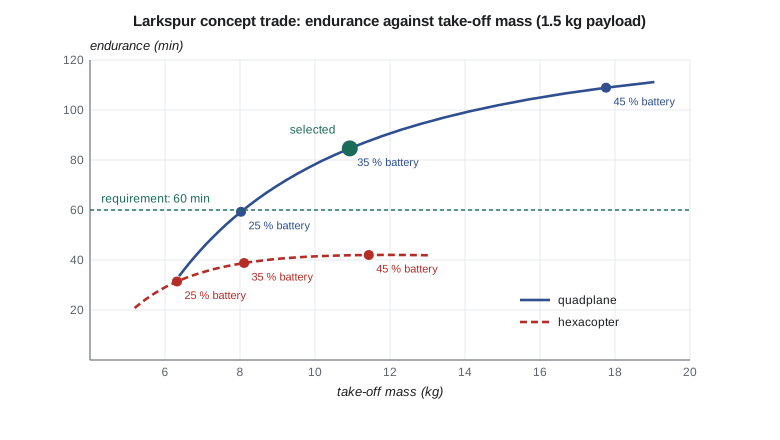
print(f"Area mapped per sortie at 22 m/s with a 160 m swath and 20 % turns: {22*t*60*0.8*160/1e6:.1f} km^2")concept f_batt mass kg span m hover W cruise W endur. min hexacopter 0.25 6.32 -- 560 532 31.4 hexacopter 0.30 7.10 -- 666 633 35.5 hexacopter 0.35 8.11 -- 813 773 38.8 hexacopter 0.40 9.47 -- 1027 976 41.0 quadplane 0.25 8.03 2.33 1130 319 59.3 quadplane 0.30 9.24 2.50 1396 368 72.0 quadplane 0.35 10.93 2.71 1795 435 84.6 quadplane 0.40 13.45 3.01 2450 535 97.0 Selected: quadplane, battery fraction 0.35 -> 10.9 kg (24 lb), span 2.71 m, 85 min Area mapped per sortie at 22 m/s with a 160 m swath and 20 % turns: 14.3 km^2
The trade
The results are decisive. The hexacopter's endurance rises from 31 minutes at a 25 percent battery fraction to only 41 minutes at 40 percent, and the curve is already flattening: each extra kilogram of battery needs more power to lift. No reasonable hexacopter meets the 60-minute requirement. The quadplane's cruise power is a quarter of its hover power, so it reaches 59 minutes at 25 percent battery and 85 minutes at 35 percent. The team selected the quadplane at a 35 percent battery fraction: 10.9 kg take-off mass, a 2.7 m span, 85 minutes of endurance on a new battery and comfortably over 60 minutes at end of life, when capacity has fallen to about 80 percent and cold weather has taken more. At 22 m/s with a 160 m wide image swath and 20 percent of the time spent turning, one sortie covers about 14 km².
The quadplane's weakness is its hover power: 1.8 kW against 0.8 kW for the hexacopter at the same battery fraction, because its four lift rotors are smaller and more heavily loaded. That makes its battery work hard during the two vertical phases, at about 2C against 0.5C in cruise, which matters in the cold. It also means that long hovers near towers, the inspection goal, would use energy quickly. The team accepts this: two minutes of vertical flight per sortie is a small share of the energy, and the inspection goal will be met by a short hover capability plus close passes on the wing, with the commercial quadcopter for detailed tower work.
Checking the selected design
A concept is only credible when its key numbers survive cross-checks against the earlier lessons. The team ran five.
Disk loading and hover: four 0.46 m rotors give 0.665 m² of disk; at 10.9 kg the disk loading is 161 N/m² and the induced velocity 8.1 m/s, giving an ideal hover power of 0.87 kW. With a figure of merit of 0.6 and drive efficiency of 0.81, the battery must supply 1.8 kW, matching the sizing code. Rotor speed for full thrust and motor Kv follow from lesson 7. The vortex ring band for vertical descent, from lesson 2, is about 2.4 to 12 m/s, so the flight controller limits vertical descent to 2 m/s below 30 m.
Battery: at 35 percent of 10.9 kg, the pack weighs 3.8 kg and stores about 840 Wh at 220 Wh/kg. A 12S configuration at about 44 V keeps the hover current near 41 A, about 2C for a pack of about 19 Ah. Lesson 8's cold-soak numbers say a pack started at −20 °C loses about a third of its usable energy and sags badly, so the pack has heaters powered from ground supply before launch and is insulated in flight.
Wing: the wing loading of 160 N/m² gives an area of 0.67 m² and, with an aspect ratio of 11, a span of 2.7 m and a mean chord of 0.25 m. The cruise lift coefficient at 22 m/s is 0.54, comfortably below stall, and the stall speed with a maximum lift coefficient of 1.3 is about 14 m/s. The Reynolds number based on chord is about 370 000, where airfoils designed for small uncrewed aircraft perform well.
Wind: a 12 m/s wind is 55 percent of the cruise speed, so flying crosswind the aircraft crabs at about 33 degrees and its ground speed downwind and upwind varies from 34 to 10 m/s. The mapping pattern is planned with lines across the wind where possible, and the endurance figure is derated by about 15 percent for windy days. In the vertical phases, the thrust-to-weight ratio of 1.6 leaves 60 percent of hover thrust in reserve for control in gusts.
Safety: the parachute weighs about 0.4 kg and, as lesson 11 showed, reduces impact energy by a factor of about 19. The independent geofence and flight termination unit, the ADS-B receiver and a strobe for night visibility are included in the 1.2 kg avionics budget. With these, the simplified SORA screen gave SAIL II for forest mapping.
Regulatory path and safety case
For US drone rules, Larkspur at 10.9 kg (24 lb) is a small UAS under Part 107. Wildfire mapping beyond visual line of sight needs a waiver under 107.205 while Part 108 remains unpublished. Because the state forest service is a public agency, its flights could also be conducted as public aircraft operations under a certificate of waiver or authorization, which is a common route for public-safety drones. Rachel will prepare the waiver application and safety case, including the detect and avoid concept, and will track Part 108; if it is adopted close to the proposal, a permit for the operation may replace the waiver. Within the fire's temporary flight restriction, the aircraft flies only under the incident's aviation plan.
The safety case brings the course together. It argues that the risk to people on the ground is acceptable because the operations are over sparsely populated land, the aircraft carries a parachute and an independent flight termination system, and its failure modes have been analyzed with defined contingencies; and that the risk to other aircraft is acceptable because flights are planned with the fire's air operations, stay below crewed traffic, broadcast or are tracked where possible, and descend quickly when an intruder is detected. Each claim must be supported by evidence: analysis, ground and flight tests, and the design and maintenance records of the aircraft.
Development plan
The conceptual design review closes with a plan. In the next three months, preliminary design will refine the mass estimate with real components, design the wing and booms, select the motors, propellers, speed controllers and cells, and model transitions in simulation. Marcus will run a structural analysis of the boom and wing joint, which carries the lift rotors' loads in hover and the wing bending in cruise. Hélène will plan a composite build of three prototypes. Teresa will run the battery and motor bench tests, including cold-chamber tests of the heated pack. Ground tests will verify thrust, endurance on a tether and the parachute deployment. Flight tests will begin with hover, move to transitions at altitude over a test range, and then to endurance and mapping trials. Each stage has success criteria traced to the requirements table, and each failure in test feeds back into the design.
| Phase | Main outputs | Lessons used |
|---|---|---|
| Requirements | Agreed requirements, success criteria | 1, 11 |
| Concept selection | Mass, power and endurance trade; selected quadplane | 2, 7, 8, 12 |
| Preliminary design | Component choices, wing and boom design, transition simulation | 3, 4, 5, 9 |
| Detailed design | Drawings, software, contingency logic, maintenance plan | 5, 8, 10 |
| Test | Bench, tether, transition, endurance and mapping trials | 2, 6, 8, 10 |
| Approval | Declaration or waiver, operations manual, safety case | 10, 11 |
Your design project
The course project asks you to repeat this process for a small uncrewed aircraft of your own choice, for a civil mission such as crop scouting, search and rescue support, bridge inspection or medical sample delivery. Write requirements with numbers and sources; screen at least three configurations; size at least two quantitatively with code like this lesson's, using momentum theory for hover, a power or drag model for forward flight, and a battery model with credible usable energy; check disk loading, battery C-rate, wing loading and stall speed of the selected design; identify the regulatory path in your country and the main hazards with their mitigations; and present a development and test plan. Present your results with the uncertainties stated: an endurance quoted as 85 minutes on a new battery at 20 °C is a different claim from 60 minutes at end of life in the cold.
Worked problem
Mapping time for a fire perimeter
A fire perimeter of 40 km must be mapped as a 1 km wide band. How many Larkspur sorties are needed if each covers 14 km² in the air?
Show solution
- Area: \(40 \times 1 = 40\ \mathrm{km^2}\).
- Sorties: \(40/14 = 2.9\), so three.
Answer: Three sorties, about four and a half hours including battery changes; two aircraft working together would map it in under two and a half.
Worked problem
Battery current in hover
Larkspur's pack is 12S at 3.6 V nominal per cell, 840 Wh. Find the pack voltage, the capacity in ampere-hours, and the hover current and C-rate at 1.8 kW.
Show solution
- Voltage \(12 \times 3.6 = 43.2\ \mathrm{V}\); capacity \(840/43.2 = 19.4\ \mathrm{Ah}\).
- Current \(1800/43.2 = 41.7\ \mathrm{A}\), ignoring sag.
- C-rate \(41.7/19.4 = 2.1\mathrm{C}\).
Answer: 43.2 V, 19.4 Ah, about 42 A and 2.1C in hover; the cruise current is only about 10 A.
Worked problem
Stall speed
Find Larkspur's stall speed at 10.9 kg with a wing area of 0.67 m² and a maximum lift coefficient of 1.3.
Show solution
- \(V_s = \sqrt{2W/(\rho S C_{L,\max})} = \sqrt{2 \times 106.9/(1.225 \times 0.67 \times 1.3)}\).
- \(= \sqrt{213.8/1.067} = \sqrt{200.4} = 14.2\ \mathrm{m/s}\).
Answer: About 14 m/s; cruise at 22 m/s is 1.55 times the stall speed, a comfortable margin for turbulence near fires.
Common mistakes
MistakeThe concept with the best performance number should always be chosen.
InsteadSelection weighs all requirements, risk, cost and maturity; a tail-sitter might score well on mass but poorly on handling and landing.
MistakeEndurance on a new battery at room temperature is the design value.
InsteadRequirements should be met at end of life and at the worst operating temperature.
MistakeA quadplane's hover power is similar to a multirotor's.
InsteadIts lift rotors are smaller and more heavily loaded, so hover costs more; it wins by hovering briefly.
MistakeRegulatory approval can be sought after the design is finished.
InsteadThe regulatory path shapes the design, from mass limits to parachutes and detect and avoid, and must be planned from the start.
Summary and key terms
- A design starts with specific, measurable requirements traced to needs, separating firm requirements from goals.
- Concepts are screened qualitatively, then the promising ones sized quantitatively.
- Mass-fraction sizing solves a fixed-point equation for take-off mass from payload, avionics, propulsion that scales with power, and structure and battery fractions.
- For Larkspur, a hexacopter could not reach 60 minutes, while a quadplane reached 85 minutes at 10.9 kg and a 35 percent battery fraction.
- The selected design was checked for disk loading, battery C-rate and cold performance, wing loading and stall speed, wind, and safety features.
- The regulatory path and safety case are planned from the start.
- Development proceeds through preliminary and detailed design, bench, tether and flight tests, and approval.
- Requirement
- A specific, measurable statement of what the design must do, with its source.
- Concept screening
- Qualitative comparison of concepts against requirements before detailed analysis.
- Mass fraction
- A component mass divided by take-off mass.
- Fixed-point sizing
- Iterating a mass estimate until the masses that depend on it stop changing.
- Quadplane
- A lift-plus-cruise aircraft with four lift rotors, a cruise propeller and a wing.
- Tail-sitter
- An aircraft that takes off and lands on its tail and pitches over to fly on its wing.
- Safety case
- A structured argument, supported by evidence, that an operation is acceptably safe.
Practice problems
Work each problem on paper first, then reveal the answer to check.
Why did the hexacopter fail the endurance requirement?
Show answer
Its cruise power is close to hover power, so endurance flattens near 40 minutes as battery mass grows.
What is Larkspur's disk loading?
Show answer
About 161 N/m²: 106.9 N over 0.665 m².
Why is the endurance requirement stated at end of life?
Show answer
Battery capacity falls with age; the aircraft must still meet the mission after a year of use.
What is the crab angle in a 12 m/s crosswind at 22 m/s airspeed?
Show answer
\(\arcsin(12/22) = 33^{\circ}\).
Name two items in Larkspur's avionics budget that serve safety.
Show answer
The parachute, the independent geofence and termination unit, the ADS-B receiver and the strobe light.
Lesson quiz · 5 questions
Score 60% or more to complete this lesson.
Create a free account to save your progress, take quizzes and earn a certificate.