
AERO-450 · Lesson 1 of 12 · 29 min
Rotorcraft configurations
Prairiewind Aerospace has always built fixed-wing aircraft. That changed this winter, when Kenji Watanabe signed two contracts on the same day. The first is an engineering support agreement with Bluestem Air Medical, which flies light twin-engine helicopters as air ambulances from a base in Wichita. The operator wants performance studies for hot-day hospital helipads, help with a vibration monitoring program, and an independent look at whether electric vertical take-off aircraft could one day carry some of its patient transfers. The second contract is smaller and stranger: the state forest service and a regional power cooperative want a small uncrewed aircraft that can map wildfire perimeters at night and inspect transmission lines, and Prairiewind Aerospace has agreed to design one. Kenji formed a Vertical Flight group to do both jobs and asked Élise Fournier to lead it. Arjun Mehta, still an engineer in training, was the first person she recruited.
Élise starts Arjun with a question that sounds simple: why does a helicopter look the way it does, and why do drones and electric air taxis look so different? The answer runs through the whole course. Every vertical-lift aircraft must push air downward to hold itself up, every rotor produces torque that must be balanced, and every design must get from hover to forward flight. The way a configuration handles those three problems defines it.
Why lift vertically?
A fixed-wing aircraft gets lift by moving a large wing through the air at speed, so it needs a runway. A rotorcraft spins its wings instead: a rotor is a set of blades, each a small wing, sweeping a disk. The blades move fast even when the aircraft is still, so the aircraft can hover, take off and land vertically, and fly sideways and backward. That ability is why helicopters do work no airplane can: hospital rooftop landings, hoist rescues, offshore crew changes, power line construction, firefighting with buckets, and logging. It comes at a price. To hover, a rotor must accelerate a column of air downward continuously, and the power that takes depends strongly on how big the rotor is compared with the weight it carries. Hovering is therefore expensive, forward flight is limited by the rotor itself, and the machinery that controls a rotor is complex.
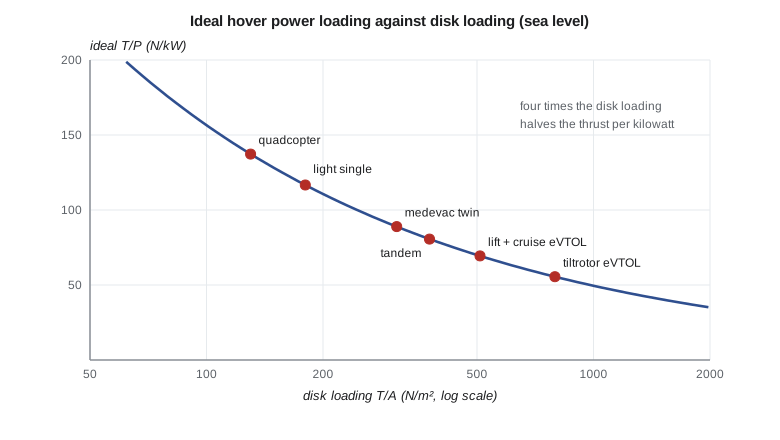
The quantity that captures the trade is the disk loading, the thrust divided by the area swept by the rotors. Momentum theory, the subject of lesson 2, shows that the ideal power needed to hover is
where \(T\) is the thrust, \(A\) the disk area, \(\rho\) the air density and \(v_i\) the induced velocity, the speed at which the rotor pushes air through its disk. The second form is the ideal power loading, thrust per unit power. It falls as the square root of disk loading: four times the disk loading halves the thrust you get per kilowatt. Large, lightly loaded rotors are efficient in hover; small, heavily loaded rotors are not, but they are compact and suit fast cruise.
# Disk loading sets the price of hovering. Ideal (momentum theory) hover power: P = T * sqrt(T / (2 rho A)).
import math
rho, g = 1.225, 9.81                     # sea-level standard air (kg/m^3), gravity (m/s^2)
# name, mass (kg), number of lifting rotors, rotor radius (m); representative civil examples, not specific types
craft = [("Small inspection quadcopter",      6.0,   4, 0.19),
         ("Light single helicopter",       1500.0,   1, 5.1),
         ("Medevac light twin",            3000.0,   1, 5.5),
         ("Heavy-lift tandem helicopter", 20000.0,   2, 9.1),
         ("Lift+cruise eVTOL (6 rotors)",  2200.0,   6, 1.5),
         ("Tiltrotor eVTOL (6 rotors)",    2200.0,   6, 1.2),
         ("Civil tiltrotor (2 rotors)",    8000.0,   2, 4.0)]
print(f"{'configuration':30s} {'DL N/m^2':>9s} {'v_i m/s':>8s} {'P_ideal kW':>11s} {'PL N/kW':>8s}")
for name, m, n, R in craft:
    T = m * g; A = n * math.pi * R**2
    DL = T / A                               # disk loading
    vi = math.sqrt(DL / (2 * rho))           # induced velocity at the disk
    P = T * vi                               # ideal induced power for the whole vehicle
    print(f"{name:30s} {DL:9.0f} {vi:8.1f} {P/1000:11.1f} {T/(P/1000):8.0f}")
print()
print("Ideal power loading T/P = sqrt(2 rho / DL): halving power loading needs four times the disk loading")
for DL in (100, 400, 1600, 6400):
print(f" DL = {DL:5d} N/m^2: T/P = {math.sqrt(2*rho/DL)*1000:6.1f} N/kW, downwash far below = {2*math.sqrt(DL/(2*rho)):5.1f} m/s")configuration DL N/m^2 v_i m/s P_ideal kW PL N/kW Small inspection quadcopter 130 7.3 0.4 137 Light single helicopter 180 8.6 126.2 117 Medevac light twin 310 11.2 330.9 89 Heavy-lift tandem helicopter 377 12.4 2434.1 81 Lift+cruise eVTOL (6 rotors) 509 14.4 311.0 69 Tiltrotor eVTOL (6 rotors) 795 18.0 388.8 56 Civil tiltrotor (2 rotors) 781 17.9 1400.9 56 Ideal power loading T/P = sqrt(2 rho / DL): halving power loading needs four times the disk loading DL = 100 N/m^2: T/P = 156.5 N/kW, downwash far below = 12.8 m/s DL = 400 N/m^2: T/P = 78.3 N/kW, downwash far below = 25.6 m/s DL = 1600 N/m^2: T/P = 39.1 N/kW, downwash far below = 51.1 m/s DL = 6400 N/m^2: T/P = 19.6 N/kW, downwash far below = 102.2 m/s
The table puts the main families on one scale. A small inspection quadcopter and a light single-engine helicopter have disk loadings near 130 to 180 N/m² and lift more than 110 N for every kilowatt of ideal power. The medevac light twin that Bluestem Air Medical operates, which this course uses as its reference helicopter, sits at about 310 N/m². Electric air taxis with six small rotors sit at 500 to 800 N/m² and get only half the hover efficiency of a helicopter, which matters a great deal when every kilowatt-hour comes from a battery. The last block of output also shows the downwash: the air leaving the rotor far below moves at twice the induced velocity, over 25 m/s at a disk loading of 400 N/m². That wind blows dust, snow and loose objects across a landing site, and it is one reason why heliport design rules care about disk loading.
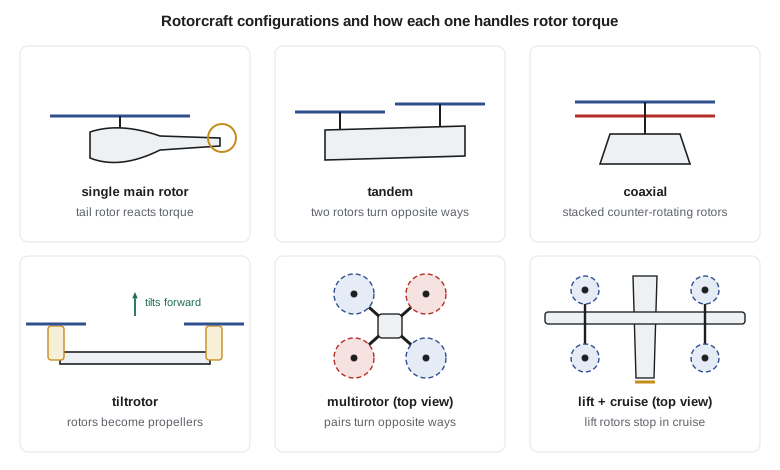
The single main rotor helicopter
Most helicopters ever built, including the Bluestem Air Medical light twins, have one large main rotor and a small tail rotor. The main rotor is driven through a gearbox by one or two turboshaft engines. Because the engines turn the rotor, the rotor turns the fuselage the other way; without a counter-torque device, the cabin would spin. The tail rotor pushes sideways at the end of a long boom to cancel this torque, and the pilot adjusts its thrust with pedals to point the nose. The arrangement is mechanically simple compared with the alternatives, gives good yaw control and allows a big, efficient main rotor. Its costs are that the tail rotor consumes roughly 8 to 12 percent of the power in hover, the spinning tail rotor is a hazard to people on the ground, and a failure of the tail rotor drive is one of the most serious emergencies a helicopter pilot can face.
Designers have found variants. A fenestron, or fan-in-fin, encloses a multi-bladed fan in a duct in the tail. It is quieter, safer near people and protected from strikes, which is why it is common on medical and police helicopters. The NOTAR system, used on some light helicopters, blows low-pressure air out of slots along the tail boom so that the main rotor downwash curves around the boom and produces a sideways force (the Coandă effect), with a rotating direct-jet thruster at the end for yaw control. Each solves the same problem with a different balance of weight, noise, power and safety.
Twin-rotor helicopters
A second way to cancel torque is to use two main rotors turning in opposite directions. In a tandem helicopter, one rotor is at the front and one at the back, often overlapping. All the power goes into lift, and the long cabin tolerates a wide range of center of gravity positions, which suits heavy-lift work such as logging and construction. Yaw is controlled by tilting the two rotors in opposite directions sideways. In a coaxial helicopter, two rotors are stacked on one mast and turn in opposite directions. The aircraft is compact, needs no tail rotor, and in forward flight the two rotors balance each other's lift asymmetry. The cost is a tall, complex mast and some loss of efficiency because the lower rotor works in the wake of the upper one. Intermeshing rotors, side by side on mast heads tilted outward so the blades pass between each other, are a third variant, used for external-load work where the pilot needs a good downward view.
Getting faster: compounds and tiltrotors
A conventional helicopter is limited to about 150 to 170 knots, for reasons lesson 4 explains. In forward flight, the blade moving forward (the advancing blade) sees the flight speed added to its rotational speed, and the blade moving backward (the retreating blade) sees it subtracted. At high speed the retreating blade stalls and the advancing tip approaches the speed of sound. Two families of aircraft get around this by taking work away from the rotor at speed.
A compound helicopter adds a wing, a propeller, or both. The wing carries part of the weight so the rotor can be slowed or unloaded, and the propeller provides thrust so the rotor no longer has to tilt forward to pull the aircraft along. Coaxial compounds with a pusher propeller have flown well above 200 knots in test programs. A tiltrotor goes further: it has a wing and two large rotors on nacelles at the wingtips. The rotors point up for hover and tilt forward to become propellers for cruise, while the wing carries the weight. A tiltrotor cruises at turboprop speeds, but it pays twice: its rotors are smaller than a helicopter's for the same weight, so it hovers less efficiently, and its rotors must work both as lifting rotors and as propellers, so the blade twist and size are a compromise. The civil tiltrotor in the code output has a disk loading near 780 N/m², two and a half times the medevac helicopter's.
Multirotors and electric aircraft
Small drones changed the picture because electric motors behave differently from turbine engines. A turbine is efficient only when large, and connecting one engine to several rotors needs heavy gearboxes and shafts. An electric motor is efficient at almost any size, responds in milliseconds, and needs only wires to connect it to the battery. A quadcopter therefore uses four fixed-pitch propellers on four motors and controls itself by changing their speeds. Diagonal pairs turn the same way so that the torques cancel in hover. Speeding up one pair and slowing the other yaws the aircraft; changing front and rear speeds pitches it; changing left and right speeds rolls it. There is no swashplate, no cyclic pitch and no gearbox, so the vehicle is cheap and robust, and a flight controller does the work a helicopter pilot does with three controls. Lesson 7 studies the multirotor in detail, including its main weakness: fixed-pitch propellers change thrust by changing speed, which becomes slow as the propellers grow, so the configuration does not scale well beyond a few hundred kilograms.
Electric vertical take-off and landing aircraft, eVTOLs, apply the same idea at human scale. Some use many small rotors because distributed electric propulsion gives redundancy: losing one motor of eight is survivable. A lift-plus-cruise design has separate rotors for hover, which stop and are stowed edgewise in cruise, plus a propeller and a wing for forward flight. A vectored-thrust or tilting design swivels some or all of its rotors so that the same motors give lift in hover and thrust in cruise. Lesson 9 compares them. Both families accept a disk loading of 500 to 800 N/m² to keep the aircraft compact enough for a city heliport, which makes the hover segments of each flight expensive in battery energy.
| Configuration | Torque balance | Strengths | Weaknesses | Typical civil roles |
|---|---|---|---|---|
| Single main rotor | Tail rotor, fenestron or NOTAR | Simple, efficient large rotor, mature | Tail rotor power and hazard; speed limit | Medevac, police, utility, training |
| Tandem | Counter-rotating rotors | All power to lift; long cabin, wide CG range | Complex drive; overlap losses | Heavy lift, logging |
| Coaxial | Counter-rotating stacked rotors | Compact; no tail rotor | Tall mast; interference losses | Ship-based and high-speed compounds |
| Tiltrotor | Opposite rotation; rotors become propellers | Turboprop speed and range | High disk loading; complex conversion | Long-range offshore, executive transport |
| Multirotor | Paired motors turn opposite ways | Cheap, robust, no linkages | Poor scaling; limited endurance | Inspection, mapping, delivery |
| Lift + cruise eVTOL | Paired rotors; pusher for cruise | Redundant; wing-borne cruise | Dead weight of lift rotors in cruise | Urban and regional air mobility |
A short history
People have imagined vertical flight for centuries, but practical helicopters came late because they needed light engines and a theory of rotor control. In 1907 the Breguet-Richet gyroplane lifted briefly with men steadying it, and Paul Cornu made a short free hop. Juan de la Cierva's autogiros of the 1920s, which use an unpowered rotor turned by the airflow, introduced the flapping hinge that let a rotor fly forward without rolling over. The Focke-Wulf Fw 61 of 1936 showed controlled flight with side-by-side rotors. Igor Sikorsky's VS-300 of 1939 established the single main rotor and tail rotor layout, and in 1946 the Bell 47 became the first helicopter certified for civil use. Turbine engines arrived in the 1950s and made helicopters lighter and more powerful. Composite blades, elastomeric bearings, glass cockpits, and health and usage monitoring systems followed. Multirotor drones became practical only in the 2000s, when cheap microelectromechanical gyros, accelerometers and lithium batteries met brushless motors and fast microcontrollers. The first eVTOL aircraft are now working through certification.
Rules that shape the configurations
Configuration choices are also shaped by certification rules. Helicopters for civil use are certified to 14 CFR Part 27 for normal category rotorcraft, which covers aircraft up to 3175 kg (7,000 lb) with nine or fewer passenger seats, or to the transport category standard (Part 29) for larger aircraft. Multi-engine rotorcraft can also meet Category A requirements, which demand that the aircraft can either land safely or continue flight after an engine failure at any point in take-off and landing. Air ambulance operators value Category A performance because their landing sites are often hospital rooftops. Small drones are governed by operating rules, 14 CFR Part 107, rather than by type certification, and eVTOL aircraft are going through new special-condition certification paths for powered-lift aircraft. Lessons 9 and 11 return to these regulations.
The medevac twin used throughout the course weighs 3000 kg at maximum take-off mass, so it fits within the normal category limit. Its main rotor has four blades and a radius of 5.5 m, it turns at about 365 rpm for a tip speed of 210 m/s, and two turboshaft engines of about 400 kW take-off rating drive it. These numbers are representative of the class rather than of any one type, so that the course can use them freely in calculations.
Worked problem
Disk loading of the medevac twin
The medevac twin has a mass of 3000 kg and a main rotor radius of 5.5 m. Find its disk loading, its hover induced velocity at sea level and its ideal hover power.
Show solution
- Disk area: \(A = \pi R^{2} = \pi \times 5.5^{2} = 95.0\ \mathrm{m^2}\).
- Thrust equals weight: \(T = 3000 \times 9.81 = 29\,430\ \mathrm{N}\).
- Disk loading: \(T/A = 29\,430 / 95.0 = 310\ \mathrm{N/m^2}\).
- Induced velocity: \(v_i = \sqrt{310 / (2 \times 1.225)} = 11.2\ \mathrm{m/s}\).
- Ideal power: \(P = T v_i = 29\,430 \times 11.2 = 331\ \mathrm{kW}\).
Answer: About 310 N/m², 11.2 m/s and 331 kW. The real rotor needs roughly 470 kW, as lesson 2 shows.
Worked problem
What doubling disk loading costs
An eVTOL designer halves the rotor area of a concept to make it fit a smaller heliport, keeping mass constant. By what factor does the ideal hover power change?
Show solution
- Ideal power is \(T\sqrt{T/(2\rho A)}\), so at constant thrust it scales as \(A^{-1/2}\).
- Halving \(A\) multiplies power by \(\sqrt{2} = 1.41\).
Answer: Hover power rises by 41 percent, and the battery energy spent in hover rises by the same factor.
Worked problem
Choosing a configuration
the state forest service wants an uncrewed aircraft that takes off from a road or clearing, flies 60 minutes mapping a fire perimeter at 20 m/s, and carries a 1.5 kg camera. Which configurations from this lesson should Arjun shortlist?
Show solution
- Vertical take-off rules out a conventional fixed-wing aircraft unless it uses a catapult and net.
- A multirotor hovers well but spends hover-level power all the time in forward flight; 60 minutes with payload is near its limit.
- A lift-plus-cruise layout (a quadplane) hovers briefly and then flies on a wing at a fraction of the power.
Answer: A multirotor and a quadplane. Lesson 12 completes the trade; the wing-borne design wins on endurance.
Common mistakes
MistakeA smaller rotor is always lighter and therefore better.
InsteadSmaller rotors raise disk loading, and hover power rises as the square root of disk loading; the battery or fuel grows to pay for it.
MistakeThe tail rotor only steers the helicopter.
InsteadIts main job is to cancel main rotor torque; steering comes from adjusting that thrust. It takes about a tenth of the hover power.
MistakeMultirotors are just small helicopters.
InsteadThey control themselves by changing motor speeds rather than blade pitch, have no swashplate, and scale poorly because speed changes get slower as rotors grow.
MistakeTiltrotors combine the hover efficiency of a helicopter with the speed of an airplane.
InsteadThey gain speed but lose hover efficiency, because their rotors are smaller and more heavily loaded.
Summary and key terms
- Every vertical-lift aircraft must push air downward, balance rotor torque and get from hover to forward flight.
- Disk loading, thrust per unit disk area, sets the ideal hover power through momentum theory; four times the disk loading halves the thrust per kilowatt.
- Single main rotor helicopters balance torque with a tail rotor, fenestron or NOTAR; tandem, coaxial and intermeshing designs use counter-rotating rotors.
- Compounds and tiltrotors unload the rotor at speed to go faster than a helicopter, at the cost of hover efficiency.
- Multirotors control themselves with motor speed, which suits small electric aircraft. eVTOLs use distributed electric propulsion with higher disk loadings than helicopters.
- Helicopters are certified to normal or transport category rotorcraft standards; small drones are governed by operating rules.
- Disk loading
- Rotor thrust divided by the total area swept by the rotors.
- Induced velocity
- The speed at which a rotor accelerates air through its disk.
- Power loading
- Thrust produced per unit of power.
- Counter-torque
- A force or moment that cancels the reaction torque of a driven rotor.
- Fenestron
- A ducted multi-bladed tail fan built into the fin.
- Compound helicopter
- A helicopter with added wings or propulsors to unload the rotor at speed.
- Tiltrotor
- An aircraft whose wingtip rotors tilt from vertical for hover to horizontal for cruise.
- eVTOL
- An electrically powered vertical take-off and landing aircraft.
- Category A
- Rotorcraft performance standard that allows a safe landing or continued flight after an engine failure at any point.
Practice problems
Work each problem on paper first, then reveal the answer to check.
What is the ideal power loading at a disk loading of 400 N/m² at sea level?
Show answer
\(\sqrt{2 \times 1.225 / 400} = 0.0783\ \mathrm{N/W}\), or 78 N/kW.
Why does a tandem helicopter not need a tail rotor?
Show answer
Its two rotors turn in opposite directions, so their torques cancel.
How fast is the far wake of a rotor with \(v_i = 14.4\ \mathrm{m/s}\)?
Show answer
Twice the induced velocity: 28.8 m/s.
Name two disadvantages of a tiltrotor compared with a helicopter.
Show answer
Higher disk loading and poorer hover efficiency; complex conversion mechanisms and compromised blade design.
What is the upper mass limit of the normal category rotorcraft standard?
Show answer
3175 kg (7,000 lb), with nine or fewer passenger seats.
Lesson quiz · 5 questions
Score 60% or more to complete this lesson.
Create a free account to save your progress, take quizzes and earn a certificate.