
AERO-450 · Lesson 5 of 12 · 27 min
Rotor dynamics and control
The second part of the Bluestem Air Medical contract is a vibration monitoring program. The operator's maintenance manager, frustrated by repeated cabin vibration complaints from flight paramedics, wants Prairiewind Aerospace to analyze its health and usage monitoring data and recommend better rotor track and balance procedures. Marcus Webb, who leads structures, joins the Vertical Flight group for this part, and he gives Arjun a short reading list: blade flapping, the Lock number, the swashplate, ground resonance. All of them come from a single fact. A rotor blade is long, light and spinning fast, so centrifugal force dominates its behavior, and the blade responds to aerodynamic forces by moving, not just by bending.
Hinges and degrees of freedom
A blade attached rigidly to a hub would transmit the huge once-per-revolution variation of lift in forward flight straight into the hub as a rolling moment and into the blade root as bending. Juan de la Cierva solved the problem in his autogiros by adding a flapping hinge: the blade is free to flap up and down about a hinge near the root. On the advancing side, the extra lift makes the blade flap up; the upward motion reduces its angle of attack and its lift. On the retreating side the blade flaps down and its angle of attack increases. Flapping equalizes the lift around the disk automatically, and the hinge carries no moment.
Flapping creates a second problem. A blade that flaps up moves its center of mass closer to the shaft, and like a skater pulling in their arms, it tries to speed up in the plane of rotation; Coriolis forces push it forward and back once per revolution. A lead-lag hinge with a damper allows this in-plane motion and relieves the root of the resulting bending. Finally, the blade must change pitch for control, so it has a feathering bearing along its span. A fully articulated rotor has all three: flap, lag and feather. Modern rotors often replace the hinges with flexible elements: a hingeless rotor uses a flexible beam for flap and lag, and a bearingless rotor replaces the feathering bearing as well, using a torsionally soft flexbeam inside a stiff cuff. Elastomeric bearings, made of bonded layers of rubber and metal, replaced lubricated bearings in many hubs during the 1970s and 1980s and cut maintenance substantially. Whatever the hardware, the dynamics can be described with equivalent hinges and springs.
The flapping equation and the Lock number
Consider a rigid blade hinged at the axis of rotation with flap inertia \(I_b\). Three moments act about the hinge: the aerodynamic moment from lift, the centrifugal moment, which pulls the blade back toward the plane of rotation, and the inertial moment of the flapping motion. Writing time in terms of azimuth, \(\psi = \Omega t\), the equation of motion is
where dots are derivatives with respect to \(\psi\). The left side is an undamped oscillator with natural frequency exactly 1 per revolution: the centrifugal spring is proportional to \(\Omega^{2}\), as is the inertia term. Because the aerodynamic moment depends on the flapping velocity, the right side contributes strong aerodynamic damping. The Lock number \(\gamma\), named after the British aerodynamicist C. N. H. Lock, is the ratio of aerodynamic to inertial forces on the blade. Light blades have high Lock numbers and respond strongly and quickly to aerodynamic forces; heavy blades have low Lock numbers. Typical values are 5 to 12.
In hover, the blade settles at a steady coning angle \(\beta_0\) where the lift moment balances the centrifugal moment. With linear twist and uniform inflow,
where \(\theta_0\) is the root pitch. Because the centrifugal force on the blade is tens of times its lift, the coning angle is only a few degrees.
# Blade flapping: Lock number, coning, flap frequency with hinge offset, and first-harmonic flapping in forward flight.
import math
rho, a, c, R, VT = 1.225, 5.73, 0.32, 5.5, 210.0
Om = VT / R
mb = 32.0                                   # blade mass (kg), taken as uniform along the span
Ib = mb * R**2 / 3                          # flap inertia about the hub
gamma = rho * a * c * R**4 / Ib             # Lock number: aerodynamic over inertial flap moments
print(f"Rotor speed {Om:.2f} rad/s ({Om*60/(2*math.pi):.0f} rpm), blade flap inertia {Ib:.0f} kg m^2")
print(f"Lock number gamma = {gamma:.2f}")
print()
th0, tw, lam = math.radians(9.3), math.radians(-12.0), 0.0535  # collective at the root-equivalent and hover inflow
th0_root = th0 - tw * 0.75                   # root collective that gives 9.3 deg at 75 % radius
beta0 = gamma / 8 * (th0_root + 4/5 * tw - 4/3 * lam)
print(f"Hover coning angle beta_0 = {math.degrees(beta0):.2f} deg (centrifugal stiffening keeps it small)")
for g2 in (4.0, 8.0, 12.0):
    print(f"  with gamma = {g2:4.1f}: beta_0 = {math.degrees(g2/8*(th0_root + 4/5*tw - 4/3*lam)):.2f} deg")
print()
print("Flap natural frequency (rotating) with hinge offset e (fraction of R):")
for e in (0.0, 0.03, 0.06, 0.10):
    nu = math.sqrt(1 + 1.5 * e / (1 - e))
    # hub moment per degree of tip-path tilt from hinge offset (spring-equivalent), per blade then rotor
    Mh = 1.5 * e / (1 - e) * Ib * Om**2 * math.radians(1) * 4 / 2   # kN m per deg (four blades, averaged)
    print(f"  e = {e:4.2f}: nu_beta = {nu:.3f}/rev, hub moment about {Mh/1000:5.1f} kN m per degree of flapping")
print()
print("Forward flight, uniform inflow, untwisted equivalent blade (Glauert-style first harmonics):")
print("   mu     a1 (back, deg)   b1 (lateral, deg)")
for mu in (0.1, 0.2, 0.3, 0.35):
    lam_f = 0.02 + 0.05 * mu                 # illustrative total inflow ratio at moderate speed
    a1 = 2 * mu * (4/3 * th0 - lam_f) / (1 - mu**2 / 2)
    b1 = 4/3 * mu * beta0 / (1 + mu**2 / 2)
    print(f"  {mu:4.2f}      {math.degrees(a1):6.2f}          {math.degrees(b1):6.2f}")
print("The pilot cancels a1 with forward cyclic and b1 with lateral cyclic to trim.")Rotor speed 38.18 rad/s (365 rpm), blade flap inertia 323 kg m^2 Lock number gamma = 6.37 Hover coning angle beta_0 = 3.67 deg (centrifugal stiffening keeps it small) with gamma = 4.0: beta_0 = 2.31 deg with gamma = 8.0: beta_0 = 4.61 deg with gamma = 12.0: beta_0 = 6.92 deg Flap natural frequency (rotating) with hinge offset e (fraction of R): e = 0.00: nu_beta = 1.000/rev, hub moment about 0.0 kN m per degree of flapping e = 0.03: nu_beta = 1.023/rev, hub moment about 0.8 kN m per degree of flapping e = 0.06: nu_beta = 1.047/rev, hub moment about 1.6 kN m per degree of flapping e = 0.10: nu_beta = 1.080/rev, hub moment about 2.7 kN m per degree of flapping Forward flight, uniform inflow, untwisted equivalent blade (Glauert-style first harmonics): mu a1 (back, deg) b1 (lateral, deg) 0.10 2.20 0.49 0.20 4.36 0.96 0.30 6.53 1.41 0.35 7.64 1.62 The pilot cancels a1 with forward cyclic and b1 with lateral cyclic to trim.
With 32 kg blades the Lock number is 6.4 and the coning angle in hover is 3.7 degrees. The centrifugal force on one blade at 365 rpm is \(m_b R\Omega^{2}/2 = 32 \times 5.5 \times 38.2^{2}/2\), about 128 kN or 13 metric tons, against about 7.4 kN of lift. The ratio of lift to centrifugal force sets the coning angle, and the root fittings must carry that centrifugal load continuously, which makes the blade retention one of the most critical parts on the aircraft.
Hinge offset and hub moments
A real flapping hinge is not on the shaft axis but offset by a distance \(eR\), typically 3 to 6 percent of the radius for articulated rotors. The offset raises the flap natural frequency above 1 per revolution, to \(\nu_\beta = \sqrt{1 + \tfrac{3}{2}e/(1-e)}\) for a uniform blade, and it lets the centrifugal force on a flapped blade create a moment on the hub. When the rotor's tip-path plane tilts, the hub transmits that moment to the fuselage. The code shows about 0.8 kN·m per degree at 3 percent offset and 2.7 kN·m per degree at 10 percent. Hingeless and bearingless rotors behave like rotors with large equivalent offsets, about 10 to 15 percent, so they produce large hub moments. That gives crisp control response and good stability, and it is why these rotors are popular on modern light twins, but it also passes more vibration and higher loads into the airframe.
Flapping in forward flight
In forward flight the airloads vary around the azimuth, and the blade flaps once per revolution. To first order, the flapping motion is \(\beta(\psi) = \beta_0 - a_1\cos\psi - b_1\sin\psi\): the rotor cones and its tip-path plane tilts back by \(a_1\) and sideways by \(b_1\). Two effects drive these tilts. The advancing blade, with more lift, flaps up, reaching its highest point not over the advancing side but about 90 degrees later, over the nose, because a system driven at its natural frequency responds with a 90-degree phase lag. The rotor therefore tilts back, by the longitudinal flapping angle \(a_1\). And the coning angle means the blades over the nose meet the oncoming air at a higher angle of attack than the blades over the tail, which gives lateral flapping \(b_1\).
The code uses the classic uniform-inflow results, \(a_1 = 2\mu(\tfrac{4}{3}\theta_0 - \lambda)/(1 - \mu^{2}/2)\) and \(b_1 = \tfrac{4}{3}\mu\beta_0/(1 + \mu^{2}/2)\). At \(\mu = 0.3\), the tip-path plane would tilt back by 6.5 degrees and sideways by 1.4 degrees if the pilot did nothing. Left alone, the back tilt slows the helicopter and the side tilt rolls it; this is the flapback that makes helicopters speed-unstable. The pilot cancels both with cyclic pitch.
Controls: the swashplate
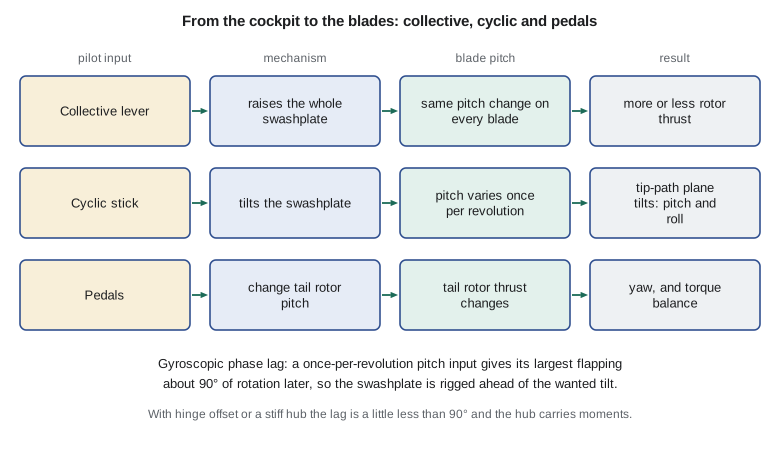
A helicopter pilot has three main controls. The collective lever changes the pitch of all blades together, raising or lowering thrust. The cyclic stick changes the pitch of each blade once per revolution, so that the blade's pitch is high on one side of the disk and low on the other: \(\theta(\psi) = \theta_0 - A_1\cos\psi - B_1\sin\psi\). The resulting lift variation makes the blades flap so that the tip-path plane tilts, and the thrust tilts with it, pitching or rolling the aircraft. The pedals change tail rotor pitch.
The device that turns these inputs into blade pitch is the swashplate: a non-rotating ring connected to the controls, and a rotating ring above it, connected by pitch links to the blade pitch horns. Raising the whole swashplate changes collective pitch; tilting it changes cyclic pitch. Because of the 90-degree phase lag between pitch input and flapping response, the swashplate is rigged so that the maximum pitch change occurs about 90 degrees of rotation before the point where the pilot wants the disk to tilt most. With hinge offset or a stiff hub, the phase lag is slightly less than 90 degrees, and the rigging accounts for it.
The medevac twin, like most modern helicopters, has hydraulic boosters between the controls and the swashplate, because the blade pitching moments, especially in forward flight, are too large for a pilot to hold. A stability augmentation system adds small, fast inputs through actuators in series with the controls to damp the aircraft's natural motions. An autopilot can hold attitude, heading, altitude and speed, and on a single-pilot air ambulance in poor weather it reduces workload significantly. The control laws themselves are an extension of the flight control work of AERO-330.
Vibration, track and balance
A rotor with \(N_b\) identical blades passes only certain frequencies to the fuselage. Forces at harmonics of the rotor speed that are not multiples of \(N_b\) cancel at the hub when summed over the blades, so a four-blade rotor transmits mainly 4 per revolution vibration (about 24 Hz for the medevac twin) and its multiples. If the blades are not identical, the cancellation fails and a 1 per revolution vibration appears. A blade that is heavier than the others gives a lateral 1/rev shake; a blade that flies higher or lower, because of a slightly different pitch or twist, gives a vertical 1/rev bounce. Rotor track and balance corrects these by adding weights to the hub, adjusting pitch link lengths and bending small trim tabs on the blade trailing edges, using accelerometers on the airframe and an optical sensor that measures the height of each blade tip as it passes. Modern health and usage monitoring systems record vibration continuously, so trends can be watched between scheduled checks.
Arjun's analysis of the Bluestem Air Medical data finds that most complaints follow blade replacements or pitch link changes, and that the vertical 1/rev level grows after each winter. Marcus suggests the trim tabs: in the cold, the blades' composite trailing edges and the tab adjustments may behave slightly differently. The recommendation is a track and balance check after each seasonal change, using a smoothing procedure that adjusts all three correction types together rather than one at a time.
Ground and air resonance
Lead-lag motion has an unpleasant property. When the blades lag in a pattern that is not symmetric, the rotor's center of mass moves off the shaft and whirls around it. If the frequency of that whirl, seen in the fixed frame, coincides with a natural frequency of the helicopter rocking on its landing gear, energy can flow from the rotor into the airframe and the oscillation grows, sometimes destroying the aircraft within seconds. This is ground resonance, analyzed by Robert Coleman and Arnold Feingold in the 1940s. It is a self-excited instability, not a forced vibration, and it can only occur when the lag frequency is below 1 per revolution, as it is for most articulated and many hingeless rotors. The cure is enough damping in both the lag dampers and the landing gear. A related instability in flight, air resonance, couples lag motion with the aircraft's body modes. Worn lag dampers and flat oleo struts are therefore airworthiness items, and pilots are trained to lift off or shut down immediately if a growing oscillation starts on the ground.
Worked problem
Lock number of a heavier blade
The replacement blade under consideration weighs 36 kg instead of 32 kg, with the same chord and radius. What happens to the Lock number and hover coning angle?
Show solution
- \(I_b = m_b R^{2}/3\) rises in proportion to mass: \(\gamma = 6.37 \times 32/36 = 5.66\).
- Coning scales with \(\gamma\): \(\beta_0 = 3.67 \times 5.66/6.37 = 3.26^{\circ}\).
Answer: A Lock number of 5.7 and coning of 3.3 degrees. The heavier blade stores more energy for autorotation but responds a little more slowly.
Worked problem
Rotor frequencies
The medevac twin's rotor turns at 365 rpm with four blades. What are the 1/rev and dominant blade-passage vibration frequencies?
Show solution
- 1/rev: \(365/60 = 6.08\ \mathrm{Hz}\).
- Four blades: \(4 \times 6.08 = 24.3\ \mathrm{Hz}\).
Answer: 6.1 Hz from blade-to-blade differences, 24.3 Hz from the normal blade passage loads.
Worked problem
Centrifugal force on a blade
Estimate the centrifugal force on one 32 kg blade of uniform mass distribution, radius 5.5 m, at \(\Omega = 38.2\ \mathrm{rad/s}\).
Show solution
- For a uniform blade the center of mass is at \(R/2\).
- \(F = m_b(R/2)\Omega^{2} = 32 \times 2.75 \times 38.2^{2} = 128\ \mathrm{kN}\).
Answer: About 128 kN, roughly 17 times the blade's share of lift. The blade root and hub carry this load on every flight.
Common mistakes
MistakeFlapping hinges make the blades flap only when the pilot moves the cyclic.
InsteadBlades flap freely in response to airloads; flapping removes the dissymmetry of lift on its own.
MistakeTilting the swashplate forward tilts the rotor forward at the same azimuth.
InsteadThe flapping response lags the pitch input by about 90 degrees, so the swashplate is rigged ahead of the desired tilt.
MistakeA four-blade rotor shakes the cabin at 4 Hz.
InsteadIt transmits mainly 4 per revolution, which at 365 rpm is about 24 Hz; 1/rev comes from blade differences.
MistakeGround resonance is a forced vibration from rotor imbalance.
InsteadIt is a self-excited instability coupling lag motion with the airframe on its landing gear, cured by damping.
Summary and key terms
- Rotor blades flap, lag and feather.
- Flapping removes the dissymmetry of lift; lag hinges relieve Coriolis bending; feathering allows pitch control.
- Hingeless and bearingless rotors replace hinges with flexible elements.
- The flapping equation has a natural frequency near 1/rev and strong aerodynamic damping; the Lock number measures aerodynamic against inertial forces.
- Hover coning is a few degrees because centrifugal force dominates.
- Hinge offset raises flap frequency and creates hub moments.
- In forward flight the disk flaps back and sideways, and the pilot cancels it with cyclic.
- The swashplate turns collective and cyclic inputs into blade pitch, rigged for the 90-degree phase lag.
- An N-blade rotor passes N/rev vibration; blade differences add 1/rev, corrected by track and balance.
- Ground resonance is a lag-mode instability cured by damping.
- Flapping
- Up-and-down motion of a blade about a hinge or flexure near the root.
- Lead-lag
- In-plane motion of a blade, forward and back in the plane of rotation.
- Feathering
- Rotation of the blade about its span axis to change pitch.
- Lock number
- \(\gamma = \rho a c R^4/I_b\), the ratio of aerodynamic to inertial blade forces.
- Coning angle
- The steady upward angle of the blades in hover.
- Tip-path plane
- The plane traced by the blade tips.
- Swashplate
- Paired rotating and non-rotating rings that transfer control inputs to blade pitch.
- Ground resonance
- Self-excited instability between blade lag motion and airframe motion on the landing gear.
Practice problems
Work each problem on paper first, then reveal the answer to check.
What is the flap frequency of a uniform blade with 5 percent hinge offset?
Show answer
\(\sqrt{1 + 1.5 \times 0.05/0.95} = 1.039\) per revolution.
Why is the flapping response to cyclic pitch about 90 degrees late?
Show answer
The blade is a system forced at its natural frequency, where the phase lag is 90 degrees.
Which blade irregularity causes lateral 1/rev vibration?
Show answer
A mass or center-of-mass difference between blades: an imbalance.
What two kinds of damping prevent ground resonance?
Show answer
Blade lag damping and landing gear damping.
At \(\mu = 0.2\), what back-flapping angle did the code find?
Show answer
About 4.4 degrees.
Lesson quiz · 5 questions
Score 60% or more to complete this lesson.
Create a free account to save your progress, take quizzes and earn a certificate.