
AERO-450 · Lesson 6 of 12 · 29 min
Helicopter performance
With the theory in place, Élise asks Arjun to build the performance model that Bluestem Air Medical actually wants: power required against airspeed, best range and endurance speeds, fuel flow, and hover ceilings in and out of ground effect on standard and hot days. The operator will compare the model with its flight manual charts and use it to plan the summer schedule and to decide whether to restrict loads at certain hospital pads. Rachel Oduya reminds the group that the flight manual, approved as part of the type certificate, remains the only legal source of performance data for operations. The model is an engineering tool for understanding and planning, and any difference from the manual must be explained, not used.
The power required in level flight
The power the main rotor needs in level flight is the sum of three parts. Induced power produces lift and falls with speed, as lesson 4 showed. Profile power overcomes the drag of the blade sections and rises slowly with speed because the advancing blade moves faster. Parasite power overcomes the drag of the fuselage, hub, landing gear and everything else that is not a rotor blade, and rises as the cube of speed. With an induced power factor \(\kappa\) and equivalent flat-plate area \(f\),
The factor \(1 + 4.65\mu^{2}\) is an empirical fit for the growth of profile power with advance ratio; simple theory gives \(1 + 3\mu^{2}\), and the larger value accounts for radial flow and other effects. The tail rotor, the transmission and accessories such as hydraulic pumps and generators add a further 10 to 15 percent, which the code includes as a single factor of 1.12. A flat-plate area of 1.3 m² is representative of a light twin with skids; retractable wheels and a clean hub can bring it below 1 m², and external equipment such as a rescue hoist, searchlight or medical stretcher racks add to it.
# Level-flight power required for the medevac light twin: induced + profile + parasite, with tail rotor and losses.
import math
rho, R, VT, m = 1.225, 5.5, 210.0, 3000.0
sigma, cd0, kappa, f = 0.0741, 0.0095, 1.15, 1.30    # solidity, mean profile drag, induced factor, flat-plate area (m^2)
A = math.pi * R**2; W = m * 9.81
vh = math.sqrt(W / (2 * rho * A))
def power(V):
    # induced velocity from v_i^4 + V^2 v_i^2 = v_h^4 (level flight, small disk tilt)
    vi = vh * math.sqrt(-V**2 / (2 * vh**2) + math.sqrt(V**4 / (4 * vh**4) + 1))
    mu = V / VT
    Pi = kappa * W * vi
    P0 = sigma * cd0 / 8 * rho * A * VT**3 * (1 + 4.65 * mu**2)
    Pp = 0.5 * rho * V**3 * f
    Pmr = Pi + P0 + Pp
    return Pi, P0, Pp, Pmr * 1.12                    # 12 % for tail rotor, transmission and accessories
print(" V m/s  V kt   induced  profile  parasite   total kW")
for V in range(0, 85, 10):
    Pi, P0, Pp, Pt = power(V)
    print(f" {V:5d} {V*1.9438:5.0f}   {Pi/1000:7.0f}  {P0/1000:7.0f}  {Pp/1000:8.0f}   {Pt/1000:8.0f}")
Vs = [v / 10 for v in range(1, 900)]
Pt = [power(v)[3] for v in Vs]
i_be = min(range(len(Vs)), key=lambda i: Pt[i])
i_br = min(range(len(Vs)), key=lambda i: Pt[i] / Vs[i])
print()
print(f"Best endurance (minimum power): {Vs[i_be]:.1f} m/s ({Vs[i_be]*1.9438:.0f} kt), {Pt[i_be]/1000:.0f} kW")
print(f"Best range (minimum power per unit speed): {Vs[i_br]:.1f} m/s ({Vs[i_br]*1.9438:.0f} kt), {Pt[i_br]/1000:.0f} kW")
sfc = 0.36                                           # kg of fuel per kWh, typical small turboshaft at part power
for name, i in (("endurance", i_be), ("range", i_br)):
    ff = Pt[i] / 1000 * sfc
    print(f"  at best {name} speed: fuel flow {ff:.0f} kg/h, {ff/(Vs[i]*3.6):.2f} kg per km")
Pavail = 2 * 350e3 * 0.95                            # two engines, maximum continuous, installation loss 5 %
Vmax = max(v for v, p in zip(Vs, Pt) if p <= Pavail)
print(f"Power-limited maximum speed with {Pavail/1000:.0f} kW available: {Vmax:.1f} m/s ({Vmax*1.9438:.0f} kt)")
print(f"Hover power out of ground effect: {power(0)[3]/1000:.0f} kW; margin at sea level {(Pavail-power(0)[3])/1000:.0f} kW") V m/s V kt induced profile parasite total kW
0 0 381 95 0 532
10 19 314 96 1 460
20 39 205 99 6 347
30 58 141 104 21 299
40 78 107 111 51 301
50 97 85 120 100 341
60 117 71 131 172 419
70 136 61 144 273 535
80 156 53 159 408 694
Best endurance (minimum power): 34.4 m/s (67 kt), 294 kW
Best range (minimum power per unit speed): 52.5 m/s (102 kt), 357 kW
at best endurance speed: fuel flow 106 kg/h, 0.86 kg per km
at best range speed: fuel flow 129 kg/h, 0.68 kg per km
Power-limited maximum speed with 665 kW available: 78.3 m/s (152 kt)
Hover power out of ground effect: 532 kW; margin at sea level 133 kW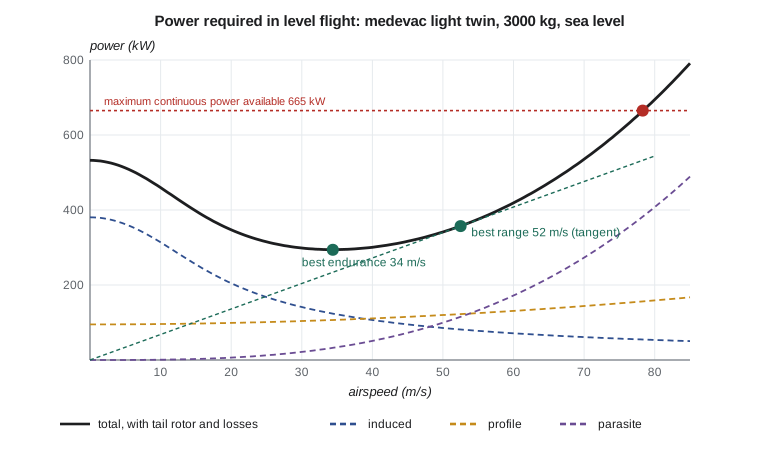
The total power curve has the characteristic bucket shape of every helicopter. In hover the rotor needs 532 kW at 3000 kg. Power falls steeply as induced power drops, reaches a minimum of 294 kW at 34 m/s (67 knots), and then rises as parasite power takes over. At the bottom of the bucket the helicopter needs only 55 percent of its hover power.
Best endurance and best range
For a helicopter, fuel flow is roughly proportional to power, so the speed for minimum power is also the speed for longest time in the air: best endurance speed. A medevac crew holding over an accident scene while ground units clear a landing zone, or a search helicopter loitering, flies near this speed. It is also the speed at which the helicopter can climb fastest, because the margin between power available and power required is largest, and the speed at which the rate of descent in autorotation is least.
The best range speed minimizes fuel per unit distance, which is power divided by speed. Graphically, it is where a straight line from the origin is tangent to the power curve. For the medevac twin it is 52 m/s (102 knots), using 357 kW, and the fuel used per kilometer is 0.68 kg compared with 0.86 kg at the best endurance speed. In practice, operators cruise a little faster than best range: the fuel cost of 10 or 15 knots more is only a few percent, and the time saved matters, above all to a patient. A headwind moves the best range speed up, because time spent in the air costs distance over the ground; the usual rule is to add about half the headwind component. The code's fuel-flow estimate uses a constant specific fuel consumption of 0.36 kg/kWh. Small turboshafts are less efficient at part power, so real fuel flow at the bottom of the bucket is relatively higher than this simple model says.
| Speed | Value | Main use |
|---|---|---|
| Best endurance (minimum power) | 34 m/s (67 knots), 294 kW | Loiter, holding, best rate of climb, minimum descent rate in autorotation |
| Best range (minimum power per speed) | 52 m/s (102 knots), 357 kW | Fuel-limited transfers, long legs into wind |
| Typical cruise | 62 to 67 m/s (120 to 130 knots) | Most patient transfers |
| Power-limited maximum | 78 m/s (152 knots) at 665 kW | Close to the never-exceed speed |
Climb, weight and altitude
The excess power at any speed gives the rate of climb: \(V_y \approx \eta_c (P_{\text{avail}} - P_{\text{req}})/W\), where the climb efficiency \(\eta_c\) is about 0.6 to 0.8 because the induced power drops in a climb, as lesson 2 showed, but the rotor and fuselage drag change too. At best endurance speed with 665 kW available and 294 kW required, the excess is 371 kW, which gives a rate of climb near 9 m/s (about 1700 ft/min) with \(\eta_c = 0.7\). Increasing weight raises induced power, which dominates at low speed, so the bucket rises and shifts to slightly higher speed. Increasing altitude reduces density: induced power rises, profile and parasite power fall, so the minimum power changes little, but the best range speed increases in true airspeed, and the engines produce less power. The net effect is that helicopters cruise faster in true airspeed at altitude, but their hover and climb performance falls.
Ground effect
Near the ground, the wake cannot expand freely. The ground slows the downwash and raises the pressure under the rotor, so the rotor needs less induced velocity, and less power, for the same thrust. A widely used estimate by Cheeseman and Bennett, from 1955, uses the method of images: at constant power, the thrust in ground effect is
where \(z\) is the height of the rotor above the ground. At a height of half a radius, the gain is a third; at one radius it is 7 percent; above about one diameter it is negligible. The skids of the medevac twin sit about 1.5 m below its rotor hub plus the hover height, so a low hover places the rotor at roughly 0.6 R and ground effect is large. Ground effect is weaker over tall grass, water or a sloping or uneven surface, and it largely disappears on an elevated pad with open sides, where the downwash spills over the edge. That last point matters for air ambulances, because hospital rooftop pads often give the pilot little or no ground effect.
Hover ceiling and density altitude
Power available from a turboshaft falls with density and with temperature: hot air is less dense, and the engine's turbine temperature limit is reached at a lower power when the inlet air is already hot. The code uses a simple model in which take-off power is proportional to the density ratio and falls a further amount with the square root of the temperature ratio. The hover ceiling is the altitude at which power required equals power available. Flight manuals present it as charts of maximum hover weight against pressure altitude and temperature, in and out of ground effect.
# Hover ceiling: power required in and out of ground effect against power available, versus density altitude.
import math
R, m, VT = 5.5, 3000.0, 210.0
sigma, cd0, kappa = 0.0741, 0.0095, 1.15
A = math.pi * R**2; W = m * 9.81
def isa(h, dT=0.0):
    T = 288.15 - 0.0065 * h + dT
    p = 101325 * (1 - 0.0065 * h / 288.15) ** 5.2559
    return p / (287.05 * T), T
def density_altitude(rho):
    return 288.15 / 0.0065 * (1 - (rho / 1.225) ** (1 / 4.2559))
def P_hover(rho, z_over_R=None):
    vi = math.sqrt(W / (2 * rho * A))
    k = 1.0
    if z_over_R is not None:                 # Cheeseman-Bennett ground effect: T_IGE/T_OGE = 1 / (1 - (R/4z)^2)
        k = 1 - (1 / (4 * z_over_R)) ** 2
    Pi = kappa * W * vi * k                   # same thrust for less induced power near the ground
    P0 = sigma * cd0 / 8 * rho * A * VT**3
    return (Pi + P0) * 1.12
def P_avail(rho, T, rating_kW):
    # simple turboshaft lapse: power falls with density and, more strongly, with hot ambient temperature
    return 2 * rating_kW * 1000 * 0.95 * (rho / 1.225) * (288.15 / T) ** 0.5
for label, dT, rating in (("ISA day", 0.0, 400.0), ("ISA + 20 C", 20.0, 400.0)):
    print(f"{label}, two engines at take-off rating {rating:.0f} kW each:")
    print("  press. alt m   dens. alt m   P_OGE kW  P_IGE kW  P_avail kW")
    ceil_oge = ceil_ige = None
    for h in range(0, 6001, 250):
        rho, T = isa(h, dT)
        po, pi_, pa = P_hover(rho), P_hover(rho, 0.6), P_avail(rho, T, rating)
        if h % 1000 == 0:
            print(f"   {h:6d}       {round(density_altitude(rho)) + 0:7d}     {po/1000:6.0f}    {pi_/1000:6.0f}    {pa/1000:6.0f}")
        if ceil_oge is None and po > pa: ceil_oge = h
        if ceil_ige is None and pi_ > pa: ceil_ige = h
    print(f"  hover ceiling OGE about {ceil_oge} m, IGE (skids 0.6 R above ground) about {ceil_ige} m pressure altitude")
print()
print("Ground effect thrust gain at constant power: T_IGE/T_OGE = 1/(1 - (R/4z)^2)")
for z in (0.5, 0.75, 1.0, 1.5):
print(f" z/R = {z:4.2f}: {1/(1-(1/(4*z))**2):.3f}")ISA day, two engines at take-off rating 400 kW each:
press. alt m dens. alt m P_OGE kW P_IGE kW P_avail kW
0 0 532 458 760
1000 1000 544 466 698
2000 2000 557 476 639
3000 3000 574 488 584
4000 4000 592 502 533
5000 5000 614 518 485
6000 6000 638 537 440
hover ceiling OGE about 3250 m, IGE (skids 0.6 R above ground) about 4500 m pressure altitude
ISA + 20 C, two engines at take-off rating 400 kW each:
press. alt m dens. alt m P_OGE kW P_IGE kW P_avail kW
0 693 540 464 687
1000 1693 553 473 629
2000 2692 568 484 575
3000 3691 586 497 524
4000 4691 607 513 477
5000 5690 630 531 433
6000 6689 657 552 392
hover ceiling OGE about 2250 m, IGE (skids 0.6 R above ground) about 3500 m pressure altitude
Ground effect thrust gain at constant power: T_IGE/T_OGE = 1/(1 - (R/4z)^2)
z/R = 0.50: 1.333
z/R = 0.75: 1.125
z/R = 1.00: 1.067
z/R = 1.50: 1.029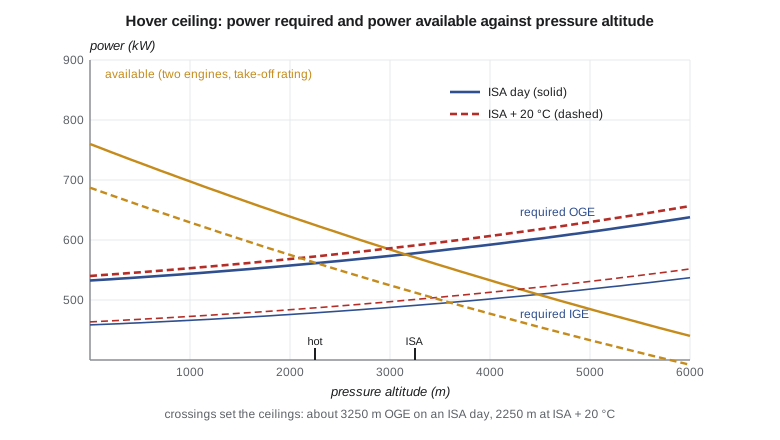
On an ISA day the medevac twin can hover out of ground effect at maximum weight up to about 3250 m pressure altitude, and in ground effect up to about 4500 m. At ISA + 20 °C the two ceilings fall to about 2250 m and 3500 m. The ISA + 20 °C line at sea level corresponds to 35 °C, and the density altitude is then about 700 m. At a hospital pad at 405 m (1330 ft) on a 35 °C (95 °F) afternoon, the out-of-ground-effect margin is therefore much smaller than in winter, which is what the Bluestem Air Medical pilots noticed. With a full medical team, extra equipment and fuel for a long transfer, the helicopter can be at or near maximum weight, and a rooftop pad offers little ground effect. The flight manual's Category A procedures, which require the helicopter to be able to land back or fly away after an engine failure, impose even tighter weight limits.
One engine inoperative
A twin-engine helicopter's main safety advantage is that it can continue after an engine failure. When one engine fails, the other must provide all the power. Turboshafts in twins have one-engine-inoperative ratings, typically a 30-second rating and a 2-minute rating well above the normal take-off rating, which allow the remaining engine to run hot for a short time while the pilot completes the take-off or landing. The weight at which the aircraft can hover or climb on one engine is far below its two-engine maximum, so Category A procedures use a defined take-off decision point. Before it, an engine failure means the pilot lands back on the pad; after it, the pilot accelerates and climbs away on one engine. The helipad size, height and surrounding obstacles determine which procedure applies and what weight is allowed.
The height-velocity diagram
Every helicopter flight manual contains a height-velocity diagram, sometimes called the dead man's curve. It shows combinations of height above the ground and airspeed from which a safe autorotative landing after an engine failure (or, for twins, a one-engine landing) is unlikely. There are usually two regions to avoid. At low speed and moderate height, roughly 10 to 150 m for a light single, the helicopter is too high to cushion the landing with the rotor's stored energy but too low and slow to establish a steady autorotation and flare. At high speed close to the ground, the pilot has no time to react and flare before the skids touch. Normal take-off and approach profiles are designed to stay outside these regions, which is another reason pilots accelerate through translational lift close to the ground before climbing. Twin-engine helicopters operating in Category A have much smaller avoid regions, and at light weights may have none.
Worked problem
Rate of climb at best endurance speed
At 3000 kg and sea level, the medevac twin has 665 kW of maximum continuous power available. Estimate the rate of climb at 34 m/s with a climb efficiency of 0.7.
Show solution
- Excess power: \(665 - 294 = 371\ \mathrm{kW}\).
- \(V_y = 0.7 \times 371\,000/29\,430 = 8.8\ \mathrm{m/s}\).
Answer: About 8.8 m/s, or 1700 ft/min.
Worked problem
Ground effect at a low hover
Sam hovers the medevac twin with its rotor 3.3 m above a level concrete pad (\(z/R = 0.6\)). By how much does the thrust available at constant power increase?
Show solution
- \(R/4z = 1/(4 \times 0.6) = 0.417\).
- \(T_{\text{IGE}}/T_{\text{OGE}} = 1/(1 - 0.417^{2}) = 1/(1 - 0.174) = 1.21\).
Answer: About 21 percent more thrust at the same power, or, at the same thrust, roughly 15 percent less power.
Worked problem
Range on a transfer flight
A transfer flight of 180 km has a 15 knot headwind. Using the model's fuel figures, estimate the fuel burned flying at 102 knots airspeed, and suggest a better speed.
Show solution
- Ground speed \(102 - 15 = 87\ \mathrm{knots} = 44.8\ \mathrm{m/s}\).
- Time \(180\,000/44.8 = 4020\ \mathrm{s} = 1.12\ \mathrm{h}\).
- Fuel \(129\ \mathrm{kg/h} \times 1.12\ \mathrm{h} = 144\ \mathrm{kg}\).
- With a headwind, best range speed rises by about half the headwind, to about 110 knots.
Answer: About 144 kg at 102 knots; flying at about 110 knots saves a few kilograms and several minutes.
Common mistakes
MistakeBest range and best endurance are the same speed.
InsteadBest endurance minimizes power; best range minimizes power per unit speed and is faster.
MistakeA helicopter always has ground effect when it hovers low.
InsteadGround effect is weak over water and tall grass and largely absent on an elevated pad with open edges.
MistakeA helicopter that can hover at sea level can hover anywhere below its service ceiling.
InsteadHover ceiling falls with temperature, humidity and weight; on hot days it can be well below the cruise ceiling.
MistakeTwin engines remove the need for the height-velocity diagram.
InsteadOne-engine performance depends on weight and conditions; Category A procedures define safe take-off and landing profiles.
Summary and key terms
- Power required in level flight is the sum of induced, profile and parasite power, plus tail rotor and transmission losses.
- The curve has a minimum at the best endurance speed, which also gives the best climb rate and the slowest autorotative descent.
- Best range is where a line from the origin touches the curve.
- Excess power gives the rate of climb.
- Ground effect, within about one rotor diameter of a firm surface, reduces the power needed to hover.
- Power available falls with altitude and temperature while power required rises, so hover ceilings in and out of ground effect fall on hot days.
- Twin-engine helicopters rely on one-engine-inoperative ratings and Category A procedures.
- The height-velocity diagram shows combinations of height and speed to avoid in case of engine failure.
- Power required
- Total power the rotors and transmission need for a flight condition.
- Equivalent flat-plate area
- Drag area \(f\) such that the airframe drag is \(\tfrac{1}{2}\rho V^2 f\).
- Best endurance speed
- Speed of minimum power, giving the longest time aloft.
- Best range speed
- Speed of minimum power per unit speed, giving the greatest distance per unit fuel.
- Ground effect
- Reduction in induced power when a rotor operates close to a surface.
- Hover ceiling
- Highest altitude at which the helicopter can hover at a given weight, in or out of ground effect.
- OEI rating
- Short-duration engine power ratings for use after the other engine fails.
- Height-velocity diagram
- Chart of height and speed combinations from which a safe landing after engine failure is unlikely.
Practice problems
Work each problem on paper first, then reveal the answer to check.
Why is the best endurance speed also the speed for best rate of climb?
Show answer
The excess of power available over power required is largest where power required is smallest.
How does a tailwind change the best range speed over the ground?
Show answer
It lowers the airspeed for best range, roughly by half the tailwind component.
What is the Cheeseman-Bennett thrust ratio at \(z/R = 1\)?
Show answer
\(1/(1 - 1/16) = 1.067\).
How far did the hot day lower the OGE hover ceiling in the code?
Show answer
From about 3250 m to about 2250 m, roughly 1000 m.
Name two reasons an elevated hospital pad is harder than a ground-level pad.
Show answer
Little ground effect, and fewer options after an engine failure, which tightens Category A weight limits.
Lesson quiz · 5 questions
Score 60% or more to complete this lesson.
Create a free account to save your progress, take quizzes and earn a certificate.