
AERO-360 · Lesson 6 of 12 · 25 min
Composite manufacturing
A composite part is made at the same time as its material. A metal part starts as a plate or forging whose properties were fixed at the mill; a composite laminate gets its properties in the factory, ply by ply, and its strength depends on how well it was laid up, compacted and cured. That is why composite manufacturing is a controlled special process, why every cure is recorded, and why process changes need requalification. This lesson follows the Tern Block 2 aileron spar from frozen prepreg to inspected part, and then compares the other ways composite parts are made. the Wichita airframe plants and the National Institute for Aviation Research at Wichita State University include some of North America's most experienced composite manufacturers, and Prairiewind Aerospace relies on that supply base for its larger parts.
Prepreg and its handling
Most primary aerospace structure is made from prepreg: fibers already impregnated with partly reacted resin, supplied as unidirectional tape or woven fabric on rolls with backing paper. Prepreg gives a controlled fiber volume and resin content, but its resin keeps reacting slowly even when stored. Rolls are kept frozen at about −18 °C, and each roll has an out-time limit, the total time it may spend at room temperature before it must be scrapped, often around 20 to 30 days for a typical 180 °C epoxy. Rolls are thawed in sealed bags before opening so that moisture does not condense on the cold material. A tracking system logs freezer time, out-time and expiry for every roll.
Layup
Plies are cut to shape, by ultrasonic knife or automated cutting table, and laid on a tool in the specified orientations. Hand layup with laser projection guides the technician to place each ply, check its orientation and remove backing paper; small parts such as the Tern aileron spar are made this way. Large parts are laid by machine. Automated tape laying places wide unidirectional tape on flat or gently curved tools; automated fiber placement uses many narrow tows that can be cut and restarted individually, so it can lay complex curved surfaces such as fuselage barrels. Every few plies the stack is debulked under vacuum to remove trapped air and compact it.
Tools themselves are carefully engineered. They must hold their shape at cure temperature and expand as little as possible, because a tool that grows during cure produces a part of the wrong size after cooling. Invar, a nickel-iron alloy with very low thermal expansion, and CFRP tools are common for large parts; aluminum and steel tools serve smaller parts where expansion can be compensated.
Bagging and autoclave cure
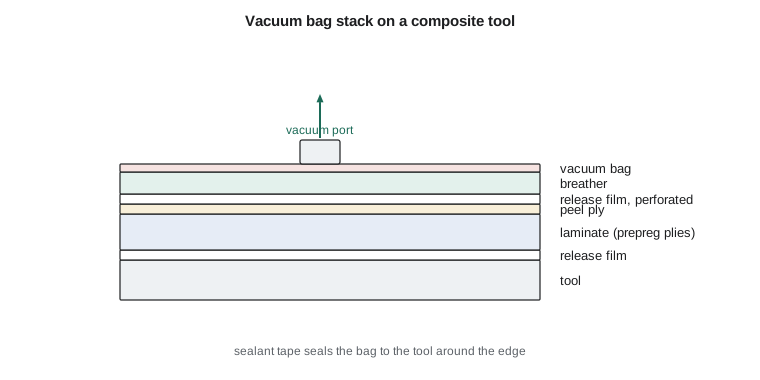
The laid-up part is covered with a stack of process materials: a release film so the bag does not stick, a peel ply that leaves a clean, textured surface for later bonding, a breather that lets air flow to the vacuum port, and a nylon vacuum bag sealed to the tool with tacky tape. Vacuum pulls the bag down and removes air and volatiles. The part then goes into an autoclave, a heated pressure vessel, where pressure of about 0.6 to 0.7 MPa (85 to 100 psi) compacts the plies and suppresses voids while heat cures the resin.
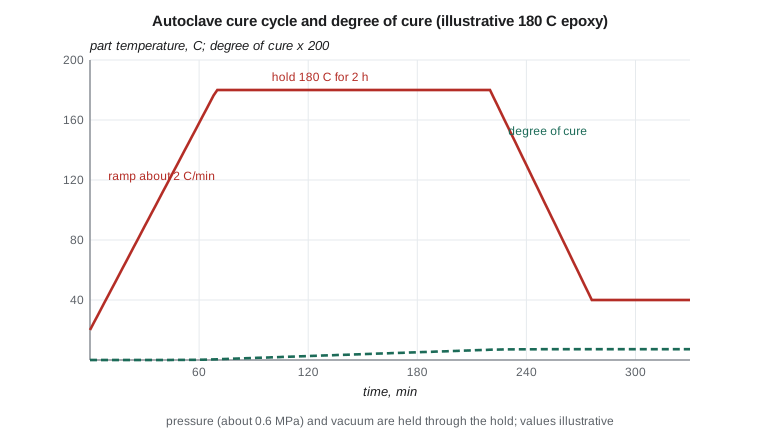
A typical cure cycle ramps the temperature at 1 to 3 °C per minute to 180 °C, holds for about two hours, and cools slowly. During heating the resin first becomes very fluid and flows, wetting the fibers; then it gels, turning from liquid to rubbery solid; then it cross-links toward full cure. The degree of cure, from 0 for uncured to 1 for fully cross-linked, follows chemical kinetics that depend strongly on temperature. Thermocouples on the part, especially on its thickest and thinnest sections, control the cycle: the hold starts only when the lagging thermocouple, the slowest to heat, reaches temperature.
# Autoclave cure of the aileron spar: heat-up, hold and degree of cure with an nth-order kinetic model.
import math
A, Ea, R, n = 5.0e4, 66.5e3, 8.314, 1.5   # illustrative epoxy kinetics: rate = A exp(-Ea/RT) (1 - a)^n, 1/s
def run(ramp, hold_T, hold_min, dt=10.0):
    T, a, t, out = 20.0, 0.0, 0.0, []
    while T < hold_T:
        a += A * math.exp(-Ea / (R * (T + 273.15))) * (1 - a) ** n * dt
        T += ramp / 60 * dt; t += dt
    t_hold = t
    while t < t_hold + hold_min * 60:
        a += A * math.exp(-Ea / (R * (hold_T + 273.15))) * (1 - a) ** n * dt
        t += dt
        if abs((t - t_hold) % 1800) < dt: out.append((round((t - t_hold) / 60), round(a, 3)))
    return min(a, 1.0), t / 60, out
for ramp, T, hold in ((2.0, 180, 120), (2.0, 180, 60), (1.0, 180, 120), (2.0, 165, 120)):
    a, tt, marks = run(ramp, T, hold)
    print(f"ramp {ramp} C/min to {T} C, hold {hold} min: degree of cure {a:.3f}, total {tt:.0f} min")
# Thermal lag: a thick part section heats slower than the air, so the thermocouple on the thickest
# section controls the start of the hold (lagging thermocouple).
for thick_mm in (3, 10, 25):
    lag = 0.12 * thick_mm ** 2        # minutes, rough diffusion scaling L^2/alpha (illustrative)
print(f"section {thick_mm:2d} mm: thermal lag about {lag:4.0f} min behind the air temperature")ramp 2.0 C/min to 180 C, hold 120 min: degree of cure 0.964, total 200 min ramp 2.0 C/min to 180 C, hold 60 min: degree of cure 0.909, total 140 min ramp 1.0 C/min to 180 C, hold 120 min: degree of cure 0.969, total 280 min ramp 2.0 C/min to 165 C, hold 120 min: degree of cure 0.909, total 192 min section 3 mm: thermal lag about 1 min behind the air temperature section 10 mm: thermal lag about 12 min behind the air temperature section 25 mm: thermal lag about 75 min behind the air temperature
The program shows why cure specifications have minimum hold times and temperatures. The standard cycle reaches a degree of cure of about 0.96; halving the hold to one hour, or holding at 165 °C instead of 180 °C, leaves it at about 0.91, which lowers the glass transition temperature and the hot-wet strength. A slower ramp barely changes the final cure but adds more than an hour of autoclave time. The thermal lag estimate is the other lesson: a 25 mm section can trail the air temperature by over an hour, so a part with thick and thin areas must be controlled by its slowest thermocouple, or the thin areas will be overcooked and the thick areas undercured.
Out-of-autoclave and liquid molding
Autoclaves are expensive to buy and run, and limit part size. Several out-of-autoclave methods are now qualified for aerospace parts. Out-of-autoclave prepregs are designed to cure under vacuum alone in an oven, with special fiber arrangements that let air escape. Resin transfer molding, RTM, places dry fiber preforms in a closed matched mold and injects resin under pressure; it gives accurate dimensions on both faces and suits complex parts such as fittings, spars and fan blades. Vacuum-assisted resin infusion draws resin through dry fibers under a vacuum bag on a single-sided tool and suits large parts. Filament winding wraps resin-wet fibers onto a rotating mandrel for pressure vessels and tubes.
Each method has a different quality challenge. Infusion and RTM must wet every fiber before the resin gels, so flow paths and gel time are designed with simulations and verified with trials. Out-of-autoclave cures must reach low porosity without high pressure. Thermoplastic parts are stamp-formed or consolidated at high temperature and cooled quickly. The Tern Block 2's new rear fuselage cone is made by resin infusion at a supplier, because it is large, lightly loaded and made in modest numbers; its aileron spar stays an autoclaved prepreg part.
Bonding, machining and assembly
Cured composite parts still need machining and joining. Edges are trimmed and holes drilled with diamond-coated or carbide tools at high speed and low feed, because carbon fiber is extremely abrasive and the laminate can splinter or delaminate where the drill exits. Drilling is often backed with a sacrificial plate to support the exit face, and holes for fasteners must be held to tight tolerances to share load evenly. Dust from machining carbon is a respiratory and electrical hazard, so cutting is done with extraction.
Secondary bonding joins cured parts with film or paste adhesive, and co-bonding cures one part against another that is already cured. Both depend on surface preparation, which is the weakest point of any bonded joint. The peel ply is removed just before bonding to expose a clean surface, sometimes followed by light abrasion or plasma treatment; contamination from release agents, fingerprints or silicone can produce a kissing bond, a joint in full contact that has almost no strength and is very hard to detect. For that reason most certified primary bonded joints still carry fasteners as a backup, or are co-cured, cured in one cycle with the parts they join.
Assembly brings composite parts together with titanium or stainless fasteners installed with sealant. Gaps between parts must be shimmed with liquid shim or solid shims, because pulling a stiff laminate down onto a gap with fasteners can crack it. Large airliner programs measure the parts with laser trackers and machine custom shims for every joint, while smaller programs such as the Tern measure gaps with feeler gauges and fill them with liquid shim to the limits in the assembly specification.
Environment, health and safety run through composite manufacturing. Uncured epoxy resins and their hardeners can cause skin sensitization, so technicians wear nitrile gloves and avoid skin contact with prepreg and liquid resin. Autoclaves are large pressure vessels, inspected and operated under boiler and pressure vessel rules, with interlocks on the door. Solvents used for cleaning are flammable. Carbon dust is controlled with extraction and housekeeping. These controls are part of the qualified process, not extras.
Defects and quality control
Typical manufacturing defects are porosity and voids from trapped air or volatiles, resin-rich or resin-starved areas, wrinkles or waviness of fibers, ply misorientation, missing plies, foreign objects such as backing paper left in the stack, and delaminations. Many of them are invisible from the surface. Quality control therefore combines process control, inspection and test. Material receiving tests check each prepreg batch; process records log every ply, debulk and cure; traveling coupons cured with the part are tested for properties; and ultrasonic inspection, covered in Lesson 12, scans every primary structural part for porosity and delamination. Porosity above about 1 to 2 percent typically leads to rejection or engineering review.
| Process | Typical parts | Strengths | Limits |
|---|---|---|---|
| Hand layup and autoclave | spars, skins, small primary parts | highest quality, well established | labor, autoclave cost |
| Automated tape or fiber placement and autoclave | large skins, fuselage barrels | fast, repeatable | capital cost, curvature limits for tape |
| Out-of-autoclave prepreg | medium skins, panels | no autoclave | tighter process window for porosity |
| Resin transfer molding | fittings, spars, fan blades | two accurate faces, complex shapes | mold cost, flow design |
| Vacuum infusion | large secondary parts, fairings | large parts, low tooling cost | one tooled face, fiber volume control |
| Thermoplastic stamp forming | clips, brackets, ribs | minutes per part, weldable | high processing temperature |
Worked problem
Out-time
A prepreg roll has a 25-day out-time limit. It has spent 6 days thawing and cutting, 9 days in layup and 4 days waiting for the autoclave. How much remains?
Show solution
- Used: \(6 + 9 + 4 = 19\) days.
- Remaining: \(25 - 19 = 6\) days.
Answer: Six days; the cure must start before the limit is reached.
Worked problem
Cure cycle time
A part is heated from 20 °C to 180 °C at 2 °C/min, held 120 min, and cooled to 60 °C at 2.5 °C/min. Find the cycle time.
Show solution
- Heating: \(160/2 = 80\) min.
- Hold: 120 min.
- Cooling: \(120/2.5 = 48\) min.
Answer: About 248 minutes, a little over four hours.
Worked problem
Autoclave pressure
An autoclave runs at 0.62 MPa on a flat panel 1.2 m by 0.8 m. What force presses the bag onto the laminate?
Show solution
- Area \(= 0.96\) m².
- Force \(= 0.62 \times 10^6 \times 0.96 = 595\,000\) N.
Answer: About 600 kN, roughly the weight of 60 metric tons.
Common mistakes
MistakeStarting the hold when the air reaches temperature.
InsteadThe hold starts when the lagging thermocouple on the part reaches temperature.
MistakeIgnoring prepreg out-time.
InsteadResin keeps reacting at room temperature; expired material must be scrapped.
MistakeOpening a cold prepreg roll straight from the freezer.
InsteadCondensation contaminates it; thaw it sealed.
MistakeAssuming a smooth surface means a good laminate.
InsteadPorosity, wrinkles and foreign objects hide inside; ultrasonic inspection is needed.
Summary and key terms
- Composite parts are made together with their material, so manufacturing is a controlled special process.
- Prepreg is stored frozen and tracked for out-time, laid up by hand or by tape and fiber placement machines, debulked, bagged and cured in an autoclave at about 180 °C and 0.6 MPa.
- Degree of cure depends on temperature and time, and the lagging thermocouple controls the hold.
- Out-of-autoclave prepregs, resin transfer molding, infusion and thermoplastic forming cut cost for suitable parts.
- Defects such as porosity, wrinkles and foreign objects are controlled by process records, traveling coupons and ultrasonic inspection.
- Prepreg
- Fiber reinforcement already impregnated with partly reacted resin.
- Out-time
- The allowed total time a prepreg may spend at room temperature.
- Debulking
- Compacting a partial layup under vacuum to remove air.
- Autoclave
- A heated pressure vessel used to cure composite parts.
- Degree of cure
- The fraction of possible cross-linking reaction completed, from 0 to 1.
- Lagging thermocouple
- The part thermocouple that heats slowest and controls when the cure hold starts.
Practice problems
Work each problem on paper first, then reveal the answer to check.
In the program, what degree of cure does a one-hour hold reach?
Show answer
About 0.91.
Why is Invar used for large composite tools?
Show answer
Its very low thermal expansion keeps the part dimensions right after cure.
What does a peel ply do?
Show answer
It leaves a clean textured surface ready for bonding or painting.
Name two out-of-autoclave processes.
Show answer
Examples: out-of-autoclave prepreg, resin transfer molding, vacuum infusion, filament winding.
Why is the Tern's rear fuselage cone made by infusion?
Show answer
It is large, lightly loaded and made in modest numbers.
Name three manufacturing defects in composites.
Show answer
Examples: porosity, wrinkles, ply misorientation, foreign objects, delamination.
Lesson quiz · 5 questions
Score 60% or more to complete this lesson.
Create a free account to save your progress, take quizzes and earn a certificate.